Thursday, November 4, 2021

COP26: Tata linked to Burmese Military: boycott Tata group for a sustainable future


COP26 PARTNER JAGUAR/LAND ROVER LINKED TO BURMESE MILITARY

November 2, 2021

Jaguar/Land Rover are not a suitable partner for the COP26 climate change conference because their owner, Tata, supplies vehicles to the genocidal Burmese military. 

The UK Presidency of COP26 has made Jaguar Land Rover an official partner of the conference: https://ukcop26.org/uk-presidency/partnerships-and-support/

Tata, which also owns Tetley Tea, have supplied troop carriers and military staff cars to the Burmese military. They feature on the Burma Campaign UK ‘Dirty List’: https://burmacampaign.org.uk/take-action/dirty-list/ which names and shames companies linked to the Burmese military. 

Tata also boast of their plans to increase their role in the coal industry, one of the dirtiest and most polluting fossil fuels. The Tata International website states:

“Having established ourselves as one of India’s leading private coal importers in the last few years, our aim is to grow into one of the largest coal trading companies in the country. Our short term goal is to grow our traded volume of thermal coal to 10 million tons per annum in the coming years with focus on India.”
https://tatainternational.com/minerals/coal-coke-and-anthracite/

Burma is one of the most vulnerable countries in the world to climate change.

The Burmese military have been documented by the United Nations as committing genocide, war crimes and crimes against humanity. They are currently being investigated for crimes against humanity by the International Criminal Court, and face charges of genocide at the International Court of Justice. 

In February the military held a coup, and since then have killed more than 1,000 people, jailed more than 7,000, and forced more than a quarter of a million people to flee their homes.

“Jaguar/Land Rover are part of a company which equips a military responsible for genocide,” said Mark Farmaner, Director of Burma Campaign UK. “Tata should not be allowed to use the COP26 conference to promote its companies and brands at the same time as it equips a military which tortures critics and rapes children.”

A Message from Burma Campaign, UK


The Burmese military is building up troops and equipment in Chin State and neighbouring areas in North-Western Burma. Rockets are being fired into towns, setting buildings ablaze.
 
We are concerned a large-scale military offensive against civilians could be imminent, leading to a human rights and humanitarian catastrophe.
 
Tell the UN Security Council to act now to prevent a catastrophe.
 

This troop build-up is happening in an area where there has been strong resistance to the military coup, and already the military have been using jets to bomb towns and villages, and have killed dozens of people as well as forcing thousands to flee their homes.
 
The UN Human Rights Commissioner has issued a strong statement, saying:
 
“We urge the international community to speak with one voice, to prevent the commission of further serious human rights violations against the people of Myanmar.  Influential states must prevail on the Tatmadaw to de-escalate the situation, protect civilian lives and property, and ensure access to humanitarian aid for those who need it.”
 
But the UN Security Council has failed to act, despite warnings.
 
For Burma Campaign UK, the current situation has echoes of the situation in Rakhine State in 2017, in the run-up to the military offensive against the Rohingya in 2017.
 
We called on the UN Security Council to act then, but they failed to do so. We must force them to act now.
 
We can’t predict for sure that the military are planning another large-scale military offensive against civilians, but based on past experience we can’t take the risk and stand by and do nothing.
 
The British government has responsibility for Burma issues at the UN Security Council. Email British Foreign Secretary Liz Truss now calling on her to convene an urgent meeting of the UN Security Council to discuss the crisis in North-Western Burma.
 
You can send an email here.

Thank you.
Anna Roberts
Burma Campaign UK
 

Click here to update your details. 

Our mailing address is:

Burma Campaign UK

110 The Bon Marche Centre

241-251 Ferndale Road

London, SW9 8BJ

United Kingdom


Add us to your address book


We hope you want to stay in touch but if you no longer want to receive our emails, you can unsubscribe here.   

You can read our Privacy Policy here, which has additional information on how we use your information and how you can opt out. 

This email was sent to saeva@aol.com


Tuesday, November 2, 2021

The Chancellor Balfour Declaration BY NICOLA PERUGINI

 On July 8 1903, the first Allied Colonial University Conference took place at the Hotel Cecil on the Thames Embankment in London. The development of knowledge production and university networks was meant to foster British imperial rule. One of the main architects of this imperial turn to academe was Arthur James Balfour, Prime Minister of the United Kingdom at that time, and also Chancellor of the University of Edinburgh. Balfour had been appointed to the Edinburgh post in 1891 and ultimately held the position until 1930—the longest chancellorship in the history of Scotland’s most prominent university.

At Hotel Cecil, Balfour presided the conference dinner attended by universities delegates, heads of colleges, and “men prominent in educational and scientific work.” After the customary toasts, Balfour delivered a speech in which he celebrated the foundation of the new British-colonial academic alliance and explained why this was a remarkable political achievement: “It is not merely, or simply, or chiefly that there are here in this room representatives of scholarship, of science, of all the great spheres of activity in which modern thought is indulging itself. It is that we are here representing what will turn out to be, I believe, a great alliance of the greatest educational instruments in the Empire—an alliance of all the universities that, in an increasing measure, are feeling their responsibilities, not merely for training the youth which is destined to carry on the traditions of the British Empire, but also to further those great interests of knowledge, scientific research, and culture without which no Empire, however materially magnificent, can really say that it is doing to share in the progress of the world.”

In Balfour’s mind, the new academic alliance was a crucial tool for cementing Britain’s global dominance. But it was also a key instrument for affirming a sense of a racialised Anglo-Saxon unity: “We boast a community of blood, of language, of laws, of literature,” the ecstatic Chancellor-PM exclaimed at the conference dinner.

After ending his tenure as Prime Minister in 1905, Balfour withdrew for almost a decade from the centre-stage of imperial foreign policy, before making his return in 1916 as Foreign Secretary. But in those ten years, the Chancellor of the University of Edinburgh continued to construct British academic space as an imperial project.

In 1912, perhaps also due to his growing interest in “the Orient,” Balfour was asked to chair a session of the Second Congress of the Universities of the Empire on The Problem of Universities in the East in Regard to their Influence on Character and Moral Ideals. In his opening speech, he underscored how in Western universities there has been “mutual adjustment” between scientific knowledge and socio-cultural traditions, while in Eastern universities science and social customs were on course for “collision.” This idea of an inherent incompatibility between Eastern traditions and science was grounded in a concept of natural racial inequalities that Balfour had articulated quite clearly a few years earlier, in his book On Decadence. In this book, Balfour theorised that Oriental history was dominated by a monotony of despotism and an incapacity of self-government, and how “any attempt to provide widely different races with an identical […] educational [environment] can never make them alike. They have been different and unequal since history began; different and unequal they are destined to remain.”

This kind of racial thinking shaped Balfour’s imperial world-making both as a statesman and a man of science and academia. This racialised understanding of global order constituted the backbone of the 1917 Balfour Declaration, which created a new imperial legal framework in the Middle East. The Declaration, issued on the 2 of November, endorsed the creation of a territorial based settler national home for the Jewish people in Palestine, while denying Palestinians their national rights and offering them only civil and religious rights. Ultimately, and in line with his writings, Palestinians were Orientals incapable of governing themselves or achieving self-determination.

Balfour inaugurates the Hebrew University of Jerusalem in 1925 Source: Library of Congress.

Balfour wrote and signed the Declaration before visiting Palestine. In fact, his first visit took place in 1925, when he inaugurated the Hebrew University of Jerusalem dressed in the robes of Edinburgh and Cambridge (where he had become Chancellor in 1919). As a guest of the Zionist movement, he toured the first “Jewish colonies” established in Palestine, including Balfouria, a settlement dedicated to him by the Zionist leadership.

In his inauguration speech on Mount Scopus, Balfour celebrated the Hebrew University as an experiment of adapting “Western methods” (Jewish science and theories) to an Asiatic site and as an institution capable of regenerating a stagnant Palestine. Balfour-the-statesman espoused the Zionist narrative about the need to regenerate the arid Palestine also when he wore the clothes of Balfour-the-Edinburgh-Chancellor. As Chaim Weizmann—who played a decisive role in convincing Balfour to issue the 1917 Declaration and invited him to give the inauguration speech in 1925—made clear in his Trial and Error, the Hebrew University was “the fulfilment of my particular dream of the early days of the movement” and a crucial tool for Zionist affirmation in Palestine. Significantly, after the inauguration, Hebrew University was included in the network of allied imperial universities Balfour had helped constitute in the beginning of the century.

The link between Balfour’s contribution to imperial governance and his contribution to the development of British imperial academia have for some reason been completely erased and does not appear in the vast amount of literature and the contemporary debates on his involvement in global imperial affairs and his infamous Declaration on Palestine.

That is why this year we might use the anniversary of the Balfour Declaration to rediscover this link and raise some fundamental questions on the imperial history of the University of Edinburgh, as well as Scottish and British academia, and its relevance to the present. As universities that formally and publicly embrace the decolonial agenda and try to decolonise curricula and academic spaces: how could we decolonise our historical imbrication with the injustice to which Palestinians have been subjected as a result of the imperial declaration issued by one of our chancellors? Why don’t we publicly acknowledge that the man that has been appointed to enhance our global academic reputation for forty years, was also a key political-intellectual actor in the production of a racialised imperial order that has dispossessed so many peoples? What would be the implications of such a recognition? And since the question of Palestine is still alive as a colonial question that continues to generate violence and dispossession, as we have seen also recently: how could we contribute, with concrete and tangible institutional actions, to decolonise Palestine and repair our institutional entanglement with a settler colonial project that continues to deny Palestinians the right to self-determination and uproot them from their land?

After all, the Balfour Declaration was also our Chancellor’s declaration.

The University of Edinburgh is a charitable body, registered in Scotland, with registration number SC005336. (Is e buidheann carthannais a th’ ann an Oilthigh Dhùn Èideann, clàraichte an Alba, àireamh clàraidh SC005336.)

Nicola Perugini teaches at the School of Social and Political Science, University of Edinburgh. He is the co-author of The Human Right to Dominate.

Israelis storm Al-Aqsa Mosque compound as military detain Palestinians in Bethlehem

 Israelis stormed the Al-Aqsa Mosque, the holiest place for Palestinian Muslims, under heavy security from the police.
ShareFlipboardRedditWhatsAppTwitterFacebook
Al-Aqsa Mosque compound is frequently targeted by Israeli settlers [Getty]

Israelis stormed the Al-Aqsa Mosque compound on Monday, the holiest Muslim site in the Palestinian territories, under the protection of Israeli police.

Dozens of settlers stormed Al-Aqsa from the Magharba Gate and performed Talmudic rituals in its courtyards, locals told The New Arab.

Groups of extremist settlers periodically storm the Muslim holy place under the pretext of performing prayers there, with the incursions often leading to confrontations with Palestinian youths.

Old Jerusalem has witnessed increased tensions after Israeli forces enacted new strict security measures with worshippers visiting Al-Aqsa being searched by soldiers.

Meanwhile, the Israeli army detained 10 Palestinians across the West Bank and East Jerusalem, according to Palestinian security sources.

"Two of the Palestinians were arrested in East Jerusalem, two in the West Bank city of Bethlehem, five in Ramallah town of Naalin, and a lecturer in Hebron," the sources told The New Arab.

Israeli forces often carry out overnight raids in the occupied West Bank, detaining Palestinians often without charge.

Israeli Woman Arrested Three Times for Refusing to Join Israeli Army

 
Israeli citizen Shahar Perets was arrested for refusing to join the Israeli army. (Photo: video Grab)

Israeli citizen Shahar Perets has served her third term in jail for refusing to join the Israeli military, the BBC reported.

In an email sent out to supporters of refuser network Mesarvot between jail sentences, Perets said she just spent her 19th birthday behind bars.

Describing the conditions in prison, Perets said she was deprived of writing down her thoughts and experiences by prison guards, with access to a pen for sometimes only ten minutes per day.

“The military does not want me to write, speak or share my thoughts. They are trying to silence me,” Perets said, adding:

“The silencing of political refusers is a small part of a more violent pattern of behavior – The silencing of the Palestinian struggle for human rights in the West Bank and Gaza.”

In an interview with the BBC, it was revealed that her parents fully supported her decision to refuse.

“Some people call me a traitor or say I don’t care about my people, different names,” she told the BBC.

“I decided to refuse to join the army because I am not willing to take part in the oppression of millions of people who live in the West Bank and Gaza.”

Under international law, the right to conscientious objection to military service is based on Article 18 of the International Covenant on Civil and Political Rights, which guarantees the right to freedom of thought, conscience and religion or belief.

Monday, November 1, 2021

Christian Minorities and Indian Democracy!


 Ram Puniyani


As sectarian nationalism is becoming more assertive and strong, the religious minorities are being subjected to intimidation and violence on regular basis. As such there is an increase the frequency of this phenomenon during last decade in an alarming way. The anti-Muslim violence is noticed and partly reported but the anti-Christian violence, for various reasons is not brought to fore as such. One reason is; it is scattered, low intensity below the radar violence so it does not make headlines as such. This is the conclusion of a citizens fact fining report, which went into investigate various incidents of anti-Christian violence in recent times. The report laments, “Human rights groups which monitor atrocities against Christians in India, have been recording regularly the cases of violence against Christians by Hindutva groups from all states. But they have largely been unnoticed in the media or even in the human right circles.”

This report chronicles the violent acts against Christians in various districts of UP, and investigates the attack on Roorkee Church, October 2020. In this violence it observes that though the police was given prior information, it did not take preventive steps and when the attack began, it arrived too late, once the attackers had left. The aim of the attack seems to be to build a narrative that Christian groups are doing conversion work.

On similar lines the other incidents which the report has compiled from different sources (Sabrang.india, UCF, EFIRLC). Some of these are Mau, 10th October 2021, Indore 26th January 2021, Shahjahanpur 3rd January 2021, Kanpur 27th January 2021, Bareilly 16th Feb 2021, Ambedkar Nagar 21st February, Prayagraj 25th February, Kanpur 3rd march 2021, Agra 14th March, Kerala 22nd March, Maharajganj 19th April, Bijnor 23 June 2021, Gonda 25th June, Azamgarh 25th June, Rampur 26th June, Raibairly 28th June, Shahjahanpur 29th June, Aurayia 29th June, Jaunpur 3rd July, Hoshangabad 3rd October, Mahasamund 3rd October, and Bhilai 3rd October. This compilation shows that more such incidents are taking place in different places in UP, while there are some from Haryana, Madhya Pradesh, Chattisgarh and one from Kerala. In most of the cases it is prayer meetings which are targeted and these are labeled as attempts at conversion. The assertion of VHP-Bajrang Dal in these matters is so intense that in Satna, the members of this group demanded on 25th October that the idol of Goddess Sarswati should be installed in the school run by Catholics.

In tune with the rising majoritarianism the religious minorities are projected in adverse ways and Christians in particular are accused of conversion through force, fraud and allurement. A large section of Christians do feel intimidated. It is this trend which made Julio Reibero, the ex police officer who served the nation with distinction, state that “As a Christian suddenly I feel stranger in my own country”. Since the time he stated it way back in 2015, things are worsening at rapid pace.

Persecution Relief, a group monitoring and anti Christian violence in India states in 2020 “The watchdog group recorded 293 incidents of anti-Christian persecution in the first six months of the year. Six of those cases resulted in murder. Two women were raped and killed for their faith, and another two women and a 10-year-old girl were raped for refusing to renounce Christianity. Uttar Pradesh “remained the most hostile state against Christians in India,” noted the report. Sixty-three hate crimes were reported there.”


According to its founder Shibu Thomas, these are just what they have records of; there may be many more cases that have gone unreported. Open Doors, another organization working with local Churches points out, “Christians are persecuted in all areas of public and private life, and anti-conversion laws (currently in nine states, with more considering adoption) are abused to harass and intimidate Christians. Few people are actually convicted under these laws, but cases can drag on for years.” India figures in their list of 10 most dangerous places for Christians to live.

As Karnatka Government is planning to introduce ‘anti conversion laws’, it has already set up massive intelligence gathering exercise on the Churches and the Christian Congregations. At a rally in Sarguja district of Chatisgarh (1st October 20210 Swami Paramatmanand called for targeted killings of minorities involved in conversion work. This he stated in presence of leaders of BJP.

While the propaganda is made through various channels about missionary work of conversions, the population census tells a different tale. As per the census figures Indian Christian population was as follows: in 1971-2.60%, 1981-2.44%, 1991-2.34%, 2001-2.30% and in 2011 census 2.30%. It is projected as a foreign religion but it is very old Indian religion, its advent in India being marked with the coming of St. Thomas in AD 52 at Malabar Coast. The Christian missionaries, while some of them overtly claim their aim of converting the people, have been working in the arena of health care and education in the remote areas or among the poor dalit communities. The educational institutes set up by them are known for their quality education. There is a heavy competition for entrance in to these institutions.

The anti-Christian tirade picked up in the decade of 1970s when the VHP and Vanavasi Kalyan Ashram extended their work in Adivasi areas. In Dangs in Gujarat: April-August, 1998 witnessed violence. Here Swami Aseemanand, who was accused of being part of various bomb blasts set up the Shabri mata temple and organized Shabri Kumbh. In Jhabua area of MP followers of Asaram Bapu (Now in jail) also organized similar congregation and the violence was witnessed in Jhabua (September 23, 1998). In Orissa Swami Laxamananand set up his work. Here Kandhmal violence of 2008 was seen.  Prior to this Pastor Stains was murdered by the Dara Singh aka Rajendra Singh Pal, (1999) who was part of Bajrang Dal.

While the accusation on Pastor Stains was that he is converting gullible Adivasis into Christian fold the Wadhava Commission report which went into this ghastly murder concluded that he was neither involved in the work of conversion nor the population of Christians showed any statistical increase in Keonjhar, Manoharpur (Orissa), where he was working.

While freedom of religion is our human and social right, it is also part of Indian Constitution. It is being challenged in practice through different mechanisms of assertion and that’s what is leading to constantly increasing violence against Christians and Muslims both.

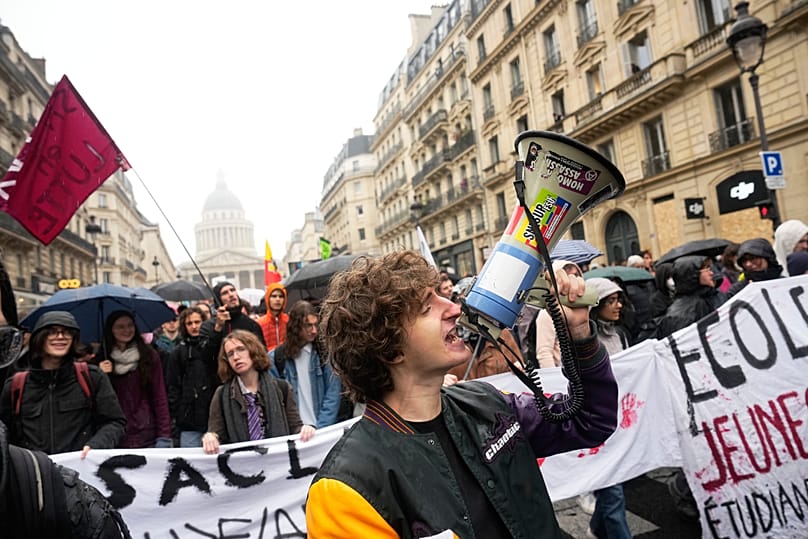
Nobel economist Joseph Stiglitz deems youth protests across Europe 'legitimate'

https://www.euronews.com/2026/11/19/nobel-economist-joseph-stiglitz-deems-youth-protests-across-europe-legitimate   Nobel Prize-winning econ...