Saturday, January 26, 2019

Inside the Vast Police State at the Heart of China’s Belt and Road

Xi’s economic ambitions drive the anti-Muslim crackdown in Xinjiang.
The state-mandated drills are part of China’s suppression campaign against Uighurs, predominately Muslim ethnic groups whose members have periodically lashed out with riots, stabbings and other attacks in protest of a government controlled by the Han Chinese majority. China has responded by installing a pervasive surveillance system in cities across Xinjiang and locking up as many as 1 million Uighurs—almost 10 percent of their regional population—in mass detention camps.
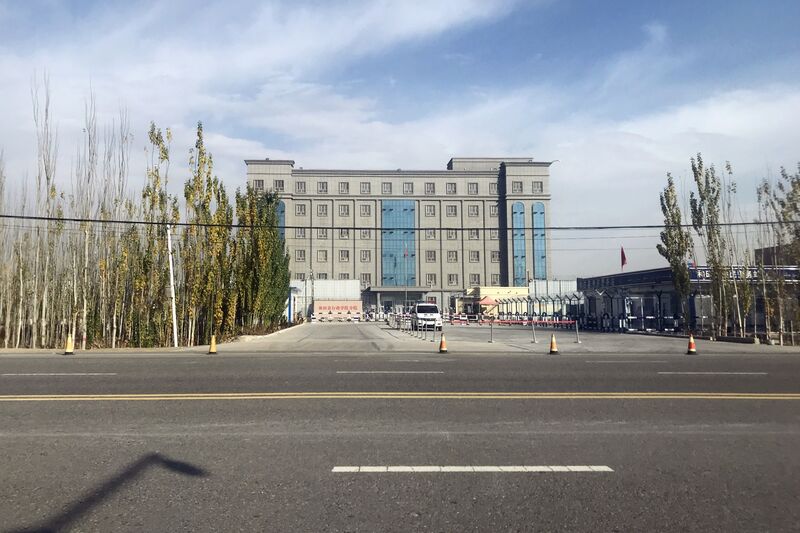
Hotan Detention Camp
This detention center in Hotan was identified using satellite coordinates. The United Nations has described as credible estimates that as many as 1 million Uighurs are being held in such camps. Local officials said it was a high school.
Source: Peter Martin/Bloomberg
The Xinjiang crackdown has drawn condemnation from human rights groups and calls for sanctions from U.S. lawmakers, who reject China’s claims that the camps are voluntary education centers that help purge “ideological diseases.”
“It is like if you have a child who misbehaves,” said Du Xuemei, a supporter of the camps and the spokeswoman for Yema Group, a trading company that operates the jewelry boutique. “The parents need to teach it right from wrong.”
But China’s severe actions in Xinjiang are about more than forcing ethnic minorities into line, as I saw on a recent trip to five cities in the region.
Far-flung Xinjiang is critically important to President Xi Jinping’s loftiest goal: completing China’s return as one of the world’s great powers. Although it represents just 1.5 percent of China’s population and 1.3 percent of its economy, Xinjiang sits at the geographic heart of Xi’s signature Belt and Road Initiative. It’s a trillion-dollar plan to finance new highways, ports and other modern infrastructure projects in developing countries that will connect them to China’s markets—and, skeptics say, put them in China’s debt for decades to come.
The government has spent vast sums building up cities in Xinjiang to attract companies and fuel growth in the relatively poor region. Concerns about lawlessness in Xinjiang could chill investment. China's campaign against the Uighurs is aimed in part at reassuring wary investors that Xinjiang is a safe place to live and work.
The Alaska-sized region borders eight countries and serves as a crossroads for a railway link to London and a route to the Arabian Sea through Pakistan, where China is financing a $62 billion port and transportation corridor.
But while Xi builds Xinjiang into a platform to project global influence, he risks undercutting his efforts to present China as a defender of free markets and international rules. Already, the surveillance tactics used in Xinjiang are spreading throughout China. Facial-recognition cameras, internet monitoring and experiments with so-called social credit systems to grade citizens based on behavior are becoming commonplace. And they are not just targeted at Muslims, but at anyone who threatens the Communist Party’s hold on power or is perceived to stand in the way of China’s geopolitical goals.

China’s Belt and Road

Modern-day Silk Road aims to revive and extend the ancient routes
Sources: Belt and Road Portal, China’s National Development and Reform Commission

Western politicians and economists long-predicted that once China opened its markets, its society would inevitably open up, too. As China digs in for a protracted trade war with the United States that’s as much about competing worldviews as steel and soybeans, he appears out to prove them wrong. If anything, China under Xi is becoming less free even as he preaches openness abroad.
That has ramifications for investors concerned about their own reputational risk. It also poses a broader challenge to the West as China holds out its centralized model of government as a viable alternative to Western-style democracy. For the leaders of some poorer countries weighing different paths to development, a top-down system may be appealing—especially if it comes with cash to finance high-cost roads, bridges and power plants.
“I see what’s happening in Xinjiang not as a local phenomenon, but as a symptom of the larger system that holds in China now under Xi,” said Rian Thum, a senior research fellow at the University of Nottingham who wrote a book about Uighurs. “It shows that Xi’s Communist Party is an organization that’s willing to go to greater extremes of repression than I think any outside observer expected.”
So far the police state in Xinjiang doesn’t appear to be reassuring investors, even as tourism picks up and a rush of government spending lures workers in search of well-paying jobs. Almost no foreign companies have located there and the region’s economy slowed last year. China sees that as a temporary setback. But as the Xinjiang campaign continues to draw unwelcome scrutiny, it is focusing attention not only on China’s treatment of Muslims but Xi’s vision for the nation’s future.
Crossing into Xinjiang from neighboring Gansu province, a deep divide soon becomes clear between Uighurs and the Han, who comprise more than 90 percent of the country’s 1.4 billion people, including Xi and almost all the party’s top leadership. Many Han have little interaction with the Turkic-speaking minority, and receive a steady stream of government news painting them as unsophisticated and susceptible to extremist ideas.

Ten Days in Xinjiang

Exploring the police state at the heart of Xi Jinping's Belt and Road initiative
Source: Bloomberg

On an overnight train into the city of Urumqi, a retired People’s Liberation Army soldier with the surname Cai told me he had no sympathy for Uighurs in the once “desolate, backward and poor” region. He thinks they should be thankful for all China has done for them.
“We have built roads for them, homes for them, given them schools,” said Cai, 69. “Some people lack any sense of gratitude to the country and the party.”
Read more: China Tests Facial-Recognition Fence in Muslim-Heavy Area
Many Uighurs have long resented the influx of Han into Xinjiang; some Uighurs consider the region an independent nation called East Turkestan. Beijing, in turn, has feared Xinjiang could peel away the same way the neighboring Central Asian republics abandoned Moscow as the Soviet Union collapsed.
China’s crackdown on the region began after a series of Uighur attacks on civilians starting in 2013, including a flaming car attack in the heart of Beijing: Tiananmen Square. The escalation alarmed authorities who had repeatedly attempted to pacify Xinjiang, most recently after 2009 riots in Urumqi killed some 200 people, mostly Han.
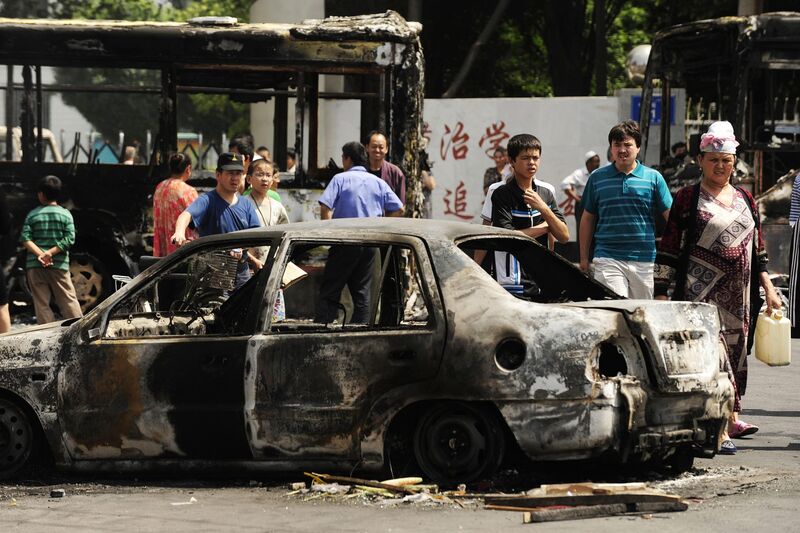
URUMQI 2009
People inspect a burned vehicle after days of rioting by Uighurs in Urumqi in 2009. The uprising killed almost 200 people and raised concerns about how China treats its ethnic minorities.
Photographer: Peter ParksAFP/Getty Images
“The government decided that openness wasn’t working,” said Raffaello Pantucci, director of international security studies at the Royal United Services Institute in London, whose research focuses on counter-terrorism as well as China’s relations with its Western neighbors. “A massive heavy hand came crashing down on the region.”
Almost all Han I spoke to in Xinjiang shared Cai’s view of the Uighurs as disloyal. They said they approved of Xi’s efforts to modernize the region, painting an optimistic picture of economic opportunities on a pacified frontier—though it was often difficult to tell whether they were truly speaking their minds, or repeating the official Communist Party line.
By contrast, most Uighurs appeared too scared to say anything, They engaged in hushed and cryptic conversations, insisting all was fine and abruptly walking away. Two Uighurs eating lamb and radishes in a restaurant just outside Xinjiang had warned it would be hard to get anyone to talk. Many of their neighbors back home had disappeared to “study,” one said.
Uighurs have reason to be paranoid. The police presence designed to track them is anything but subtle. Always, there is the fear of being taken away.
Police question them on the street, demanding to know where they’re going and why. Metal detectors, facial scanners and document checks are routine. Surveillance cameras are everywhere, even in some public restrooms. In one Uighur mosque, I counted 40 of them.
The mosques themselves were sparsely attended and I never heard a call to prayer in Xinjiang. Over time, authorities have banned “abnormal beards,” religious names for children, fasting during Ramadan and attending lavish weddings—part of a broader effort to assert control over all religions, including Christianity.
Read more: China Takes Diplomats to Tour Xinjiang ‘Re-Education Camps’
As I was riding in a packed third-class train car to Hotan, a former oasis town that once connected China to India, Uighur passengers fell silent and lowered their heads as a police officer walked in. Parents shushed their children.
Soon, a dozen more men wearing blue train conductor suits and red armbands clambered in, pulling bags from the overhead racks and shouting commands.
“Take this down!” “Open it!” “What’s this?” They took a young Uighur girl into the next car for questioning. A child started crying.
When we arrived in Hotan, I approached a Uighur man and told him what had happened.
“That’s what it’s been like every day for three years,” he said cautiously. Some of his family members had been sent to the Muslim camps, he added, where they spend all day studying Chinese law.
Foreign news outlets and non-profit organizations have detailed physical and psychological abuse inside the camps, with the Associated Press reporting that Uighurs were forced to disavow their Islamic beliefs, praise the party and endure solitary confinement. Former detainees told Human Rights Watch they were jailed without hearings, shackled and beaten.
“People go for two years minimum, and many for three years,” the Uighur man told me. “The first one or two years you can take it, but after that, you can’t.”
Officially, Xinjiang is just as open as most other parts of China. Yet as I arrived in Khorgas, a city established in 2014 on the border with Kazakhstan, four police officers with body armor and rifles ordered me from the car. One instructed me to kneel on the ground and empty my bag. He pointed a laser at things he wanted to inspect more closely.
A man in a black jacket joined the uniformed policemen. He introduced himself as “Mr. Li, a local businessman.” But his ID card said he was Mr. Wang, of the Public Security Department
“We knew you were coming,” he said pleasantly.
Wang took my phone and erased photos and files, something that happened repeatedly during my time in Xinjiang. “I am deleting these for your own good,” he said, before handing it to a colleague who took down the phone’s identifier number, presumably to track my location.
Wang and two propaganda officials were my constant companions. They pointed out construction sites and exhibitions hailing Xi’s accomplishments, including a display titled “My Country Is Awesome.” Wang encouraged me to take pictures, but only of “positive things.”
Read more: The Architect of China’s Muslim Camps Is a Rising Star Under Xi
At one restaurant a waitress wore body armor, though it was unclear why: there is little visible crime in Khorgas. Police stations with flashing lights dotted the road and a near-constant whir of sirens filled the air.
At the end of my time in Khorgas, Wang bid me farewell. “You are welcome back anytime,” he said. “As soon as you arrive, I’ll appear.”
In Kashgar, another former Silk Road oasis, the full gamut of Xinjiang’s security state was on display. Police patrolled the streets in teams of three, wielding shields and pointed black sticks. Soldiers marched with automatic weapons and sheathed bayonets.
Wittingly or not, Han civilians play a part in the government’s efforts to stoke fears that a Uighur attack could happen at any moment. Groups of shopkeepers all around the city performed drills with wooden clubs. Knives were chained to the tables in butcher shops, and storefronts were barricaded at night.
At times, the surveillance was excessive to the point of absurdity. Seven security officers were assigned to shadow me in Kashgar. When I asked a local police officer why such a large group was required, he denied the men were there at all.
“You’re hallucinating,” he said.
Across Xinjiang, the fear of saying something wrong hung over every conversation, even with the Han. It was impossible to know who was telling the truth.
One afternoon in Hotan, when the police didn’t seem to be following me, I ventured into a coffee shop. A young Han woman came charging toward me through the metal detector at the entrance. When she saw I was a foreigner she burst into nervous laughter
“You scared me to death!” she said. “I thought it was the police inspecting our security arrangements—and our guard isn’t here.” If it had been the police, “we’d all have to go for a study session on security in the community.”
Conditions like this would drive businesses and people away from any Western city. In Xinjiang, the police presence is a selling point and source of pride for some newly arrived Han.
While it’s unclear how many Han migrants have moved to Xinjiang—the most recent annual statistics available, from 2016, showed a decline in the Han population—the number of visitors is rising. The state-run China Daily reported that Xinjiang attracted more than 105 million tourists in the first eight months of 2018, almost as much as in all of 2017.
A Han man named Tian, who traveled to Xinjiang from Shanghai with his girlfriend, said he wouldn’t have imagined vacationing in the region until recently.
“Look around, there are police everywhere,” he said while watching Uighurs wrestle on stage in a bazaar. “It’s true it’s a little inconvenient but there’s a guarantee of our safety. The terrorists and bad people have nowhere to hide.”
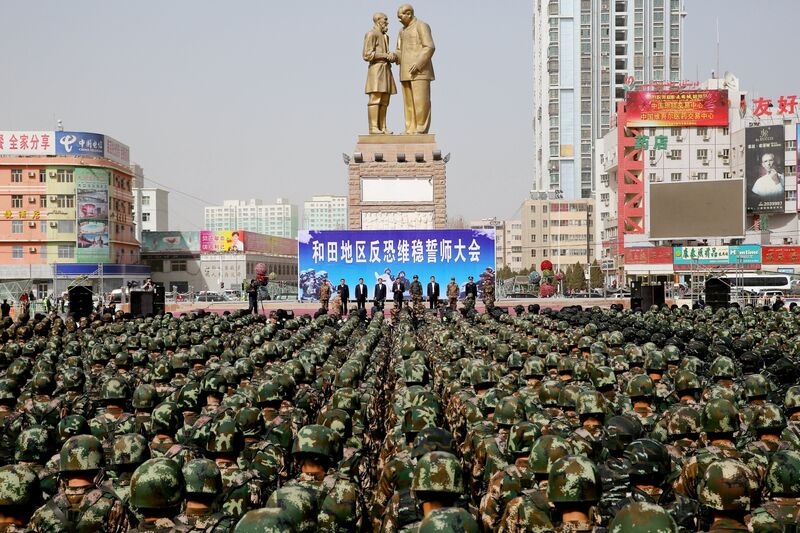
FILES-CHINA-POLITICS-RIGHTS-XINJIANG
Chinese paramilitary troops attend an anti-terrorism oath-taking rally in Hotan in 2017. These specialized troops oversee regular police, and are now a fixture in Xinjiang.
Source: STR/AFP/Getty Images
Xinjiang’s cities can’t hire police quickly enough. Official statistics show that regional government spending on public security nearly doubled in 2017. From August 2016 to July 2017 more than 90,000 security-related jobs were advertised, according to research published by the Jamestown Foundation. Xinjiang accounted for 21 percent of all criminal arrests in China in 2017.
Many Han had stories about recently graduated friends who headed west to find work. In Hotan, I met a 67-year-old woman named Lu who moved from Gansu province a decade ago in search of a better life. Now her sons operate two liquor stores.
“When we first came here, the Uighurs would tell us, ‘This is our place, we don’t want you Han here,’” she said. Now that’s changed, and she credits Xi.
“I really like him,” she said. “There are a lot more Han now and it’s very safe.”
It’s not at all clear, however, whether the huge public investment and police presence are spurring the economic miracle China envisions for the region.
Xinjiang’s economic growth slowed to 5.3 percent in the third quarter of last year, compared with 7.6 percent during the same period in the previous year, according to government data. Growth has been propped up by fixed-asset investment, which increased 20 percent in 2017 and was set to rise again thanks to a new rush of government spending.
Companies are not flocking to the region. Foreign direct investment into Xinjiang fell more than 40 percent year-on-year in the first 11 months of 2016, according to the most recent release from the local statistics office. That year FDI amounted to 0.4 percent of Xinjiang's economy, about a third the rate of the national average.
QuickTake: China’s ‘Project of the Century,’ the Belt and Road Initiative
“It’s one of the main tensions in the Belt and Road as a concept,” said Jonathan Hillman, a former U.S. trade official who heads the Center for Strategic and International Studies’ Reconnecting Asia project. “If you want to be promoting the movement of goods and people and data, having an overwhelming security presence is at odds with that. You need to be willing to give up some control.”
There is little evidence that Xi intends to do that. Some of the methods now used in Xinjiang are spreading to other Chinese cities. An anti-terrorism task force from the former British colony of Hong Kong recently visited Xinjiang to study local security initiatives, the South China Morning Post reported. The neighboring area of Ningxia also signed a cooperation agreement to learn from the region’s efforts to fight terrorism and promote "social stability."
Some Uighurs were finding it easier to join with the Communist Party than to resist: Perhaps half of the shadowy men and propaganda officials who followed me during various parts of my trip were Uighur.

Friday, January 25, 2019

France, Yellow Vests and the MEK


No one today is surprised at the foreign policy of the United States. War, violation of international law and disdain for human rights are all characteristics of the criminal enterprise known as the U.S. government.
Most of the U.S.’s allies display some or all of these same vices, but some are often considered above such activities. One that is mistakenly believed to be better than the U.S. is France. A look at some of its current policies is instructive.
At present, there are two groups active in France. One is known as the ‘Yellow Vests’ an informal organization that started to protest an increase in fuel taxes, and expanded to oppose a wide range of practices of the government of President Emmanuel Macron that are seen as detrimental to the public. There was no well-established plan and no recognized leader.
The second organization is the MEK (Mujahideen-e Khalq), a terrorist organization that seeks the overthrow of the Iranian government. MEK members have been responsible for the deaths of thousands of innocent people.
One would think that a responsive government would react positively to protesters opposing government policies. Government officials would look at those policies; acknowledge the problems they cause, and work with the opposition, in this case, the Yellow Vests, to fully understand their concerns. Then they would work to resolve the issues.
One would also think that any reasonable government would condemn a well-organized and well-financed terrorist group, and offer no support to it in any form.
Unfortunately, this is not the case with the government of France. The reverse, unfortunately, is true. The Macron government works tirelessly and violently to end the Yellow Vest protests, while it welcomes and supports the MEK.
Why would this be? The explanation is not difficult to see.
Like most world leaders, Macron isn’t beholden to the people of France, but to keeping the rich where they are, with little or no consideration for those less fortunate. As in the United States, it is the middle class that bears the largest tax burden, while the poor lose entitlements such as assistance with buying food and paying for housing. The tax overhaul that was passed in the United States last year overwhelmingly benefited the rich, at the expense of everyone else. France seems to follow this model.
And what of French support for MEK? This follows the hypocrisy usually demonstrated by the United States. France, one of the signatories of the Joint Comprehensive Plan of Action (JCPOA), condemned the U.S. withdrawal from this international agreement, and French government officials are looking for a means to circumvent the threatened U.S. sanctions if its corporations continue to do business with Iran. Yet they support a terrorist organization whose sole purpose is the overthrow of the Iranian government.
What has Iran done to incur the wrath of France? The government of Iran worked with the Syrian government, one of its close allies, to defeat U.S.-backed rebels who were attempting the overthrow of the Syrian government. Iran also develops defensive weapons to protect its people from a possible attack by the U.S. or apartheid Israel.
Yet Iran hasn’t invaded another country since 1798; it occupies no countries, and its bombs only fell on terrorist-held sites in Syria, at the request of the Syrian government. Why would France object to a nation that honors international alliances, develops an effective defense system, and basically minds its own business on the global stage? And why would France work so diligently to destroy legitimate protests in its own cities?
The United States differs from Iran in many ways. Currently, the U.S. is bombing at least five countries. It continues to support anti-government rebels in Syria. Yet it gives unreserved support to the brutal apartheid Zionist regime, and has close ties with Saudi Arabia which, like Israel, has an abominable human rights record. Since the end of World War II, it is estimated that the U.S. has killed at least 20,000,000 people, by invading or supporting rebels in at least 30 countries. And the rebels it supports always oppose a democratically-elected government, and support a brutal and cruel dictator.
Domestically, the U.S. has the highest number of citizens per capita in its prisons, and hunger and poverty are among the highest for any industrialized nation.
Despite the clown-like Donald Trump inhabiting the White House, much of the world remains intimidated by the U.S.’s reckless use of its power. While Trump is bogged down in a ‘partial’ government shut-down, along with a variety of investigations into his questionable associations with foreign leaders and porn stars, he continues to control the most powerful military system, and the strongest economy, on the planet. France, like most other countries, bows and scrapes to the imperial U.S. master.
Yet all is not well on the French or U.S. fronts. The Yellow Vests aren’t showing any signs of going away anytime soon, and Trump’s bullying isn’t having the impact he would have liked. The fact that several nations are looking for ways around his threatened sanctions is in itself a good sign, one that is indicative of dwindling U.S. power and influence. While France praises the terrorist MEK, it also seeks ways of continuing to trade with Iran.
The United States is a world power in decline, as shown by the mixed signals that France is sending: support for an anti-Iran terrorist group, while also seeking to maintain the JCPOA. The leaders of any declining imperial nation will do all they can to stem the tide of their decreasing power, and this makes such nations even more dangerous, at least in the short-term. France’s government officials should be cautious about which other countries they align their policies with; short-term gains can result in disastrous long-term losses, and France, at this point, appears to be on the wrong side of history. It is hoped that it will soon change course, and seek domestic and international justice.
 
Robert Fantina’s latest book is Empire, Racism and Genocide: a History of US Foreign Policy (Red Pill Press).

Bosnia betrayed

Bosnians were betrayed by the West since the very day it declared independence. A hodge-podge state was created that was unfair to its majority Muslim Bosnians and Catholic Croats. The murderous Serbs that collaborated full heartedly with Serbian military and the genocidal regime in Belgrade have since the Republic a joke.
=====================

SARAJEVO (Reuters) - A Muslim party said it would launch a legal bid to change the name of Bosnia’s Serb region, enraging all Serbian parties in the volatile country and prompting calls for calm from the European Union.
The largest Bosnian Muslim party, SDA, said on Wednesday the name Republika Srpska (Serb Republic) discriminated against Bosniaks and Croats there, and it would challenge it in the constitutional court.
Under the 1995 Dayton peace accords that ended Bosnia’s 1992-95 war, the country is split into two highly autonomous regions, the Serb-dominated Serb Republic and the Federation dominated by Muslim Bosniaks and Croats, linked via a weak central government.
SDA leader Bakir Izetbegovic said the legal challenge was a response to “intensified attacks on Bosnia and its integrity” by Bosnian Serb nationalist leader Milorad Dodik.
 

Central African Republic peace talks open in Khartoum

Peace talks aimed at ending chronic violence in the Central African Republic began in Sudan’s capital Khartoum on Thursday, January 24, attended by representatives of the government and 14 armed groups.
Brokered by the African Union, the African Initiative for Peace and Reconciliation in the Central African Republic Inter-Central African Dialogue between Government and Armed Groups began after 18 months of exploratory work
It is the the eighth bid in six years to agree a lasting peace. The last attempt, in 2017, was forged with the help of the Catholic Church, but fighting resumed within a day, leaving 100 dead.
The leaders of the armed groups will speak directly with high-ranking emissaries of the Bangui government, including ministers and President Faustin-Archange Touadera’s chief of staff.
The talks, aimed at reaching an accord and setting up a follow-up committee, could last up to three weeks, according to Sudanese authorities.
In August, the Facilitation Panel of the African Initiative of the African Union met with armed groups, where they agreed 104 demands later presented to the government.
Five issues were “put to one side” by the A.U., including the demand for a general amnesty. Five human rights organizations united in opposition to an amnesty for the armed groups which they said “would be incompatible with the government’s duty to bring those responsible for grave international crimes to justice.”
It was unclear which militia leaders attended the opening of the talks, but journalist Fridolin Ngoulou noted that Ali Darassa, the leader of the Union for Peace in the Central African Republic (UPC) ex-Seleka militia was spotted in Khartoum. Darassa had previously said he would not attend.
For 10 days earlier this month, UPC militants fought U.N. peacekeepers and Central African Armed Forces in Bambari.
Humanitarian organisations have stressed the importance of the talks for CAR’s population. Violence since 2012 led to thousands of deaths. Nearly 700,000 people are displaced, 570,000 have fled the country and 2.9 million – 63 per cent of the population – are in need of humanitarian aid, according to the U.N.
“Central African Republic is steering towards a catastrophe, unless upcoming peace talks succeed,” Secretary General of the Norwegian Refugee Council Jan Egeland said on Wednesday.
Egeland, who recently visited CAR, said that the “Central African government and the international community have failed in their response to the crisis.
“We now need to seize this opportunity to prevent the country from sliding backwards into a full-blown war,” Egeland said.
“Currently, the willingness of the international community to fund the humanitarian and development work in Central African Republic has been lacking,” he added.
According to NRC, donor countries provided less than half of the $516 million needed for humanitarian relief in 2018.
The U.N.’s humanitarian coordinator in CAR has requested $430.7 million to fund the Humanitarian Response Plan in 2019.
Despite reserves of diamonds, gold, uranium, copper and iron, Central African Republic remains one of the world’s poorest countries.
Fighting broke out between the Seleka, a coalition of mainly Muslim rebel groups, and the mainly Christian anti-balaka militia in 2012. A peace deal was singed in January 2013, but Seleka rebels captured the capital Bangui that March and ousted President Francois Bozize.
Seleka was officially disbanded within months, but many fighters refused to disarm, becoming known as ex-Seleka. Many others joined the anti-balaka militia to fight the Seleka, leading to a spiral of violence between groups along religious and ethnic lines.
By the end of 2014, CAR was de facto partitioned – anti-balaka in the southwest and ex-Seleka in the northeast.
Elected in 2016, President Faustin-Archange Touadera’s weak government controls around a fifth of the country and relies heavily on the U.N. peacekeeping mission, Minusca, for support. The rest is controlled by at least 14 different militia groups who often fight each other for revenue from extortion, roadblocks or mineral resources.
A Special Criminal Court has been set up to decide cases of serious rights violations committed in the country since 2003.

Afghanistan and the Implosion of America


Originally posted at TomDispatch.
As I approach 75, I’m having a commonplace experience for my age. I live with a brain that’s beginning to dump previously secure memories – names, the contents of books I read long ago (or all too recently), events, whatever. If you’re of a certain age yourself, you know the story.
Recently, however, I realized that this experience of loss, like so much else in our world, is more complex than I imagined. What I mean is that such loss also involves gain. It’s turned my mind to, and made me something of an instant expert on, one aspect of twenty-first-century America: the memory hole that’s swallowed up parts of our all-too-recent history. In fact, I’ve been wondering whether aging imperial powers, like old men and women, have a tendency to discard what once had been oh-so-familiar. There’s a difference, though, when it comes to the elites of the aging empire I live in at least. They don’t just dump things relatively randomly as I seem to be doing. Instead, they conveniently obliterate all memory of their country’s – that is, their own – follies and misdeeds.
Let me give you an example. But you need to bear with me here because I’m about to jump into the disordered mind of a man who, though two years younger than me, has what might be called – given present-day controversies – a borderline personality.  I’m thinking of President Donald Trump, or rather of a particular moment in his chaotic recent mental life. As the New Year dawned, he chaired what now passes for a “cabinet meeting.” That mainly means an event in which those present grovel before, fawn over, and outrageously praise him in front of the cameras. Otherwise, Trump, a man who doesn’t seem to know the meaning of advice or of a meeting, held a 95-minute presidential ramble through the brambles in front of a Game of Thrones-style “[Iran] Sanctions Are Coming” poster of… well, him. The media typically ate it up, even while critiquing the president’s understanding of that HBO TV series. And so it goes in the Washington of 2019.

Excuse me if I seem to be wandering off subject (another attribute of the aging mind), but I’m about to plunge into history and our president is neither a historian, nor particularly coherent. Read any transcript of his and not only does he flip from subject to subject, sentence by sentence, but even – no small trick – within sentences. In other words, he presents a translation problem. Fortunately, he’s surrounded by a bevy of translators (still called “reporters” or “pundits”) and, unlike the translators in the president’s meetings with Russian President Vladimir Putin, we have their notes.
So here, as a start, is a much-quoted passage of his on this country’s never-ending Afghan War from that cabinet meeting, which reporters and pundits jumped on with alacrity and criticized him roundly for:
“We’re going to do something that’s right. We are talking to the Taliban. We’re talking to a lot of different people. But here’s the thing – because mentioned India: India is there. Russia is there. Russia used to be the Soviet Union. Afghanistan made it Russia, because they went bankrupt fighting in Afghanistan. Russia. So you take a look at other countries. Pakistan is there; they should be fighting. But Russia should be fighting.
“The reason Russia was in Afghanistan was because terrorists were going into Russia. They were right to be there. The problem is it was a tough fight. And literally, they went bankrupt. They went into being called Russia again, as opposed to the Soviet Union. You know, a lot [of] these places you’re reading about now are no longer a part of Russia because of Afghanistan.”
As I said, Donald Trump is no historian. So it’s true that the Red Army didn’t move into Afghanistan in 1979 thanks to a terrorist presence in Russia. And yes, every stray pen or talking head in Washington seemed to skewer the president for his ignorance of that reality, including the Atlantic’s eminent neocon pundit David Frum who basically claimed that the president was simply pushing the latest dish of pasta Putinesca our way. (“It’s amazing enough that any U.S. president would retrospectively endorse the Soviet invasion. What’s even more amazing is that he would do so using the very same falsehoods originally invoked by the Soviets themselves: ‘terrorists’ and ‘bandit elements.’ It has been an important ideological project of the Putin regime to rehabilitate and justify the Soviet invasion and occupation of Afghanistan…”)
While critics like Frum did begrudgingly admit that the Soviet fiasco in Afghanistan might have had just a teensy-weensy something or other to do with the implosion of the Soviet Union in 1991, less than two years after the Red Army limped home, the president, they insisted, basically got that wrong, too. The Soviet Union bankrupted by Afghanistan? Not in your dreams, buddy, or as the Washington Post‘s Aaron Blake wrote in a piece headlined “Trump’s Bizarre History Lesson on the Soviet Union, Russia, and Afghanistan”:
“The overlap between the fall of the Soviet Union and its foray into Afghanistan is obvious. The USSR invaded in 1979 and left a decade later, in 1989. The superpower dissolved shortly thereafter in 1991. But correlation is not causation… It was perhaps among the many reasons the USSR collapsed. But it was not the reason.”
And then, of course, came the next presidential tweet, and everyone – except me – moved on with alacrity. I was left alone, still dredging through my memories of that ancient conflict, which, these days, no one but the president would even think of bringing up in the context of the ongoing U.S. war in Afghanistan. And yet here’s the curious thing when it comes to an aging empire that prefers not to remember the history of its folly: Donald Trump was right that Russia’s Afghan misadventure is a remarkably logical place to start when considering the present American debacle in that same country.
Two Empires Trapped in Afghanistan
Let me mention one thing no one’s likely to emphasize these days when it comes to the Russian decision to enter that Afghan quagmire in 1979. At the highest levels of the Carter and then the Reagan administrations, top American officials were working assiduously to embroil the Soviets in Afghanistan and would then invest staggering sums in a CIA campaign to fund Islamic extremist guerrillas to keep them there. Not that anyone in Washington is likely to play this up in 2019, but the U.S. began aiding those Mujahidin guerrillas not after the Red Army moved in to support a pro-Soviet regime in Kabul, but six months before.
Here’s how President Carter’s national security advisor, Zbigniew Brzezinski, would describe the situation almost two decades later:
“According to the official version of history, CIA aid to the mujahidin began during 1980, that’s to say, after the Soviet army invaded Afghanistan. But the reality, kept secret until now, is completely different: on 3 July 1979 President Carter signed the first directive for secret aid to the opponents of the pro-Soviet regime in Kabul. And on the same day, I wrote a note to the president in which I explained that in my opinion this aid would lead to a Soviet military intervention.”
Asked if he had any regrets, Brzezinski responded:
“Regret what? The secret operation was an excellent idea. It drew the Russians into the Afghan trap and you want me to regret it? On the day that the Soviets officially crossed the border, I wrote to President Carter, saying, in essence: ‘We now have the opportunity of giving to the USSR its Vietnam War.'”
Think about that largely missing bit of history for a moment. Top U.S. officials wanted to give the Soviet Union a version of their own disastrous Vietnam experience and so invested billions of dollars and much effort in that proxy war – and it worked. The Soviet leadership continued to pour money into their military misadventure in Afghanistan when their country was already going bankrupt and the society they had built was beginning to collapse around them. They were indeed suffering from what General Secretary Mikhail Gorbachev came to call “the bleeding wound.” And if that isn’t the language of disaster (or bankruptcy or, perhaps more accurately, implosion), what is? Yes, Afghanistan, that “graveyard of empires,” wasn’t the only thing that took their world down, but the way their much-vaunted army finally limped home a decade later was certainly a significant factor in its collapse.
Now, let me tax your memory (and especially elite Washington’s) just a bit more. Think again about the history that led up to the American war President Trump was fretting about in that cabinet meeting. Under the circumstances, it wouldn’t be an exaggeration to say that Brzezinski and his successors were just a tad too successful – or, to put it another way, that they lured not one but two empires into their trap; the second being, of course, the American one.
After all, in that 10-year Afghan proxy war (1979-1989), they laid the foundations for the creation by a rich young Saudi named Osama bin Laden of a resistance outfit of Arab fighters. You know, “al-Qaeda,” or “the base.” They also funded other extremist Islamic figures and groups like Gulbuddin Hekmatyar or the Haqqani network that would, more than a decade after the Soviets straggled home, go to war against… well, us. And through their investment in that brutal quagmire, they also helped lay the foundations for the destruction and destitution of significant parts of Afghanistan, and so for the brutal civil war that followed in the early 1990s amid the ruins. Out of that, of course, came another group whose name might still ring a bell or two: the Taliban.
In other words, Brzezinski & Co. laid the foundations for what would become a nearly 30-year American quagmire war (with a decade off between its two parts) in a land that, in 1979, few Americans other than a bunch of hippies had ever heard of. Here, then, is a small hint for the president: you might consider starting to refer to Afghanistan – and I assure you this would be historically accurate (even if you were roundly criticized for it by the Washington punditariat) – as America’s “bleeding wound.”
No matter how many years it goes on, one thing seems probable: like the Red Army, the U.S. military will finally limp out of that country in defeat and will also, in some way, bring that defeat home with them. It may not be what finally bankrupts or implodes the great(er) and far wealthier imperial power of the Cold War era, but as with Russia it will surely lend a helping hand.
There’s No Success Like Failure in Washington
In a country in which implosive elements are already being mixed into its politics, President Trump had his finger on something when he brought up the Russian war in Afghanistan. However historically and syntactically mixed up he might have been, his brain was still far more on target than those of most of the wise men and women of the present Washington establishment.
Take David Frum. Who today thinks much about his role in the history of American folly? As a speechwriter for George W. Bush, however, he was memorably ordered to produce “in a sentence or two our best case for going after Iraq.” In other words, he was to make a case for the invasion of that country in the president’s 2002 State of the Union address. At that time, with America’s superpower enemy, the Soviet Union, long gone and the U.S. seemingly unopposed on planet Earth, he somehow found three weak countries – Iraq, Iran, and North Korea – to turn into a World War II-style “axis of evil.” In doing so, he produced this memorable passage for the president:
“States like these, and their terrorist allies, constitute an axis of evil, arming to threaten the peace of the world. By seeking weapons of mass destruction, these regimes pose a grave and growing danger. They could provide these arms to terrorists, giving them the means to match their hatred. They could attack our allies or attempt to blackmail the United States. In any of these cases, the price of indifference would be catastrophic.”
Mission accomplished! No matter that neither Iraq, nor the other two countries were anywhere near having nukes.
Donald Trump has often been accused of megalomania as if that were a unique trait of his, but that’s because we’ve blotted out Washington’s other megalomaniacs of this century. I’m thinking of the neocon officials of the Bush administration with their urge to turn this planet into an American possession and their disastrous invasion of Iraq. Because of that sense of amnesia, David Frum, Mr. Axis of Evil, like the rest of his neocon companions has, a decade and a half later, risen again in Washington. Like him, many of them are now critics of the Trump administration, while others, like National Security Advisor John Bolton, are ascendant in that very administration.
In the end, when it comes to history and memory, it all seems to prove one thing: if you want to ensure your success in twenty-first-century Washington, there’s no way you can be too wrong. (The key figures in that city these days are evidently only familiar with the first of those two famed lines in Bob Dylan’s “Love Minus Zero”: “She knows there’s no success like failure/And that failure’s no success at all.”)
You now have 60 seconds (and the clock’s already ticking) to answer a question: Who, in or out of the administration, critic, pundit, or official, was against the invasion of Iraq once upon a time? I think you know the answer to that one. If you were against the single most disastrous, megalomanic foreign policy act of this century, there’s no place for you in present-day Washington, not in the administration, either party in Congress, or even in memory. You are not worth listening to, writing about, thinking about, or remembering in any way. You are the anti-Frum and have been deposited in the proverbial dustbin of history along with all those other embarrassing memories like… to mention just one more… the myriad elections in other countries that the U.S. interfered with before we were shocked (shocked!) to discover that some country might have meddled with one of ours.
Think of those neocons, the ones who have yet again made it into positions of power or influence and respect in Washington, as the gang who helped pave the way for Donald Trump to become president. Think of them as the imploders. Think of them as our domestic bleeding wound and (when it comes to taking down the system) the truest pasta Putinesca around.
What Might Have Been?
And now that I’ve left you with a completely bad taste in your mouth, let me bring up another small forgotten memory, one that might qualify – in an alternate universe of memories at least – as utopian, rather than dystopian. I’m thinking about “the peace dividend.” You don’t remember it? Well, that’s not surprising. But after the Soviet Union disappeared in 1991 (something official Washington hadn’t faintly expected and initially greeted in a kind of stunned silence), it briefly seemed as if the great-power struggles that had preoccupied history since perhaps the fifteenth century were finally over. The U.S. was the lone superpower left on planet Earth. Enemies were beyond scarce. A judgment of some sort had been rendered and, for a brief moment, even in Washington, people began talking about that most miraculous of things: a peace dividend.
The staggering sums that had gone into the Pentagon and the rest of the national security state in the Cold War years were visibly no longer necessary. So it was time to bring it all – billions and billions of dollars that had long been invested in the militarization of our American world – home. There was, after all, nothing left to build up military power against and so that money could now be put into what wouldn’t for another decade be called “the homeland.”
In fact, though modest cuts were made in U.S. forces and military spending in those years, they would prove to be anything but a dividend and would soon enough simply evaporate in the face of the military-industrial complex and, of course, that “axis of evil.”
In the years that followed, the very idea of a peace dividend, even the phrase itself, would simply vanish. Still, just for a moment, in a country whose infrastructure is now crumbling, whose teachers are underpaid, whose health care system is under siege, it was possible to dream about a world in which the bleeding wounds of the planet might begin to be staunched. Imagine that and think about what the future might have been.
Tom Engelhardt is a co-founder of the American Empire Project and the author of a history of the Cold War, The End of Victory Culture. He runs TomDispatch.com and is a fellow of the Type Media Center. His sixth and latest book is A Nation Unmade by War (Dispatch Books).

Regime Change Amnesia in Washington


The decline of Venezuela finally came to a head on Wednesday when the opposition leader Juan Guaidó swore himself in as interim president, igniting a crisis of uncertainty about support for Guaidó among the Venezuelan military and eliciting the passionate support of the Trump administration. With the notable exception of Congressman Ro Khanna, a California Democrat, Washington appears to have forgotten the long and sordid history of US-backed regime change around the world.
In 1953 the US supported a coup against Iranian Prime Minister Mohammed Mosaddeq, resulting in the installation of the pro-US Reza Shah Pahlavi. The abuses of the Shah ultimately led to the rise of today’s theocratic Islamic Republic of Iran, failing to benefit us or the Iranian people in any way. This coup initiated half a century of CIA involvement in regime change around the world, often with terrible unforeseen consequences. Our policy of toppling foreign governments is, at least in theory, meant to make the world a better place by spreading liberal democracy and capitalism. We were supposed to be spreading democracy and promoting global safety in 2003 when we took a month to topple Saddam Hussein and eight years dealing with the consequences. I doubt Iraq would be substantially worse off today had we left them alone a decade ago.
Intervention in foreign civil conflicts has an equally bad track record of making life worse for people around the world. Libya, Egypt, and Syria were all the subject of US-backed opposition movements, resulting in an authoritarian regime in Egypt, an ongoing civil war in Libya, and an ongoing civil war in Syria. Despite this history, Washington continues to use a combination of sanctions and political pressure to provoke further regime change around the world.
Regime change is simply a tool for undermining our global rivals by eliminating governments friendly to them, and to impute any noble intentions upon the actions of the Trump administration in Venezuela is unwise and unrealistic, especially when one considers Trump’s recent eagerness to invade Venezuela. Continued US support for Saudi Arabia, especially considering the horrors of their war in Yemen, completely exposes the Trump administration’s support for this coup as a strategic measure against our opponents abroad. To ignore what Washington is doing in Venezuela as simply promoting democracy is to risk the possibility of a long, deadly ground war in South America which would be a disastrous response to the already terrible crisis in Venezuela.
What is missing from the national conversation about Venezuela, and foreign policy generally, is a realistic and pragmatic non-interventionism. We only need look to countries like Mexico, which decided to respect Venezuelan sovereignty by leaving its internal affairs alone, for guidance. The civil conflict of another nation shouldn’t be the concern of the United States, any more than our domestic issues should worry the world. Considering he claims to consider America’s problems first, I wonder why Trump doesn’t understand the value of noninterventionist foreign policy.
Michael Sweeney is a peace activist with a BA in political science concentrated in international relations.

Kamala Harris Has an Israel Problem

"Kamala Harris Has an Israel Problem. That Is a Deal-Breaker for Me," writes M. Byrne

Kamala Harris is a cop, or so goes the saying from many of her critics who decry her history as a prosecutor in the state of California. Since her announced candidacy for president in 2020, Kamala Harris has unknowingly ignited a debate among the left regarding her record as prosecutor and California AG and her contributions to the prison industrial complex. Briahna Gray at the Intercept asks the question of whether a prosecutor can even be president in the age of Black Lives Matter, while Hannah Giorgis, writing in the Atlantic, takes Harris’s record to task while critically examining her recent book. Margaret Kimberley of Black Agenda Report, is most direct in her criticism of Harris, stating without hesitation that She did everything in her power to support the mass incarceration system and all of its foundations.I am a fan of all three of these writers, and I do not seek to critique the scope of their analysis, but instead expand on the scope and contribute to the ongoing discussion regarding Kamala Harris and her views on justice. When it comes to issues of justice and progressivism, discussions mainly adhere to what transpires within the borders of the United States, while ignoring the many injustices that are committed against the victims of US imperialism worldwide. Justice is an issue of human rights, not just American rights, and progressives need to hold accountable those who shun human rights in order to score domestic political points. In the case of Harris, her unbridled support for Israel and its many injustices towards the Palestinian people should raise a few red flags.
Examining Harris’s criminal justice record is important, because this country has a prison problem, and a racism problem. When you combine those two elements, you are faced with a carceral state that disproportionately affects the lives of those who most often face racial discrimination in this country. So while supporters of Harris are apt to point out that they agree she needs to answer for this, they are as quick to point out that her problematic criminal justice record was accumulated prior to her becoming a Senator, making the point that sometimes “people grow”. While it is true that people grow, we have to be more skeptical of that saying when it comes to politicians, because their growth, while sometimes genuine, can oftentimes be traced to ambition. Sometimes politicians have to grow based on the office they seek and the bloc of voters they need to pander to. Considering Harris is now running for president, maintaining that level of skepticism is more important than ever. With that being said, the question I still want to ask people is whether Kamala Harris has actually grown in regards to her stance on criminal justice? For me, assessing the growth of a politician comes down to a critical analysis of not only their public statements, but their voting record, and the morals and values behind what drives them. When taking into account Harris and her connection to Israel, we start to see that her morals may have never shown any real growth.
During her time in the Senate, her support for Israel can be summed up by her co-sponsoring of S.Res.6, a resolution objecting to United Nations Security Council Resolution 2334. UNSC Resolution 2334 was a controversial statement from the UN, which historically has failed to condemn Israel for any of its war crimes, specifically their indiscriminate bombing raids in Gaza, or their continued construction of illegal settlements. This resolution was a clear condemnation of Israeli settlement activity, and was allowed to pass when the US made the unprecedented decision to abstain from voting. Overall, the US has used its veto power 43 times to prevent the UNSC from condemning Israel, which is one of the main reasons why the move by the Obama administration to allow such a resolution to pass was seen as groundbreaking. By cosponsoring S.Res.6, Harris made it clear her support for Israeli settlement activity and Israeli settlements, which thanks to UNSC 2334 are illegal under international law. These settlements change the facts on the ground by continuing the forced displacement of Palestinians from their land and homes, and further tanking the peace process by destroying what little is left of a Palestinian state in the West Bank. If these are the sort of principles that Kamala Harris supports, then I suspect that her definition of justice is a bit hypocritical
It is not uncommon in the House or the Senate to support Israel, as the vast majority of elected Representatives and Senators, as well as Presidents have expressed unwavering support for the Jewish state. Kamala Harris is one of those elected officials who has gone out of the way to make sure her support for Israel is special and stands out from the rest of the pack. One way that elected officials in this country show their allegiance to Israel is by speaking at the annual policy conference of AIPAC, or the American Israel Public Affairs Committee. AIPAC functions as the major pro-Israel lobby organization in Washington, and is responsible for, among many things, making sure the US government maintains support for Israel and passes legislation favorable to Israel’s interests. AIPAC’s policy conference is the yearly culmination of that work, and the conference itself is an extravagant display of bombastic pro-Israel rhetoric, and touts a lineup of dignitaries, among them many US politicians, who voice their unabashed support for Israel. Harris has become somewhat of a regular at this conference, speaking there in 2017 and 2018. Harris’s 2017 speech at the AIPAC policy conference is particularly telling because we learn much about the origins of Harris’s Zionism. For instance, speaking of her childhood connection to Israel, Harris said:
So having grown up in the Bay Area, I fondly remember those Jewish national fund boxes that we would use to collect donations to plant trees for Israel. Years later when I visited Israel for the first time, I saw the fruits of that effort and the Israeli ingenuity that has truly made a desert bloom.
The phrase “desert bloom” is common in Zionist circles, and is a widely used phrase by apologists for Israel, because it is used to describe the way in which Israel supposedly transformed a once desolate and empty desert into a thriving and modernized western society. It rests on the myth that much of the land taken by Zionists was unoccupied, and erases the history of the forced expulsion of the Palestinians from their homes. The organization that Harris refers to, the Jewish National Fund, is one such organization that provides a cover for the continued bulldozing of Palestinian homes under the guise of “planting trees”. I wonder if Harris was aware of this history or would even care if presented with the facts?
That aside, this is about justice, and when it comes to Israel, we know that justice only comes to those who are not Palestinian. Kamala Harris in the same 2017 speech to AIPAC dedicated some of her words to praising the Israeli Supreme Court. According to her, she was struck “by the iconic architecture which embodies Israel’s founding principles of democracy and rule of law” and used that sentiment to compare it to her own journey to becoming a prosecutor. I wonder if Harris is using definitions of “democracy” and “rule of law” that mean something different than what they are, because you could hardly attribute those principles to the Supreme Court in Israel. I wonder what democratic principles the Israeli Supreme Court embodied when it ruled in 2014 that admissions committees in 434 communities in the Negev and Galilee (43% of all towns in Israel) could reject housing applicants based on the “social suitability” as well as the communities’ “social and cultural fabric”? This decision from the Supreme Court basically legalized segregation, considering the overwhelming number of Israelis who don’t want to live anywhere near Palestinians. I wonder what principles of the rule of law were embodied by the Israeli Supreme Court when it ruled in 2006 that targeted assassinations of Palestinian civilians killed since the start of the second intifada were legal and did not violate international law. The Yale Law Journal warned of the danger of this in 2007 noting that it was “the world’s first judicial decision on targeted killings,” and had the potential to weaken international law. Those words would prove themselves true over time as the Obama administration in 2014 cited that Israeli court decision in a Justice Department memo attempting to justify the killing of Americans without trial. Does Kamala Harris believe that principles of democracy and the rule of law can be found through enforcing legalized segregation or the ability to assassinate your own citizens?
Harris’s 2017 AIPAC speech also gives us a preview of her foreign policy, as Israel plays a major role in the entire Middle East region and our interests often align with theirs when it comes to allies and enemies. Harris herself supports the massive amounts of money we give to Israel saying that “Our defense relationship is critical to both nations, which is why I support the United States’ commitment to provide Israel with $38 billion in military assistance over the next decade.” That money allows Israel to maintain it’s military superiority over the region and also helps to prop up the occupation of Palestine. She also says that she will do anything in her power to “ensure broad and bipartisan support for Israel’s security and right to self-defense.” Ensuring that defense comes at a cost, because Israel has made a lot of enemies over the last century. Harris speaks at length on defending Israel when she says:
In the midst of uncertainty and turmoil, America’s support for Israel’s security must be rock solid. And as Iran continues to launch ballistic missiles while it arms and funds its terrorist proxy Hezbollah, we must stand with Israel. As Hamas maintains its control of Gaza and fires rockets across Israel’s southern border, we must stand with Israel. And as ISIS and civil war in Syria destabilize the region, displacing millions and threatening shared security interest, we must support all those affected by ongoing violence and terror, and we must stand with Israel.
Right there in that statement Harris has already informed us how she would govern relations with Iran, and gave us a preview of how she would handle negotiations with the Palestinians and the conflict in Syria with the use of her language in describing Hamas and the Syrian government. Her rhetoric was similar with Russia, saying “Russia’s explicit support for these actions is a direct threat to American interest, and it makes Israel less secure.” There you go, Harris’s entire strategy for conducting diplomacy with a nuclear peer is to see what Israel thinks. “See what Israel thinks” might be a catchy campaign slogan when she hits the trail looking for that Israel lobby money.
There may still be naysayers who will argue that we shouldn’t judge Kamala Harris for statements she made in 2017. That is a fair point, so I will quote from her 2018 AIPAC speech. Wait a minute, that speech was given in private and off the record, so no one really has a clear idea what Kamala Harris said at AIPAC in 2018. We know based on the tweets of some of the participants who were in attendance of her workshop that much of what she said echoed the sentiments of her 2017 speech. When it comes to Israel, it doesn’t look like Kamala Harris will change anytime soon, if ever. Of course, this doesn’t surprise me, because like most people, Kamala Harris has a set of principles that are set in stone. If her views on Israel haven’t changed since her childhood, I doubt they are going to change, and that is something that we need to consider in 2020 because principles matter. Harris, again in that 2017 speech said “I stand with Israel because of our shared values which are so fundamental to the founding of both our nations. I believe the bonds between the United States and Israel are unbreakable, and we can never let anyone drive a wedge between us.” That seems like someone who is pretty set in their ways, and if we are to be honest, that statement there is more problematic than anything else she said in that speech. When it comes to the “shared values fundamental to the founding” of both the United States and Israel, we have to see those values for what they are, mainly as one of “manifest destiny” or a Zionist version of “lebensraum”. Either way it is a justification for the violent possession of land from the indigenous people, their forced dispossession, and cultural genocide. Is that the kind of rule of law that Harris will stand for as president? Let’s remember that above all, the president is the commander-in-chief of the armed forces, so the number one duty a president Harris would have is overseeing the vast military industrial complex that overseas the military budget, and among other things, the diplomatic relations between the US and Israel. These days, when the dangers of criticizing Israel are hitting the shores of the US, whether that be in the form of loyalty pledges to keep your job (or get hurricane relief), or getting blacklisted for speaking out in support of Palestinian liberation, it is important that we keep another Zionist from making it to the Oval Office.
One last point. Given Kamala Harris and her opposition to the Boycott, Divestment, and Sanctions movement (BDS), she doesn’t even support the 1st amendment, let alone a protest movement whose stated purpose is fostering equality. Some principled upholder for the rule of law, let alone a “progressive prosecutor”, which Harris has unflinchingly referred to herself as. We can do better in 2020, not just for ourselves, but for the entire world.
Michael Byrne is an antiwar activist who works in the Washington DC area.

OIC Ministerial Contact Group Calls for a Comprehensive Solution to the Rohingya Crisis

  The Organization of Islamic Cooperation (OIC) Ministerial Contact Group on the Rohingya Muslims held a meeting chaired by the OIC Secretar...