o . 35 charred bodies found in Kayah State
last month were killed in the ‘most inhumane manner I have seen in my life’,
said a doctor who conducted the autopsies
·
o . Aid agencies lament world powers’ ‘out
of sight, out of mind’ approach, including the US and China, to reports of
grisly mass killings and other atrocities


Bhavan
Jaipragasand Min Ye Kyaw
Published:
1:00pm, 9 Jan, 2022

Smoke and
flames billow from vehicles in Hpruso on December 24. Myanmar government troops
rounded up and shot more than 30 villagers and set their bodies on fire,
witnesses said. Photo: Karenni Nationalities Defence Force via AP
In 2021
there were a raft of reports about the Myanmar military regime’s mass killings, and the massacre in Hpruso, Kayah
state, on Christmas Eve ranks as one of the deadliest attacks of the year.
Anti-junta
fighters, rights activists and officials from international aid agencies who
spoke to This Week in Asia said that while news of large civilian casualties no longer jolted
them after months of fighting, the nature of the latest killings had horrified
them.
On
Christmas Day, the Myanmar Now news portal reported that the remains of at
least 35 charred bodies had been found in three burnt-out vehicles. This week,
a doctor who conducted autopsies on the bodies told a press conference that the
condition of the remains showed the victims were killed “in the cruellest
and most inhumane manner I have seen in my life”.

Smoldering vehicles in Hpruso, Myanmar, where women and children
were shot and set on fire. Photo: AP
Among the
victims were women, children and two employees of the charity Save the
Children. The doctor said several of the bodies had their hands tied behind
their backs, were gagged, and had holes in their lungs and chests. The group of
doctors who conducted the postmortem examinations were able to carry out
autopsies on only 31 bodies as other remains had been completely destroyed by
the fire and crumbled to ashes when touched.
The
Tatmadaw, as the Myanmar military is known locally, said after the incident
that people were “killed in the crossfire”, adding that “gunmen” fired back at
soldiers when the convoy of vehicles was asked to stop for checks. Interviewees
suggested that without stepped-up international action including an arms
embargo endorsed by the United Nations, such killings were likely to intensify in the coming
months.
Since junta
chief Min Aung Hlaing seized power and detained leaders of the democratically
elected National League for Democracy last February, more than 1,400 people
have been killed by security forces, according to local monitoring group the
Assistance Association for Political Prisoners.
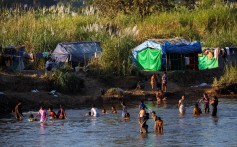
Myanmar villagers seek ‘freedom’ as
thousands set up camp along Thai border
8 Jan 2022
A senior
official from an international aid agency directly involved in Myanmar
operations lamented what he referred to as an “out of sight, out of mind”
policy on the latest killings by world powers including the US and China, and suggested that national governments’ public
condemnations of the violence was “out of step from their positions on what is
a civil war in all but name”.
A
Yangon-based aid worker said it was incomprehensible that Cambodia’s prime
minister Hun Sen – the current chairman of the Asean bloc, which Myanmar
belongs to – was visiting the country this week. He is the first head of
government to do so since the coup.
The visit
has drawn severe criticism given that it departs from an earlier consensus
within the bloc to sideline Min Aung Hlaing over his failure to adhere to the
Association of Southeast Asian Nations’ “five-point consensus” peace plan.

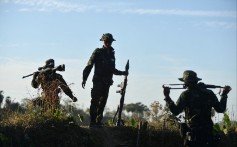
Members of the People’s Defence
Forces on the front line in Myanmar. Photo: Reuters
“Min Aung
Hlaing is being rewarded with a semblance of legitimacy [through Hun Sen’s
visit] just days after one of the Tatmadaw’s worst atrocities since the coup.
It’s simply inexplicable,” said the person, who spoke on condition of anonymity.
While the
UN Security Council took the rare, unified step of calling for “accountability
for this act”, there has been little other action from the international
community to take the Tatmadaw to task.
“Broad
condemnations from the UN will just go in one ear of the Tatmadaw and out the
other unless it is backed by real concrete action by the Security Council,
starting with moving forward for a global arms embargo against Myanmar,” said
Phil Robertson, the deputy director of Human Rights Watch’s Asia division.
“The
unconscionable silence from regional powers like China, India, Australia, Japan
and South Korea in the face of such appalling atrocities gives a green light to
the Myanmar military to do it again.”
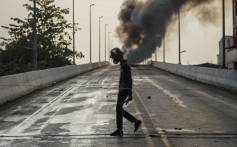
Hun Sen accused of undermining
Asean with ‘cowboy diplomacy’ on Myanmar trip
7 Jan 2022
“So
far, the coalition of governments taking action against Myanmar is significant,
but still too narrow. So there needs to be a sustained effort to get these
fence sitters off the fence and acting to support respect for human rights,
accountability for rights crimes, and restoration of democracy in Myanmar,” he
added.
The Kayah
state killings were just one instance of the military atrocities that took
place in December alone. On December 9, images circulated on social media
showed charred corpses in Done Taw village in the northeastern Sagaing region,
which has emerged as the epicentre of
fighting between Min Aung Hlaing’s forces and the so-called People’s Defence
Forces (PDFs) who are loyal to the shadow National Unity Government (NUG). As
in the Hpruso killings, some of the victims in the Done Taw massacre
had their hands tied behind their backs.
On December
23, nine civilians were killed when the military engaged the PDF in Sagaing’s
Kalay region, according to Myanmar Now. In another incident in the same week,
seven civilians were killed following air strikes in Sagaing’s Ye-U township.
Myanmar has ‘ingredients for civil
war’, Cambodia warns
5 Jan 2022
Members
of various PDFs, which sprang up across the country in the aftermath of the
coup in February last year, say the killings have intensified since November,
as the Tatmadaw began rolling out a scorched earth military offensive dubbed
“Alaung Min Taya”.
The assault
follows the NUG’s declaration of a “defensive war” against the military and has
involved the use of air strikes and helicopter assault operations, the PDF
sources said. One member of a PDF said local defence
forces – while skilled in covert rural fighting – “were not ready” for the
full-on assault from the military.
Still, the
forces have survived in part by seizing weaponry including AK-47 rifles from
Tatmadaw soldiers, the person said. PDF sources also cited concerns about
facing off with the Tatmadaw’s Light Infantry Divisions – a centrally commanded
counter-insurgency force seen as the tip of the military’s spear.
The 33rd
and 99th Light Infantry Divisions gained notoriety in 2017 for atrocities that
forced 700,000 Rohingya Muslims to flee Myanmar. Their modus operandi of “clearance operations” –
involving burning civilians’ homes in places where resistance fighters are
nearby – has been used in the current conflict.
In a recent
commentary, veteran Asian military analyst Anthony Davis said that while the
media had in recent months described the state of the conflict as a
“stalemate”, the real trajectory of the fighting was unclear “given the wide
geography of the Myanmar heartland and a stark lack of independent reporting”.
Myanmar villagers settle
temporarily on border with Thailand

Nonetheless, an overstretched boots-on-the-ground
fighting force of “significantly fewer than” 100,000 soldiers and weakening
morale were vulnerabilities for the Tatmadaw in 2022, Davis said in a
commentary for the Asia Times. “Anecdotal evidence suggests that at the end of
2021 army morale might best be described as ‘uncertain’ – somewhere between
‘brittle’ at the negative end of the spectrum and ‘robust’ at the positive
end,” Davis wrote.
He added
that the regime was likely to intensify its offensive in the country’s dry
season that usually lasts until May. “Army commanders can be expected to throw
the full weight of their forces against PDFs with a focus on Sagaing where the
armed revolt is most advanced,” he said.
“Failure to
contain it risks exacerbating vulnerabilities that later in 2022 could yet tip
a precarious strategic balance sharply against the Tatmadaw with consequences
that are difficult to predict.”


No comments:
Post a Comment