Himal: Politics Nepal’s brutal history of police violence in the Madhesh by Anjali Sah
ON THE NIGHT of 26 July, a dispute between Hindus and Muslims over religious flags and loud music in Dewanganj, a municipality in Sunsari district of Nepal’s Tarai, ended with the police opening fire. Nepal Police first fired warning shots to disperse the crowd; when that failed, the Armed Police Force opened fire with live rounds. Around 25 rounds were fired in total, leaving ten people injured and three men dead: 30-year-old Om Prakash Mehta, killed on the spot; 25-year-old Jay Prakash Mehta, who died of his injuries three days later; and 21-year-old Rabindra Mehta, shot in the left thigh, who died in Kathmandu on 4 August after the wound turned septic and led to organ failure following an amputation. As anger over the shootings mixed with rising communal tensions, unrest spread across parts of the Tarai. Authorities imposed curfews and prohibitory orders in Sunsari before extending restrictions to other towns in Madhesh as fresh clashes erupted.
On 30 July, in Golbazar municipality in Siraha district, security forces fired again as demonstrators torched motorcycles, killing 15-year-old Ganesh Yadav at the scene.
Much of the public discussion around these clashes has centred on the communal nature of the violence, with commentators warning that the sectarian polarisation visible across the Indian border is now spilling into Nepal. Four days into the unrest, the prime minister Balendra Shah, who has rarely appeared in public since taking office in March, broke his silence with a televised address appealing for calm, urging citizens to “maintain peace, harmony, brotherhood and national unity,” and promising a “completely fair and transparent” investigation into the violence.
The call for calm is necessary at a moment when communal tensions in Nepal appear sharper than they have been in years. But it risks reducing the violence to a story of communal polarisation alone. Long before these riots, and under governments of every political stripe, unrest in the Tarai has repeatedly been met with live ammunition before less lethal means are exhausted. Where a baton charge or a water cannon might come first elsewhere in Nepal, in the Tarai, the state too often shoots to kill.
MADHESH, WHICH IS in Nepal’s Tarai plains along the border with India’s Bihar, is one of the country’s most historically marginalised regions: poorer than much of the country, underdeveloped, and long treated as peripheral by the state. That marginalisation traces back to the dominance of the Pahad, the hill region centred on Kathmandu, which has shaped Nepali politics and national identity since the Shah unification of the country in the eighteenth century. That dominance has endured through every subsequent political order – the Rana oligarchy, the Panchayat system, and the democratic era that followed 1990 – with Madheshis kept largely outside the police and army that enforce the state’s authority in their own region. Madheshis, an umbrella term for the region’s many caste and religious communities, share languages, kinship networks and customs with communities across the border, an intimacy Nepali nationalism has long read as divided loyalty rather than geographical affinity. For much of the twentieth century, official ideology held that to be Nepali was to speak Nepali and follow Pahadi custom, leaving Madheshi languages, from Maithili to Bhojpuri, obscured and Madheshi citizens themselves permanently suspect. It took a decade-long civil war, the end of the monarchy in 2006 and the Madhesh movement that followed to force federalism and proportional representation onto the political agenda, and even then only in diluted form.
In 2015, the Madhesh rose up once more, this time against a new constitution that Madheshis felt had been drafted without them and that fell short of the autonomy they had been promised. Human Rights Watch’s report on the crackdown that followed called Like We Are Not Nepali – a line the group borrowed from something protesters told its researchers – documented the killing of 25 people, 16 of them civilians and nine police officers, across five Tarai districts in under three weeks that August and September alone. By the time the unrest wound down months later, the toll nationwide stood somewhere between 45 and 60 dead, with the National Human Rights Commission’s own count being 49. The overwhelming majority of them were Madheshi or Tharu protesters and bystanders. The Tharus are indigenous to the Tarai, with their own languages and customs distinct from the Madheshi communities, though sharing a similar history of exclusion under Pahadi-dominated rule.
Witnesses told Human Rights Watch that police shouted “Thok! Thok!” (Shoot! Shoot!) and more specifically “Thok Bihariharulai” (Shoot the Biharis), a slur that folds Madheshis into a supposed Indian “other” regardless of the fact that they are Nepali citizens by birth. Among those shot, per Human Rights Watch’s account, were children: Nitu Yadav, 14, dragged from bushes and shot dead at point-blank range, and Bikas Yadav, 12, shot and wounded in the buttocks while carrying water to an injured man.
The state has never meaningfully reckoned with that violence. A commission led by the retired Supreme Court justice Girish Chandra Lal examined more than 3,000 complaints before submitting its report to the government in December 2017. Although the government promised to make the findings public, it never did. What is known of the report comes from leaks to the Nepali press in 2019, including its conclusion that the use of lethal force in the eastern Tarai “could not have occurred without the direction and orders from the local administration.” This pointed to the chief district officers who oversee day-to-day security in the Tarai, appointed by and answerable to the home ministry in Kathmandu rather than to any elected local authority. Human Rights Watch, which campaigned for years for the report’s release, says no police officer has been held accountable for any of the deaths during the 2015 unrest.
The episode most often invoked to complicate this history occurred in Tikapur in Kailali district, in Nepal’s far west, home to a large Tharu population. In August 2015, during protests over where the borders of Nepal’s new federal provinces would fall, a crowd there killed eight people, seven of them police officers. But the aftermath of Tikapur also revealed the broader patterns of impunity and unequal state response that have marked conflicts in the Tarai. Amnesty International documented arbitrary arrests and torture of Tharu residents following the killings, amounting less to the investigation of a crime than to the collective punishment of a community. Eleven defendants were sentenced to life imprisonment in 2019, but years later rights groups continued to argue that justice remained elusive, not only for those killed in Tikapur but also for the abuses committed by the state in its response.

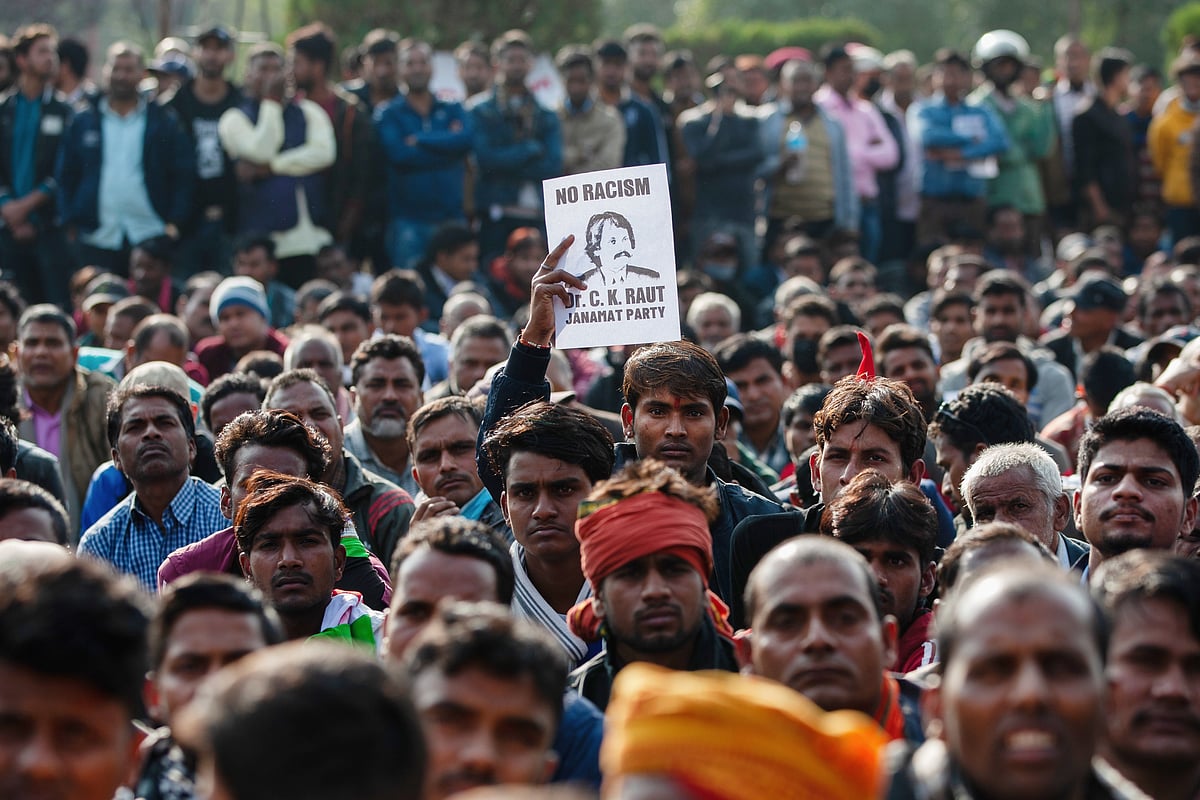
While 2015 was an explosive year, lethal police violence in the Tarai did not end with the Madhesh movement. It continued over the following decade as part of a longer pattern in which the state has repeatedly responded to unrest in the region with live ammunition. Reporting for The Record in 2022, journalists Bhrikuti Rai and Shristi Shakya documented at least 16 people shot dead by police during Tarai protests in the preceding five years alone. Most of the disputes that led to these deaths were not communal conflicts at all; they stemmed from local grievances, accidents, allegations of police abuse, or demands for accountability.
In Sarlahi in 2019, Saroj Mahato was shot in the head during a protest over the drowning of a child. In Jhapa in 2020, Rasikul Alam was killed while demonstrating against the arrest of two Muslim men accused of killing an ox. That same year, in Bardibas, Buddhiraj Neupane died after police opened fire on a protest following the rape and murder of a six-year-old girl. In Susta, Nawalparasi, in 2021, Abhinash Rajbhar was shot dead during a confrontation with police over their alleged mistreatment of his brother. Months later, in Rupandehi, police fired into a crowd, killing four people, including Birendra Kurmi, a construction worker who had stopped to record the protest on his phone and was later found with a bullet wound to the waist and bruising consistent with beatings. In 2022, the victim was 18-year-old Nabina Tharu, shot dead as villagers protested the lack of protection against a second tiger attack in as many weeks.
The pattern extends beyond protest policing into everyday encounters with the state. The Tarai Human Rights Defenders Alliance (THRD, a human rights organisation that runs the region’s longest-running torture-monitoring programme), found that in 2017, nearly one in four detainees surveyed across 19 Tarai districts reported torture in custody, compared to a national average of around 17 percent. A 2023 investigation by the Centre for Investigative Journalism, Nepal found that, of 22 people who died in police custody nationwide in the five years from mid-July 2016, 14 deaths occurred in Tarai or plains districts, while 18 of those who died were Dalit or Madheshi. In 14 cases, police attributed the deaths to suicide by hanging in cell toilets, explanations that families and rights monitors have repeatedly challenged. Although torture became a distinct criminal offence under Nepal’s Criminal Code in August 2018, no custodial death in the Tarai has resulted in a successful prosecution since.
THE THRD ALLIANCE put it plainly in 2015: “In none of the protests in Tarai [we] investigated was tear gas or a water cannon used to disperse the mob. Rather the security forces used lathis and then immediately resorted to live ammunition.” This pattern of escalation, from batons straight to bullets with little use of intermediate crowd-control measures, is closely tied to the force responsible for riot control in much of the Tarai: the Armed Police Force. Established in October 2001 at the height of the civil war between the Nepali state and Maoist rebels, the APF was created as a paramilitary force situated somewhere between the civil police and the army, with a mandate focused on “armed conflict, rebellion, separatist and terrorist activities and riots.” The war that produced the force ended in 2006, but the operational logic it inherited has proved harder to dismantle. A force built for counter-insurgency has continued to approach public unrest through the language of threat rather than de-escalation. Two decades later, the APF still turns to live ammunition more quickly and more frequently than police elsewhere in Nepal resort to tear gas or water cannons, carrying a wartime doctrine into civilian conflicts.
Who wears that uniform matters too. The Record has reported that a 2013 study by researchers Lynn Bennett, Bandita Sijapati and Deepak Thapa put Madheshi representation in Nepal Police at 17.8 percent, against a national population in which 22.5 percent speak a Madheshi mother tongue: Maithili, Bhojpuri, Awadhi, Urdu, Hindi. Move up the ranks and the numbers do not so much narrow as evaporate: The Record’s 2017 analysis of home ministry personnel records found Madheshis holding eight percent of inspector posts, five percent of deputy superintendent posts, 10 percent of superintendent posts, one of 20 deputy inspector general posts and none at all among the country’s 39 senior superintendents. Nobody has yet published an equivalent breakdown for the APF. A force drawn lopsidedly from Pahadi communities in the hills is the one making calls, at every level that matters, on how to treat Madheshis in the plains.
Nepal’s 2015 constitution promises provinces control over their own police. Article 268(2) states that each province “shall have” its own police organisation, while Schedule 6 places law and order among provinces’ exclusive powers. Parliament passed the legislation needed to implement that promise in 2019, but more than a decade after the constitution’s adoption, no province has an operational police force because Kathmandu has never transferred personnel or authority. Madhesh has challenged that failure more aggressively than any other province, issuing ultimatums and filing six writ petitions at the Supreme Court demanding control over its own police. “The chief district officers [appointed by Kathmandu] enjoy more power than we do,” Mohammad Samim, Madhesh’s minister for home affairs, law and communications, told The Kathmandu Post in 2023. The Armed Police Force, meanwhile, has no provincial counterpart at all. Whoever decides to open fire in the Tarai is doing so on Kathmandu’s authority, not that of the elected provincial government.

Nobody has ever had to answer for getting such decisions wrong. The Lal Commission’s report on those killed in 2015 reached the public only in pieces, leaked to Nepali newspapers in 2019, four years after it was submitted and never once officially released. Not a single officer has been prosecuted over any of those deaths. Earlier this year, in Sunsari, the APF shot dead a rickshaw driver named Bijay Sah as he ferried goods across the border, then said, without producing any evidence to back it up, that he had died in crossfire. The APF claimed to form a three-member investigation of the incident, led by three police superintendents. Nobody followed up. An institution built for war, answering only to the capital, has simply never had to learn what law and order looks like once the war is over.
Ask people who actually deal with this on a daily basis and the picture sharpens further. “The police support Pahadis the most,” a resident of Kanchanrup, in Saptari district, told The Record in 2017, months after police killed five Madheshi protesters nearby; Maithili speakers in the same town said they could not walk into the local police post and be understood, let alone believed, without a village leader in tow. A retired schoolteacher there summed up two centuries in one sentence: “From the Shah times, to the Rana times, to the Panchayat times, to the democratic era, people from the Tarai have always been kept out of the police and army.” Nepal became a federal republic to break precisely that inheritance– yet the people who decide whether to fire on a crowd in the Tarai are, for the most part, still the same people who always did.
THE GEN Z PROTESTS that brought down Nepal’s last government did not begin as a revolt against police brutality. They began in September 2025 over a ban on social media and widened into a broader rejection of corruption, nepotism and a political class that had exhausted public patience. It was the killing of protesters, many of them teenagers, that transformed the movement into a government-ending crisis. At least 76 people died, several dozen on a single day – 8 September – as government buildings and parliament burned. K P Sharma Oli resigned within two days. A judicial commission was formed to investigate the killings. Like the Lal Commission before it, it has yet to make its findings public.
The former chief justice Sushila Karki became the interim prime minister, parliament was dissolved and elections in March 2026 delivered a landslide to Balendra Shah’s Rastriya Swatantra Party. Shah, Kathmandu’s rapper-turned-mayor, became prime minister at 35, the world’s youngest head of government and the first Madheshi to hold the office. On 30 July, he ended the address pleading for peace and calm in Maithili, a language long derided by Kathmandu elites. But its substance, the promise of an investigation and the appeal for calm, followed a script Nepal has heard many times before.

The address came 19 days after Majid Ansari, a Madheshi Muslim law student and activist, was allegedly beaten by police in Kirtipur, a town in the hills about five kilometers from Kathmandu. Ansari had gone with fellow activists to a holding centre where landless families displaced from Kathmandu’s riverbanks under Shah’s squatter clearance campaign had been relocated. After questioning the legal authority of an unelected official who appeared to be directing police operations at the site and later refusing to hand over his phone or enter a cell without an arrest warrant, Ansari says he was surrounded, beaten by a dozen or more officers and detained without documentation. In a detailed testimony published by Himal Khabar, Ansari argued that he was targeted for insisting on his legal rights, not for any specific offence. The government’s response was telling: Sudan Gurung, the home minister and a figure who emerged from the Gen Z movement, reacted to a Facebook post about the beating with a “Haha” emoji. Gurung’s flippancy shows that Nepal’s new political leadership isn’t so new after all in how it treats citizens at the margins.
Gurung’s response to Sunsari followed a familiar pattern. He travelled to the Tarai, met affected families and signed agreements promising compensation, martyr status and a “transparent investigation.” The Rastriya Swatantra Party’s first statement struck the same note of caution, expressing condolences, wishing the injured, including security personnel, a speedy recovery and appealing for “pluralistic culture, mutual unity, tolerance and social harmony.” But compensation, not justice, has long been the state’s preferred response to violence in Madhesh, recognition of loss without accountability for those who ordered the use of force and neither the minister nor his party asked the central question: why was live ammunition used and who authorised it?
Those questions have followed those governing the Tarai for more than a decade. The faces in government have changed. The language of inclusion has changed. A prime minister can now address the Tarai in Maithili and a new political movement can promise to break with the old order. But the institutions that decide whose lives are protected and whose deaths become another inquiry remain largely intact. A decade ago, the Lal Commission investigated deaths the state has never fully accounted for. Today, another inquiry will examine Sunsari. Whether it produces justice or simply another report that disappears will determine whether Nepal’s new politics can do what the old one never did: hold those who order shootings accountable.
Comments
Post a Comment