This text is adapted from the author’s keynote address at the
March 2023 Fourth International Conference on Islamophobia in Istanbul.
American and European
domestic and foreign policies and politics, and the notion of a global “war on
terrorism”, have played a major role in the growth of Islamophobia,
both domestically and internationally. But the biggest crises of Islamophobia
now exist outside of the western world, with the genocides against the Uyghurs in China and
the Rohingya in
Myanmar, alongside the dangerous growth of Islamophobia in India under
the Modi government.
While often overlooked, the origins and roots of modern forms of
Islamophobia in the West shape attitudes and government policies towards Islam
and Muslims, influencing the current globalisation of Islamophobia.
While Muslims lived in western countries prior to the 1979 Iranian revolution,
their numbers remained relatively small. They had no broad-based identification
or visibility as Muslims. Arabs and Muslims were identified primarily by their
country or ethnic background - Egyptian, Lebanese,
etc - rather than by their religion, and there were few mosques in the US.
Prior to the Iranian revolution, Islam and Muslim politics were
largely invisible in relevant professional organisations, such as the Middle
East Studies Association and the American Academy of Religion; in the training
of diplomats and the military; in education in most schools, colleges and
universities (with the exception of a handful of universities); and in media.
When I finished my PhD in 1974, there were no jobs in Islamic
studies, no book contracts, no invitations to speak. This all changed
dramatically with the Iranian revolution. As I have often said, I owe my
career, and my first Lexus, to the Iranian revolution.
Iran’s
Islamic revolution, and the resurgence of Islam in Muslim politics, society and
culture, was totally unexpected. Ayatollah Khomeini’s call for the export
of its Islamic revolution became the lens through which western governments and
many of their citizens, who knew nothing else about Islam, now encountered
Islam and Muslims.
Fear of what came to be called “Islamic fundamentalism”, or the
“Green Menace”, heavily covered in the news, was reinforced by subsequent
hijackings, hostage-takings and other acts of terrorism.
Clash of
civilisations
Long before Samuel Huntington’s warnings of a “Clash of
Civilizations”, one prescient scholar, Edward Said, warned in 1981,
in the aftermath of the Iranian revolution, of what was to come.
He warned: “For the general public in America and Europe today,
Islam is ‘news’ of a particularly unpleasant sort. The media, the government,
the geopolitical strategists, and - although they are marginal to the culture
at large - the academic experts on Islam are all in concert: Islam is a threat
to western civilisation.”
Negative images of Islam were prevalent, corresponding not to
what it was, but to what prominent sectors of a particular society took it to
be, he added: “Those sectors have the power and the will to propagate that
particular image of Islam, and this image therefore becomes more prevalent,
more present, than all others.”
The
9/11 attacks in the US and subsequent attacks in Europe … led to an
exponential increase in global Islamophobia
More than 10 years later, in a 1993 Foreign Affairs piece titled
“The Clash of
Civilizations?”, Samuel Huntington argued that after the
Cold War, conflicts over cultural and religious identity would dominate global
politics.
Statements by western policymakers and media commentators
increasingly warned of an “Islamic threat”. It was a triple threat to the West:
political, civilisational and demographic, feeding a notion of an impending
clash of civilisations.
Around the time of the Islamic Salvation Front’s electoral
success in Algeria in
1991, I met with the US assistant secretary of state. He asked whether Algeria
would be another Iran; I explained the differences between the two countries.
At one point, he noted that with the defeat and withdrawal of the Soviet Union
from Afghanistan,
Islam and the many Muslim countries were the only significant global
ideological political presence and power.
9/11 and the
'war on terrorism'
In recent years, the major catalysts in the exponential growth
of Islamophobia in the US and Europe have included the 9/11 attacks on
the World Trade Center and the Pentagon by al-Qaeda,
and subsequent attacks in Europe; the successful spread of the Islamic State group
in Iraq and Syria;
and mass immigration to the West, fuelling the rise of the far right and white
nationalism, which have affected American and European politics.
The 9/11 attacks in the US and subsequent attacks in Europe,
including the 7/7 bombings in London, led to an exponential increase in global
Islamophobia - and with it, a fear of Islam and Muslims in popular culture.
Islam and Muslims - not just Muslim extremists and terrorists -
were cast, and in many cases demonised,
as the radical “Other” in western media and society. The US-driven global
“war on terrorism”, with all its rhetoric, policies and actions - including the
invasion and occupation of Iraq and Afghanistan, the US Patriot Act and Guantanamo Bay -
would ultimately lead to the globalisation of Islamophobia.

9/11
anniversary: When ‘never forget’ is used to justify the ‘forever war’
This phenomenon spread far beyond the borders of the West to the
Muslim world, as well as non-Muslim Asian countries, such as India, Myanmar and
China. Its victims were not just a small minority of Muslim extremists and
terrorists, but also, and more broadly, the faith and identity of the
mainstream majority of Muslims.
Mass media, and especially social media, have played a critical
role in the spread of
Islamophobia, providing a platform for anti-Islam and anti-Muslim
statements by political and religious leaders, media commentators, and a host
of other “preachers of hate”. As the old adage goes, “if it bleeds, it leads”;
in other words, sensational bad news increases readership and sales.
A 2011 report by Media Tenor, titled “A New Era for Arab-Western
Relations”, found that out of nearly 975,000 news stories from American and
European media outlets, networks significantly reduced coverage on events in
the Middle East and North Africa region to the actions of Muslim
militants.
A comparison of media coverage in 2001 versus 2011 demonstrated
a shocking disparity: In 2001, two percent of all news stories in western media
presented images of Muslim militants, while just over 0.1 percent presented
stories of ordinary Muslims. In 2011, 25 percent of stories presented the militant
image, while images of ordinary Muslims hardly increased, at 0.5 percent.
The result was an astonishing imbalance of coverage: a
significant increase in media coverage of militants, yet no increase in
coverage of ordinary Muslims over the same 10-year period.
Explosion of
social media
This was accompanied by an explosion of social media websites,
with domestic and international impacts and consequences. Users took advantage
of bad news to spread prejudice and hate, painting all Muslims with the
terrorist brush. An organised Islamophobia network emerged, with
social-media campaigns relying on a cottage industry of pundits, bloggers,
authors, lobbyists, politicians, and ideological, agenda-driven anti-Muslim
polemicists with significant funding.
In response to the 16 October 2020 brutal murder of a secondary
school teacher by an 18-year-old Chechen immigrant, the French interior
minister called for swift measures against “the enemy within”, a reference to France’s
Muslim community. Their religion and culture were seen as a threat.
Under the banner of protecting the state from “Islamic
terrorism”, French authorities launched a crackdown not just on extremists and
terrorists, but also on the country’s six million Muslims.
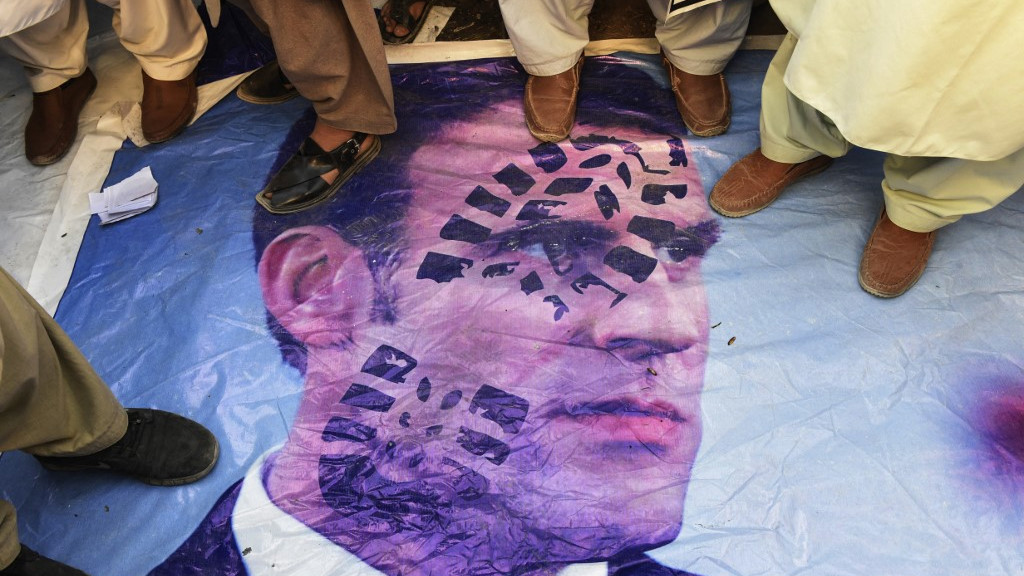
Muslim demonstrators
stand over a poster of French President Emmanuel Macron in Quetta, Pakistan, in
October 2020 (AFP)
The
government carried out raids
targeting Muslim civil society, marking 231 people for deportation,
arresting dozens of others, and classifying more than 50 Muslim associations
for potential dissolution. Many French Muslims feared the government was
weaponising the killing to institute a government policy equating Islam with
terrorism.
One of the organisations French authorities identified for dissolution
was the Collective Against Islamophobia in France, an advocacy
organisation that documents hate crimes against Muslims. The group
had cited rising
anti-Muslim sentiment in France and found that in 2019, there were nearly 800
anti-Muslim acts, a 77 percent increase in two years.
Yet, French Interior Minister Gerald Darmanin, with no
proof, called the
organisation “an enemy of the republic”. The government shut down at
least 73 mosques and Islamic schools in 2020. President Emmanuel Macron,
like right-wing candidates Marine Le Pen and Eric Zemmour, campaigned for an
“Islamist separatism” law, saying government
measures were needed to fight “political Islam”.
Criminalising
political Islam
Similar to Macron’s crackdown on Muslim civil society, in the
early morning of 9 November 2020, Austrian forces raided the houses of
around 70 Muslim
community leaders and academics across the country on suspicion
of organising terrorism and money laundering. Involving more than 900 police
officers, special agents and other officials, Operation Luxor,
named after an ancient city in Egypt,
was the largest coordinated police raid in Austria since the Second World
War.
Farid Hafez,
an Austrian scholar, expert on Islamophobia and senior researcher for
Georgetown University’s Bridge Initiative, and his family were among the
victims.
Chancellor Sebastian Kurz then announced on 11 November 2020 a
proposed law to make “political Islam” a criminal offence. Austrian authorities
said the raid targeted people with alleged links to the Muslim Brotherhood and
Hamas. Despite this allegation, not a single person was charged.
The
Chinese government has further entrenched Islamophobia by spreading false
information about its treatment of Uyghurs
In addition to the trauma of the raid, those arrested had their
assets and bank accounts frozen, affecting their ability to pay rent and legal
fees.
According to
Helmut Krieger, a political scientist at the University of Vienna, Operation
Luxor “was intended as a means to criminalise the politically active Muslims in
Austria under the label of political Islam. How the Austrian state understands
political Islam is deeply influenced by the understanding of it by Egypt,
the United Arab
Emirates and Israel.”
Yet, perhaps no state is as organised and systematic in its
oppression of Muslims on the basis of their ethnicity and faith than China. It
has imprisoned Uyghurs in what some would call concentration camps, alongside
increased and enhanced surveillance of their homes, mosques and daily life. The
state has also used social media in an attempt to combat reports of Uyghur
abuse.
In response to being accused of genocide, the state
strategically launched a disinformation campaign. Hiring social media influencers
and content creators, the Chinese government has further entrenched
Islamophobia by spreading false information about its treatment of Uyghurs. The
greatest tool at China’s disposal in this information war is its ownership of
the rapidly growing and incredibly popular app, TikTok.
Dispossessing
Muslims
The situation in Myanmar most closely resembles that of China.
Where China targets Uyghurs, a predominantly Muslim ethnic group, the political
elite in Myanmar targets the Muslim ethnic Rohingya.
Similar to India, where state representatives rely on the
support of Hindu religious extremists, security forces in Myanmar depend on the
support of Buddhists led by extremist monks.
The most obvious manifestation of Islamophobia in Myanmar has
been the systemic genocide of the Rohingya. In recent years, the torture of
Rohingya Muslims has been thoroughly documented and reported by major human
rights groups and the media.
Much as in India, government repression includes dispossessing
Muslims from their own lands, and legally recognising the “property ownership”
of settlers who have claimed Rohingya homes.

Repression and
fear: Life as a hijabi Muslim in Modi's India
In India, Islamophobia is arguably rapidly approaching a climax
in the country’s 75-year history. Startling examples of Islamophobia can be
found in legislative, educational, professional and private spaces.
Many Muslims are finding classrooms to be hostile spaces. In one
instance, a professor alleged referred to his Muslim student as a terrorist.
Muslim women have also been banned from wearing the hijab on school
property.
Unfortunately, it is not only the classroom where Muslim women
are unsafe in India. Shocking the global community, in August 2022, the state
freed 11 men convicted of gang-raping a Muslim woman in 2002 on the basis of
her faith. Their release was further evidence of the Modi government’s
increasingly anti-Muslim
orientation and policies.
State-sanctioned violence and repression includes bulldozing
properties owned by Muslims. In a move strikingly similar to Israeli army
policies, Muslims have reported arriving home to find Indian state officials
with papers permitting them to destroy their homes or property.
The Modi government has used the term “love jihad” as an excuse
to surveil Muslim men and promote Islamophobic narratives about them, with men
accused of trying to increase their numbers by tempting Hindu women away from
Hindu men.
Finally, many Muslims in India report facing intense
discrimination when seeking employment, alongside a rise in explicitly
anti-Muslim music featuring hateful lyrics. And on social media, as
journalist Alishan Jafri recently
noted, for many young Indian Muslims, their feeds have begun “looking like a
visitors’ diary outside a busy graveyard”.
Authoritarian
regimes
At the same time, governments and regimes in many Muslim
countries - such as Egypt, Syria,
the UAE, Saudi Arabia, Bahrain,
Algeria and Tunisia -
have practiced their own brand of Islamophobia. They have stoked fears of a
global Islamic threat at home and abroad.
Authoritarian rulers across the region have consistently and
deliberately failed to distinguish between terrorist groups and mainstream
Islamic organisations, political parties, social welfare agencies and human
rights groups.
Egypt legitimised its military coup,
slaughter, imprisonment and torture of tens of thousands of members or
supporters of the Muslim Brotherhood, along with mass trials and death
sentences, on the grounds that they were Muslim terrorists.

Police stand guard as
Egyptians react from behind the defendant’s cage during their trial in May 2014
(AFP)
President
Abdel Fattah al-Sisi has used his appointed religious leaders and their
institutions to advocate an “Islamic reformation” to review and presumably
discard centuries-old Islamic traditions, as evidence of Sisi’s own
anti-Islamist credentials.
The UAE and Saudi Arabia, major supporters of the coup that
deposed Egypt’s democratically elected president, subscribe to the same mantra.
All three cite in particular the Muslim Brotherhood, openly warning western
governments about a global threat from the Brotherhood not only in the Muslim
world, but also in the West, aiming to immunise themselves from criticism for
their own human rights records.
“Arab regimes spend millions of dollars on think tanks, academic
institutions, and lobbying firms in part to shape the thinking in western
capitals about domestic political activists opposed to their rule, many of whom
happen to be religious,” noted Ola Salem and Hassan Hassan in a 2019 Foreign
Policy article.
Arabs as the
'enemy'
Islamophobia in Israel/Palestine is
one of the least-covered examples. Jewish Voice for Peace (JVP) has succinctly
underscored its importance in Israeli politics, and its devastating impact on
portraying Muslims and Arabs as the “enemy” and denying their fundamental
rights.
Here is an important and relevant excerpt from
a fact sheet produced by JVP: “Islamophobia plays a key role in building and
sustaining public and U.S. government backing for Israel. Right-wing Christian
and Jewish groups dedicated to denying the fundamental rights of Palestinians
deliberately fuel fear of Muslims and Arabs (commonly assumed to be Muslims) to
push their agenda in the Middle East. Unwavering support of Israeli policies
contributes to the characterisation of Muslims and all Arabs as the ‘enemy’ and
to the perpetuation of Islamophobia, or the failure to speak out against it.
Rather
than focusing on wealth and competition, leaders need to foster a deep sense of
our political and religious pluralism and interdependency
“A money-Islamophobia-Israel network - bound by ideology, money,
and overlapping institutional affiliations - both furthers a rabidly
anti-Muslim climate in this country and helps bolster the state-sponsored
Islamophobic and anti-Palestinian policies adopted and promoted by the U.S.
government …
"An impetus for the view that Muslims are enemies of Israel
and ‘the West’ came from the introduction in 1990 and the subsequent
popularization of the term ‘clash of civilizations’: the idea that ‘Western
civilization’ is locked in an implacable battle with Islam resulting from fundamental
cultural differences, not history, politics, imperialism, neocolonialism,
struggles over natural resources, or other factors.
“The virulently anti-Muslim 'clash of civilizations' concept
views more than a billion Muslims as belonging to a monolithic, insular,
inherently backward, violent, and inferior culture that cannot be changed. It
provides an ideological foundation for both the ‘war on terror’ and the
militantly pro-Israel belief that ‘the West’ must back Israel, because of ‘fear
of large Muslim minorities - unassimilated and unassimilable’.
A new narrative
Despite their rhetorical commitments to democracy and human
rights, the US and EU have consistently sided with authoritarian
regimes. What former US President George W Bush called “democratic
exceptionalism” was ironically used to justify the invasion and occupation of
Iraq, all in the name of bringing democracy to Iraq and the Arab world, while
also supporting the status quo of authoritarian allies.
They have vacillated between using “democracy” as a political
and diplomatic tool against some Arab powers, and using regional violence,
terrorism and instability as a justification for deeper relations with
authoritarian regimes, such as Egypt, Saudi Arabia, the UAE and Bahrain.
In Egypt, the US and EU equivocated and ultimately accepted the
military coup that deposed the first democratically elected president, Mohamed Morsi,
and more recently, the coup in Tunisia.

How
Islamophobia has entered a new phase - using these 10 strategies
The US, Europe and the international community must not only
construct a new narrative that emphasises self-determination, government
accountability, rule of law and human rights, upon which political actions and
policies are based - but they must also act on that narrative. This is
something that no administration, including the Biden government in the US, has
been willing to do.
This reinforces anti-westernism and the mantra of militant
extremists that neither Arab regimes nor their western allies will “allow”
democratisation - and this mantra can fuel radicalisation and recruitment by
terrorist organisations.
Today, we live in a globally interconnected world through the
internet, travel, global corporations and various religions. Christians,
Muslims, Jews, Hindus and Buddhists are not only “over there” in foreign
countries, but also right here in the West.
This interconnected world, illustrated by the Covid-19 crisis,
demonstrates our 21st-century reality. If some of us are not okay, all of
us are not okay. Human rights are not just about “us”, but about global rights
for all.
We should move in our thinking and behaviour beyond simply
considering “my” religion, “my” ethnic group or “my” country, to fostering a
deep awareness of our shared planet and interdependency. Rather than focusing
on wealth and competition, leaders need to foster a deep sense of our political
and religious pluralism and interdependency, and lead us to work towards wider
goals, encompassing our planet’s common good. Among our seven billion beings,
we all have a role to play.


No comments:
Post a Comment