Who was Tipu Sultan
by
Ravi Visvesvaraya Sharada Prasad
============
Indian history is getting hijacked by Hindutvadi fascists distorting facts and figures. Nothing is immune to these extremists who want to rewrite history and force their garbage through the mouth of anyone interested in swallowing it. As Mr. Prasad shows below, they even tried to distort history about Tipu Sultan; simply because the latter was a Muslim Sultan who fought against marauding Marathas, who happened to be Hindus. Maratha hoodlums and terrorists are now celebrated as real heroes while the true ones that fought against colonization are not only forgotten but are often times maligned. Read the story below.
======
THE blatantly false propaganda being spread by the Hindutva Sangha Parivar over Tipu Sultan is reaching outlandish proportions.
A Hindutva troll is trying to teach me my own family history with regard to Tipu Sultan’s patronage of Hindu temples. She has been posting all kinds of nonsense on my timeline, disputing what I know about my own ancestors, and I have blocked her.
Almost all the wars in medieval Deccan India were over territory, power, riches, gold. Almost none were over religion.
Every Muslim king had Hindu ministers and Hindu generals.
Every Hindu king had Muslim generals and Muslim ministers.
Temples were looted because that is where gold and diamonds were kept. Many Hindu kings looted Hindu temples in the lands they conquered, such as the Hindu Marathas looting my family shrine of Sringeri Shree Sharada Peetham in 1791 AD.
In 1759 AD, a military force of the Marathas occupied Tirupati, and took over its revenue stream. The Marathas withdrew from Tirupati only after several years, when a contingent of the East India Company approached.
Indian history is far more complex and nuanced than the simplistic version being propagated by the Hindutva Sangha Parivar of ‘Cruel Muslims massacring and raping innocent Hindus and destroying their temples’.
My father’s family served in very senior positions in Tipu Sultans court.
Several of the Shankaracharyas of Sringeri have come from my father’s family.
In 1791 AD, the Hindu Marathas, led by Raghunath Rao Patwardhan, looted our family shrine of Sringeri Shree Sharada Peetham, and killed several priests. Ironically, the Marathas were worshippers of Shiva.
Tipu Sultan sent his army to expel the Maratha invaders, and helped rebuild the shrines at Sringeri Shree Sharada Peetham.
Tipu Sultan also gave several expensive gifts to the Sreekantha temple at Nanjangud, where my father’s family members were priests.
This Hindutva troll disputed all these on my timeline, saying that this was false propaganda spread by ‘sickulars’.
True that Tipu Sultan carried out brutal military conquests of Coorg, Mangalore, North Karnataka, Kerala, etc, with cruel massacres.
True that Tipu Sultan tortured the Catholics of Mangalore. But that was because he suspected them of siding with the British.
But within his own kingdom of Mysore, Tipu Sultan was revered as a just, benevolent, enlightened, and SECULAR king who ushered in an era of prosperity, and introduced modern agriculture, technology, and administration.
True that Tipu massacred Christians and Hindus in his invasions of Kerala. Has anyone noted how many Kerala Muslims too were massacred by Tipu during his invasions of Kerala?
A more telling example from my maternal family’s history of the Vijayanagaram empire.
My maternal family were the Tatacharyas, who were the hereditary ministers in the court of the Vijayanagaram Empire. They were mostly massacred after the battle of Talikota in 1565 AD, when Vijayanagaram was conquered by an alliance of the kingdoms of Bahmani, Bidar, Berar, Bijapur, Golconda, Ahmednagar, all of which were ruled by Muslim dynasties.
But after 450 years, I am objective enough not to claim that my maternal family was massacred by Muslims.
Although the Bahmani, Bidar, Berar, Bijapur, Golconda, Ahmednagar kingdoms were all ruled by Muslim dynasties, all their armies were led by Hindu generals, and they all had Hindu dewans and Hindu ministers. The Ghorpades and Sardesais fought on behalf of the Sultanate alliance.
And while the Vijayanagaram emperors were devout Hindus, they had Muslim generals and Muslim administrators in senior positions. Rama Raya always kept a copy of the Holy Quran with him.
The commander in chief of the Golconda army was a Maratha Brahmin, Murahari Rao. He personally looted the temple at Ahobilam in 1579 AD.
In fact, Tipu Sultan massacred several hundred members of my mother’s Shri Vaishnava Iyengar family, the Tatacharyas.
But even though my own maternal relatives were killed by Tipu, I do not claim that this was because of religion; it was brutal realpolitik.
The Wodeyar queen, Lakshmammanni, had hated Haider Ali and Tipu Sultan, and she made numerous attempts to overthrow them.
Her principal advisors were Thirumalai Rao and his brother Narayana Rao. They were from my mother’s Shri Vaishnava Iyengar family, the Tatacharyas. They derived their authority from their being the direct descendants of the Rajgurus of the Vijayanagaram emperors.
Thirumalai Rao and Narayana Rao were senior officials in the finance ministry and the posts ministry under the Wodeyars. After Haider Ali seized power, they continued to work for a few years in his regime, but then they migrated to the Maratha Court at Thanjavur, where they became ministers.
The Wodeyar queen Lakshmammanni asked Thirumalai Rao and Narayana Rao to organise a coup to overthrow Tipu Sultan. She promised to make Thirumalai Rao her Dewan, and offered him ten percent of the revenues of her Kingdom.
Several hundred Iyengar Brahmins held middle to senior positions in Tipu Sultan’s administration, and Thirumalai Rao and Narayana Rao sent instructions to his fellow kinsmen to overthrow Tipu Sultan.
However, the biggest mistake that Queen Lakshmammanni made was to involve the British in her efforts to overthrow Tipu Sultan.
As the British forces encouraged by the Wodeyar Queen Lakshmammanni closed in, a furious Tipu Sultan arrested all the seven hundred Iyengars in Mandyam and Melkote, and had them brutally put to death in Srirangapatnam.
Even though it was my own maternal relatives who were massacred by Tipu Sultan, I do not view it as Muslims massacring Brahmins. They were trying to overthrow Tipu Sultan in order to restore the Wodeyar rule, in collaboration with the British.
True that Aurangzeb beheaded the revered Sikh Guru Tegh Bahadur when Guru Tegh Bahadur protested against Aurangzeb’s cruel treatment of Kashmiris.
But how many recall that a few years earlier, the very same Guru Tegh Bahadur was the advisor and chief military strategist of Aurangzeb’s military campaign to conquer Assam, with Aurangzeb’s army being led by the Rajput king Raja Ram Singh? Guru Tegh Bahadur personally led Aurangzeb’s troops in the battle against the Ahoms, and negotiated the peace treaty afterwards.
In fact, 148 of Aurangzeb’s top military generals were Hindus.
Jaswant Singh, Jaya Singh, Raja Rajrup, Kabir Singh, Arghanath Singh, Prem Dev Singh, Dilip Roy, Rasik Lal Crory, Raja Vim Singh, Indra Singh, Achalaji, Arjuji were some of Aurangzeb’s top ministers, advisors, and generals.
True that Aurangzeb demolished many Hindu Temples. But Aurangzeb also built a Balaji temple near Chitrakoot. Aurangzeb is also supposed to have given gifts to the Krishna temple at Nathdwara.
In fact, even in the battles between Shivaji and Aurangzeb, many Maratha chieftains fought on the side of Aurangzeb.
Indian history is much more complex and nuanced than the simplistic version being propagated by the Hindutva Sangha Parivar of ‘Evil Muslims massacring and raping innocent Hindus and destroying Hindu temples’.
In fact, in the Vijayanagaram empire, emperor Krishna Deva Raya’s army looted temples when they conquered Udayagiri and Pandharpur, and brought back the temple loot to be displayed at Hampi.
Krishna Deva Raya’s army carried out massacres in the territories they conquered. My direct maternal ancestor, Thirumalai Tatacharya, was Krishna Deva Raya’s Rajguru and principal minister.
The Cholas had destroyed the Chera empire temples at Thiruvanchikulam, even though both were Shiva worshippers.
The Pandyas destroyed the Chola temples at Gangakondaicholapuram, even though both were worshippers of Shiva.
The Rashtrakutas had destroyed the temples of the Pratiharas.
The attempts today by illiterate fanatics to rewrite history and whip up communal sentiments has to be resisted and countered by facts.
A large part of the stereotype of Tipu Sultan as a persecutor of Hindus and Christians comes from an influential text book written in the 1920s by professor Harprasad Shastri, professor and head of the department of Sanskrit at Calcutta University.
Unfortunately, Harprasad Shastri’s textbook was based entirely on hearsay, and not on any verification of facts from Mysore.
In fact, eminent historians from the University of Mysore, and the editors of the Mysore Gazetteer had pointed out the falsehoods in the textbook written by Harprasad Shastri in the 1930s itself.
Brijendra Nath Seal had his suspicions about Shastri’s book, and ordered an inquiry. Ashutosh Mukherjee had Shastri’s textbook withdrawn from Calcutta University.
However both Allahabad University and Benares Hindu University prescribed Shastri’s book as a textbook.
In one of his books, the eminent historian BN Pande (long time member of parliament and governor of Odisha) spent several pages pointing out the falsehoods in Harprasad Shastri’s textbook. Shastri had mentioned numerous references. He confessed to Pande that he had not actually read any of the sources which he had cited as references in his textbook.
But generations of students have grown up on Harprasad Shastri’s textbook.
Monday, October 30, 2017


Sunday, October 29, 2017
Savitri Devi: The mystical fascist being resurrected by the alt-right
Savitri Devi, a mystical admirer of Hitler and a cat-loving devotee of the Aryan myth, seemed destined to fade into obscurity after her death 25 years ago. But thanks to the rise of the extreme right, her name and her image now crop up online more and more, writes Maria Margaronis.
In 2012, browsing the website of Greece's Golden Dawn party for an article I was writing, I stumbled on a picture of a woman in a blue silk sari gazing at a bust of Hitler against a blazing sunset sky. What was this apparently Hindu woman doing on the site of an openly racist party devoted to expelling all foreigners from Greece? I filed her as a curiosity at the back of my mind, until the rising tide of extreme-right politics in Europe and America threw up the name "Savitri Devi" once again.
It isn't hard these days to find discussions of Savitri Devi's books on neo-Nazi web forums, especially The Lightning and the Sun, which expounds the theory that Hitler was an avatar - an incarnation - of the Hindu god Vishnu, and Gold in the Furnace, which urges true believers to trust that National Socialism will rise again. The American extreme-right website Counter-Currents hosts an extensive online archive of her life and work.
Her views are reaching a wider public audience, too, thanks to American alt-right leaders such as Richard Spencer and Steve Bannon, former Trump chief strategist and chair of Breitbart News, who have taken up her account of history as a cyclical battle between good and evil — a theory she shared with other 20th Century mystical fascists.

Who was Savitri Devi, and why are her ideas being resurrected now? Despite the sari and the name she was a European, born Maximiani Portas to an English mother and Greek-Italian father in Lyon in 1905.
From an early age, she despised all forms of egalitarianism. "A beautiful girl is not equal to an ugly girl," she told an interviewer sent by the Holocaust denier Ernst Zundel in 1978.
Swept up by Greek nationalism, she arrived in Athens in 1923 at the same time as thousands of refugees displaced after Greece's disastrous military campaign in Asia Minor at the end of World War One.
She blamed the Western allies for Greece's humiliation, and for what she saw as the unjustly punitive terms imposed on Germany by the Treaty of Versailles. In Savitri's mind, Greece and Germany were both victims, denied the legitimate aspiration of uniting all their people in one territory. That view, combined with a passionate anti-Semitism which she claimed she learned from the Bible, led her to identify herself early on as a National Socialist.
Hitler was Germany's champion but, she said, his desire to eradicate Europe's Jews and restore the "Aryan race" to its rightful position of power made him her "Fuhrer" too.

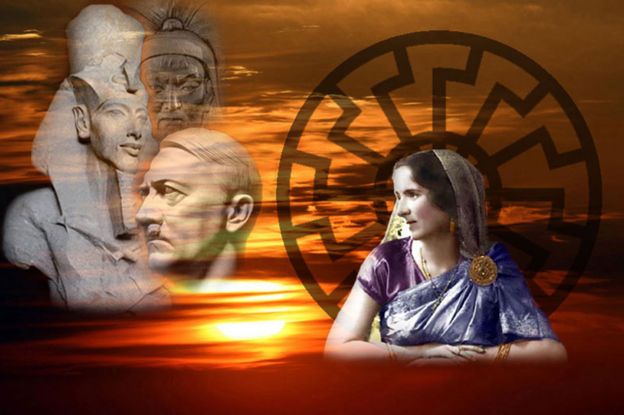
So unusual was the sight of a European woman travelling fourth class by train that she was placed under surveillance by the British colonial authorities. But Savitri had little to do with the British in India until World War Two, when she passed information she gleaned from them to the Japanese. She learned Indian languages, married a Brahmin (whom she believed to be an Aryan like herself), and forged an elaborate synthesis of Nazism and Hindu myth, in which Hitler was a "man against time" destined to bring about the end of the Kali Yuga and usher in a new golden age of Aryan supremacy.
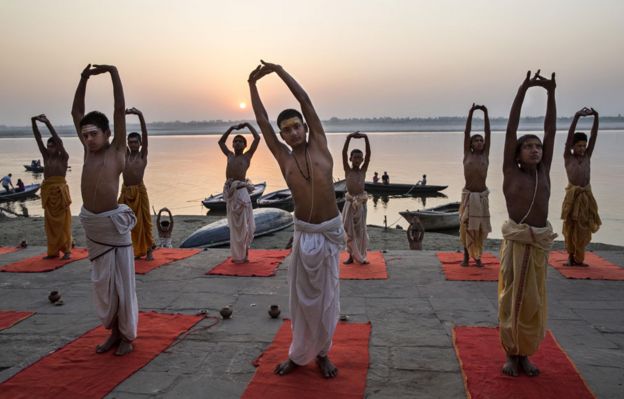
Savitri offered her services to the Mission's director, Swami Satyananda, who (like many Indians before independence) shared her admiration for Hitler and allowed her to mix Nazi propaganda with her talks on Hindu identity. She travelled the country lecturing in Hindi and Bengali, salting her talks about Aryan values with quotations from Mein Kampf.
In 1945, devastated by the fall of the Third Reich, she returned to Europe to work for its restoration. Her arrival in England is described in her book Long-Whiskers and the Two-Legged Goddess, a children's fable whose heroine is a cat-loving Nazi like herself.
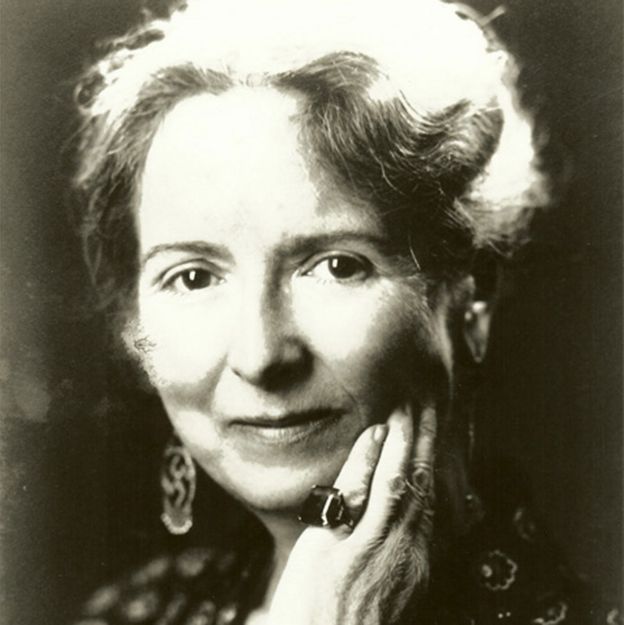
Savitri was always clear that she preferred animals to humans. Like Hitler, she was a vegetarian. She viewed the world as if from a great distance, caring more for what she saw as the deep patterns of nature than for human lives. Visiting Iceland, she spent two nights on the slopes of Mount Hekla as it erupted. "The original sound of creation is 'Aum'," she wrote. "The volcano says every two or three seconds, 'AUM! AUM! AUM!' And the Earth is trembling under your feet all the time."
In 1948, Savitri managed to enter occupied Germany, where she distributed thousands of pro-Nazi leaflets, bearing the words: "One day we shall rise and triumph again! Hope and wait! Heil Hitler!"
She said years later that she was glad to be arrested by the British occupation authorities because it brought her closer to her jailed Nazi "comrades". During her imprisonment, which was cut short by her husband's intervention through the Indian government, she grew close to a former Belsen wardress condemned as a war criminal, "a beautiful-looking woman, a blonde of about my age." Savitri's sexuality has been the subject of some speculation. Her marriage to Asit Mukherjee was allegedly celibate because they were not of the same caste; the Nazi financier Francoise Dior, niece of the fashion designer, claimed to have been her lover.
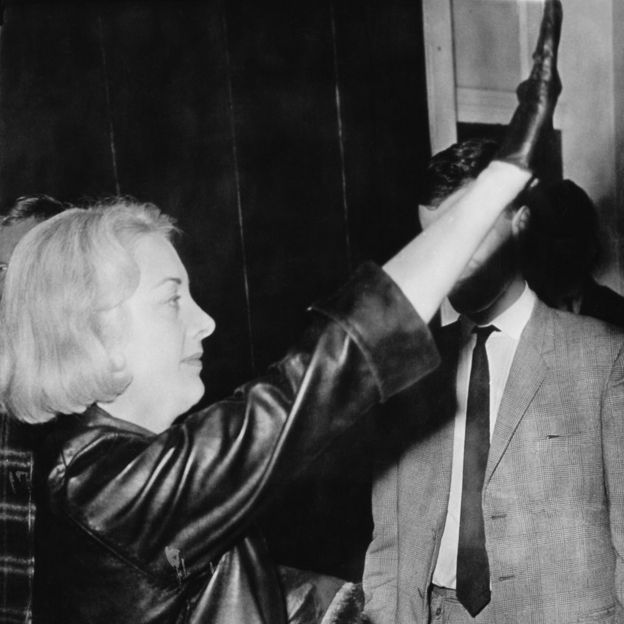
She died at a friend's house in England in 1982. Her ashes were laid to rest with full fascist honours, purportedly next to those of American Nazi leader George Lincoln Rockwell.
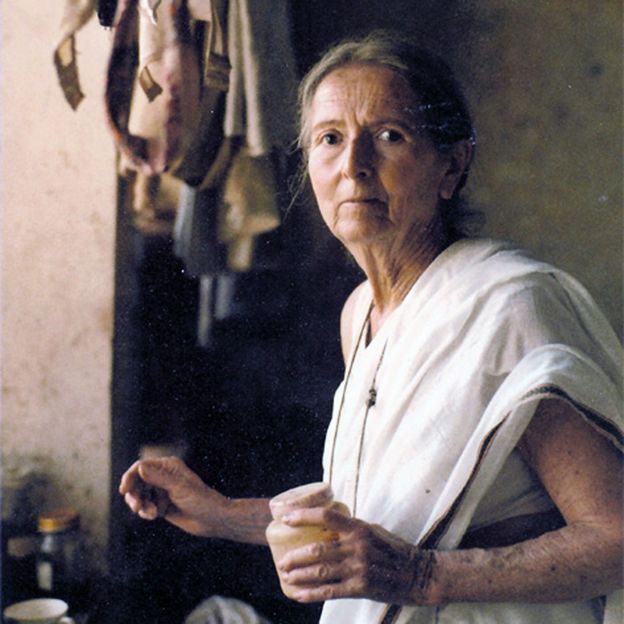
"In her book A Warning to the Hindus, which came out in 1939, she advised the Hindus to cultivate a 'spirit of organised resistance throughout Hindudom,'" he says. "The targets of this resistance were the Muslims, who were a threat, according to her, to the Hindus. And this is the same fear that is being echoed today."
Hindutva is the official ideology of Prime Minster Narendra Modi's ruling Bharatiya Janata Party, which claims that Muslims and secularists have undermined the strength of the Hindu nation. Though the party's official spokesmen condemn violence, the riots that led to the tearing down of the Babri Mosque at Ayodhya in 1992 and the current waves of attacks - sometimes fatal - by vigilante groups on Muslims and dissenters tell a different story.
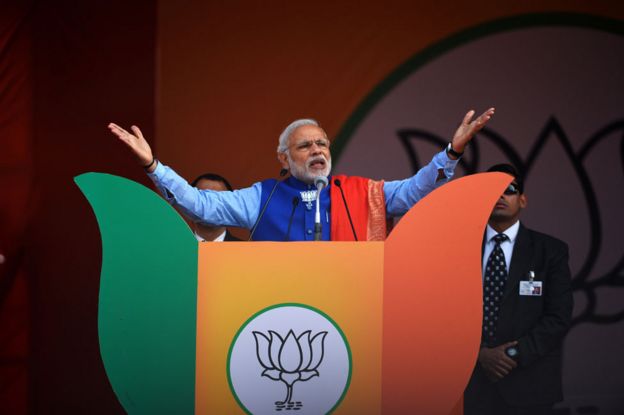
And as in India, the traditional ruling majority's fear of losing power has been an effective recruiting tool.
"Since the middle of the Obama administration the single most important factor in the minds of people who joined the Tea Party was the idea that white people were being shoved aside," says researcher and writer Chip Berlet. "The far right and organised white supremacist groups have both been buoyed up by fear among many white citizens in the United States that they're being displaced and humiliated."
Savitri Devi's work forms part of the history of both India's Hindu nationalists and the European and American extreme right. Her flamboyant, eccentric writings contain - unvarnished and uncensored - all their key ideas: that human beings can be divided into "races" which should be kept separate; that certain groups are superior to and more entitled than others; that these groups are under threat; and that the dark times in which we live will only end when they again take power, returning us to a mythical golden age.
President Trump: heed the plight of the Rohingya
Murat Guzel lives and works in Pennsylvania. He is the founder and CEO of Natural Food Group, a multinational organics food and beverage company. The Washington Examiner posted his plea to President Trump, which I post below.
----------
Malatya, the town where I was born, hosts one of the 25 refugee camps across the plains of southeastern Turkey. With our NATO allies, the United States has helped provide 2,083 shipping containers in Malatya alone that serve as homes for 7,625 refugees. In the dusty summer heat and in the windy, rainy winter, they serve as shelter for men, women, and children who have escaped the Syrian conflict. A small commitment of our tax dollars early in a refugee crisis is an investment in the future.
According to NATO’s Euro-Atlantic Disaster Response Coordination Center, the Turkish government and private sector have diligently clothed, fed, and housed over 3.1 million people fleeing conflict. This makes Turkey the host country with the largest refugee population in the world.From Nov. 3 to 14, President Trump and the first lady will travel across Asia. While the itinerary is not fully set, according o the White House, U.S. goals include profiling the “longstanding United States alliances and partnerships, and reaffirm[ing] United States leadership in promoting a free and open Indo-Pacific region
On Sept. 7, the first lady of Turkey, Emine Erdogan, visited Bangladesh. Over the course of just the twelve prior days, the United Nations estimated that 146,000 Rohingya Muslim refugees had fled ethnic cleansing in Myanmar.
Entire communities being burnt to the ground are still visible by satellites in space. Women are being raped. Children are being killed. Men are being executed. Emine Erdogan took a risk in traveling to a conflict region and witnessed these horrors with her own eyes.
At the crossroads of difficult geopolitics with growing Indian and Chinese influence in the region, Bangladesh is the most densely populated country in the world. Roughly the size of my home state of Pennsylvania, Bangladesh has over 160 million citizens. Since the September visit of the Turkish first lady, this number has grown to include approximately 900,000 Rohingya refugees. As American taxpayers, in 2016 alone, we invested $211 million in this multiparty Muslim majority democratic country.
To date, the U.S. has primarily just offered critical statements not backed with clear action or comprehensive strategy. Secretary of State Rex Tillerson and U.N. Ambassador Nikki Haley have raised the prospect of punishing the Mynamar military. Vice President Mike Pence, a man of deep faith, has called the situation a “great tragedy” and a “heart-breaking assault on human rights.”
Bipartisan congressional leaders have taken notice of the worst ethnic cleansing of the 21st Century. On Sept. 28, 21 Republican and Democratic senators led by Sens. Ben Cardin, D-Md., and John McCain, R-Ariz., wrote an open letter to Tillerson requesting, among other points, that the U.S. re-evaluate our relationship with Myanmar. Democrats and Republicans in Congress and previous administrations have devoted significant time and resources to the U.S.-Bangladesh alliance. Knowing that early investment is the most cost effective, $95 million in taxpayer dollars for this tragedy are being committed.
In May, Trump visited Saudi Arabia to “deliver a message of friendship and hope” to the Muslim world. In his May speech, the president shared with the assembled heads of state from the Muslim world, “We in this room are the leaders of our peoples. They look to us for answers, and for action.”
I immigrated to Pennsylvania over three decades ago to pursue my education. While not a refugee, the realities behind leaving one's home, learning a new language, and embracing a new culture are difficult for many in Washington to grasp. Our first lady is an exception. Like many in Bangladesh, Melania Trump was born in a country that no longer exists. At age 21, the country she knew, Yugoslavia, became embroiled in bloody conflict. While Slovenia emerged after just a few days, practically unscathed and with minimal fighting, it did play a similar critical role in subsequent years absorbing refugees fleeing conflict in Croatia and Bosnia.
As the itinerary is still being finalized, I hope our first lady visits with the Rohingya refugees in Bangladesh, just as the first lady of Turkey has done. Mrs. Trump would not only visit a Muslim-majority state led by a female leader, but also, as her husband stated so eloquently in Saudi Arabia, she would “look back at their faces, behind every pair of eyes is a soul that yearns for justice.” American leadership ended the war in the former Yugoslavia and, so too, American leadership and values can bring justice to the Rohingya people.
Rohingya children: Raped, kidnapped, orphaned
The plight of the Rohingyas forced to flee the atrocities committed by militants and the army in Myanmar is hard to stomach. The most vulnerable are children, as John Owens' photo series shows.


Rohingya girls under 10 raped while fleeing Myanmar, MSF says
Médecins Sans Frontières (MSF) says more than half the girls it has treated after sexual assaults are under 18.
Rohingya children, some of them under 10 years old, are receiving treatment for rape in camps on the Bangladesh border, according to medics who say that young refugees account for half of those sexually assaulted while fleeing violence in Myanmar.
Médecins Sans Frontières says dozens of Rohingya girls have been given medical and psychological support at its Kutupalong health facility’s sexual and reproductive health unit – a specialist clinic for survivors of sexual assault based in the largest refugee camp in Cox’s Bazar.
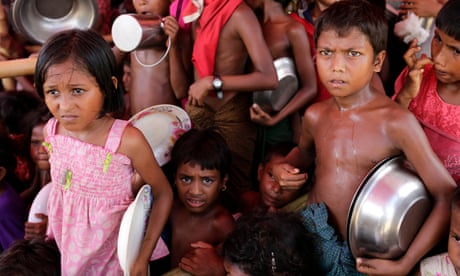 The organisation stressed this was just a fraction of those believed to have been sexually assaulted and raped since military operations began on 25 August, as most survivors faced practical and cultural barriers to accessing treatment.
“Women and girls often don’t seek medical care for sexual violence due to the stigma, shame and fear of being blamed for what’s happened to them,” said Aerlyn Pfeil, an MSF midwife focusing on support for survivors of sexual and gender-based violence (SGBV) in Cox’s Bazar.
In the last week a nine-year-old girl was among the new arrivals who received medical treatment after being raped, as military violence against Rohingya Muslims in Rakhine continues.
“A lot of them are just 12 or 13 years old,” she said.
One recent case she dealt with involved a child under 10 with severe bleeding who had been raped by three soldiers, she said.
Her account backs the stories of numerous refugees who describe similar incidents of mass rape, with many saying some victims were subsequently killed.
After speaking to psychological experts in the camps who warned such interviews could increase trauma for victims, the Guardian did not seek to speak directly to child rape survivors.
“The military put all the male people to one side and took all the female people into the jungle,” she said, adding that the soldiers then selected some girls and women.
“I cried when they took away my little sister, but I couldn’t stop them.
“They tortured and raped many girls and women. When they stopped and left I went looking for my sister and saw many bodies on the ground. When I found my sister I didn’t know if she was alive or dead, but she was breathing.
“She was bleeding a lot so I carried her to a little river and washed her. Then I took her on my shoulders till I found a small medical clinic [in Rakhine] and got some medicine for her.”
The woman said her sister had later told her she had been raped by two soldiers and by one of the ethnic Rakhine Buddhist civilians who had been involved in the attack on their village.
Médecins Sans Frontières says dozens of Rohingya girls have been given medical and psychological support at its Kutupalong health facility’s sexual and reproductive health unit – a specialist clinic for survivors of sexual assault based in the largest refugee camp in Cox’s Bazar.
Of those fleeing Rakhine state who come to the clinic for treatment relating to rape, “about 50% are aged 18 or under, including one girl who was nine years old and several others under the age of 10”, an MSF spokesperson said.
“Women and girls often don’t seek medical care for sexual violence due to the stigma, shame and fear of being blamed for what’s happened to them,” said Aerlyn Pfeil, an MSF midwife focusing on support for survivors of sexual and gender-based violence (SGBV) in Cox’s Bazar.
In the last week a nine-year-old girl was among the new arrivals who received medical treatment after being raped, as military violence against Rohingya Muslims in Rakhine continues.
Rohingya refugees have described incidents of gang rape and sexual assaults by the Myanmar army during military operations the UN has said amount to ethnic cleansing, but this is the first timeevidence of a large number of children being targeted has emerged.
According to another SGBV medical specialist working in the camps, who asked not to be named because of patient privacy, most cases she has dealt with involve the army gathering all the women and girls in a village in one place and picking “the most beautiful” to be taken away and raped, either by individual soldiers or groups.“A lot of them are just 12 or 13 years old,” she said.
One recent case she dealt with involved a child under 10 with severe bleeding who had been raped by three soldiers, she said.
Her account backs the stories of numerous refugees who describe similar incidents of mass rape, with many saying some victims were subsequently killed.
After speaking to psychological experts in the camps who warned such interviews could increase trauma for victims, the Guardian did not seek to speak directly to child rape survivors.
However, during an interview with a 27-year-old woman from the Buthidaung area of Rakhine, who said her husband and father were rounded up and killed by the Myanmar military shortly after 25 August, it emerged the woman’s 14-year-old sister had been raped during the attack.I cried when they took away my little sister, but I couldn’t stop them.
“The military put all the male people to one side and took all the female people into the jungle,” she said, adding that the soldiers then selected some girls and women.
“I cried when they took away my little sister, but I couldn’t stop them.
“They tortured and raped many girls and women. When they stopped and left I went looking for my sister and saw many bodies on the ground. When I found my sister I didn’t know if she was alive or dead, but she was breathing.
“She was bleeding a lot so I carried her to a little river and washed her. Then I took her on my shoulders till I found a small medical clinic [in Rakhine] and got some medicine for her.”
The woman said her sister had later told her she had been raped by two soldiers and by one of the ethnic Rakhine Buddhist civilians who had been involved in the attack on their village.
Interview of Dr Azeem Ibrahim on Rohingya
To view the video on interview of Dr Azeem Ibrahim, click here. He says: ‘The ambition of the army and the elite in Myanmar has always been to eliminate the Rohingya.’
Saturday, October 28, 2017
He Escaped Burma, But Not Australia’s Abusive Refugee Policy
He Escaped Burma, But Not Australia’s Abusive Refugee Policy
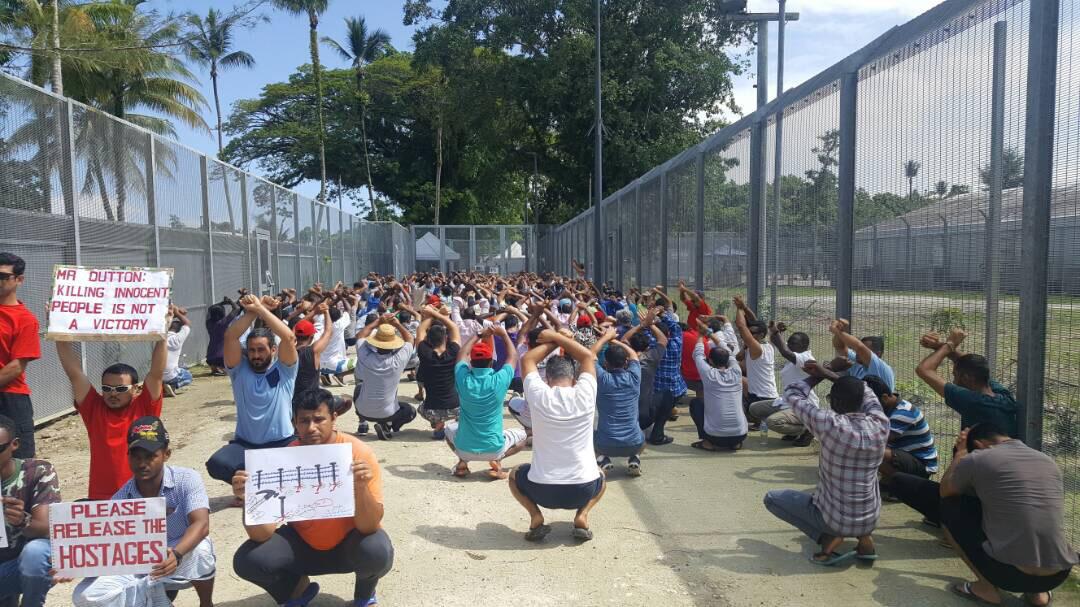
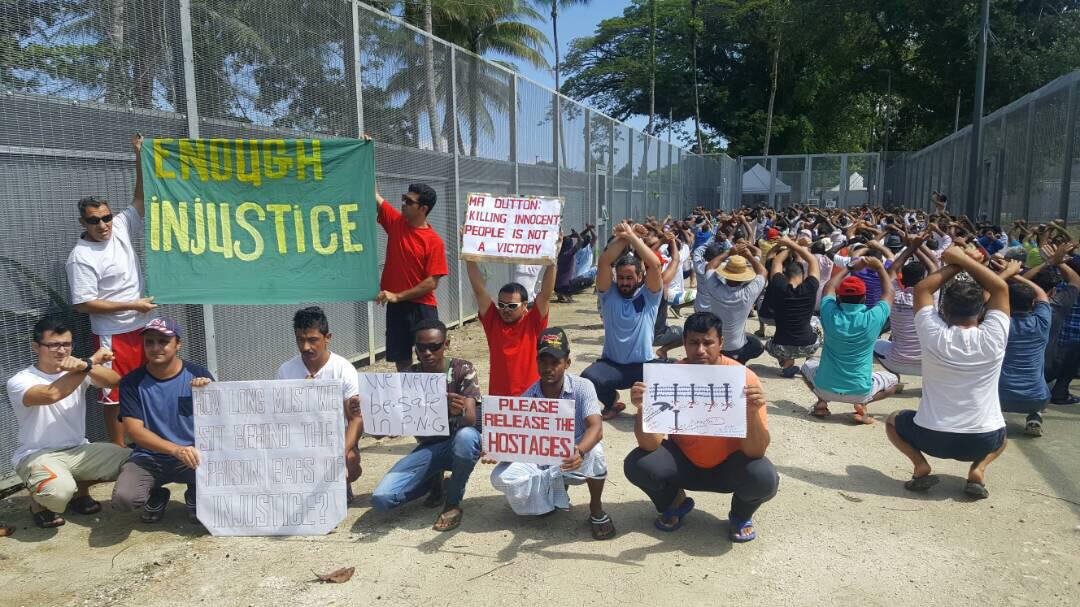 Refugees and asylum seekers protest against Australia’s offshore processing policy at a detention center on Manus Island, Papua New Guinea. © 2017 Private
Rohingya Refugee Has Spent 4 Years on Papua New Guinea’s Manus Island
Nazish Dholakia @nazishd
Media Desk OfficerRefugees and asylum seekers protest against Australia’s offshore processing policy at a detention center on Manus Island, Papua New Guinea. © 2017 PrivateNazish Dholakia @nazishd
Media Desk Officer
When the Burmese military appeared in “Faruk’s” home village in Rakhine State in 2013, his mother pleaded for him to leave. They are Rohingya Muslims, who have long been persecuted in Burma, and his mom feared for her 18-year-old son’s safety. She’d heard of Rohingya men who had been summarily executed when the military arranged “meetings” in their villages. Faruk fled.
He made the journey from Burma by boat to Thailand, to Malaysia, to Indonesia, and then to Australia’s Christmas Island. But when his boat reached Australian waters, Australian immigration officials questioned him and transferred him to a detention center on Manus Island in Papua New Guinea (PNG).
In the years since then, he’s been trapped on Manus Island. “In four years, I couldn’t find any way to live here,” said Faruk, now 23. “We’ve suffered a lot.”
Since July 2013, Australia has sent all asylum seekers who try to reach Australia by boat to cramped and dirty offshore processing centers on Manus Island and to the Pacific island nation of Nauru. Faruk arrived at Christmas Island a few days after the policy change. Now, he is one of 770 refugees, asylum seekers, and rejected asylum seekers, all men, stuck in PNG. Human Rights Watch recently interviewed 40 of them from Afghanistan, Bangladesh, Burma, Iran, Pakistan, Sri Lanka, and Sudan. All described their difficult lives on Manus, including being assaulted and robbed by local youths and not receiving proper medical care.
Returning to Burma is not an option for Faruk. The Burmese government does not recognize Rohingya, who have lived in the country for generations, as citizens, and refuses to take them back. Since August, more than half a million Rohingya have fled the countryafter the military opened a campaign of killing, rape, and arson against them that amount to crimes against humanity.
He learned that his family’s village was burned down in early September, and his family fled by boat to neighboring Bangladesh. His older sister, who was pregnant, delivered her baby an hour before getting on the boat. He replayed the WhatsApp voice message his mother sent him as they were leaving: “We don’t know when we’re going to die, please pray for us. Praise Allah, you are safe.” He said he could hear gunshots in the background.
“I felt hopeless … I am so glad that they are safe,” Faruk said, adding that they’ve asked him to name the baby.
He said it’s difficult for him to talk about his family, about everything that’s happening in Burma. “Since Rakhine happened, I used the internet for two, three days, and then I just switched it off. I had enough of seeing this,” he said.
Faruk spent his first two years on Manus Island at the main regional processing center, on an isolated part of the small island, before authorities pressured him to relocate to a transit center designated for refugees. He resisted the move because the residents of the transit center are often targets of assault or robbery by young Papuan men. But immigration officials just made life at the processing center more difficult: They cut off his phone and internet access at the main center, and stopped giving him “points,” which had enabled him to buy goods at the center’s canteen. Finally, he gave in and moved.
About two years ago, the Human Rights Watch Australia director, Elaine Pearson, first met Faruk at the transit center. At the time, he couldn’t eat or sleep, he said. He had terrible headaches and started taking sleeping tablets.
Pearson saw Faruk again this September. He was still living at the transit center.
 It is difficult for the refugees and asylum seekers on Manus to feel safe outside the main center and the transit center. Groups of local young men, sometimes armed with sticks, rocks, knives, or screwdrivers, have robbed them in town, including in broad daylight. Faruk said he has been attacked physically and verbally by the men, who have often thrown stones at him.
“It happened so many times, it’s not one time. So many, many times. Not only to me, to many, many other visitors,” Faruk said. In recent months, the attacks have escalated. Faruk says he rarely ventures into town anymore, for fear of being assaulted, and often doesn’t leave the confines of the transit center.
He told Pearson he suffers from anxiety and has collapsed a few times. His ankle was swollen from a recent collapse.
“I’ve become very weak and sick,” he said. “When I take sleeping tablets, I sleep long but I don’t know what to do, what to think, what to cook, what to eat, what to pray. I don’t feel good.”
In September, Faruk participated in a training course in PNG’s capital, Port Moresby, which he hoped would provide a brief respite from life on Manus and some useful skills. But he witnessed attacks even in Port Moresby. During the day, a raskol (criminal) gang came into the motel where he was staying and at gunpoint forced a Papuan man to hand over the keys to his car.
So Faruk waits. He hopes for asylum in the United States, which has agreed to take some Manus and Nauru refugees, and has completed the interview process. But Australia remains unwilling to admit any of the refugees on its offshore processing centers and yet insists that it will shut the main center on Manus by October 31, putting those evicted at greater risk. Rather than abandoning refugees like Faruk, it should admit and integrate these men, whom it has failed to protect.
Faruk said he doesn’t dream of buying a car or owning a house. He dreams of working part-time, and studying part-time.
“The simple life,” Faruk said. “Easy and simple life.”
In the years since then, he’s been trapped on Manus Island. “In four years, I couldn’t find any way to live here,” said Faruk, now 23. “We’ve suffered a lot.”
Since July 2013, Australia has sent all asylum seekers who try to reach Australia by boat to cramped and dirty offshore processing centers on Manus Island and to the Pacific island nation of Nauru. Faruk arrived at Christmas Island a few days after the policy change. Now, he is one of 770 refugees, asylum seekers, and rejected asylum seekers, all men, stuck in PNG. Human Rights Watch recently interviewed 40 of them from Afghanistan, Bangladesh, Burma, Iran, Pakistan, Sri Lanka, and Sudan. All described their difficult lives on Manus, including being assaulted and robbed by local youths and not receiving proper medical care.
Returning to Burma is not an option for Faruk. The Burmese government does not recognize Rohingya, who have lived in the country for generations, as citizens, and refuses to take them back. Since August, more than half a million Rohingya have fled the countryafter the military opened a campaign of killing, rape, and arson against them that amount to crimes against humanity.
He learned that his family’s village was burned down in early September, and his family fled by boat to neighboring Bangladesh. His older sister, who was pregnant, delivered her baby an hour before getting on the boat. He replayed the WhatsApp voice message his mother sent him as they were leaving: “We don’t know when we’re going to die, please pray for us. Praise Allah, you are safe.” He said he could hear gunshots in the background.
“I felt hopeless … I am so glad that they are safe,” Faruk said, adding that they’ve asked him to name the baby.
He said it’s difficult for him to talk about his family, about everything that’s happening in Burma. “Since Rakhine happened, I used the internet for two, three days, and then I just switched it off. I had enough of seeing this,” he said.
Faruk spent his first two years on Manus Island at the main regional processing center, on an isolated part of the small island, before authorities pressured him to relocate to a transit center designated for refugees. He resisted the move because the residents of the transit center are often targets of assault or robbery by young Papuan men. But immigration officials just made life at the processing center more difficult: They cut off his phone and internet access at the main center, and stopped giving him “points,” which had enabled him to buy goods at the center’s canteen. Finally, he gave in and moved.
About two years ago, the Human Rights Watch Australia director, Elaine Pearson, first met Faruk at the transit center. At the time, he couldn’t eat or sleep, he said. He had terrible headaches and started taking sleeping tablets.
Pearson saw Faruk again this September. He was still living at the transit center.
“It happened so many times, it’s not one time. So many, many times. Not only to me, to many, many other visitors,” Faruk said. In recent months, the attacks have escalated. Faruk says he rarely ventures into town anymore, for fear of being assaulted, and often doesn’t leave the confines of the transit center.
He told Pearson he suffers from anxiety and has collapsed a few times. His ankle was swollen from a recent collapse.
“I’ve become very weak and sick,” he said. “When I take sleeping tablets, I sleep long but I don’t know what to do, what to think, what to cook, what to eat, what to pray. I don’t feel good.”
In September, Faruk participated in a training course in PNG’s capital, Port Moresby, which he hoped would provide a brief respite from life on Manus and some useful skills. But he witnessed attacks even in Port Moresby. During the day, a raskol (criminal) gang came into the motel where he was staying and at gunpoint forced a Papuan man to hand over the keys to his car.
So Faruk waits. He hopes for asylum in the United States, which has agreed to take some Manus and Nauru refugees, and has completed the interview process. But Australia remains unwilling to admit any of the refugees on its offshore processing centers and yet insists that it will shut the main center on Manus by October 31, putting those evicted at greater risk. Rather than abandoning refugees like Faruk, it should admit and integrate these men, whom it has failed to protect.
Faruk said he doesn’t dream of buying a car or owning a house. He dreams of working part-time, and studying part-time.
“The simple life,” Faruk said. “Easy and simple life.”
DPRK’s little known secrets ensure sustainability of the Stalinist regime
In recent months, North
Korea has attracted much world attention due to its nuclear program threatening
its neighbors to the east and south. The official name of the country is
Democratic People’s Republic of Korea (DPRK), although it is neither democratic
nor a people’s republic.
The state is run by Kim Jong-un, a tyrant with a
Fred Flintstone haircut. He is effectively one of the last pure hereditary
absolute monarchs on the planet. He is the Marshal of the DPRK, the Great
Successor, and the Sun of the 21st Century. In his mid-30s, the Supreme Leader
owns the longest list of excessive honorifics anywhere, every one of them
unearned. He is the youngest head of state in the world and probably the most
spoiled.
Recently, US Defense Secretary Jim Mattis was in Seoul, South Korea where he said the
threat of nuclear missile attack by North Korea
is accelerating. With the South Korean defense minister Song Young-moo at his
side, Mattis accused the DPRK of illegal and unnecessary missile and nuclear
programs – and vowed to defeat any attack. Mattis said the North Korea engages
in “outlaw” behavior and that the US will never accept a nuclear North Kores. He
added that regardless of what the North Korea might try, it is overmatched
by the firepower and cohesiveness of the decades-old US-South Korean alliance.
Mattis has apparently forgotten the mere fact that the inferiority in
firepower has not always deterred someone from being in the offense.
North Korea, with mostly Buddhist/atheist population, considers its supreme
leader Kim Jong-un as "a great person born of heaven", a propaganda
term only his father and grandfather had enjoyed. With no belief in God and
accountability to Him, like his father and grandfather before him, the young
leader has proven to be a despot and a ruthless murderer who tolerates no
dissension. Kim has been brutally cracking
down on dissent since he rose to power in late 2011. He is the brutal warden to
more than 120,000 political prisoners, and has executed officials, and has
successfully reduced the annual number of defectors. To solidify his control, he
had his uncle, Jang Song Thaek, killed.
In 2014, a United Nations report concluded North
Korea's system of prisons constitutes a "crime against humanity."
Alexander Artamonov of
Pravda summarizes some little-known facts about North Korea, which are worth noting.
1. The North Korean
chronology begins from the birth of Kim Il Sung, not Jesus Christ (or any other
calendar). Today's North Korea lives in the Year 105, not 2017.
2. The first President of
North Korea, Kim Il Sung, as stated in his official biography, was born on a
volcano underneath a double rainbow, when a new star saw the light in the sky.
It is believed that the founder of the DPRK was a "god-like gift from
heaven" who learned to walk at a three-week age.
3. On December 24, the
DPRK celebrates the birthday of Kim Jong Il's mother, the previous North Korean
leader. They do not celebrate Christmas. Valentine's Day in North Korea is
known as the Generalissimo Day. It is celebrated on February 14 to honor the
day when Kim Jong-il received the title "Generalissimo" posthumously
in 2012.
4. North Korea still
practices public executions.
5. In the DPRK, people work
six days a week. During their only day off, the North Koreans
"volunteer" to work for the glory of their motherland, so that there
is virtually no such thing as weekend there.
6. A North Korean national
convicted of various crimes serves their sentence together with the whole
family ("three generations punishment"). If children are born during
this time, the next two generations are doomed to spend their whole life in
prison.
7. North Korean women have
not been allowed to ride a bicycle since 1996, since the skirt should always
cover their knees, and women are not allowed to wear trousers there.
8. North Koreans are
required to register their television sets with competent authorities. There
are three television channels available, and one is strictly prohibited to
watch something else.
9. One does not allow to
turn the government radio off even in one's own house. One can only turn the
volume down a bit. There are special units that track down those who listen to
forbidden radio programs, and this crime is punishable by death.
10. The DPRK spends about
30 percent of its budget on maintaining military power. By the mid-1990s,
hundreds of thousands of North Koreans had died of starvation.
11. North Koreans are
allowed to wear only short hairstyles. There are 28 types of haircuts approved
by the country's administration: 18 for women and 10 for men.
12. In the event of a
fire, the first thing to rescue from a burning home must be portraits of DPRK
leaders.
Despite such
tight controls, as many North Koreans go hungry citizens in this impoverished Stalinist state are believed to be getting more and more
angry about conditions they have been subjected to. Many young North Koreans
are reportedly suspected of
being hostile to the Kim dynasty and the authorities fear
they may lash out at symbols of the murderous regime. Orders have been handed down to increase
attention towards 'eternal life' towers (statues praising eternal President Kim
Il Sung), oil paintings, and wall murals located all over the country.
Lights are being used to illuminate statues
and paintings of the Kim family dynasty and patrols have been increased to
deter vandals.
In recent days, there have also been numerous reports of attempted coups and
assassination attempts in North Korea. But I doubt if such attempts would ever succeed
without outside help or manipulation. As we have seen in Buddhist Myanmar with
its murderous leaders – both military and civilian – ordinary citizens, having
lived under tyranny for generations, become too gullible and see their rulers
mostly as benign saviors – mini-Buddha like ‘heavenly’ personalities, and are
willing to believe in government propaganda no matter how untrue such are!
North Korea's nuclear program is exploited by the regime as
its best hope for maintaining power and evading its citizen’s basic needs. They
are continuously reminded how the supreme leader is protecting them from the
unfriendly world that they live in.
In such an environ, Kim’s countrymen are expected
to die, if required,
in the name of the government and the ideas that it follows - these are characteristic
features of the people living in the DPRK. The poor North Koreans! Will they
ever see a real change for the better?
Myanmar's ethnic clleansing of Rohingya population - in pictures
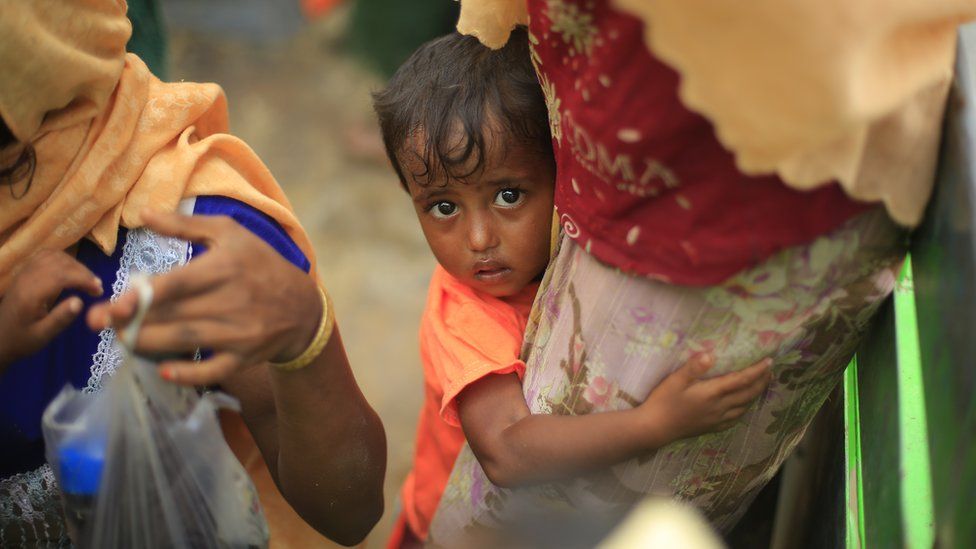
Confused and scared, two-year-old Hazera holds on to her mother after reaching Bangladesh from Myanmar
Myanmar's military has brutally evicted more than half a million Rohingya people from the country's northern Rakhine state. The UN human rights office says their homes and villages have been burned down, and their crops and livestock destroyed to stop them coming back.
Rohingya who fled to neighbouring Bangladesh say that the security services' "clearance operations" involved mass civilian killings, torture, and child rape.
The military denies committing genocide, insisting it has only targeted Rohingya militants. But for those who fear being homeless or worse, the semantics are immaterial.
Bangladesh's UN ambassador says more than 600,000 people have crossed the border since late August, joining the 300,000 or so who fled earlier outbreaks of violence.
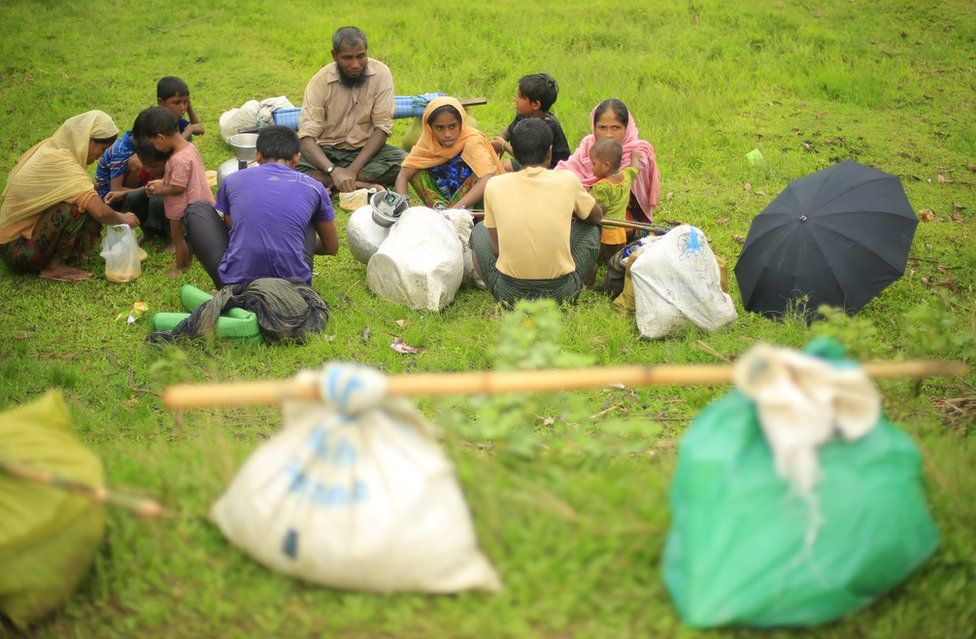
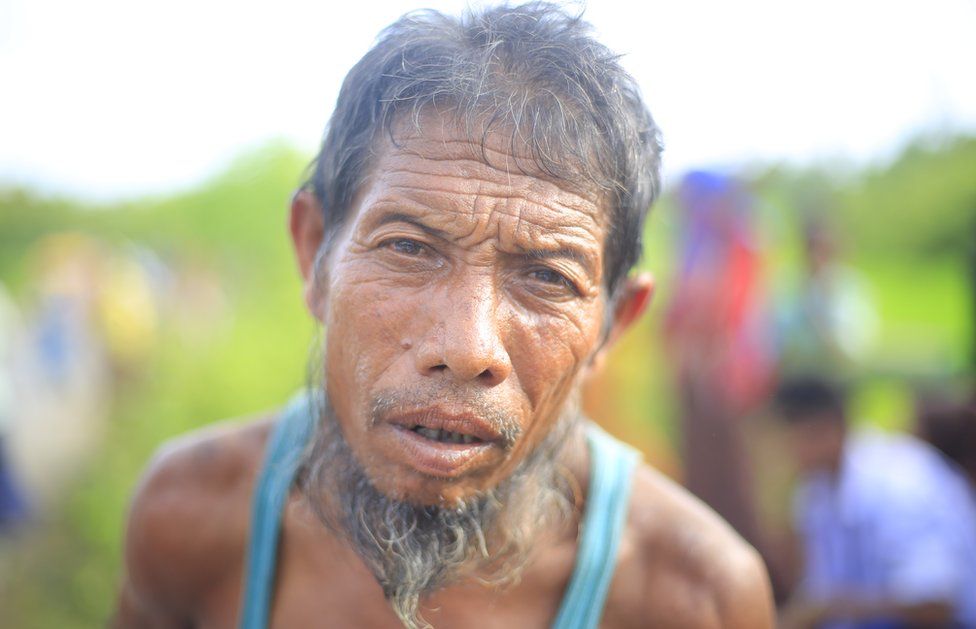
They are starving and exhausted. Many are traumatised, and most have children with them. BBC photographer Salman Saeed took these pictures near the refugee camps in Palongkhali, Kutupalong and Balukhali, in the Cox's Bazar area of Bangladesh.
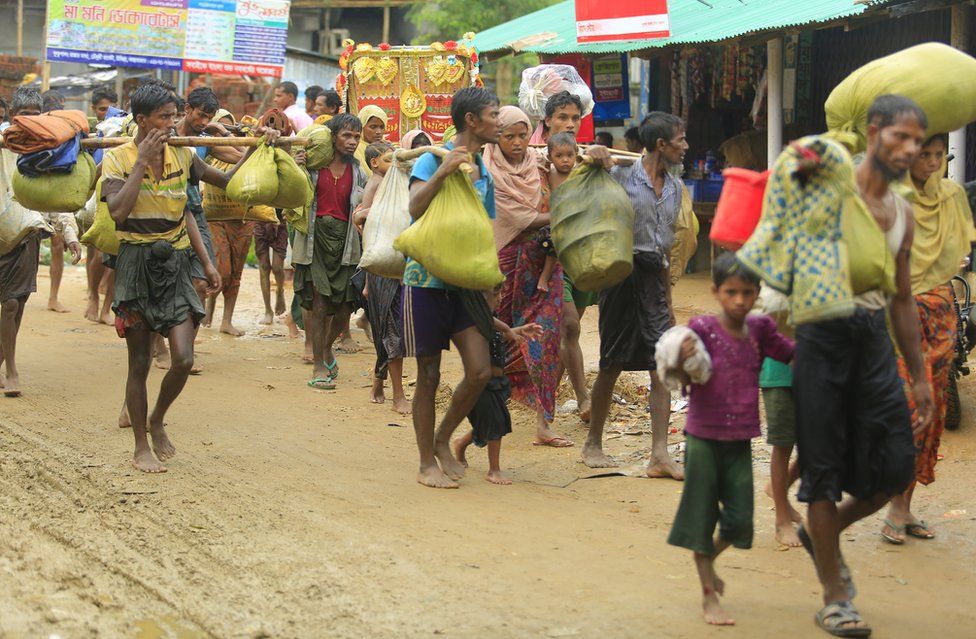
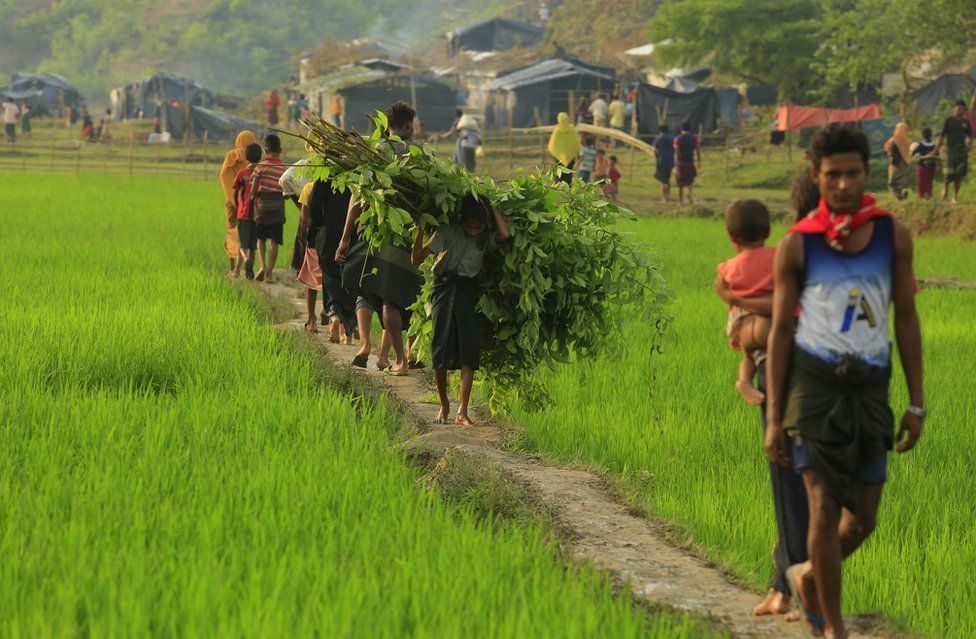
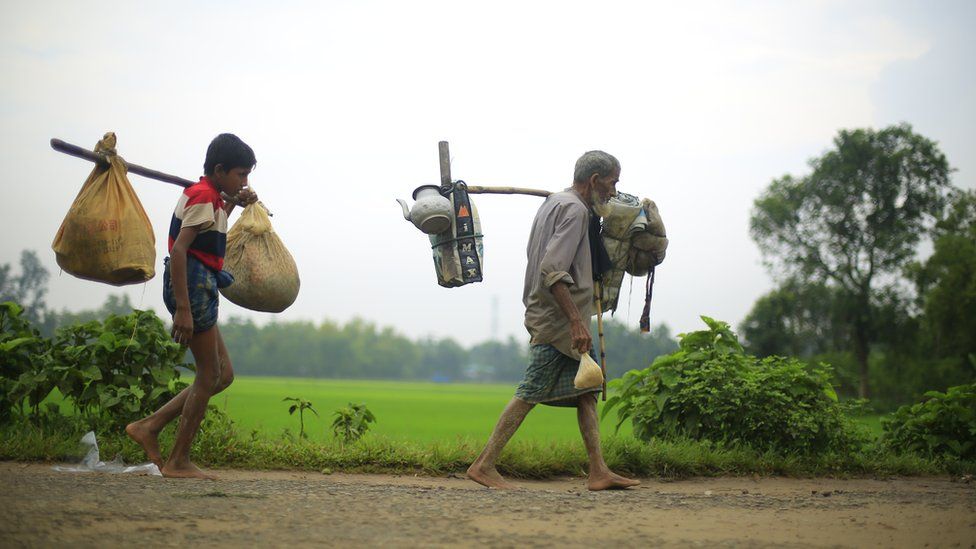
They carry their few belongings and blankets on sticks over their shoulders.
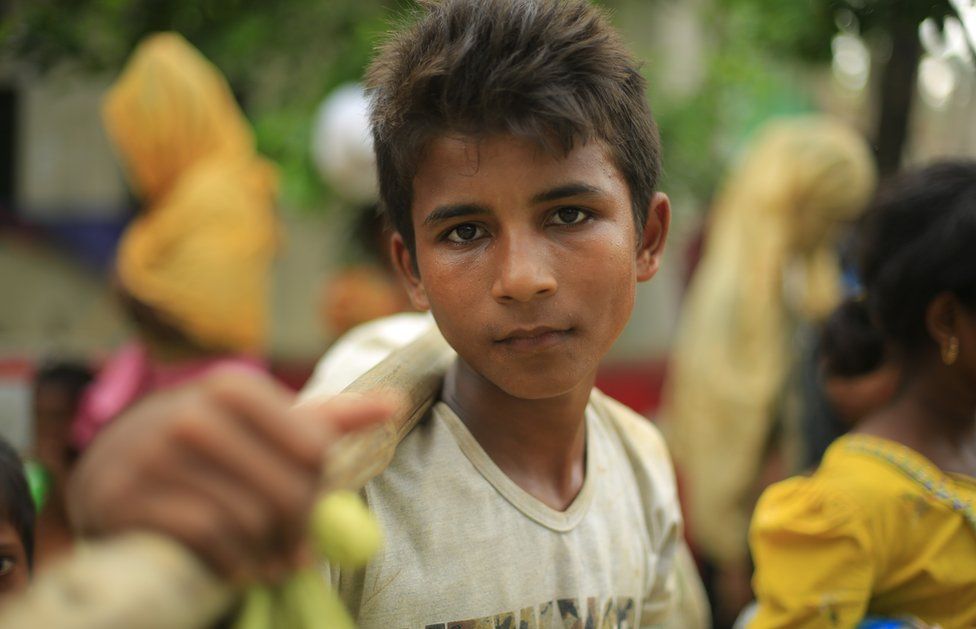
UN experts believe it is "highly likely" that Myanmar's security forces planted landmines along the border in recent weeks, making an arduous journey yet more fraught with danger.
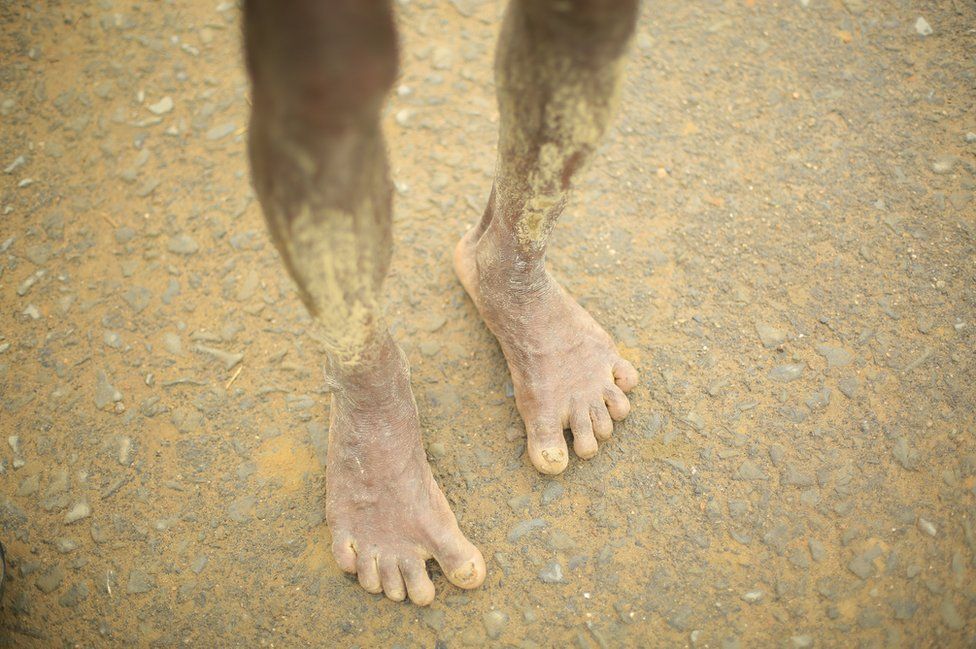
International observers say some Rohingya people have walked for up to three weeks before arriving at government-run settlements like Kutupalong. The children have welts on the soles of their feet.
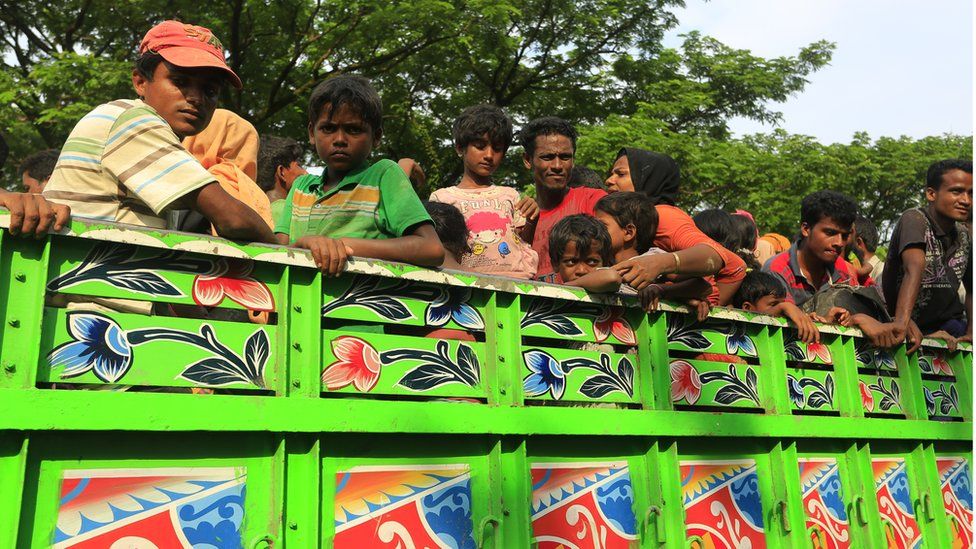
Dozens have already died trying to cross into Bangladesh in small, rickety fishing boats.
The Dhaka Tribune reports that 28 boats have capsized since 24 August, killing 184 people - mostly women and children.
The boats are often overcrowded, and the risk of disaster considerable. Some of those on board are unable to swim.
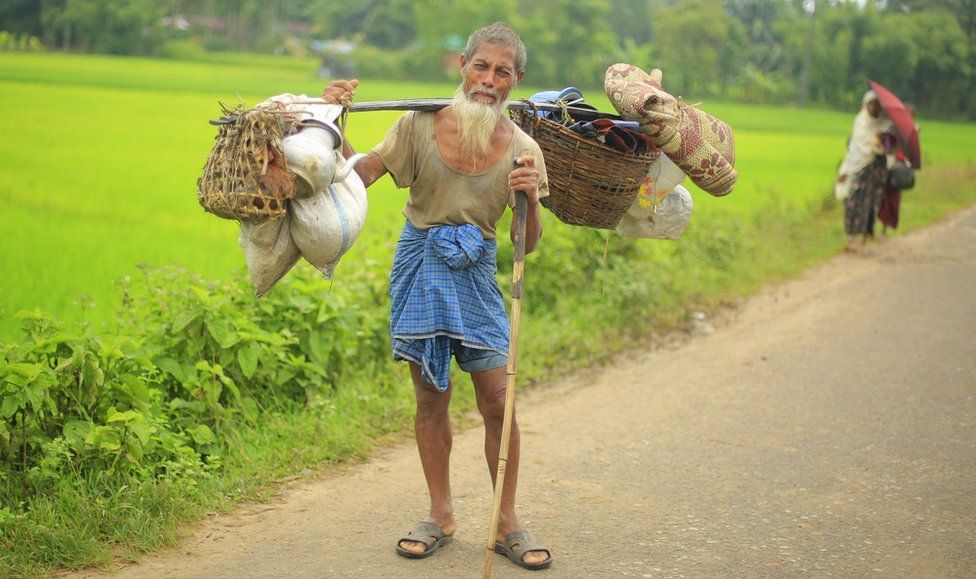
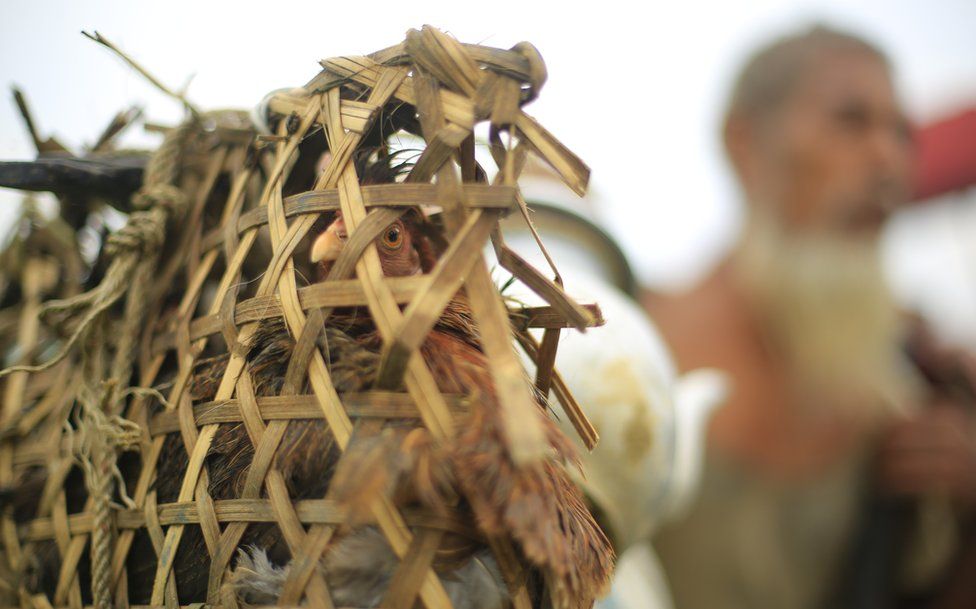
The caged chicken below was his only companion on the long journey to find a new home.
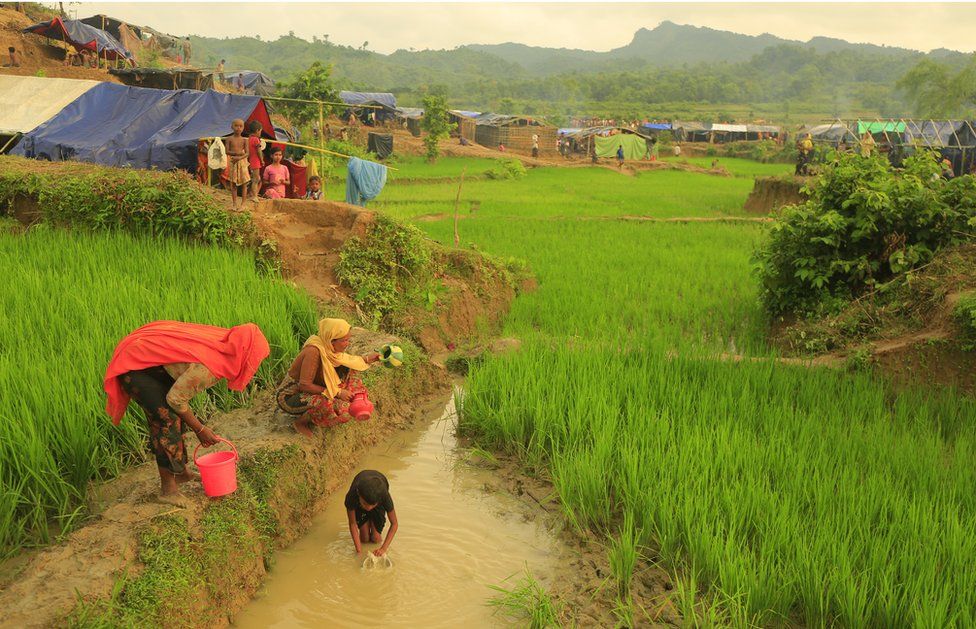
The settlements are muddy, wet and overcrowded, with a shortage of clean water and poor sanitation. There are very few toilets. Torrential rain has increased the hardships - and the risk of diseases like cholera.
Many of those crossing the border already have relatives in Cox's Bazar, whom they are desperate to find.
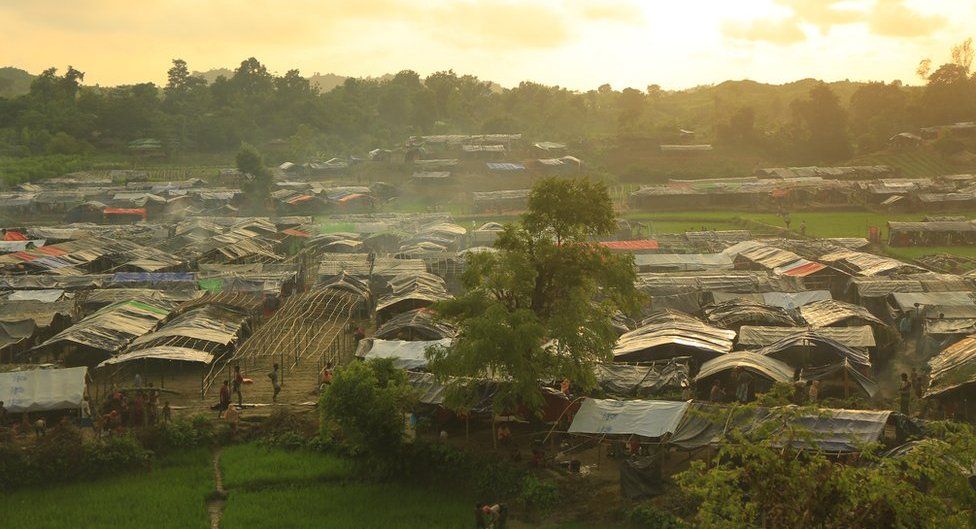
It has three wards, an operating theatre, a maternity ward, and a psychosocial support unit.
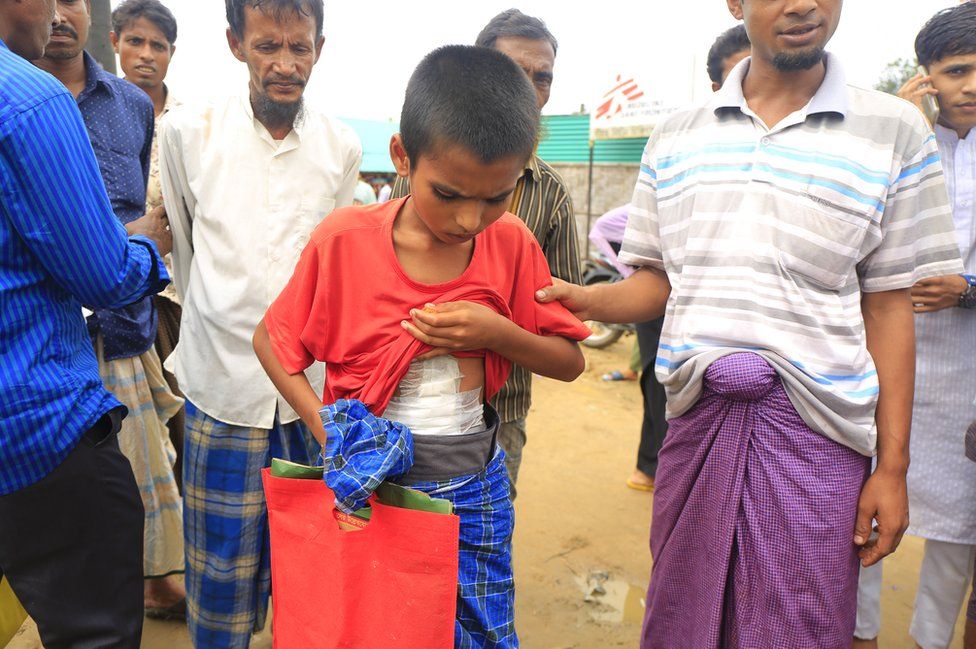
This young Rohingya boy is comparatively lucky - he has received some medical treatment.
It would be the largest such settlement in the world.
Survivors say starvation had helped drive them from their villages, as food markets in Rakhine state have been shut and aid restricted.
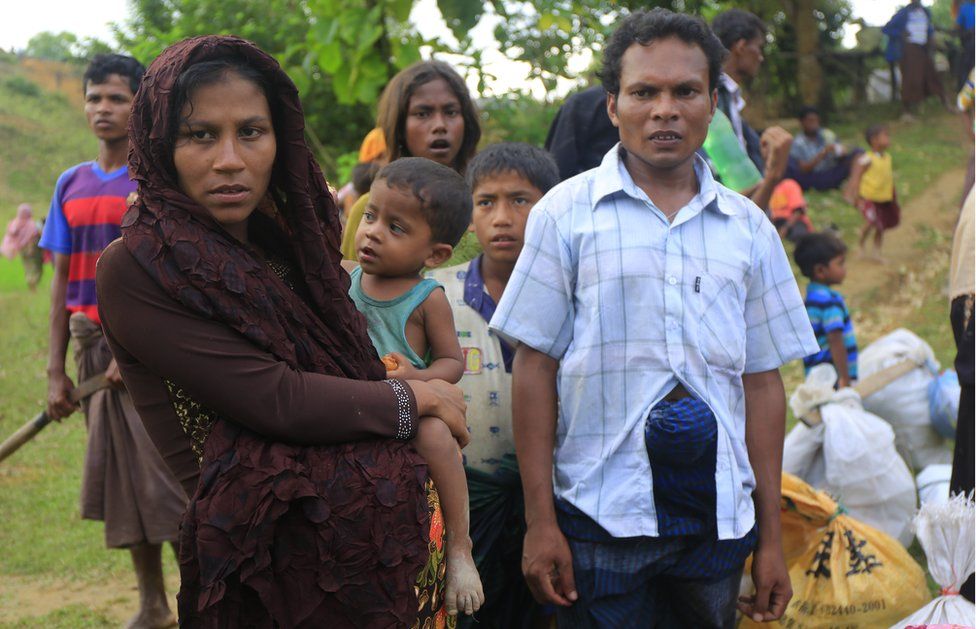
The United Nations Population Fund estimates that of the nearly 150,000 Rohingya women of reproductive age (15-49 years), some 24,000 are pregnant and lactating.
Some have had no choice but to give birth by the roadside.
It urged Bangladesh to speed up the vetting of up to 15,000 affected people, and move them inland to safety.
Andrej Mahecic, a UN refugee agency spokesman, said it wanted Bangladesh to "urgently admit these refugees fleeing violence and increasingly difficult conditions back home".
He added: "Every minute counts, given the fragile conditions they're arriving in."
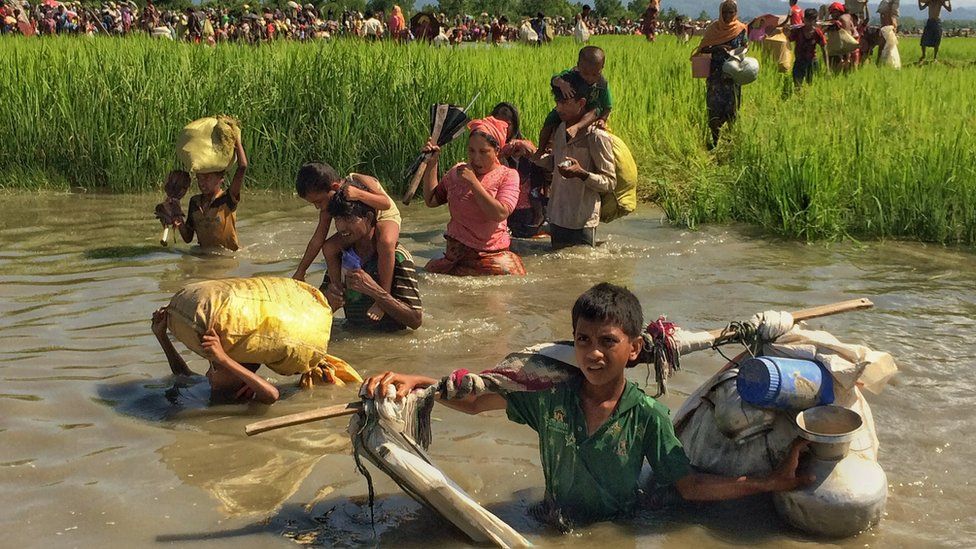
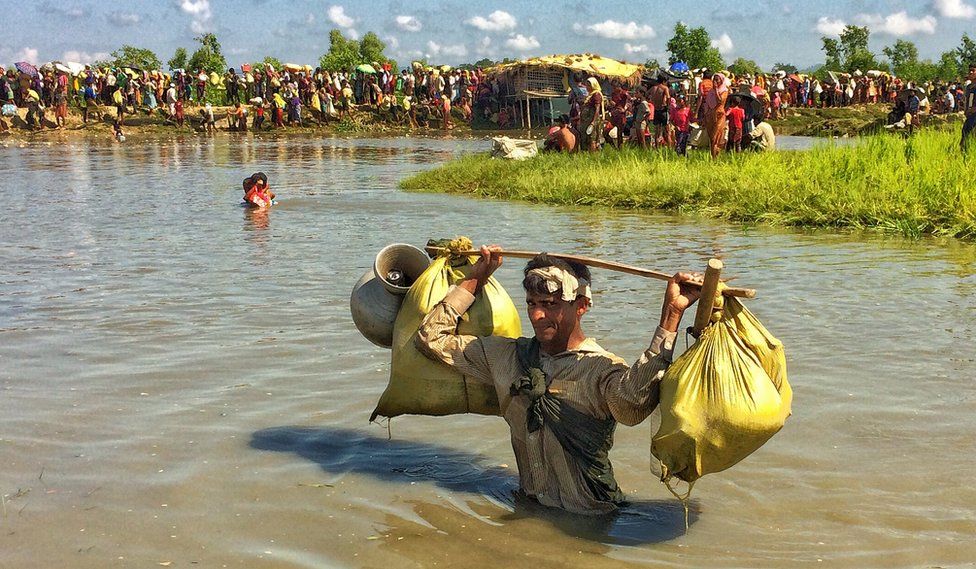
All pictures were shot by Salman Saeed in Cox's Bazar, Bangladesh.
The Art and science of being charismatic
What do Bill Clinton, Steve Jobs and Tony Blair have in common? Love ‘em or loathe ‘em, they all oozed charisma. Charismatic leaders can inspire followers to be more loyal and work harder. But are there different ways in which leaders can be charismatic?
While BBC Capital has previously examined how being charming can help influence people in the workplace, charisma involves a rather different set of skills. Researchers have shown that charisma involves communicating (whether verbally or in written text) using powerful metaphors and anecdotes, using expressions and body language that successfully convey emotions that back up your message while displaying confidence, among other traits.
Charm involves making eye contact with individuals and flashing them a smile, getting people to talk about themselves, asking personal questions and making empathic statements, whereas charismatic leaders don’t necessarily have to interact directly with the people they influence at all – they can do it from afar. So, while charmers are popular, charismatic people don’t have to be.
“You can be charismatic without being likeable,” says Olivia Fox Cabane, an executive coach and author of The Charisma Myth. She uses Steve Jobs as an example, someone who was deeply disliked by some of his employees but still considered to be incredibly charismatic.

Steve Jobs in 2010, employing many of the verbal tricks and gestures needed to inspire followers (Credit: Getty Images)
Fox Cabane demarcates several types of charisma: difficult-to-acquire ‘star power’ charisma, exemplified by Marilyn Monroe, who loved performing for the camera; ‘focus’ charisma, which involves listening attentively; and ‘kindness’ charisma, displayed by the Dalai Lama, which can be learned.
The charisma effect
It turns out, there are a lot of quantifiable benefits to using charismatic behaviour.
For instance, when the values a leader stands for overlap with those of the people he or she is trying to influence, a ‘charismatic effect’ can occur. “People will identify with you more, they will want to be more like you, they will be more willing to follow you,” says John Antonakis, professor of organisational behaviour at the University of Lausanne.
In one 2015 study, Antonakis and his colleague found that temporary workers at a fundraising campaign increased their output by 17% after watching a charismatic pre-recorded motivational speech versus a standard speech.
“Independent of how attractive you are, if you’re more charismatic in a short clip competing for venture capital funding, you’re more likely to get backed,” Antonakis says. “For people who give TED Talks, you’ll get more views and your talks will be considered more inspiring if you deliver the talk in a more charismatic manner.”

Former US President Bill Clinton and former UK Prime Minister Tony Blair in 1997 (Credit: Getty Images)
Charisma can even increase people’s willingness to cooperate. Antonakis did an experiment where participants were shown a video of an actor trying to persuade them in a charismatic way to cooperate in a game that mimics financial decisions. Players were more likely to contribute to the collective benefit rather than enjoy a ‘free ride’. “Charisma can help people by not only affecting their preferences but their beliefs about what they think other people will do,” Antonakis says.
Why do these effects occur? Research suggests it comes down to trust. A study from 2016 found charismatic leaders were more likely to be trusted by their employees, who in turn were more willing to help colleagues, show concern about the future of the team or display commitment to the company beyond their contractual obligations in other ways.
Bjorn Michaelis, a professor of management and organisation at Kühne Logistics University in Germany and one of the authors of the study, says charismatic leaders show employees they have high ability by generating new ideas and integrity by taking personal risks for the good of the organisation. Think of CEOs like Mark Zuckerberg, who famously makes a salary of $1 and Elon Musk, who has never accepted a salary from Tesla.
Can you train yourself to be more charismatic?
For those wanting to be more charismatic, there is evidence that it is not such a magical, or imperceptible quality as it might first seem.
Most of it stems from the way we use words and how points are conveyed. For example, in one set of studies, Antonakis trained middle managers at a German company and MBA students to be perceived as more charismatic by using what he calls charismatic leadership tactics.
These are made up of nine core verbal tactics including metaphors, stories and anecdotes, contrasts, lists and rhetorical questions. Speakers should demonstrate moral conviction, share the sentiments of the audience they are targeting, set high expectations for themselves, and communicate confidence. Managers trained to use these tactics were rated as more competent, more trusted and able to influence others. MBA students who analysed recordings of themselves giving speeches, with these tactics in mind, ultimately gave new speeches that were rated as more charismatic.

Former UK Prime Minister Margaret Thatcher used metaphors, rhetoric, contrasts, lists, moral conviction and sentiment of the collective in speeches (Credit: Getty Images)
“Margaret Thatcher was unbelievably charismatic because of her rhetoric and use of these tactics,” Antonakis says. Analysis of a speech the UK Prime Minister delivered to the Conservative Party Conference in 1980, known as ‘The lady’s not for turning’, highlighted her extensive use of many of these verbal tricks. Her speech was packed with metaphors, rhetorical questions, stories, contrasts, lists, and references to ambitious goals.
But it’s not just how you use words that is important. Body language, gestures, facial expressions and tone of voice contribute to emotional signalling too and should match the message you want to convey. “What you need to convey [is] the appropriate emotion to what you’re saying. You need to look credible so people will trust you, ” says Antonakis.
This is likely one of the factors that makes Hillary Clinton less charismatic than Bill, he adds. “In comparison to Bill Clinton, Hillary Clinton came across as a tad cold [during her run for the Presidency]; she did not convey a warm and folksy sort of image like her husband did.” He adds that her gestures, facial expressions and tones didn’t emotionally reinforce her message, making her “sound scripted.”
Fox Cabane, who trains executives to be charismatic, especially when dealing with the public via speeches or interviews, says the strategy you use to increase the trait depends on what kind of charisma you want to exude.
“Authority charisma is useful when the house is on fire and you need to get everyone out,” says Fox Cabane. “While you don’t care much about how much people like you, you do care about being obeyed.”
She says the best way to improve authority charisma is to improve your self-confidence. She often sends clients to martial arts classes and emphasises the benefits of taking up physical space, pointing to Amy Cuddy’s research on power poses.
“Standing as if you are a big gorilla intimating a rival off the territory really does work,” she says.

Charismatic leaders show integrity by taking personal risks for the good of the firm such as Elon Musk, who has never accepted a salary from Tesla (Credit: Getty Images)
Fox Cabane describes Steve Jobs as a quintessential example of someone who learned what she calls “visionary charisma” over the course of his career. She has analysed clips of his speeches over the years.
“In his first presentation in 1984, you can see he’s a nerd,” she says. “He’s depending on the product to sell itself. He displays no power nor presence, and certainly no warmth. “But what you see gradually through the early 2000s, is Jobs gaining the elements of charisma. He displays presence first – he looks at his audience and focuses on them rather than the product. He learns power second, gradually taking up more of the stage, and projecting his voice.”
There's another tried and tested way in which well-known figures will ultimately increase their charisma. Research suggests we often romanticise people after their death and perceive them to have been more charismatic. In a study from 2016, participants read a story about the career of an American scientist who created a vaccination for a specific bacterium. When the article emphasised that the scientist had died from a disease originating from the bacterium in question, people rated him as more connected to America, and more charismatic.
The study also looked at newspaper references to heads of state who died in office between 2000 and 2013, and found leaders were more likely to be regarded as charismatic post-mortem.
This last one may be an effective method, but we don’t recommend it.
Subscribe to:
Posts (Atom)