Wednesday, January 31, 2024

Indian court allows Hindus to pray in Varanasi mosque

India, under Modi, is hostile to Islam, Muslims and their holy sites. Critics of the ruling party have long claimed that Hindtuvadi partisans that are sympathetic to the Hindutva causes of the ruling BJP and the Sangh Parivar are appointed throughout India's judicial system to get favorable verdict. They sanctify land-grab of Muslim holy sites.  The latest landgrab is another naked demonstration of such a hideous agenda.- HS 
=============
LUCKNOW, India, Jan 31 (Reuters) - An Indian court on Wednesday ruled that Hindus can offer prayers in a 17th century mosque in the holy city of Varanasi, a lawyer for the Hindu petitioners said...
The fight over claims to holy sites has divided India, which has a Hindu majority but also the world's third-largest Muslim population, since independence from British rule in 1947.
The court in Varanasi, which is Prime Minister Narendra Modi's parliamentary constituency in northern Uttar Pradesh state, said Hindus can offer prayers in the Gyanvapi Mosque.
The mosque abuts a temple of Hindu Lord Shiva and is one of the most prominent mosques that Hindu groups say was built over demolished temples.
"The judge has allowed the priest's kin to worship Hindu deities in the cellar of the Gyanvapi mosque," said Vishnu Shankar Jain, the lawyer representing Hindu petitioners.
He said last week that the Archaeological Survey of India (ASI) had determined that the mosque had been built over a destroyed Hindu temple and that remnants of statues of Hindu gods were found in the basement of the mosque.
The ASI did not respond to a request for comment.
Akhlaq Ahmad, the lawyer representing Muslim petitioners, said the order would be appealed in a higher court.
Jain added that the court asked the district administration to make arrangements for Hindus to be able to pray there within seven days.
Hindu claims on contentious sites have been in the spotlight, with Modi this month opening a grand temple to Hindu Lord Ram in Ayodhya, built on the site of a 16th century mosque that was destroyed by a Hindu crowd in 1992 claiming it was the birthplace of the god-king.
The razing of the Ayodhya mosque led to riots across India that authorities say killed at least 2,000 people, mostly Muslims.
The consecration of the Ram temple by Modi fulfilled a 35-year-old pledge of his Hindu nationalist Bharatiya Janata Party and has been portrayed by the party and its affiliates as a Hindu reawakening.
Critics accuse Modi of pushing a pro-Hindu agenda and promoting discrimination against Muslims, but he says his government does not do so.
The temple inauguration came months ahead of a national election due by May and is expected to boost Modi's chances of winning a rare third term.
Ahmad, the Muslim petitioners' lawyer, said of the court ruling on the Varanasi site: "We object to it and we will challenge the decision at the earliest in the high court."

Ending the Israel-Hamas War–Where Things Stand BY MEL GURTOV


Image by Craig Manners.

The New York Times reported January 27 on three negotiating tracks that are being pursued simultaneously to end the Israel-Hamas war. None of them seems likely to succeed at the moment, and Israel is not directly involved in two of them. Changes on the battlefield or in Israeli public opinion might alter the situation for the better, but changes in the region threaten to do the opposite.

Track 1 is a Hamas hostage release in exchange for a time-limited cease-fire and Israel’s release of Palestinian prisoners. Hamas is demanding a permanent cease-fire, not simply a pause. A deal that includes the release of some hostages and some prisoners seems most likely. Pres. Biden has sent the CIA director, William Burns, to the Middle East to move the negotiations along.

Track 2 is an overhaul of the Palestinian Authority (PA) so as to make it a more efficient and less corrupt entity to rule in Gaza. Mahmoud Abbas, the 88-year-old longtime PA leader, wants to name his own successor. That idea won’t float with the US or the Arab states. There is also discussion of having a multinational force take charge of Gaza’s postwar security, but no agreement has been reached about the composition of that force.

Track 3 is normalization of Saudi-Israel relations. Saudi Arabia’s price for such an agreement is high, probably too high: a security agreement with the US, US support of a Saudi nuclear power program, and US support for creation of a Palestinian state with Palestinian control of Gaza. A security treaty with Saudi Arabia probably lacks support in the US Senate, and the Netanyahu government is unalterably opposed to Palestinian statehood.

Track 1 currently seems like the best bet to gain approval from Israel and Hamas if only because it provides only a temporary halt to the war. But two developments in the past week threaten to sidetrack all three negotiations. One is a wider war stemming from a drone attack by an Iran-backed militia group that killed three US servicemen in Lebanon. It raises the possibility of a US strike inside Iran itself. Pres. Biden is reportedly being pressed by Republicans and others to go beyond attacking the militia group. That would give Republicans the war they have always wanted—and that even Donald Trump sought to avoid.

The other development is Israel’s charge that a dozen aid workers for the UN relief organization in Gaza—the United Nations Relief and Works Agency for Palestine Refugees (UNRWA)—helped Hamas in its Oct. 7 attack. Several countries, including the US (the largest donor by far at about $343 million), have stopped providing financial aid to the UN group. That withdrawal could essentially put the group out of business at a time when around six million Palestinian refugees depend on it.

Kenneth Roth, the longtime director of Human Rights Watch, had this comment: “I wish the US government were as quick to suspend military aid to Israel upon a ICJ [International Court of Justice] finding of plausible genocide . . . as it is to suspend aid” to UNRWA.

Mel Gurtov is Professor Emeritus of Political Science at Portland State University, Editor-in-Chief of Asian Perspective, an international affairs quarterly and blogs at In the Human Interest.

Genocide and War BY HOWARD LISNOFF


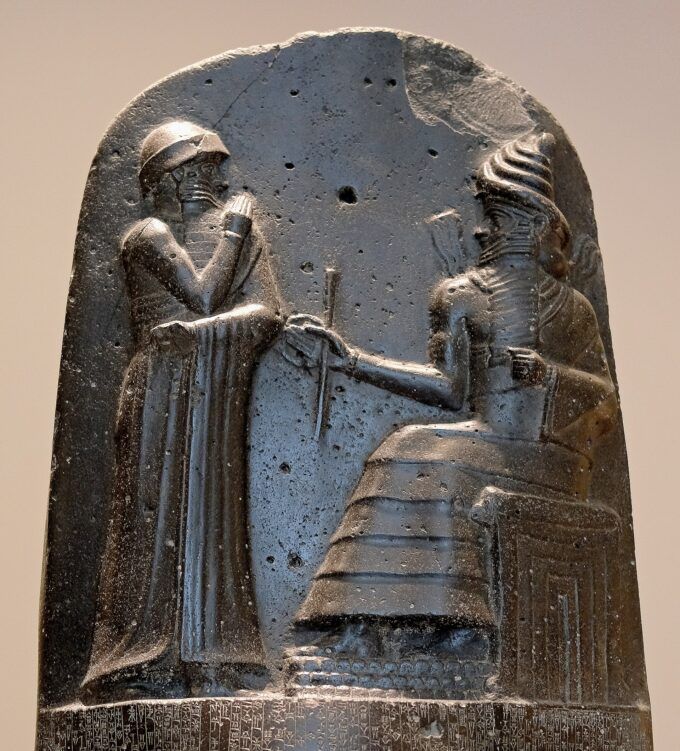
The relief on the Louvre stele. Photograph Source: Mbzt – CC BY 3.0

In the heady days of the antiwar movement during the Vietnam War, and larger wars in Southeast Asia, including Cambodia and Laos, millions of people took part in the great push against war on the streets around the entire globe. Here in the US, hundreds of thousands of men and women resisted war in groups and as individuals. We were on the streets and and in the jails, sitting in, teaching in, and in many other significant places. Hundreds of thousands of men and women directly pushed back against the military draft and the military in one of the largest examples of resistance in history. By 1973, when direct military operations ended for the US, followed by the reunification of Vietnam and the end of the war in 1975, it became almost impossible for the government here to stop the hemorrhaging of troops because of their refusal to obey orders in the field seen as useless. Acts of violence were committed against those in command who were viewed by troops as giving ill-advised orders to fight. Many soldiers simply walked away.

The majority of those involved in whatever form of protest they championed knew that killing innocent civilians was wrong decades before the euphemism of collateral damage was invented. We knew those wars had nothing to do with the interests of the US, or safety. Anti-communism and the projection of power half a world away were drivers of the war, and masses of atrocities took place that extended far beyond the hamlet of My Lai. 

Time passed and even as early as 1975 an antiwar organizer in Providence, Rhode Island lamented that the tiger cages (small cages designed to limit movement and torture victims used by the government of South Vietnam) he set up were not drawing the level of ire that earlier protests had. Many protesters were tired after years of resistance and the end of the military draft brought self-interest into the debate of the wrongheadedness of war.

Then Ronald Reagan ushered in a period of low-intensity warfare, mainly in Central American nations, that was soon eclipsed by George H.W. Bush and his intention of eradicating the Vietnam Syndrome, which was the hesitancy of people in the US to back foreign entanglements. Historical memory is short in the US. September 11, 2001 unleashed the unparalleled military might across the globe that reverberates today in places like Ukraine and in the attempts to eradicate the people of Palestine by our client state Israel. Could the US government, with the aid of the mass media, be underwriting genocide? The UN’s International Court of Justice has ruled that Israel’s war against the Palestinian people is genocidal.

What does history say about the limits of war in a world where the insanity of endless wars are visited against the innocent?

The Code of Hammurabi (1750 B.C.) holds “the strong do not oppress the weak” in war. In ancient India, the Mahabharata “urged mercy on unarmed or wounded enemies.”  The Bible and the Quran “contain rules of respect for the adversary…” “It is always a matter of establishing rules that protect civilians and the defeated.” The latter has become a footnote lost on the so-called leaders, governments, and militaries today.

Ancient sources seeking to limit war point to efforts for protecting the environment, protecting women, including from sexual assault, and protecting livestock. The major objective of war pointed to “acceptable behavior on the battlefield…” War was waged for the “sake of conquest…” “One should not be enraged toward an enemy who is not trying to kill him.” A Muslim caliph held that noncombatants need protection during war, a position that would come as foreign to many in today’s wars, both among leaders and soldiers on the ground.

The just war theory, a just cause for war and a just war, is based on the thinking of war from as far back as two millennia. Christianity produced criteria under which war could be justified. The thinking was that a grave wrong “could be stopped by only violence,” Augustine of Hippo wrote in The City of God. “No war is undertaken by a good state except on behalf of good faith or for safety.” But Augustine did not outline the criteria under which a just war could be conducted. Some observers see the melding of the state and religion in the creation of the rules of war. 

In the Catholic Church, Saint Thomas Aquinas was the major theologian in the 13th century to address war. Aquinas believed that a just war had three elements. War had to be fought by order of a rightful sovereign. There must be a just cause to wage war, a wrong that needed to be righted. Soldiers must operate under right intent by promoting good as opposed to evil. Aquinas held that a just war could be offensive, needed to be proportional, violence in battle was limited to what was necessary, and noncombatants required protection during war.

Contemporary Catholic doctrine holds that: “The damage inflicted by the aggressor on the nation or community of nations must be lasting, grave and certain. All other means of putting an end to it must have been shown to be impractical or ineffective. There must be serious prospects of success. The use of arms must not produce evils and disorders graver than the evil to be eliminated.” Contemporary warfare makes a lethal joke out of those doctrines gleaned from Catholic theology. Contemporary warfare is a free-for-all of violence and the economic greed reaped from war.

Following World War I, the League of Nations (1919) was a failed attempt to protect member nations from aggression and a means to retaliate against aggressor nations. The US was not a member, and the League’s intent was buried in the ground by aggression driven by militarism and fascism two decades later. The United Nations Charter (1945) attempted to ban the “threat of the use of force…” Perhaps most recognizable is the UN’s Genocide Convention (1948). Although there have been many genocides before and after the Convention, the Israel/Hamas war and the International Court of Justice opinion on genocide against Israel in that war has been the most contemporary iteration on that atrocity. US support of Israel in that war, including a copious amount of weaponry, puts the US in a position of supporting a war leading to genocide (Guardian, January 27, 2024). The same could be said of the Cambodian genocide. Enforcement of breaches of the peace were to be met, according to the UN Charter, by an international force to maintain the peace (The Laws of War: A Comprehensive Collection of Primary Documents on International Laws Governing Armed Conflict, Michael Reisman and Chris Antoniou, 1994). 

The Hague Convention(s) of 1899 and 1907 held,”The right of belligerents to adopt a means of injuring the enemy is not unlimited.”  

“The Geneva Conventions are international humanitarian laws consisting of four treaties and three additional protocols that establish[ed] international legal standards for humanitarian behavior in war. The singular term Geneva Convention usually denotes the agreements of 1949, negotiated in the aftermath of the Second World War (1939–1945), which updated the terms of the two 1929 treaties and added two new conventions. The Geneva Conventions extensively define the basic rights of wartime prisoners, civilians, and military personnel; establish protections for the wounded and sick; and provide protections for the civilians in and around a war-zone.”

My friends and I unrolled out our sleeping bags in West Potomac Park in Washington, DC, getting ready for the May Day demonstrations of 1971. “If the government won’t stop the war, then we’ll stop the government,” was the motto of our protest. It was pure mayhem as the DC police chased us everywhere around the city with the National Guard there as a backup. In May 1971, we were not interested in any kind of insurrection. Our goal was simple: to stop the war in Southeast Asia. Although the demonstration scared Richard Nixon, it did not stop him from continuing the war and with vicious consequences for the people of Southeast Asia. The Cambodian genocide (1975-1979), with between 1.5 and 2 million dead, was not far over the horizon. The Rwandan genocide (1994), with one million dead, was farther away. Now, in front of our eyes unfolds the genocide in Gaza with the number of dead still piling up. There have also been other examples of mass murder across the globe, but not amounting to genocide. This species has not stopped since the fascist and militaristic mass murder of 60 million during World War II, which included the Holocaust, killing Jews, gays, political prisoners, and Roma. The better angels are nowhere in sight. The human species, or at least a part of it, got “better” at applying technology to war, including doomsday nuclear weapons’ technology, and gaining profit from those efforts.

Howard Lisnoff is a freelance writer. He is the author of Against the Wall: Memoir of a Vietnam-Era War Resister (2017).

South Africa’s Gift to the World BY RICHARD PITHOUSE

 Speaking at the International Court of Justice the South African lawyer and writer Thembeka Ngcukaitobi pointed to the statement by Israeli defence minister Yoav Gallant that Israel was “fighting human animals”. The denial of the full and equal humanity of Palestinians by Israel and its Western backers is part of a long history of European and then Western monopolization of the claim to be fully human. This was famously expressed by Aimé Césaire, the great Martinican poet, in 1950 when he wrote that the West has never been able to “live a true humanism—a humanism made to the measure of the world.”

In 1973 Steve Biko, the charismatic young leader of the Black Consciousness movement in South Africa, who understood his struggle as a “quest for a true humanity”, wrote that “the great gift still has to come from Africa – giving the world a more human face”. Oppressive regimes are never able to tolerate the intersection of principle and courage and in 1977 Biko met his death, as he had anticipated, at the hands of the police.

In April this year, South Africa will mark thirty years since the formal end of apartheid. In that time it has not realized its most basic commitments to millions of its citizens. One in four people do not have enough food, youth unemployment is over 60%, public education and health care are in deep crisis, there has never been meaningful land reform and corruption and violence are endemic. There is an alarming degree of state-driven xenophobia towards impoverished and working-class African and Asian migrants. Impoverished people are often governed with violence and from the massacre of striking miners in Marikana in 2012 to the many assassinations of grassroots activists popular dissent has often been met with severe repression

So many people gave so much in the struggles against colonialism and apartheid that its almost impossibly painful to measure the commitments and aspirations that animated these struggles against the realities of contemporary South Africa. Struggles for justice, sometimes scattered and ephemeral and sometimes very well organized, continue. It is striking that the declaration “We are human beings, not animals!” has often been present on street protests organized by impoverished people.

Unsurprisingly though political and social cynicism are pervasive, and for many people progress is now only imagined in individual terms. But when South Africa’s lawyers made their case to the International Court of Justice (ICJ) at The Hague on the 11th January, and when the court made its ruling on 26 January, it seemed, for a sudden and golden moment, that Biko’s aspiration had been realised. It seemed as if the principles forged in the long struggle to free South Africa had endured and were now being presented as a gift to the world.

Since it became clear that former South African president Jacob Zuma was running a repressive kleptocracy the standing of the African National Congress (ANC), which has ruled South Africa since the end of apartheid, has been in steep decline at home and abroad. This has enabled an overweening arrogance on the part of the white lobby in South African public life that insists on the moral superiority of the West and effectively demands that the country be run as a proxy state of the West. This lobby, which has strong political connections in the United States, the United Kingdom and Israel, refuses to accept that rejection of the domination of the West by the ANC could be motivated by principle. One of its leading figures, Frans Cronje, recently insisted, without providing any evidence, that the ANC was paid to institute proceedings against Israel at the ICJ by Iran. This conspiracy theory functions to make a principled action appear as corruption.

But of course the ANC has a long history of solidarity with the Palestine Liberation Organisation (PLO) and struggles for national liberation in countries like Ireland and Western Sahara. After his release from prison in 1990 Nelson Mandela made it clear to the West that his solidarity with Palestine, and Cuba, was not negotiable. Thabo Mbeki, who followed Mandela as president, defied the West by refusing to accept the legitimacy of the 2004 Western-backed coup against Jean-Bertrand Aristide, the elected president of Haiti.

The ANC’s failures in terms of meeting the aspirations of its own people, and its turn to repression, cannot be denied. But its long history of solidarity with anti-colonial struggles developed principles that have not been extinguished. Just as Mandela’s support for Palestine and Cuba and Mbeki’s solidarity with Aristide and the right of the Haitian people to elect their leaders was genuine, so too is the party’s current support for Palestine, led by its foreign minister Naledi Pandor.

The shared and at times electric elation in South Africa on 11 and 26 January was animated by both the deep sense of solidarity that most South Africans feel with Palestinians as well as a euphoric recognition that the political principles of the past have not been wholly squandered. There was a sense of hope that something may shift for Palestine, that there may be an opening towards the possibility of a more just global order and that it may become possible to restore some sense of principle in political life at home.

Following the ruling at the ICJ South Africa will face a backlash by the West, and it’s well-funded and organized academic, NGO, media and political proxies within the country. It requires strong and clear support for the position it has taken in solidarity with the people of Palestine. Progressives in other countries will need to mobilize this support and, where possible, encourage their own governments to stand with South Africa on this matter.

But this solidarity must be with the brave and principled action taken by the South African state in support of Palestine, and not an uncritical solidarity that erases the ongoing struggle to, in Biko’s words, “bestow on South Africa the greatest possible gift–a more human face”.

Richard Pithouse is a research associate in the philosophy department at the University of Connecticut and a columnist with the Mail & Guardian in Johannesburg.

Nearly 180 percent spike in anti-Muslim and anti-Palestinian incidents in US: Report

 Incidents of discrimination, bias and hate targeting Muslims and Palestinians in the United States increased by 178 percent in the three months following the 7 October Hamas-led attacks on Israel, the Council on American-Islamic Relations (Cair) said on Monday. 

The Muslim advocacy group said it received 3,578 complaints during the last three months of 2023 since the Israel-Palestine war began. 

In the period from October to December, the majority of the reported complaints fell into three main categories: 19 percent were employment discrimination cases; 13 percent were hate crimes and hate incidents; and 13 percent of the instances were discrimination in educational environments.

“In the face of relentless hate and bogus smears, American Muslims, Arabs and a broad coalition of Jewish, Christian, African American, Asian Americans, and others continue calling for justice for Palestine,” Cair research and advocacy director Corey Saylor said.

“This coalition knows the way to stop the hate is to end the apartheid, occupation, and genocide occurring in Palestine.”

Stay informed with MEE's newsletters

Sign up to get the latest alerts, insights and analysis, starting with Turkey Unpacked


In early 2023, Cair reported that 2022 showed the first-ever drop in incoming complaints to the organisation since it started tracking data in 1995. But the events on 7 October changed that. 

At least 26,637 Palestinians have been killed and 65,387 wounded in Israeli strikes on Gaza since the war began, the Palestinian health ministry said in a statement on Monday.

In the past 24 hours, 215 Palestinians were killed and 300 injured, the ministry added.

Israel-Palestine: Palestinian student shot in US paralysed from the chest down
Read More »

In October, a six-year-old Palestinian-American was fatally stabbed 26 times and his mother seriously wounded in the US, in an attack officials say was linked to the ongoing Israel-Palestine war and because they identified as Muslim.

Wadea al-Fayoume, a six-year-old boy, had been stabbed 26 times and had a 12-inch serrated military knife with a seven-inch blade lodged in his body.

In December, three Palestinian-American college students were speaking Arabic and wearing keffiyehs, a scarf synonymous with Palestinian solidarity, and were en route to dinner before they were shot by a gunman in Burlington, Vermont.

One of them is now paralysed from the chest down and may not be able to walk again.

“Despite this disturbing wave of bias targeting the Muslim, Arab-American and Palestinian communities, we are witnessing an impressive resilience in the face of bigotry,” Cair national executive director Nihad Awad said on Monday.
 

Media Release from Burmese Rohingya Organisation UK (BROUK)

  UN rights chief calls for ‘reality check’ on Burma as BROUK warns Rohingya face erasure The Burmese Rohingya Organisation UK (BROUK) today...