Tuesday, September 27, 2022

Giorgia Meloni and the Return of Fascism to Italy BY GEORGE NEWTH

 The rise of far-right politician Giorgia Meloni has left many outside Italy asking how her brand of what many argue is fascism can achieve such prominence in a country that has experienced life under the dictatorship of Benito Mussolini. The answer can be traced back to a recent normalisation of reactionary politics.

In truth, the existence of a far-right government in Italy is not entirely without precedent in the post-war era. Between 1994 and 2011 a speciously labelled “centre-right” alliance – consisting of Silvio Berlusconi’s Forza Italia (FI), various iterations of a small Christian democratic or centrist wing, Umberto Bossi’s Northern League (LN) and Gianfranco Fini’s National Alliance (AN) – governed Italy four times. The National Alliance was the predecessor party to Meloni’s Brother’s of Italy

Berlusconi takes a revisionist view of Mussolini’s role in Italian history. He believed him to be one of Italy’s “greatest statesmen” and an essentially “benign dictator” who had “done good things for Italy”. This provided a counter-narrative that contradicted the reality of the Italian republic’s anti-fascist foundations. That, in turn, was exploited by the far right.

The Northern League first emerged as a series of parties seeking greater autonomy for Italy’s prosperous northern regions. And the National Alliance was the latest iteration of a neo-fascist tradition which has roots in the Italian Social Movement (MSI) established by veterans of Mussolini’s Italian Social Republic in 1946.

Both parties helped bring far-right and reactionary policies into the mainstream as coalition partners in Berlusconi-led administrations.

The balance of power in this alliance shifted decisively between 2013 and 2017 when Matteo Salvini took the reins of the Northern League. He gradually abandoned regionalism for nationalism and appealed to the far and extreme right, adopting the slogan “Italians First”, which was previously used by the neo-fascist party Casa Pound. The (now renamed) League partnered with the Five Star Movement to govern as what was euphemistically termed a “populist” coalition between 2018 and 2019.

Extreme views packaged as ‘common sense’

This was a period which saw, among other reactionary policies, a “security decree” which tightened immigration regulations, limited the right to asylum and made the expulsion of migrants and revocation of citizenship easier. The decree was ultimately overturned in 2020 but by that time it had already served as a symbolic victory for Salvini.

Back in 2017, Salvini promised Italian voters a “common sense revolution” – a trope which soon became central to his party’s political messaging. The idea was to bring far-right ideology into the mainstream by portraying extreme, racist policies as “normal” ideas based on views shared by “ordinary Italians”.

Like many populist far-right politicians, he thrived on the idea that he was saying out loud what “everyone was really thinking”. Salvini claimed to be putting “Italians first” – although he really meant white, Catholic, straight Italians from “traditional” (read mother and father) families. He also promoted closing borders and clearing migrant camps.

Salvini’s common sense image, while deeply flawed, initially proved a successful electoral tactic. But by 2019 he started to lose control of the narrative, largely thanks to a series of miscalculations.

The first of these was his ill-fated decision to pull the plug on the government he had formed in coalition with the Five Star Movement in 2018. Fuelled by hubris induced by strong polling figures and in the hope of triggering elections, Salvini withdrew support for the government. But his gamble did not pay off. He instead consigned his party to the opposition benches.

Meloni profits from Salvini’s tactics

Salvini’s losses have been Meloni’s gains and the balance of power on Italy’s political right has once again shifted away from the League. With Salvini spending the past two years lending his parliamentary support to the government, Meloni has been able to position herself as having been “alone in opposition” – and therefore as being more in touch with “real Italians”.

Meanwhile, she has capitalised on his success at bringing far-right and reactionary ideas further into the mainstream.

A key element of Salvini’s “common sense” strategy was downplaying the threat of fascism and arguing that calling for law and order or stronger borders is not fascistic. This has created the perfect conditions for neo-fascists to thrive.

Meloni has been free to claim that her party has shaken off its fascist past even as she espouses obviously hardline views. What might be termed a post-fascist strategy is unfolding.

Meloni can gaslight the public by making fascist assertions while claiming fascism no longer exists. Importantly, those who warn that fascism is making a comeback are derided as irrational.

This is all exemplified in the dog whistle references to Mussolini that have characterised the 2022 election campaign. Both the League and Brothers of Italy have deployed campaign slogans first used in the fascist era. The latter has even kept the tricolour flame logo used by its predecessors, the neo-fascist MSI.

Meloni opposes same-sex marriage, wants to put significant curbs on access to abortion to address the “emergency” of Italy’s declining birth rate and has made explicit references Europe’s supposed “Judeo-Christian” roots. The latter is a common Islamophobic trope that has long formed a key part of European far-right ideology.

Her racism is also evident in a depiction of immigration as an invasion – via calls for a naval blockade and portrayal of “undocumented migration” as a UN plot. This plays willingly on racist “great replacement” narratives.

Meloni’s success may shock, but it should not surprise. She is a canny social media operator and expert strategist but her path has been cleared by many figures that came before her. Salvini now follows her lead but his work to shift the Overton window of what is mainstream in politics has made her the politician she is today. That was a process that took years and unfolded in front of our very eyes.

This article is republished from The Conversation under a Creative Commons license.

George Newth is a Lecturer in Italian Politics at University of Bath.

From Exodus to Marvel: A Brief History of Hollywood’s Justification of Israeli War Crimes BY RAMZY BAROUD

 The introduction of an Israeli Mossad agent as the latest Marvel movie character crosses the line, even by Hollywood’s poor moral standards. However, the Israeli superhero, Sabra, must be understood within the rational progression of the Israelification of Hollywood, a phenomenon that is surprisingly new.
Sabra is a relatively old character, dating back to a Marvel comic, the Incredible Hulk, in 1980. On September 10, however, it was announced that the Israeli character will be included in an upcoming Marvel film, ‘Captain America: New World Order’.
Expectedly, many pro-Palestine activists in the United States and around the world fumed. It is one thing to introduce an ordinary Israeli character, with the mere aim of normalizing Israel, an unrepenting apartheid state, in the eyes of Marvel’s impressionable young audiences; but it is far more sinister to normalize a state intelligence agency, the Mossad, known for its numerous bloody assassinations, sabotage and torture.
By adding Sabra to its cast of superheroes, Marvel Studios has shown its complete disregard for the massive campaign by millions of fans around the world who, in 2017, protested the inclusion of a former Israeli soldier, Gal Gadot, as Marvel’s Wonder Woman. Gadot is a vocal supporter of the Israeli government and military.
In response to the news, many rightly highlighted Hollywood’s inherent bias, starting in the 1960’s movie, Exodus, by Otto Preminger, with Paul Newman as the lead actor, which provided pseudo-historical justification for the colonization of Palestine by the Zionists. Ever since, Israel has been elevated, celebrated and included in an ever-positive context by Hollywood, while Muslims, Arabs and Palestinians continue to be vilified.
Although Israel was represented in a positive light by Hollywood filmmakers, the Israelis themselves were quite marginal in the content creation process. Until recently, the Israel construct was mostly built on behalf of Israel, not by Israel itself. “Things began to change in 1997,” wrote Brian Schaefer in ‘Moment Magazine’. It was then that the L.A. Federation’s Entertainment Division and the Jewish Agency launched the project, the ‘Master Class’, which, “for nearly 15 years … brought countless actors, directors, producers, agents, managers and top studio and network executives to Israel, introducing many of them to the country for the first time, and taught Israelis how to pitch their projects.”
The indoctrination of American actors and filmmakers through these visits and the introduction of many Israeli actors and filmmakers to Hollywood paid dividends, leading to a major change of narrative on Israel. Instead of simply communicating Israel to American and international audiences using references to historical victimization, positive association or even humor, Israelis began to make their case through Hollywood directly. And, unlike the haphazardness of past messages – good Israel, bad Arabs – the new messages are far more sophisticated, tailored around specific ideas, and designed with full awareness of the politics of each era.
Steven Spielberg’s movie, Munich (2005), was released within the cultural context of the US invasion of Iraq as part of Washington’s so-called ‘war on terror’, where human rights were violated on a global scale. Munich was a selective ‘historical’ account of the supposedly difficult choices that Israel, namely the Mossad, had to make to fight its own ‘war on terror’. That was the era when Tel Aviv tirelessly underscored its affinity to Washington, now that both countries are purportedly victims of ‘Islamic extremists’.
Unlike Munich, the widely popular TV series Homeland was not just another pro-Israel American argument that justifies Israeli wars and violence. The series itself, one of the most racist, islamophobic shows on television, was entirely modeled after the Israeli show HaTufim – ‘Prisoners of War’ or ‘Abductees’. The writer and director of the Israeli show, Gideon Raff, has been included in the American version of the show, serving as an executive producer.
The change in the ownership of the narrative may seem superficial – as pro-Israel Holywood propaganda is being replaced by organic Israeli propaganda. However, this is not the case.
The pro-Israel agenda of the past – the romanticization that followed the creation of Israel in 1948 –  did not last long. The Israeli defeat of Arab armies in 1967 – thanks to the massive US military support of Tel Aviv – replaced the image of nascent, vulnerable Israel with that of the brave Israeli army, capable of defeating several militaries at once. It was then that Israeli soldiers toured US colleges and schools talking about their heroism on the battlefield. The Israeli invasion of Lebanon and the subsequent massacres, like that of Sabra and Shatila, forced a rethink.
Throughout the 1980s and ‘90s, Israel largely existed in Hollywood as a comic relief, from shows like Friends, Frasier and, more recently, the Big Bang Theory. References to Israel were often followed by a laugh – a clever, and effective way of linking Israel with positive, happy associations.
The ‘war on terror’, starting in 2001, coupled with the creation of the ‘Master Class’ project, allowed Israel to return to the Hollywood universe, not as an occasional reference, but as a staple, with Israeli shows, or joint US-Israeli productions, defining a whole new genre: making difficult choices to fight terrorism and ultimately save the world.
The exploitation of Israeli women on Magazine covers – for example, Maxim – was a whole different shady business, catering to a different audience. The half-naked Israeli army girls have succeeded, in the minds of many, in justifying war through sexual imagery. This genre became particularly popular following the bloody Israeli wars on Gaza, which killed thousands.
Israel’s growing influence on the Marvel movies is a combination of all of these elements: the sexualization of the supposedly strong, empowered woman, the normalization of those who carry out Israeli crimes – Gadot, the soldier, Sabra, the Mossad agent – and the direct injection of Israeli priorities as part of everyday American reality.
Yet, there is a silver lining. For decades, Israel has hidden behind false, romanticized historical notions, making its case to the US and other western public, often indirectly. The wars on Gaza, the exponential growth of the Palestinian boycott movement and the proliferation of social media have, however, forced Israel out of hiding.
The new Hollywood Israel is now a warrior, often forced to make difficult moral choices, but it is, like its American counterpart, ultimately a force for good. Whether Israel will succeed in maintaining this image will depend on several factors, including the pro-Palestinian communities’ ability to counter such falsehood and hasbara.

Introducing Giorgia Meloni: How the US Opened the Door for Fascism’s Return to Italy BY MICHAEL LEONARDI

 The Italian Parliamentary election has concluded and the neofascist, Giorgia Meloni, is ready to emerge as the new prime minister of a divided country with no clear mandate from around 60 percent of eligible voters, in one of the lower voter turnouts in history. The choices were quite grim and the system rigged along the lines of the anti-democratic US election model after years of CIA influence in working to create a bipolar schizophrenic and easily destabilised political system.

Berlusconianism, the creation of a disastrous neoliberal and US/NATO controlled Democratic Party modelled after the United State’s own corporate driven party, and a general malaise and degradation of Italian culture overall have contributed to create the ingredients for the Steve Bannon groomed Meloni to rise to the top, like a toxic slime on the surface of a sea of contaminated waste.

Italy has become like a country of spoiled children that has lost its identity. It has been colonised and lobotomised by multinational corporate interests, the mythological concept of the American dream, mass consumerism, US/NATO dictated militarism, and a crass materialism. For almost 30 years, from Berlusconi’s first election in 1994 and even going back to the post WW2 era when the United States asserted its sphere of influence by steamrolling an anti-communist agenda in order to maintain geopolitical control over the peninsula, Italy has been slowly but steadily pulling out its historic roots and erasing its historical memory.

Giorgia Meloni is the aggressive, bombastic, volatile and narcissistic woman that leads the far right, racist, anti-immigrant, anti LGBTQ +, Italian first, neofascist party called Fratelli di Italia (Brothers of Italy). Several of her party’s candidates have been arrested for corruption scandals as recently as last week, and it is a political party with strong ties to Italy’s organised criminality.

The other political choices have inspired little to no enthusiasm after the technocratic Center Right/Neoliberal disaster led by the former president of the European central bank, Mario Draghi, whose coalition government included components from all stripes of the Italian political spectrum from the populist 5 Star Movement, to the xenophobic Lega with the Democratic Party and always more incoherent Berlusconi and his Forza Italia in between.

Meloni’s popularity, with around 25% support from the electorate, is based on her fiery rhetoric and sloganeering, feeding on the spiralling discontent of an increasingly ignorant populace. Wages have been stagnant for decades, the post covid bailouts from the EU are drying up and costs of everything are on the rise. The Italian people are suffering a major increase in economic hardship from the criminal and stratospheric rise of energy prices leading to crippling inflation across the board combined with and compounded by the disastrous war in the Ukraine where Italy does whatever the United States government dictates. This has allowed for Meloni to ride a populist wave of anger as her political party strategically positioned itself as the opposition to the unfolding Neoliberal disaster that has set the Italian and European economy back decades.

There are small glimmers of resistance. There is the Green/Italian Left that has a broad based social democratic platform based on a socially just ecological transition, however, they are schizophrenically aligned with the Democratic Party whose leadership openly declared that they were only in coalition with them for useful votes to defeat the threat of Meloni and that they would then again push the neoliberal NATO dominated Draghi agenda and largely ignore their Green/Left counterparts. Then there is Unione Popolare (Popular Union) that has a broad based transformative program led by the former mayor of Naples, Luigi DeMagistris, though they were lucky to get 1 percent of the vote. This week they garnered the support of Ken Loach and the embattled former pro immigrant mayor of Riace, Domenico Lucano, but their campaign has been barely perceptible.

And then there is the newly reorganised 5 Star Movement now led by former prime minister Giuseppe Conte, which has splintered with the components that were supportive of the Draghi neoliberal agenda. But after 5 Star’s meteoric populist rise a decade ago, it has proven to be an incoherent and hypocritical flop in implementing any effective policies and has betrayed its promise of political purity by forming coalitions with parties from across the entire political spectrum from the far right to the extreme center in order to insure its political survival.

Another political alliance that has developed is the former prime minister and former leader of the Democratic Party, Matteo Renzi, and a newer crook on the scene named Carlo Calenda who is a senator and recent candidate for mayor of Roma. Renzi’s political party, Italia Viva, caused the fall of the popular Conte government at the height of the Covid pandemic and Calenda considers himself a “liberal globalist”. This pair like to depict themselves as the grand center representing a Clintonesque approach to governance. Renzi is known for his shady alliances with the house of Saud and a series of corruption scandals that have made him quite unpopular. This alliance has the tendency to serve US interests at all costs and push a neoliberal agenda that favours corporate driven reform and, for an example of their backwardness, Calenda has called for the building of nuclear power plants across the peninsula to help confront the newly created energy crisis and with a false narrative of ecological transition.

So, in coalition with Berlusconi’s Forza Italia and Matteo’s Salvini’s xenophobic Lega, Meloni and the Brothers of Italy/Fratelli di Italia have received around 45 percent of the vote. Meloni’s party is likely to earn around 25 percent, making Fratelli di Italia the most popular party in Italy, and insuring that Meloni will become the first woman prime minister of the country.

Italy is one of the most beautiful countries in the world with a love for good food, good wine, and a historic rootedness in the land and sea that surrounds it. The sea is, unfortunately, contaminated and always more filled with plastic. The climate crisis is creating havoc with ever more extreme weather conditions by the day. Floods, droughts, fire and extreme heat are the new normal. The political leadership is leading the country in the opposite direction of where it needs to go. Profits for the weapons makers, profits for the fossil fuel producers and the insanity of nuclear power still dominate across the political spectrum. The United States dictates the politics in this subordinated outpost of empire. Thousands of people migrating from extreme and deadly conditions in Africa, Asia and the Middle East die each year trying to reach Europe from across the Mediterranean and are met with a cold death stare from Italy and the EU. Instead of acting as a neutral party and demanding a pathway for a negotiated peace in the Ukraine, the Italian government is a pawn on the United State’s chess board ready to declare checkmate on the climate and on the future.

While visiting Italy and the Venice film festival a month back Hillary Clinton said, in an interview with the Italian national newspaper Corriere Della Sera, that Meloni being elected would be a positive thing. She said that anytime a woman is elected to a position of power it is a step forward for women around the world. A fitting statement coming from the woman who brought us Donald Trump with her campaign’s pathetic pied piper strategy to elevate what they thought was the weakest candidate. And this a fitting conclusion, as the United States has effectively opened the door for fascism’s return to Italy.

Israeli troops evict Muslim worshippers from Al-Aqsa to make way for extremist settlers

 Israeli soldiers escorted dozens of extremist settlers into the courtyards of Al-Aqsa Mosque through the Mughrabi gate on the morning of 26 September, forcing Muslim worshippers out of the holy site as they performed dawn prayers.

Israeli troops also attacked Palestinian journalists covering the incursion in the Old City of occupied Jerusalem.

As a result of the hostilities, at least two Palestinians needed medical attention, according to the Palestinian Red Crescent Society.

The latest breach of Al-Aqsa Mosque comes in celebration of the Jewish holiday of Rosh Hashanah, which began on Sunday.

Over the past weeks, several Jewish supremacist groups urged settlers to storm the mosque during Rosh Hashanah, while Palestinian resistance groups have said that worshippers must maintain a presence at the complex to protect it from attack.

Just last week, far-right Israeli member of the Knesset (MK), Itamar Ben Gvir, stormed Al-Aqsa and toured its courtyards under the protection of Israeli police. Ben Gvir has openly supported plans to demolish Al-Aqsa in order to build a third Jewish temple.

According to the Palestinian news agency WAFA, Israel has banned over 100 Palestinians from either being at Al-Aqsa Mosque or even in Jerusalem, in order to facilitate the storming of the holy site by supremacist groups.

For its part, the Gaza-based resistance group Hamas warned of “repercussions” over these incursions. Yemeni resistance group Ansarallah also recently warned that its long-range arsenal is ready to defend Al-Aqsa and occupied East Jerusalem.

Palestinian news agency Sama recently revealed that nearly 50,000 extremist settlers raided Al-Aqsa Mosque between September 2021 and September 2022.

According to the far-right “Temple Mount Administration,” this is a 65 percent increase compared to the previous year.

Al-Aqsa: Israeli settlers storm the compound on Jewish New Year

 Hundreds of Israeli settlers stormed the Al-Aqsa compound in occupied East Jerusalem on Monday as the Jewish New Year began over the weekend, amid Palestinian protests. 

On Monday morning, hundreds of settlers entered Al-Aqsa compound from the Mughrabi Gate under strict protection from security forces and toured the site.

Wafa news agency reported that Israeli forces had barricaded several gates leading to Al-Aqsa compound, including the Damascus Gate, the Via Dolorosa route and other entry points to Al-Aqsa.

The Islamic Waqf, a Palestinian-Jordanian body that runs the affairs of Al-Aqsa compound, said that Israeli settlers stormed the site in groups of 50 people, while Israeli forces barred Palestinian entry to the site.

Waqf said that Israeli forces had assaulted Palestinians in the Al-Aqsa compound, arrested six Palestinians and drove some of them out, firing tear gas canisters inside the site.

An older Palestinian man lost consciousness when Israeli forces pushed him and he fell on his head on concrete stairs.

Some settlers were filmed blowing the shofar, a musical horn, outside the gates of Al-Aqsa compound and in Bab Al-Rahmah cemetery. 

Israeli forces had deployed a surveillance plane in the sky of Jerusalem to monitor the movement of people in the city who had climbed on top of Al-Qibli mosque inside the Al-Aqsa compound.

Palestinians barred

Since the early hours of Monday, Israeli forces barred Palestinians under the age of 40 from entering the Al-Aqsa compound, checking their ID cards and erecting barriers in different areas of the Old City.

Sheikh Ekrima Sabri, a veteran imam at Al-Aqsa mosque, told Arab48 that it was "not permissible to leave Jerusalemites alone in the field to defend Al-Aqsa, and Arab and Islamic countries must move to support Al-Aqsa mosque and protect it from occupation".

Fakhry Abu Diad, a Palestinian activist in Jerusalem, described the scene on Monday morning in Jerusalem as a siege.

UN experts criticise UK PM's potential plan to move British embassy to Jerusalem
Read More »

"Occupation authorities imposed a strict siege on Al-Aqsa mosque, setting up a number of military barricades at its entrances, and all the roads that lead to it, closing the Old City with military checkpoints, controlling the roofs of houses and the walls of the Old City, to prevent the arrival of the people of Jerusalem to the mosque," Abu Diad told the news site.

The Palestinian Authority (PA) had condemned Monday's storming of Al-Aqsa compound.

"The storming of the Al-Aqsa mosque by the occupation and its settlers comes within the framework of the Israeli escalation against our people, their land and their holy sites," the PA's presidential spokesman, Nabil Abu Rudeineh, said.

"A number of settlers blowing trumpets at the gates of Al-Aqsa Mosque under the sight and hearing of the occupation police is a dangerous escalation in the series of continuous attacks on Al-Aqsa Mosque, and an attempt to impose a new fait accompli."

Israeli settler groups are expected to enter Al-Aqsa compound in the upcoming weeks in large numbers as they mark the Jewish New Year this week, Yom Kippur on 5 October and Sukkot between 10 and 17 October.

‘No to war!’: Anger over troop conscription rages in Russia

 Hostility towards Russia’s troop mobilisation continues as violence broke out in an impoverished ethnic-minority region and a gunman opened fire at a recruitment office, seriously wounding the commandant.

A young man entered a military enlistment centre in the Siberian city of Ust-Ilimsk and shot the commander at close range on Monday morning.

Russian media reports said the attacker walked into the facility saying: “No one will go fight,” and “We will all go home now.” Local authorities said the commandant was in intensive care in “extremely grave” condition.

The man, identified in the media as 25-year-old resident Ruslan Zinin, was reportedly upset a call-up notice was served to his best friend who did not have any combat experience, which authorities say is the main criteria for the draft.

Kremlin spokesman Dmitry Peskov on Monday acknowledged some call-ups had been issued in error and mistakes would be corrected. He said no decision had been made on closing Russia’s borders amid an exodus of military-age men.

‘Why take our children?’

In the southern Russian region of Dagestan, at least 100 people were detained at a protest opposing conscription on Sunday, underscoring the anger with President Vladimir Putin’s order to send hundreds of thousands more people to fight in Ukraine.

Public anger has appeared particularly strong in poor ethnic-minority areas such as Dagestan, a Muslim-majority region on the shores of the Caspian Sea in the mountainous north Caucasus.

Russia’s first military mobilisation since World War II, announced by Putin on Wednesday, has triggered protests in dozens of cities across the country.

The independent OVD-Info protest monitoring group said at least 100 people were detained in Dagestan’s regional capital Makhachkala. Dozens of videos posted on social media showed confrontations with police as protesters shouted: “No to war!”

Footage showed a group of women chasing away a police officer, while several clips captured violent clashes including police sitting on protesters as officers attempted to make arrests.

Privacy Policy

“Why are you taking our children?” one person shouted.

Police earlier fired warning shots into the air after dozens of demonstrators in Dagestan blocked a major road in protest against officials reportedly calling up more than 100 men from a village for military service.

Enlistment offices attacked

The Kremlin announced “a partial mobilisation” to add at least 300,000 troops to its force in Ukraine. According to the British military, the first batch of reservists has arrived at military bases.

The call-up, which marked a sharp shift from Putin’s previous efforts to portray the war as a limited “special military operation”, which would not interfere with most Russians’ lives, has proved extremely unpopular at home.

Thousands of men of fighting age flocked to airports and Russia’s land border crossings to avoid being called up. Russian media reported an increasing number of arson attacks on military enlistment offices.

Dagestan has already paid a heavy human toll during the seven-month war. According to a tally by the BBC’s Russian service, at least 301 soldiers from Dagestan have died – the most of any Russian region and more than 10 times the number of deaths from Moscow, which has a population five times larger.

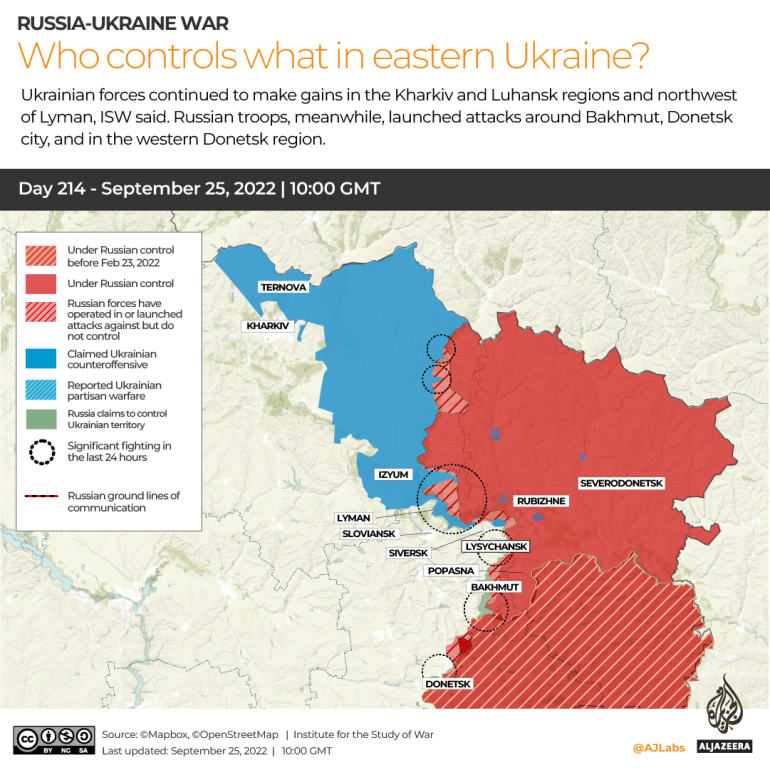
INTERACTIVE- WHO CONTROLS WHAT IN EASTERN UKRAINE

‘Mistakes have been made’

Unauthorised rallies are illegal under Russia’s anti-protest laws and are rare outside of big cities.

More than 2,300 people have been detained at anti-mobilisation rallies in Russia since Putin announced the drive, said OVD-Info.

In an attempt to dispel public anger, Dagestan’s Governor Sergey Melikov said “mistakes have been made” in the mobilisation rollout in the region.

There have been several reports from across Russia of people with no military experience or parents of young children being called up in the draft – despite guarantees from defence minister Sergey Shoigu that they would be excluded.

Russia’s two most senior lawmakers – key Putin allies – also addressed public concerns about mobilisation, acknowledging “excesses” had stoked public anger.

‘De-mobilising these Russians’

The Ukrainian defence ministry ridiculed Moscow’s move, posting on Twitter a mash-up of social media videos of Russian police beating and arresting men protesting conscription.

“Russia still has remnants of a professional army” that the Ukrainian army “hasn’t yet destroyed”, it said in an English-language tweet, referring to this month’s rout of Russian forces from much of the northeastern Kharkiv region.

“Looks like we’ll be ‘de-mobilising’ these Russians ahead of schedule.”

Ukrainian President Volodymyr Zelenskyy has called on Russians to not submit to “criminal mobilisation”.

“The more citizens of the Russian Federation at least try to protect their own lives, the sooner this criminal war of Russia against the people of Ukraine will end,” he said.

The situation is “catastrophic” in Crimea where Russia is using mobilisation to call up native Crimean Tatars for service, he added.

“Why should their husbands, brothers, sons die in this war? For a war that one man wants. For a war against our people on our land. He [Putin] does not send his children to war,” said Zelenskyy in Russian.

SOURCE: AL JAZEERA AND NEWS AGENCIES

Most US, UK Adults Know Nothing About Files That Assange Is Charged With Publishing

 Most American and British adults do not know anything about the documents that the United States government is prosecuting WikiLeaks founder Julian Assange for publishing, according to a poll by Morning Consult.


Both populations are apathetic or unaware when it comes to whether Assange should be extradited and face a US trial. In fact, nearly half of US adults polled said they had “never heard” of Assange.

The lack of awareness of Assange and the case against him is likely why only a minority in the US and United Kingdom support the prosecution.

Meanwhile, in Australia, almost half of adults said Assange “should not be extradited from the UK to the US, and he should be released from jail.” That reflects how the case has become a significant political issue in the country during the past year.

The US Justice Department charged Assange with 17 counts of violating the Espionage Act. Each Espionage Act charge stems from the publication of documents, which WikiLeaks obtained from US Army whistleblower Chelsea Manning in 2010.

Assange has been jailed at Her Majesty’s Prison Belmarsh since April 11, 2019, when the Ecuador government revoked his political asylum and allowed the British police to enter their London embassy and arrest him.

UK Home Secretary Priti Pratel approved Assange’s extradition in June, but Assange’s legal team immediately filed two separate appeals in the UK High Court of Justice.

The Espionage Act charges criminalize the publication of the Afghanistan War Logs, Iraq War Logs, and US Embassy cables, as well as the Guantánamo Files and Iraq rules of engagement documents.

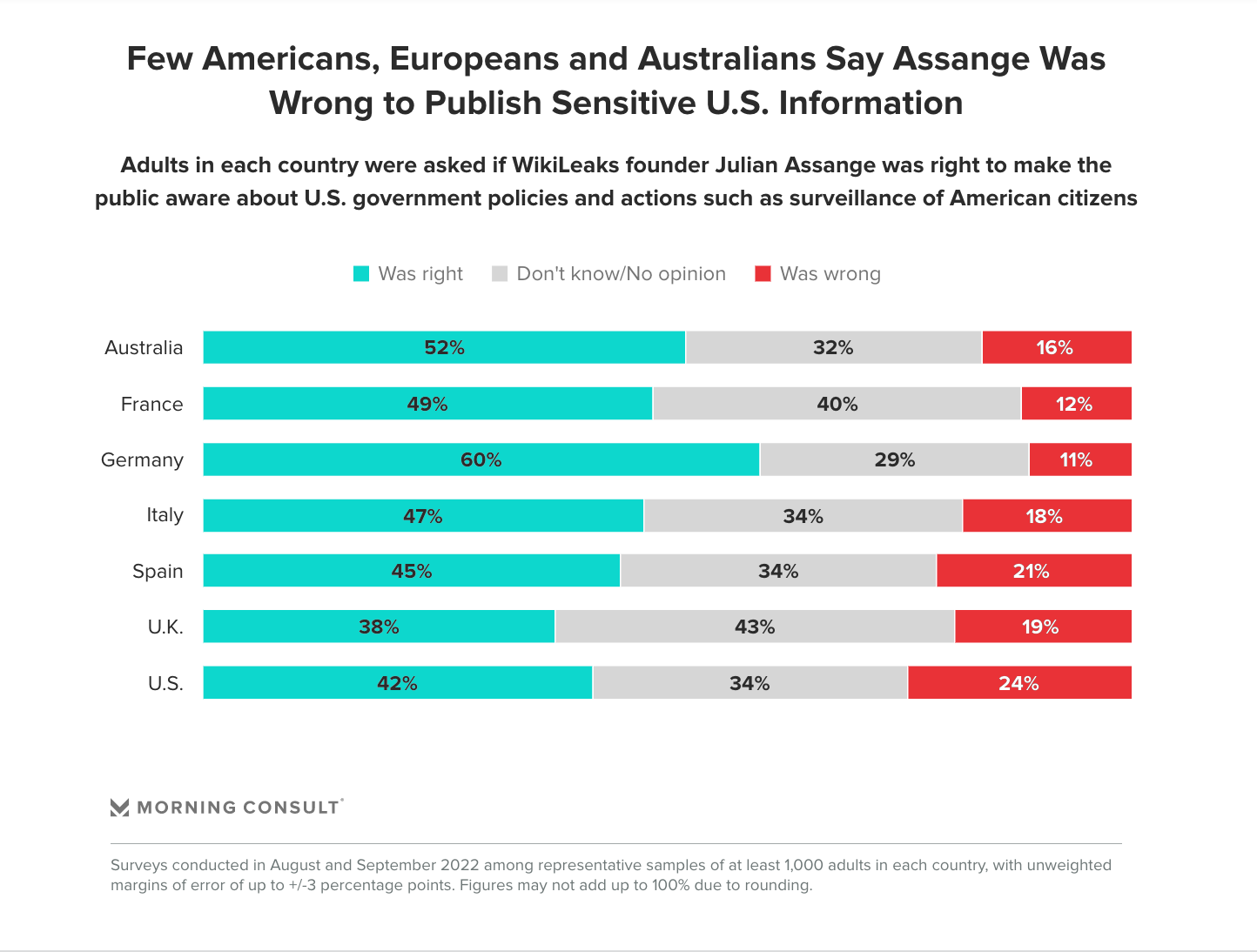
Screen shot of Morning Consult graphic reflecting polling results on Assange and WikiLeaks


Morning Consult conducted surveys in the United Kingdom (August 5-6, 2022), United States (September 7-9, 2022), and in Australia, France, Germany, Italy, and Spain (August 16-17, 2022). They sampled at least 1,000 adults in each country.

In the US, 55 percent of adults said they had never seen, read, or heard anything about the Afghanistan War Logs. Fifty-four percent said they they had never seen, read, or heard anything about the Iraq War Logs.

Fifty-seven percent of US adults said they had never seen, read, or heard anything about the US Embassy cables.

UK adults appear to have even less knowledge of the publications, though more have heard of Assange.

Fifty-seven percent of UK adults said they had never seen, read, or heard anything about the Afghanistan War Logs. Fifty-six percent said they had never seen, read, or heard anything about the Iraq War Logs. Sixty-three percent said they had never seen, read, or heard anything about the US Embassy cables.

The results were very similar in Australia: 53 percent said they had not seen, read, or heard anything about the Afghanistan War Logs, 54 percent said they had not seen, read, or heard anything about the Iraq War Logs, and 56 percent said they had not seen, read, or heard anything about the US Embassy cables.

A majority (52 percent) of Australians polled agreed that Assange was “right to make the public aware about US government policies and actions, such as surveillance of American citizens.” (Bizarrely, that’s not really what the war logs or diplomatic cables that WikiLeaks published revealed.)

Half of Australian adults polled said Assange would not receive a fair trial in the United States.

Contrast that with results in the US and UK: 28 percent of US adults said Assange would not receive a fair trial in their country, and 36 percent of UK adults said Assange would not receive a fair trial.  

Only 38 percent of UK adults said Assange was “right to make the public aware” of information about the US government while 42 percent of US adults said Assange was “right to make the public aware” of information about their government.

Forty percent of US adults said Assange “should be extradited from the UK to face trial for publishing secret US government documents,” which is troubling for those who care about press freedom. But just as worrisome is the fact that about the same percentage indicated they did not know about the case or had no opinion.

In the UK, where the government recently approved the extradition of Assange, a staggering 44 percent of respondents said they didn’t know about the case or had no opinion about whether the WikiLeaks founder should be extradited.

Morning Consult asked respondents whether they could recall anything about WikiLeaks’ publication of Hillary Clinton’s campaign emails, CIA hacking materials (“Vault 7”), and NSA files on spying against French presidents. But the charges against Assange do not cover those publications.

While the US did charge Assange for publishing the Guantánamo Files, the polling firm did not ask respondents about those documents.

Respondents were also asked about NSA whistleblower Edward Snowden. Although Assange is being criminalized for engaging in source protection by helping Snowden flee Hong Kong, how one views Snowden is largely irrelevant to the Assange case.

Overall, the poll results illustrate the extent to which the Western news media has shaped views of Assange and WikiLeaks.

Western news media has been hyper-fixated on the publication of Clinton campaign emails, despite the fact that the files were much less consequential than documents that exposed the Afghanistan and Iraq Wars as well as the lengths that US diplomats will go to advance US foreign policy.

Press freedom advocates may be relieved that in the US, UK, and Europe there is only minority support for prosecuting Assange. However, the apathy and lack of awareness of this unprecedented political case has probably done more to aid than hinder the US and UK government in their efforts to secure extradition and bring a publisher to trial.

UNGA president Khalilur Rahman terms Rohingya crisis as ‘grave human crisis’

  President of the UN General Assembly’s 81st session Khalilur Rahman has described the Rohingya crisis as a ‘grave human crisis’ and said v...