Thursday, April 30, 2020

Around 100 Rohingya refugees died at sea, hundreds more left to starve, warns MSF

Around 100 Rohingya refugees died upon a voyage from refugee camps in Bangladesh to Malaysia earlier this month, with hundreds of others left to starve on the boat at sea, according to a release from Doctors Without Borders (Médecins Sans Frontiéres – MSF).
More than a million Rohingya – Muslims from majority-Buddhist Myanmar’s western Rakhine province – have been forced to flee to neighboring Bangladesh since 2017 due to targeted violence at the hands of the Myanmar military which the UN described as having “genocidal intent.”
But in March 2019, Bangladesh announced it was no longer taking in refugees, while conditions in the camps have deteriorated, forcing some Rohingya to try and flee to a new location.
According to MSF, hundreds tried to travel to Malaysia this month – but were beaten and starved by people smugglers on the voyage, with the ship eventually returning to Bangladesh two months later after being denied permission to land in Malaysia. The exact number of people who died is unknown, but MSF estimated it is around 100.
While the return of the ship was reported on at the time, MSF teams who met the survivors have shed new light on the ordeal – and warned that the refugee communities are in urgent need of help.

Malnourished and overwhelmed

The survivors were malnourished and overwhelmed when they returned to Bangladesh, according to the MSF team who met them once the Bangladeshi coastguard rescued the vessel after it was seen driving offshore.
“They were mostly adolescents, young people between the ages of 12 and 20, mostly single males and single females. Many of them couldn’t stand or walk on their own,” said Hanadi Katerji, MSF nurse and medical team leader who was present at the scene. “They were just skin and bone – a lot of them were barely alive.”
Katerji said that many of the men had severe injuries which weren’t healing due to malnutrition.
“There was a large burden of mental health needs. Mostly people were stressed, traumatised, frightened and uncertain,” she described.
A 14-year-old refugee who spoke to MSF confirmed Katerji’s account.
“We were adrift at sea, with people dying every day,” said “Amina,” whose real name has been changed for safety.
“Many people died, especially the men because they couldn’t breathe properly, there wasn’t enough oxygen,” they said.
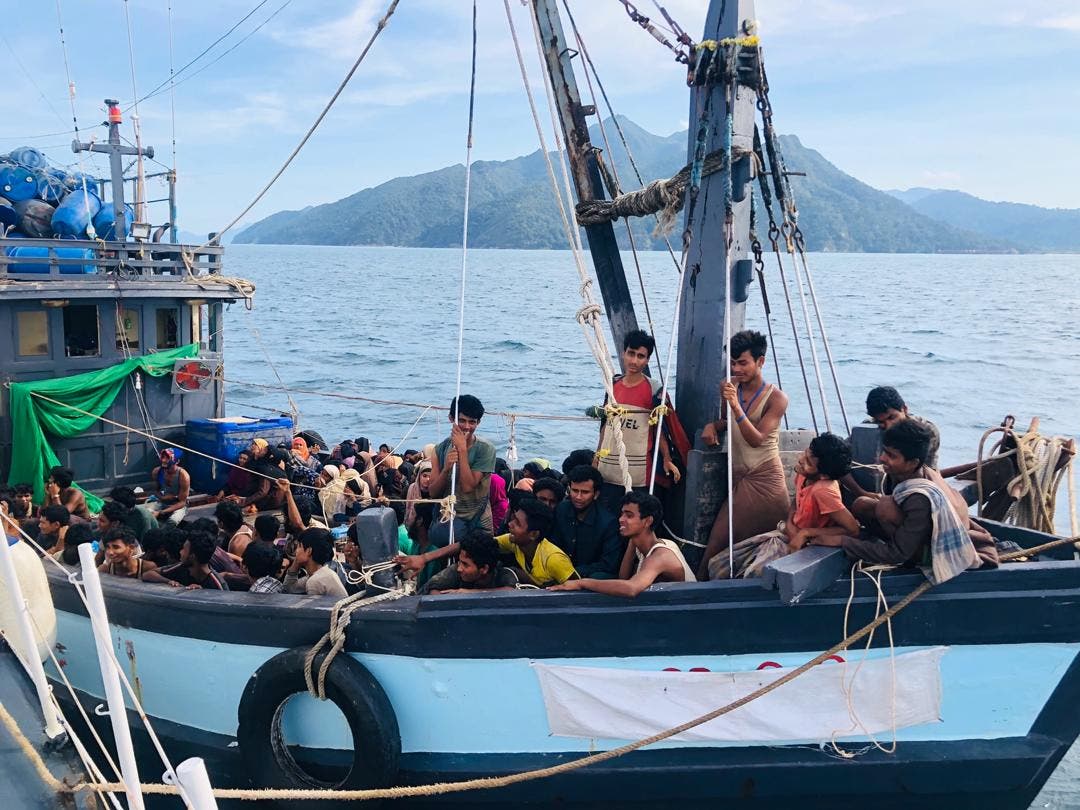
A boat - not the one referred to here - carrying suspected ethnic Rohingya migrants is seen detained in Malaysian territorial waters, in Langkawi, Malaysia April 5, 2020. (Reuters)

Renewed calls for justice amid COVID-19

The details of the ordeal come a day after the UN’s human rights expert on Myanmar called for a new investigation into allegations of war crimes and crimes against humanity in Rakhine.
UN special rapporteur Yanghee Lee accused Myanmar’s military of “inflicting immense suffering” on ethnic minorities in Rakhine and Chin states, including the Rohingya.
“While the world is occupied with the COVID-19 pandemic, the Myanmar military continues to escalate its assault in Rakhine state, targeting the civilian population,” Lee said in a statement issued Wednesday in Geneva.
She accused the military of “systematically violating the most fundamental principles of international humanitarian law and human rights,” and said its conduct toward civilians “may amount to war crimes and crimes against humanity.”
Lee’s comments come as charges of genocide against Myanmar are pending at the International Court of Justice in the Netherlands, which agreed to rule on them last year.
UN agencies and human rights organizations have extensively documented atrocities, but Myanmar’s government says it acted justifiably and denies any major abuses during its conflict against the Arakan Army military group.
Lee was also critical of the Arakan Army, which she said “has also conducted its hostilities in a manner that has had negative impacts on civilians, including kidnapping local officials and parliamentarians.”
She added that the guerrilla force had declared a unilateral cease-fire, citing the need to combat the spread of COVID-19.
“The focus of all authorities, including security forces, should be on dealing with the COVID-19 crisis,” Lee said.
For its part, MSF warned that refugees fleeing at sea must be adequately protected.
“We urge all regional authorities to deploy adequate search and rescue capacity to avoid loss of lives, facilitate the disembarkation of people rescued in a place of safety and allow people in need of international protection in as per UNHCR guidance,” the organization told Al Arabiya English.
With The Associated Press.

ARNO Press Release

“Leaving no one behind” amidst genocide: the Myanmar government’s response to Covid-19 in Rakhine State 


On April 10, 2020, the Myanmar Ministry of Foreign Affairs issued a press release, “Myanmar leaves no one behind in its fight against COVID-19 in Rakhine State,” describing its intensified efforts to raise public awareness about the virus “in Rakhine and Muslim villages and IDP camps,” and to work with the UN and INGOs to address any possible outbreak in the IDP camps.

International donors are rallying behind these efforts. The World Bank has approved a USD 50 million loan to improve the government’s health care system. The multi-lateral Access to Health Fund has raised 6.2 million dollars. UNOCHA ’s weekly Myanmar Covid-19 situation updates describe ongoing awareness and prevention programs in the IDP camps, by both the Myanmar government and international aid agencies.

While all aid to the IDP camps in Rakhine State is, of course, welcome, and desperately needed, ARNO urges international donors to scrutinize whether the aid is reaching all those currently displaced, as many of the newly displaced IDPs are in unofficial camps, where humanitarian access is being blocked by the authorities, and where they remain vulnerable to attacks.

ARNO is also gravely concerned that the international community’s uncritical buy-in of the Myanmar government’s efforts against the virus, will further embolden it to continue its genocidal operations against the Rohingya and other ethnic peoples of Rakhine – which are bound to worsen the spread of the virus.

For it is crystal clear that the hundreds of thousands of IDPs in Rakhine State, both confined to concentration camps, and newly displaced from the Burma Army’s relentless air and ground offensives, are far more vulnerable to the virus than the general population. As IDPs, they cannot practice social distancing, have limited access to water for washing, and have weakened immunity due to lack of adequate food and shelter.

The best way to protect these IDPs would be for the government to immediately end all military operations and withdraw troops so that the newly displaced can return home, and to immediately grant citizenship and full rights to the Rohingya, so that they are no longer confined to concentration camps.

We appreciate that 18 foreign ambassadors in Myanmar called for an end to armed conflict amid the COVID-19 pandemic on April 2, but the statement failed to identify the Myanmar military as the main aggressor, spending millions of dollars of the national budget on aerial and ground bomb attacks, instead of on the national health emergency. It also failed to condemn the Myanmar military for its ongoing torture and killing of civilians in Western Burma.

Meanwhile, there have been no new international sanctions on Myanmar since the ICJ’s ruling in January 2020 that the Rohingya must be protected from genocide. International business continued as usual until the recent virus lockdown, and now the World Bank and leading Western investors are assisting the Myanmar government to draw up a post-Covid economic recovery plan.

It is hard not to conclude that the international community is continuing to prioritize its own short-term business and strategic interests in Myanmar over the fate of the country’s ethnic peoples.
The deadly spread of the virus is forcing governments around the world to reassess their priorities, and to realize that all their citizens need to be equally protected or all are at risk. We urge these governments to transpose this newfound awareness to Myanmar. Unconditional support to a government that is driving large sectors of its population into the arms of a pandemic will, finally, be a risk to all.   


For more details, please contact:
Dr Mohammad Habib Ullah +1-4438158609 or email at info@rohingya.org

India should be placed on religious freedom blacklist, US panel says

A US government panel has called for India to be put on a religious freedom blacklist over a “drastic” downturn under the prime minister, Narendra Modi, triggering a sharp response from New Delhi.
The US commission on international religious freedom recommends but does not set policy, and there is virtually no chance the state department will follow its lead on India, an increasingly close US ally.
In an annual report, the bipartisan panel said that India should join the ranks of “countries of particular concern” that would be subject to sanctions if they do not improve their records.
“In 2019, religious freedom conditions in India experienced a drastic turn downward, with religious minorities under increasing assault,” the report said.
It called on the US to impose punitive measures, including visa bans, on Indian officials believed responsible and grant funding to civil society groups that monitor hate speech.
The commission said that Modi’s Hindu nationalist government, which won a convincing election victory last year, “allowed violence against minorities and their houses of worship to continue with impunity, and also engaged in and tolerated hate speech and incitement to violence”.
It pointed to comments by the home minister, Amit Shah, who referred to mostly Muslim migrants as “termites, and to a citizenship law that has triggered nationwide protests.
It also highlighted the revocation of the autonomy of Kashmir, which was India’s only Muslim-majority state, and allegations that Delhi police turned a blind eye to mobs who attacked Muslim neighborhoods in February this year.
The Indian government, which has long been irritated by the commission’s comments, quickly rejected the report.
“Its biased and tendentious comments against India are not new. But on this new occasion, its misrepresentation has reached new levels,” a foreign ministry spokesman, Anurag Srivastava, said.
“We regard it as an organization of particular concern and will treat it accordingly,” he said in a statement.
The state department designates nine “countries of particular concern” on religious freedom – China, Eritrea, Iran, Myanmar, North Korea, Pakistan, Saudi Arabia, Tajikistan and Turkmenistan.
Pakistan, India’s historic rival, was added by the state department in 2018 after years of appeals by the commission, which was appalled by attacks on minorities and abuse of blasphemy laws.
In its latest report, the commission asked that all nine countries remain on the list. In addition to India, it sought the inclusion of four more – Nigeria, Russia, Syria and Vietnam.

The face of Hindutvadi fascism and intolerance

'Do not buy from Muslims': BJP leader in India calls for boycott

"Keep one thing in mind. I am telling everyone openly. There is no need to buy vegetables from 'miyans' [Muslims]," legislator Suresh Tiwari from Deoria town in the northern state of Uttar Pradesh was heard saying in the mobile phone video that went viral on Tuesday.
Millions in India are facing unprecedented job losses and hunger because of the coronavirus pandemic and lockdown, with daily wagers, vendors and small shopkeepers being severely affected.
As outrage grew, the BJP asked Tiwari why action should not be initiated against him over his call to boycott Muslim vendors.

'Precautionary measure'

A report in the Hindustan Times quoted Tiwari as saying his call for a boycott was "a precautionary measure to protect people from getting infected".
"On April 18, I was distributing masks among people in Deoria when people complained that Tablighi Jamaat was spreading the infection. Many of them were worried that Muslim vendors were infecting vegetables with saliva," he told the newspaper.
"As a responsible MLA, I asked them not to take the law into their hands to deal with situation but simply stop buying vegetables from them [Muslims]. Tell me what wrong I have done if I have said such things?"
India's Muslims have been targeted in different areas of the country following reports of an outbreak of COVID-19 at a religious gathering in New Delhi last month that was organised by the Tablighi Jamaat, a Muslim missionary group.
India's communal faultlines, still stressed by deadly riots in New Delhi in February over a new citizenship law that excludes Muslims, were split wide open by the allegations against the Jamaat.
Some BJP politicians and journalists were seen on TV describing the Jamaat incident as "corona terrorism" and accusing the Muslim community in general of hatching a "conspiracy" to spread the virus.
Tiwari's call for the boycott of Muslim vendors or the community in general was not an isolated incident. 
Far-right groups in India have been seen distributing saffron flags to vegetable vendors in many places to allow consumers to identify them as Hindu sellers.
Certain neighbourhoods in New Delhi and other states including Karnataka, Telangana and Madhya Pradesh also put posters to stop Muslims from entering.

Calls to ban adhan

Even mosques have been attacked, with many calling for a ban on adhan, a call to Muslim prayer.
On Tuesday, a group of men in Uttar Pradesh's Gorakhpur district allegedly vandalised a mosque and attacked a muezzin, one who calls Muslims for prayer, when he did not stop giving adhan on a loudspeaker during the lockdown as demanded by them, local media reported.
Muezzin Abdul Rahman, 35, who suffered minor injuries in the incident, said there were only three people in the mosque as permitted by the police during the lockdown, said the report.
The Islamic holy month of Ramadan began on April 25.

'Attach primacy to unity'

On April 18, as anti-Muslim hate campaign over the virus grew in India, the rights body of the Organisation of Islamic Cooperation (OIC) called on New Delhi to stop Islamophobia.
The next day, Indian Prime Minister Narendra Modi posted a message of unity on Twitter.
"COVID-19 does not see race, religion, color, caste, creed, language or border before striking. Our response and conduct thereafter should attach primacy to unity and brotherhood. We are in this together," he tweeted. 
Meanwhile, the opposition Samajwadi Party spokesman Anurag Bhadoriya said authorities should file a case against BJP leader Tiwari for calling for a boycott of the Muslim community.
"At this time of crisis, he is busy spreading hate against a particular community. This shows how much he cares about humanity," Bhadoriya told Anadolu news agency.

Who are the Uyghurs, China's Islamic minority?

The Uyghurs are an ethnic minority living in China’s autonomous northwestern Xinjiang province.
Being predominantly Muslim, Uyghurs are closer ethnically and culturally to other Central Asian nations like Kazakhstan and Turkmenistan rather than China.
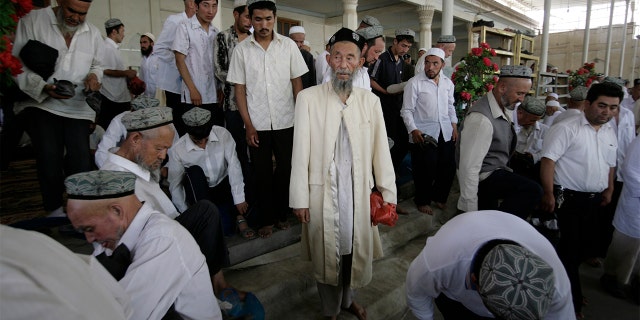
Muslims attend Friday prayers at a mosque in the former Silk Road city of Hotan, Xinjiang province. 
Muslims attend Friday prayers at a mosque in the former Silk Road city of Hotan, Xinjiang province.  (Reuters)
Uyghurs lived in the Xinjiang region for around 1,000 years before it was annexed by China in the mid-18th century.
For centuries prior, Xinjiang’s major cities like Kashgar and Urumqi – its present-day capital – were important trade hubs on the infamous Silk Road.
Following a revolt in the late 19th century, the region was given its current name, “Xinjiang.” This name carries negative connotations for most Uyghurs who privately refer to it “East Turkestan.”
In 1933, the region briefly declared independence but was quickly crushed by China. A decade later, the Soviet Union briefly supported the creation of the “Second East Turkestan Republic,” before withdrawing its support and backing the Communist takeover of China.
Today the Uyghur population in Xinjiang is roughly 11 million, or about 60 percent of the region.
For decades, tensions have existed between Uyghurs and Han Chinese, who are the ethnic majority of China. Beijing, likewise, has deemed Uyghurs a threat for its adherence to Islam.
Following a series of terrorist attacks in the early 2010s, China began a brutal crackdown in the region that has resulted in an estimated 1 million Uyghurs being thrown into concentration camps without charges or a trial. 
This campaign has provoked international condemnation for alleged human rights abuses. China initially denied the existence of camps, but a mountain of evidence forced them to acknowledge the camp’s existence.
Today, China maintains that these camps are “vocational centers” to provide job training and Mandarin lessons to help Uyghurs better assimilate into society.
he U.S. Congress has introduced two bills aimed at sanctioning individuals responsible for the mass detention of Uyghurs. But the bills have been temporarily shelved with the world’s attention focused on the COVID-19 pandemic.

Media Release from Burmese Rohingya Organisation UK (BROUK)

  UN rights chief calls for ‘reality check’ on Burma as BROUK warns Rohingya face erasure The Burmese Rohingya Organisation UK (BROUK) today...