Friday, April 29, 2022

Russia, Israel and the Media BY ROBERT FANTINA

 The world is, very reasonably, horrified at what is happening in Ukraine. Russia is apparently committing war crimes and crimes against humanity as it bombs residences, hospitals and any other sites its warplanes encounter.

The headlines are jarring:

“Russia bombs five railway stations” (The Guardian).
“Russia bombs Ukraine Steel Plant” (Daily Sabah).
“Russia using cluster bombs” (The Guardian).
“Russia restarts bombing” (iNews).

These are just a few examples.

Let us look now at some other headlines:

“Israel Airstrikes Hit Gaza After Rocket Fire” (Wall Street Journal).
“Israel Airstrikes Target Gaza” (Sky News).
“IDF Says it Struck Hamas Weapons Depot” (The Times of Israel).
“Israel Military Launches Airstrikes” (New York Post).

Is it just this writer, or does it appear that ‘airstrikes’ seems a lot more benign that ‘bombs’? Why not say ‘Israel Bombs Gaza’ rather than sugar-coating the deadly bombing of innocent men, women and children? Would anyone find it acceptable to say that ‘Russian Airstrikes hit Ukraine Steel Plant after Resistance’?

We live in a world in which the masses are told who and what to concern themselves with and, generally speaking, that is white people. Some examples are illustrative:

  • CBS news correspondent Charlie D’Agata:  Ukraine “isn’t a place, with all due respect, like Iraq or Afghanistan, that has seen conflict raging for decades. This is a relatively civilized, relatively European – I have to choose those words carefully, too – city, one where you wouldn’t expect that, or hope that it’s going to happen”.[1]

  • A former deputy prosecutor general of Ukraine, stated the following: “’It’s very emotional for me because I see European people with blue eyes and blond hair … being killed every day.’ Rather than question or challenge the comment, the BBC host flatly replied, ‘I understand and respect the emotion.’”[2]

  • On France’s BFM TV, journalist Phillipe CorbĂ© stated this about Ukraine: “We’re not talking here about Syrians fleeing the bombing of the Syrian regime backed by Putin. We’re talking about Europeans leaving in cars that look like ours to save their lives.”[3]

  • An unidentified ITV journalist who was reporting from Poland remarked as follows: “Now the unthinkable has happened to them. And this is not a developing, third world nation. This is Europe!”[4]

  • Peter Dobbie, a reporter from Al Jazeera said this: “Looking at them, the way they are dressed, these are prosperous … I’m loath to use the expression … middle-class people. These are not obviously refugees looking to get away from areas in the Middle East that are still in a big state of war. These are not people trying to get away from areas in North Africa. They look like any European family that you would live next door to.”[5]

  • Writing for the Telegraph, Daniel Hannan explained: “They seem so like us. That is what makes it so shocking. Ukraine is a European country. Its people watch Netflix and have Instagram accounts, vote in free elections and read uncensored newspapers. War is no longer something visited upon impoverished and remote populations.”[6]

Apparently, bombs are dropped on white, Christian Europeans, but ‘airstrikes’ are launched on Middle-Eastern Muslims.

One of the items referenced above, from iNews, discusses the bombing of the Azovstal steelworks plant in Mariupol, where, according to the article, thousands of Ukrainian civilians have been sheltering. This has, rightly, caused international outrage. In 2014, The BBC reported on the Israeli bombing of a clearly-marked United Nations refugee center. “The attack on the school in the Jabaliya refugee camp, which was sheltering more than 3,000 civilians, took place on Wednesday morning (July 29, 2014).”[7] Where was the international outcry then?

In March of 2019, the United Nations condemned the attack on a refugee camp in Gaza that killed at least seven people, including a 4-year-old girl. [8] Again, why did the world ignored this?

In May of 2021, ten members of a single family, including two women and eight children, were killed by an Israeli bomb – oh! Excuse me! An Israeli ‘airstrike’ – in a refugee camp in Gaza. One must suppose that, since they don’t watch Netflix and drive ‘cars that look like ours’, one need not care about them. And it’s unlikely that any of them had the blue eyes and blond hair that is so admired by the former Ukrainian deputy prosecutor.

The United States government has publicly called for an investigation by the International Criminal Court (ICC) into possible war crimes committed by Russia against the Ukrainian people (a bit ironic, considering the U.S. has refused to sign the Rome Statute that established the ICC, not wanting the U.S. to be investigated for its many war crimes). Yet the U.S. government has also condemned the ICC investigation of possible war crimes committed by Israel against the people of Palestine. Note, please, that the U.S. and Israel are not opposing the charges against Israel, only the investigation of those charges.

It is no secret that racism is alive and well and thriving in the United States. It is also not surprising that it rears its ugly head internationally, as demonstrated most explicitly by the quotations mentioned above.

Another concept that isn’t surprising is U.S. hypocrisy; this writer, along with many others, has commented on it many times before. Note that when the U.S.’s ‘enemy’ (Russia) commits war crimes against a mainly white, mainly Christian, European country, the U.S. will support that victim-nation with arms and money, and will endorse the ICC investigation fully. But when a U.S. ‘ally’ (Israel) commits war crimes against a mainly Muslim, Middle Eastern country, well, that’s a different story altogether. Doesn’t sacred Israel have the right to defend itself, U.S. officials will ask, disingenuously. As Palestinian activist Hanan Ashrawi has said, “the Palestinians are the only people on earth required to guarantee the security of the occupier, while Israel is the only country that demands protection from its victims.” It is illogical for a perpetrator to ‘defend’ itself against its victim. It is like criticizing a woman who tries to fight off her rapist.

So the world will continue to hear about atrocities in Ukraine, as it should. At the same time, the news media in general will ignore or sugar-coat the same atrocities that Israel commits against the people of Palestine.

The people of the world have two responsibilities in this context:

1) Do not fall for it. Do not assume that because one victimized peoples don’t ‘look like any European family that you would live next door to’, that they are somehow less important, or that their suffering can be overlooked. They suffer, grieve, bleed, feel fright and terror, love and anguish, just the way we all do.

2) Demand better. Write letters to the editors of newspapers, magazines and journals, and to elected officials. Ask them why they focus on one suffering population, and not the others. Read independent journals that actually report the news, the circumstances that are happening around the world, without picking and choosing what they will report based on race and/or ethnicity.

It has been said if the people only realized the power they have, there would be major, positive change in the world. Seize your power; write, vote, march, demonstrate, protest, boycott, etc. to demand the changes that must occur. It is the responsibility of each and every one of us.

1. Bayoumi, Moustafa. “They Are ‘Civilised’ and ‘Look like Us’: The Racist Coverage of Ukraine | Moustafa Bayoumi | The Guardian.” The Guardian, The Guardian, 2 Mar. 2022, https://www.theguardian.com/commentisfree/2022/mar/02/civilised-european-look-like-us-racist-coverage-ukraine. 
2. Ibid
3. Ibid 
4. Ibid 
5. Ritman, Alex. “Ukraine: CBS, Al Jazeera Criticized for Racist, Orientalist Reporting – The Hollywood Reporter.” The Hollywood Reporter, The Hollywood Reporter, 28 Feb. 2022, https://www.hollywoodreporter.com/tv/tv-news/ukraine-war-reporting-racist-middle-east-1235100951/. 
6. Bayoumi. 
7. https://www.calendar-365.com/2014-calendar.html 
8. https://www.un.org/unispal/document/auto-insert-213680/ 


Robert Fantina’s latest book is Propaganda, Lies and False Flags: How the U.S. Justifies its Wars.

Bennett Must Tread Carefully: The ‘Sword of Jerusalem’ Could Be Unleashed Again BY RAMZY BAROUD

 Starting on April 15, the Israeli occupation army and police raided Al-Aqsa Mosque in Occupied East Jerusalem on a daily basis. Under the pretence of providing protection to provocative ‘visits’ by thousands of illegal Israeli Jewish settlers and rightwing fanatics, the Israeli army has wounded hundreds of Palestinians, including journalists, and arrested hundreds more.

Palestinians understand that the current attacks on Al-Aqsa carry deeper political and strategic meanings for Israel than previous raids.

Al-Aqsa has experienced routine raids by Israeli forces under various guises in the past. However, the significance of the Mosque has acquired additional meanings in recent years, especially following the popular Palestinian rebellion, mass protests, clashes and a war on Gaza last May, which Palestinians tellingly refer to as Saif Al Quds – Operation Sword of Jerusalem.

Historically, Haram Al-Sharif – or the Noble Sanctuary – has been at the heart of popular struggle in Palestine, as well as at the center of Israeli policies. Located in the Old City of Occupied East Jerusalem, the Sanctuary is considered one of the holiest sites for all Muslims. It has a special place in Islam, as it has been mentioned in the Holy Quran and frequently in the Hadith – the Sayings of Prophet Mohammed. The compound contains several historic mosques and 17 gates, along with other important Islamic sites. Al-Aqsa is one of these mosques.

But for Palestinians, the significance of Al-Aqsa has gained additional meaning due to the Israeli occupation which, throughout the years, has targeted Palestinian mosques, churches and other holy sites. For example, during the 2014 Israeli war on the besieged Gaza Strip, the Palestinian Ministry of Endowments and Religious Affairs said that 203 mosques were damaged by Israeli bombs, with 73 being completely destroyed.

Therefore, Palestinian Muslims, but also Christians, consider Al-Aqsa, the Sanctuary and other Muslim and Christian sites in Jerusalem, a red line that must not be crossed by Israel. Generation after generation, they have mobilized to protect the sites though, at times, they could not, including in 1969 when Australian Jewish extremist, Denis Michael Rohan carried out an arson attack in Al-Aqsa.

Even the recent raids on the Mosque were not confined to the bodily harm and mass arrest of worshippers. On April 15, the second Friday of Ramadan, much destruction took place at Al-Aqsa, where the Mosque’s famous stained-glass windows were shattered and furniture inside was left broken.

The raids on the Haram Al-Sharif continue, at the time of writing of this article. The Jewish extremists are feeling increasingly empowered by the protection they are receiving from the Israeli military, and the blank check provided to them by influential Israeli politicians. Many of the raids are often led by far-right Israeli Knesset member Itamar Ben-Gvir, Likud politician Yehuda Glick and former government minister Uri Ariel.

Israeli Prime Minister, Naftali Bennett, is undoubtedly using the raids on Al-Aqsa as a way to keep his often rebellious far right and religious constituency in line. The sudden resignation on April 6 of Idit Silman, a member of the Yamina right-wing party, left Bennett even more desperate in his attempt to breathe life in his fractious coalition. Once a leader of the Yesha Council, an umbrella organization of West Bank illegal settlements, Bennett rose to power on the back of religious zealots, whether in Israel or in the Occupied Palestinian Territories. Losing support of the settlers could simply cost him his post.

Bennett’s behavior is consistent with those of previous Israeli leaders, who have escalated violence in Al-Aqsa as a way to distract from their own political woes, or to appeal to Israel’s powerful constituency of rightwing and religious extremists. In September 2000, then Israeli Prime Minister Ariel Sharon raided the Mosque with thousands of Israeli soldiers, police and like-minded extremists. He did so to provoke a Palestinian response, and to topple the government of his archenemy Ehud Barak. Sharon succeeded, but at a high price, as his ‘visit’ unleashed the five-year long Second Palestinian Intifada, also known as Al-Aqsa Intifada.

In 2017, thousands of Palestinians protested an Israeli attempt at installing ‘security cameras’ at the entrances of the holy shrine. The measure was also an attempt by former Israeli Prime Minister Benjamin Netanyahu to appease his rightwing supporters. But the mass protests in Jerusalem and the subsequent Palestinian unity at the time forced Israel to cancel its plans.

This time around, however, Palestinians fear that Israel aims at more than just mere provocations. Israel plans to “impose a temporal and spatial division of Al-Aqsa Mosque”, according to Adnan Ghaith, the Palestinian Authority’s top representative in East Jerusalem. This particular phrase, ‘temporal and spatial division’, is also used by many Palestinians, as they fear a repeat of the Ibrahimi Mosque scenario.

Following the killing of 29 worshippers in 1994 at the hands of an Israeli Jewish extremist, Baruch Goldstein, and the subsequent killing of many more Palestinians by the Israeli army at the Ibrahimi Mosque in Hebron (Al-Khalil), Israel partitioned the mosque. It allocated a larger space to the Jewish settlers while restricting access to Palestinians, who are allowed to pray at certain times and barred at others. This is precisely what Palestinians mean by temporal and spatial division, which has been at the heart of Israeli strategy for many years.

Bennett, however, must tread carefully. Palestinians today are more united in their resistance and awareness of the Israeli designs than at any other time in the past. An important component of this unity is the Palestinian Arab population in historic Palestine, who are now championing a similar political discourse as that of Palestinians in Gaza, the West Bank and East Jerusalem. In fact, many of the defenders of Al-Aqsa come from these very communities. If Israel continues with its provocations in Al-Aqsa, it risks another Palestinian revolt as that of May, which tellingly started in East Jerusalem.

Appealing to rightwing voters by attacking, humiliating and provoking Palestinians is no longer an easy task, as was often the case. As the ‘Sword of Jerusalem’ has taught us, Palestinians are now capable of responding in a unified fashion and, despite their limited means, even put pressure on Israel to reverse its policies. Bennett must remember this before carrying out any more violent provocations.

The Second Level Geopolitical War in Ukraine Takes Over BY RICHARD FALK

 It has become increasingly clear to the world that there is not one, but two, actually three, distinct levels of conflict embedded in what the world’s media and political leadership deceptively insist of calling the ‘Ukraine War.’ The first level was clearly initiated on February 24, 2022 when Russia launched an aggressive war against Ukraine imperiling its sovereign rights and territorial integrity. The second level was difficult to discern in the first weeks of the war, but became soon evident as the NATO countries led by the United States placed an increasing emphasis on lending escalating support to Ukraine’s adopted goals of achieving an unexpected military victory. This support took various forms including the steady supply of heavy weaponry, robust economic assistance, punitive sanctions, and a drumbeat of ‘official’ demonization of Russia and its leadership. In the beginning it seemed appropriate to lend support to Ukraine as the target of aggression, and hail the resistance effort led by President Volodymyr Zelensky, in defense of a relatively small country being overrun by its large neighbor.

Even this widely endorsed narrative was deceptive and one-sided as it overlooked the provocative nature of NATO expansion, abetted in Ukraine’s case by American interference in the internal politics of the country to help turn the political tide in the country against Russia. It is  in this internal setting that the third level of the war persists as there is no doubt that anti-Russian elements in Western Ukraine were deeply abusive toward the majority Russian speaking population in Eastern Ukraine known as the Donbas region. The non-implementation of the Minsk Agreements negotiated in 2014-15 to protect the Ukrainians in the East was never properly implemented. It remains uncertain as whether the Russia/Ukraine level of combat can be resolved without serious addressing Russian and Donbas concerns at the core of this third level of conflict.

What has been apparent to critics for some time is that Western diplomacy has become primarily committed to second level Geopolitical War even at the cost of greatly prolonging and aggravating the Ukrainian war on the ground and producing growing risks of a wider war. Only in the past few days has this priority been more or less acknowledged by high officials in the U.S. Government, most dramatically in the visit of Antony Blinken, Secretary of State, and Austin, Secretary of Defense to Ukraine and later to meeting in Europe with their NATO counterparts. What was revealed was that the number one policy goal of the U.S. was ‘the weakening of Russia’ made a viable undertaking by the unexpected resistance capabilities of Ukrainian armed forces bolstered by a show unified patriotic resolve. In keeping with this line of thinking, arms shipments to Ukraine were increased significantly, and more tellingly, overtly acknowledging the shipment of so-called heavy armaments with offensive capabilities. As this dynamic unfolded, Germany dramatically reversed its policy of not providing heavy weaponry, and the whole tenor of assistance was shifted from helping Ukraine resist to addressing the geopolitical agenda with its two goals: inflicting a humiliating defeat on Russia and signaling China not doubt Western resolve to defend Taiwan.

Despite this shift in emphasis, earlier concerns with escalating the Geopolitical War with Russia have not been abandoned, such as inducing situations that tempt the use of nuclear weapons. White House perceptions of what will cause such a temptation seem dangerous divergent. Apparently, the Biden presidency continues to oppose a No Fly Zone in Ukraine because it would greatly increase the prospects for direct combat encounters between the NATO and Russia, and with it risks of this new species of cold war turning hot. But what of Biden’s demonization of Russia as guilty of genocide and Putin as a war criminal who should be driven from power. And what of the continuously increasing diplomatic, financial, and military assistance to Ukraine. What has been missing all along has been any indication by Washington of receptivity to a diplomacy emphasizing the primary humanitarian imperative of an immediate ceasefire and a political process of compromise and mutual security between Russia and Ukraine the overt international antagonists. It is missing because the U.S. commitment to the Geopolitical War takes precedence over the wellbeing of the Ukrainian people.

Zelensky early in the war indicated receptivity to a ceasefire and political compromise, including permanent neutrality for Ukraine, and signaled his willingness to meet with Putin. More recently, however, Zelensky has pulled back from this dual stance of armed resistance and peace diplomacy, and come to adopt a position seamless with that of the U.S. My conjecture is that Zelensky, although displaying great talents as a wartime resistance leader has very little sophistication about international relations in general, and seems susceptible to this more militarist line both by promises of decisive support from Washington and possible militarist advice from his own general staff. After all, Zelensky’s background is in theater and as a performing comedian without any signs that he is aware the wider risks at stake if Ukraine goes along with premises of the Geopolitical War.

As expected, Moscow has already reacted to this escalation of the second war with the warning that it will not back down, but will take all necessary steps to protect its national security interests, intimating a possible recourse to nuclear weapons. Such inflamed atmospherics can easily produce preemptive acts that accelerate escalation, which is especially serious in the current context that lacks crisis management links of the sort established between Moscow and Washington in the aftermath of the Cuban Missile Crisis. It took that close encounter with an all out war scenario that led these superpower antagonists to understand that they had averted a monumental mutual catastrophe by sheer luck.

While most attention is focused on the inter-governmental play of forces it is helpful to take account of other perspectives: civil society peace initiatives, the views of the Global South, and the initiatives of the UN Secretary General. These perspectives call attention to the startling fact that alternatives to war and geopolitical ambition exist, and that Russia is more globally supported in the Geopolitical War than is the United States. The Global North controls the discourse prevailing on the most influential media platforms, creating the misleading impression that the whole world, except the outliers, are content with U.S. leadership.

Civil Society Initiatives

Almost from the day the Russian attack began, peace activists and NGOs concerned in some way with peace, security, and humanitarianism urged an end to the killing by way of a ceasefire and some political process that dealt with the level 1 and 3 grievances. This is not to say there were not sharp tensions within civil society, especially surrounding how to interpret the pre-war NATO maneuvers  or the strife in Dombas. Provocations. By and large the liberal and left liberal mainstream supported outright condemnation Russian aggression, but favored an immediate ceasefire and diplomacy to ending the war and mitigating the humanitarian emergency of death, devastation, and displacement. Those who can be crudely identified as the anti-imperial left tended to excuse or at least place heavy emphasis on the context of Western provocations and interference in Ukraine’s internal politics since 2014 as did some on the extreme right who identified with Putin’s authoritarianism as the wave of the future.

What contrasted the civil society perspectives in spite of their diversity, with NATO/mainstream media postures, was their shared stress on stopping the killing , the relevance of diplomacy, and their implicit or explicit refusal to condone recourse to the Level 2 Geopolitical War. Typical examples of civil society proposals can be found in the Pugwash Peace Proposal and the Just World Education booklet distributed under the title “Ukraine: Stop the Carnage, Build the Peace” (available from Amazon or from www.justworldeducational.org with its eight policy recommendations).

The Voice of the Global South

Given little notice in the Global North was the refusal of the greater part of the Global South to support the mobilization of coercive and punitive sanctions diplomacy directed at Russia and its leader. This split from the West first became evident in the two votes on Ukraine in the UN General Assembly. The entire world including the most of the main countries in the Global South supported the condemnation of the Level 1 Russian aggression, but either abstained or opposed support for the Level 2 Geopolitical War Initiated by the U.S. against Russia in the early stages of the attack on Ukraine. As Trita Parti of the Washington-based think tank, Quincy Institute, pointed out much of the Global South actually supported Russia in the Geopolitical War context, which was interpreted as the U.S. commitment to extending the mandate contained in a unipolar world order of the sort it had acted upon since the Soviet collapse and the end of the Cold War. The Global South greatly preferred the dynamics of a multipolar world, and regarded Russia as seeking in Ukraine to reassert its traditional geopolitical suzerainty over its ‘near abroad,’ a stand against the U.S. as the unopposed guardian of security throughout the planet. It should be appreciated that the U.S. has 97% of overseas military bases and accounts for 40% of the world’s military expenditures, or more than the next 11 countries.

The U.S. position is no way renounces traditional geopolitics but seeks to monopolize its implementation. In that spirit it views the attempted reassertion by China and Russia of traditional spheres of influence as an intrusion on international law, while the U.S. at the same time defends its practice of managing the first global sphere of influence in world history. Blinken has said as much, declaring spheres of influence as contrary to international law ever since World War II while claiming for the U.S. the sole prerogative of managing security throughout such a rule-governed world. The UN or international law are subjugated in the face of this assumption of geopolitical dominance resting on a mixture of political ambition and military capabilities.

The UN Secretary General

Throughout the Ukraine crisis Antonio Guterres, the UN Secretary General, has articulated a point of view toward the Ukraine Crisis that contrasts in fundamental ways from the positions taken by the political actors on the three levels of conflict. His words and proposals are much closer in spirit to the calls emanating from civil society and the Global South. He expressed the spirit of his endeavors concisely shortly after Russia attacked: “End the hostilities now. Silence the guns now. Open the door to dialogue and diplomacy.” “The ticking clock is a time bomb.”

Traveling in Moscow to meet with Putin and the Foreign Minister, Sergei Lavrov, the message was the same: Focus on ways to end war, and desist from carrying the fight against Russia a day longer.

He told Lavrov that “We are extremely interested in finding ways to create the conditions for effective dialogue, create conditions for a ceasefire as soon as possible, create conditions for a peaceful solution.” Putin in their one-on-one meeting given the aggressiveness of his counterpart in Washington seemed guardedly receptive to allowing the UN and Red Cross to play a humanitarian role in Ukraine and seemed willing to seek a negotiated end to the conflict on the ground. Of course, it is premature to reach any assessment until deeds follow words, but we have yet to hear a comparable level of peace-mindedness in Biden’s public statements, which so far seem calculated to stir anti-Russian fury rather than to set the stage for ending this frightening multi-level conflict.

The stark difference between the UN SG’s approach and that of the geopolitical leadership of the world, should make many persons dedicated to a better future initiate a campaign to set the UN free from geopolitical primacy.

Conclusionary Observation

Unraveling the intertwined nature of these three levels of conflict bound up in the ambiguities of the Ukraine War is crucial for an understanding of its complexity and to analyze whether responses and proposals are of service to the general betterment of humanity. It also facilitates the identification of unresponsive policies and proposals. On this basis, I believe that two overriding assessments emerge: stop the killing by all means available and unconditionally repudiate the Geopolitical War.

Richard Falk is Albert G. Milbank Professor Emeritus of International Law at Princeton University and Visiting Distinguished Professor in Global and International Studies at the University of California, Santa Barbara.

Youngest Guantanamo inmate approved for release, needs country for 'rehabilitation'

 Hassan bin Attash, Guantanamo Bay's youngest detainee, has been cleared for release. This marks the latest departure from the controversial prison camp that every US president has promised to close since it was opened two decades ago.

The Yemeni national, who grew up in Saudi Arabia, has been held since 2002, when he was captured in a raid in Pakistan. He and his brother Walid have been at Guantanamo since 2006.

He has been accused of conspiring to commit the 9/11 attacks, though he has never been formally charged.

The main stipulation for his release is finding a country where he can be "rehabilitated", according to the Pentagon, which made the announcement on Tuesday.

Though known to be Guantanamo's youngest inmate, his exact age is unclear. A New York Times report says he was born in 1982 or 1985.

Khmer Rouge Tribunal, helping Cambodians heal, nears end

 After 19 years, hundreds of millions of dollars and just two successful convictions, the Khmer Rouge Tribunal in Phnom Penh is approaching its end.

The only case now ongoing for atrocities committed in Cambodia by Pol Pot’s brutal regime is an appeal by Khieu Samphan, who was convicted in 2018. The country’s youthful population is anxious to move on from a national identity characterised by a genocide it does not remember, while an ageing political elite is keen to limit chains of accountability before they edge too close to home.

Cambodia’s National Assembly, where the ruling party has every seat, has voted unanimously to wind up the court’s activities by the end of this year.

But despite the difficulties that dogged its progress – from funding to political obstruction to the death of defendants before verdicts could be reached or charges laid – the court forced the horrors of the Khmer Rouge out into the open and will have a profound effect on future fights for justice around the world.

Not only as an invaluable example for future study and prevention, as Youk Chhang, director of the Documentation Centre of Cambodia (DC-CAM) and a survivor of the Khmer Rouge, puts it. But also, as former chief of investigations for the tribunal Craig Etcheson explains, because it brought into sharp focus the immense challenge of pitting a slow-moving, technically-minded judicial establishment against an experienced, tenacious leader who is determined to politicise the process.

The Extraordinary Chambers in the Courts of Cambodia (ECCC), known informally as the Khmer Rouge Tribunal, was set up in 2003 by the Cambodian government and the United Nations but was designed to have judicial and political independence from both.

Its purpose was to identify and prosecute those responsible for atrocities committed by the Khmer Rouge, the ultra-Maoist political party led by Pol Pot, whose rebel forces seized control of Cambodia from 1975 to 1979. Allegations included mass murder, torture, forced marriages and the genocide of Cambodia’s Cham and ethnic Vietnamese minorities.

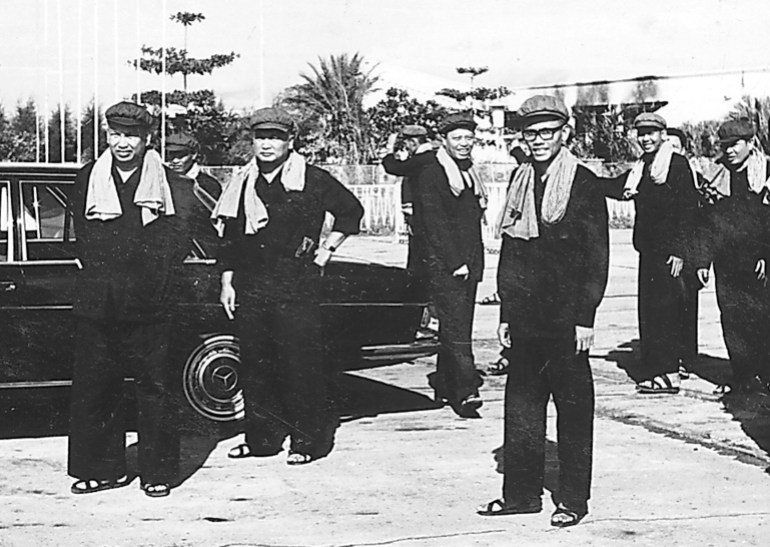
Pol Pot, Noun Chea, Leng Sary, Son Sen and other supporters pictured in Phnom Penh in thir customary black outfits next to a Mercedes Benz during the Khmer Rouge regime
Khmer Rouge leaders (L-R), Pol Pot, Nuon Chea, and Ieng Sary with other officials and Khmer Rouge guards. Pol Pot died before the court was convened, Ieng Sary died before a verdict was reached, while Nuon Chea died at 93 after being found guilty of genocide [File: Documentation Center of Cambodia Archives via EPA]

During the Khmer Rouge’s brief time in power, Cambodia’s educated, professional classes were eviscerated, the cities emptied, and the population redistributed to collective farms and rural construction projects. In just four years, approximately two million Cambodians were either killed or died of starvation, overwork and disease.


“What would ‘justice’ look like when we are talking about two million people killed, millions of families ripped apart, and an entire culture whiplashed to within inches of its very existence?” asked Etcheson. “My expectation would be that there is no kind of justice which would satisfy everyone in the wake of such catastrophic crimes.”

Yet many have tried.

Privacy Policy

Ever since senior Nazi commanders were tried (and hanged) at Nuremberg in 1946, international criminal tribunals have been set up to prosecute war criminals everywhere, from Japan to Rwanda and Iraq.

Some, like the International Criminal Tribunals for Yugoslavia and Sierra Leone, were run by the UN. Others, including atrocities committed in Uganda, Palestine and Myanmar, are being investigated by the International Criminal Court (ICC). Myanmar is also facing a genocide case at the International Court of Justice (ICJ).

‘Hybrid’ court

What makes the ECCC unusual is that it is a ‘hybrid’ court: a joint project between the UN and the Cambodian government.

The UN and Cambodian legal teams work in parallel, and judgements are made in accordance with Cambodia’s laws. The idea was to give the court’s verdicts legitimacy in Cambodia, avoiding the kind of accusations levelled at many UN and ICC courts in the past – that they are neo-colonial interventions imposing Western perspectives on sovereign states, for example – and ensuring that those prosecuted would actually go to jail.

It also placed greater emphasis on victim testimonies and community dialogue, improving on earlier models like Yugoslavia, where the UN-run court failed even to release transcripts and press releases in Serbian or any other local languages for the first six years of its operations.

But the hybrid model also meant the court has had to contend with the interests of a country rated 127 out of 128 for the rule of law. This includes sticking to cases sanctioned by the Cambodian side – and by extension, the country’s all-powerful prime minister, Hun Sen, himself a former Khmer Rouge cadre.

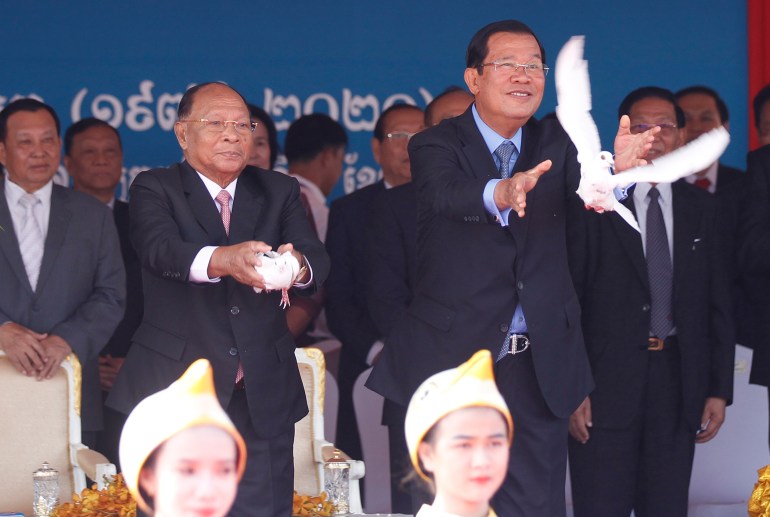
Hun Sen, in a blue suit, releases a white dove into the sky during a parade to mark Cambodia's liberation from the Khmer Rouge
Cambodian Prime Minister Hun Sen (right) releases a dove during celebrations to mark the liberation of Cambodia from the Khmer Rouge. He was a cadre in the ultra-Maoist movement but later joined forces with the Vietnamese to topple the regime [File: Mak Remissa/EPA]

In 2011, a group of UN lawyers protested against the decision to drop investigations into two military leaders, accusing senior judges of caving to government pressure and failing to “discharge their legal obligation to ascertain the truth”. In the aftermath, UN Judge Siegfried Blunk and his Cambodian counterpart You Bunleng resigned, citing attempted interference by Hun Sen’s government.

Over the past two decades, the court has brought four cases involving nine individuals to trial.

The first case led to the successful prosecution of ‘Comrade Duch’ (his real name is Kaing Guek Eav), who ran the notorious prison S-21 – a former school building where more than 18,000 men, women and children were tortured into confessing to farcical acts of treason, before being sent for execution in the Killing Fields.

Under the second, Khmer Rouge Chairman Khieu Samphan and ‘Brother Number Two’ – Pol Pot’s second-in-command – Nuon Chea were both convicted in 2018 on genocide charges.

By this time, most architects of the genocide were already dead or too infirm to stand trial.

Pol Pot had died long before, in 1998 and his military chief Ta Mok, nicknamed ‘The Butcher’ for his brutality, died in custody in 2006 before the trials began.

As proceedings dragged on, ‘Brother Number Three’ Ieng Sary died of heart failure before a verdict was delivered. His wife Ieng Thirith, who had served as minister of social affairs under the Khmer Rouge, developed Alzheimer’s disease and was declared unfit for trial. Ao An, charged with crimes against humanity as head of the country’s ‘Central Zone’, died at home in his village in Battambang in 2020, aged 87. Meanwhile, Nuon Chea appealed his conviction before dying in 2019, aged 93, while still awaiting the outcome.

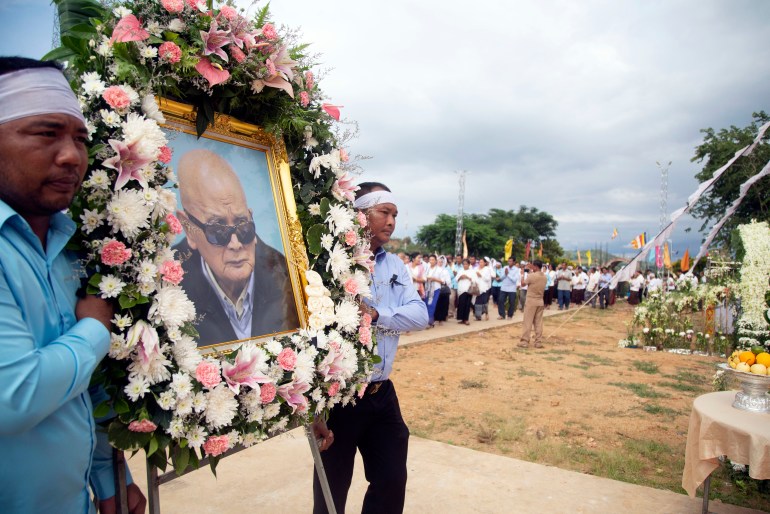
Relatives carry a portrait surrounded by fresh flowers of former Khmer Rouge's chief ideologist and No. 2 leader, Nuon Chea, during his funeral procession in 2019
Relatives carry a portrait of Nuon Chea, who was the right-hand man of Pol Pot and was found guilty of charges of genocide at the Khmer Rouge Tribunal. He died at the age of 93 [File: Chorn Chanren/AP Photo]

Frustrations mounted when the court dismissed charges against ex-navy commander Meas Muth in December 2021, bringing the third case to a close. Case 4, the last one left, has also fallen apart – charges were dropped against co-defendant Yim Tith in January 2022, and the prosecution has run out of appeals to bring to trial 74-year-old grandmother Im Cheam. Many feel that, even if she had been convicted, it would have been too late for any real justice to be done.

Im Cheam – who allegedly oversaw the deaths of half a million people – has lived out her days surrounded by grandchildren on her farm in Cambodia’s rural northeast.

Political pressure

Almost since its inception, the ECCC has had to contend with increasing pressure from the ruling Cambodian People’s Party (CPP).

Hun Sen initially welcomed the court; prosecuting Pol Pot’s clique for war crimes helped vindicate his leadership after years of being snubbed by an international community that refused to recognise his Vietnam-backed government and insisted on dealing with the Khmer Rouge until the Paris Peace Agreements were signed in 1991.

But Hun Sen’s support was based on the expectation that the court would stick to investigating politically safe targets with no connection to the ruling party, and that just the most senior Khmer Rouge leaders would be brought to trial.

It is not surprising that Hun Sen, a Khmer Rouge commander himself before defecting to Vietnam in 1977, would strive to limit accountability to the very top of the chain of command. But in a country where many survivors live in the same village as former executioners, he may have genuinely feared that the threat of mass trials would undermine Cambodia’s fragile peace.

When UN lawyers tried to broaden their scope, Cambodian judges in the ECCC pushed back and the political elite became less and less cooperative. As Etcheson points out, in the first two cases, the government cooperated fully in surrendering the accused to the court, while “notably failing” to do the same for the other two cases. Another tactic to undermine the tribunal was withholding the salaries of Cambodian tribunal staff in 2013, triggering a strike and temporarily bringing the court’s activities to a halt.

The spectre of political interference has brought criticism, including from Human Rights Watch which described the two successful convictions in 2014 as “too little, too late” and dismissed the court as a “fundamentally flawed” failure. Others are frustrated with the duplicated costs of setting up parallel Cambodian and international systems in one court and rampant corruption in the Cambodian judiciary’s hiring processes.

Two female students stand at a door behind rusted barbed wire as they visit the Tuol Sleng Genocide Centre from where the Khmer Rouge sent thousands of Cambodians to their deaths
Cambodian students visit the Tuol Sleng Genocide Museum (S-21 prison) in Phnom Penh. Experts say the most important legacy of the Khmer Rouge Tribunal will be teaching Cambodians about the horrors of the past [File: Mak Remissa/EPA]

This included the expectation that those given well-paid jobs at the court would pay bribes to secure their position plus a portion of their salary to their bosses. Demanding that subordinate staff pay up to half of their salaries up the chain of command is a common practice in the Cambodian judiciary, government, military and police, as confirmed by multiple police and diplomatic sources who asked to remain anonymous.

Confirming atrocities ‘for perpetuity’

Despite these headaches, reaching verdicts has been “a transparent exercise,” says former US Ambassador for War Crimes David Scheffer, who was appointed to advise the UN Assistance to the Khmer Rouge Trials in 2012. “Yes, one can find setbacks, but I think the court will stand the test of time.”

While Scheffer acknowledges the court’s “imperfections”, he believes that without it, the Cambodian people would have lost the chance to hold any of the Khmer Rouge’s top figures accountable.

While some may have ultimately evaded trial, he says, the process created a powerful historical record based on publicly presented, rigorously interrogated evidence that will “confirm the atrocities of the Pol Pot regime for perpetuity”. Not only was this the final nail in the coffin for the Khmer Rouge’s credibility back in the late 1990s, says Scheffer, but it should also make it impossible to whitewash their crimes in the future.

Crucially, the court has doubled as a form of truth and reconciliation commission, giving thousands of survivors the opportunity to tell their stories, be heard, and be believed. Engaging so many Cambodian people in this process was no small feat, says Kip Hale, a UN expert on atrocity crimes accountability, who formerly worked for the office of the co-prosecutor at the ECCC. Hundreds of thousands of people spent a day in court, and millions listened or watched on the radio and TV, he says. For Hale, that alone represents time and money well spent.

Or, as Youk Chhang says, “the court has given so much power to the Cambodian people and a sense of ownership over their history.”

For Chhang, the true legacy of the court is its educational value for future generations. Indeed, the trove of evidence and testimony gathered by the court and DC-CAM provides a vital – and easily accessible – Cambodian-language resource of what happened under the Khmer Rouge.

Disagreement over the official narrative means it has received little attention in school history books and few students explore it in depth. Unless they hear stories directly from parents or grandparents, many young Cambodians have little understanding – or interest – in what really took place, says Darathtey Din, a communications and international affairs researcher from Phnom Penh.

While ambivalent about the impact and effectiveness of the court as a whole, Din feels that survivor testimonies play an important role in teaching people about the past and challenging tidy official narratives. “Our education system does not teach us to ask questions,” she says. “I think the younger generation should question why some things are not being said.”


As Youk Chhang explains, pursuing truth and justice is about more than reckoning with the past; it is about preventing history from repeating itself.

“People need to be reminded that this can happen,” he said.

And it does happen, as people fleeing state-sponsored violence in countries from Myanmar to Ethiopia and Afghanistan can attest. The ECCC may be coming to an end, but for survivors elsewhere, the nightmare is just beginning. The lessons learned from this tribunal may determine their access to justice in years to come.

SOURCE: AL JAZEERA

Myanmar’s partial Rohingya repatriation plan: Another attempt to mislead Bangladesh?

  On 15 August, the Myanmar Ministry of Foreign Affairs issued a press statement on the state’s “ongoing efforts” towards the repatriation o...