Sunday, July 31, 2022

Alarm grows as Orban prepares to take ‘pure Nazi’ rhetoric to US By Flora Garamvolgyi and Shaun Walker in Budapest

 A longstanding adviser to Hungarian prime minister Viktor Orbán who resigned last week has warned him that his far-right rhetoric could have tragic consequences.

The Hungarian leader sparked a backlash at home and abroad with a recent speech in which he spoke out against “race mixing”. Soon after, Zsuzsa Hegedüs, a sociologist who has known Orbán for 20 years, handed in her resignation, criticising the prime minister for what she called a “pure Nazi” speech.

“I am a Jew. And our generation’s job is to stop anything like this because we have seen what happened. Not just with Jews. In Rwanda as well. Ethnic hatred leads to genocide,” said Hegedüs in an interview with the Observer.

Orbán’s speech came at a showpiece annual gathering in Romania last weekend, which the Hungarian leader often uses to make important announcements. During his speech, he said mixing between Europeans was acceptable, but Europeans mixing with non-Europeans created “mixed race” people.

“We are willing to mix with one another, but we do not want to become peoples of mixed race,” said Orbán. He added that western European countries where this was seen as acceptable are “no longer nations”.

Orbán, who in April won a fourth consecutive term as prime minister, has frequently used far-right rhetoric, especially since 2015, when he emerged as Europe’s fiercest opponent of welcoming refugees and migrants. His repeated attacks on the Hungarian-born Jewish businessman and philanthropist George Soros have also been widely criticised as antisemitic.

Orbán thrives on controversy, and his anti-migration stance, as well as regressive policies on LGBT rights, have made him a darling of the international right. In the coming days he is due to travel to Dallas, Texas, and give the opening speech at the Conservative Political Action Conference (CPAC), an influential assembly of American rightwingers.

In May Orbán spoke at a special CPAC session in Hungary, when his speech referenced the “great replacement”, a conspiracy theory popular on the far right that claims there is a liberal plot to change the ethnic makeup of the US and European countries through immigration.

While Orbán’s statements have frequently prompted criticism from liberals, the reaction to Orbán’s words about mixing races has been stronger than usual.

The Hungarian Academy of Sciences condemned the comments, calling them “scientifically untenable” and “a dangerous ideology”, while Hungary’s chief rabbi, Róbert Frölich, also criticised the speech.

Hegedüs said she does not believe Orbán is racist and she had previously defended him from claims of antisemitism, she said. For some time, she had been concerned about the prime minister’s “illiberal turn”, but felt the recent speech crossed a line.

“I told Viktor about the things I found unacceptable before. I shouted at him sometimes. But he never crossed this line before. It really was a Nazi speech,” she said.

Numerous international politicians have also spoken out in disgust over the speech.

“Racism is a poisonous political invention. There should be no place for it in Europe where our strength comes from diversity,” said European Commission vice-president Frans Timmermans.

The US envoy to combat antisemitism, Deborah Lipstadt, criticised Orbán’s “use of rhetoric that clearly evokes Nazi racial ideology”.

Dani Dayan, the chairman of Yad Vashem, the Holocaust memorial centre in Jerusalem, also drew parallels with the Nazi past. “The statement made by the prime minister of Hungary, Viktor Orbán, is all too reminiscent of ideologies associated with the horrible atrocities of the Holocaust. The Holocaust teaches us that we must address such expressions swiftly and directly,” said Dayan.

In a sign that the backlash may have blindsided Orbán, he took the unusual step of backtracking somewhat, insisting that he was not talking about the mixing of races, but of cultures.

“I don’t want Hungary to become an immigrant country. It is not a question of race for us. It is about cultural differences,” he said during a visit to Vienna last Thursday.

“Sometimes I can be ambiguous. We are talking about a civilisational position. We are proud of what Hungary has achieved in the fight against racism,” he added.

As Orbán heads to the CPAC, it is unlikely that many on the American right will have been perturbed by his speech.

“The far-right represents an increasingly present part of the Republican community. The party has changed so radically. Ideas like the great replacement theory have become the mainstream for them,” said Rick Wilson, a former Republican strategist and co-founder of the Lincoln Project, an anti-Donald Trump political action committee, in an interview.

Orbán had warm relations with Trump and praise of Hungary’s “illiberal democracy” has frequently appeared on Fox News’s Tucker Carlson Tonight show. Carlson spent a week in Hungary last year and painted the country as a conservative paradise.

“Orbán is seen as anti-Europe, anti-immigration, anti-elite and anti-woke, which appeals to Republicans and conservatives,” said Tim Miller, the former political director of Republican Voters Against Trump.

Matt Schlapp, chairman of the CPAC, was asked last week if Orbán was still invited to open the gathering. “Let’s listen to the man speak. We’ll see what he says. And if people have a disagreement with something he says, they should raise it,” he said.

In Hungary, Orbán supporters in the pro-government media have been working hard to paint criticism of the speech as partisan and irrelevant.

A recent article in the pro-Orbán Magyar Nemzet accused Hegedüs of “deliberate lying, dishonesty and treachery”. Other outlets used insulting language about her or downplayed her importance.

Hegedüs said she was ignoring the criticism and claimed she had received many private messages of support from people inside Orbán’s Fidesz party who were also uneasy over the speech. “That is reassuring,” she said.

Hegedüs said she had “accepted” Orbán’s clarification that he was referring to the mixing of cultures and not races and believed the matter closed. However, she does not plan to withdraw her resignation and said with a possible economic downturn around the corner, incendiary rhetoric was particularly irresponsible.

“In times when people are desperate ... it’s much easier to mobilise the hateful,” she said.

Iran arrests ‘spies linked to Israel’s Mossad’

 The Iranian police have arrested the alleged leader and four other members of a spy network they suspect is affiliated to Israel’s secret services, Iranian law enforcement authorities have said.

They did not give the nationality of those arrested but said on Thursday that they had received training for armed operations and sabotage.

“The arrested five members of this spy network were given various pledges from [Israel’s] Mossad, including financial promises, to gather information from important areas across the country,” the law enforcement intelligence organisation said in a statement reported by the semi-official ILNA news agency.

In Israel, the Prime Minister’s Office, which oversees the foreign intelligence agency Mossad, declined to comment on the reported arrests.

Iran and Israel are longtime foes and are currently locked in a dispute over Iran’s nuclear programme.

Israel accuses Iran of backing militant attacks against it, while Iran says Israel has carried out a number of killings of Iranian officials, including that of a senior officer in May. Israel does not confirm nor deny such actions.

On Wednesday, Iran’s Minister of Intelligence Esmaeil Khatib said Tehran had foiled subversive actions from the “Zionist regime” – its term for Israel.

Iranian security forces have successfully carried out a number of operations against Israel over the last few months, he said without specifying what they consisted of.

Last week, Iran’s security forces said they had arrested a network of agents working for Israel who entered Iran from Iraq’s Kurdish region to carry out sabotage and what they called “terrorist operations”.

Nournews, an outlet affiliated with Iran’s Supreme National Security Council, had said the arrested agents were on their way to blow up an unspecified “sensitive centre” in Isfahan, which among other things houses the country’s main nuclear facilities.

The Natanz nuclear facilities in Isfahan were targeted by two major sabotage attacks in 2020 and 2021, which Iran condemned as “nuclear terrorism”.

The developments come amid intensified tensions with arch foe Israel, which has pledged to prevent Iran from acquiring a nuclear weapon at any cost as indirect talks with the United States to restore the 2015 nuclear deal have stalled since March.

Observers have pointed out that as tensions between Iran and Israel continue to grow, further escalation might be a possibility.

Antisemitism – most enduring and irrepressible social pathology of all timeby Steven J. Manning

 Hatred of Jews, virulent antisemitism, is not a political, economic, social or anthropological belief grounded in facts. It is an entirely destructive ideology.

Antisemitism is endemic in many populations. In fact it is congenital. Millions, perhaps billions of people are antisemites from birth, with no basis for being so other than, they are offspring of antisemites.

The prejudice and discrimination against Jews is both as individuals and as a group. And people. And a religion.

Both “Jews are bad” and the “worldwide Jewish conspiracy” have been and remain guiding lights of antisemites worldwide.

In many societies, to this day, Jews are blamed for many of their ills. And remarkably for the inability of those societies to advance. That is even true among wide segments of US society. It is a glaring paradox given the immense contributions by Jews to society, science and business.

The absurd belief of “worldwide Jewish conspiracy” endures to this day, in wide segments of many societies.

Just ask any cab driver in Budapest, why cab fares are so high. It is the cost of the gasoline. And that is because of the Jews. I know… I had an office in Budapest. Hungarians are among the most virulent antisemites about. Not that many years ago, during one of my fifty trips to Budapest, I was stuck there for Yom Kippur. Most unmemorable: I was unable to get into the iconic Dohány Street Synagogue – The Great Synagogue in Budapest. The security line was so long, by the time I was “wanded”, much of the service was done.

More memorable was on the anniversary of Kristallnacht a few years ago, when the skinheads blanketed the city with leaflets wishing the Jews a happy anniversary and, “Don’t worry, Jews. This time you will die here.”

Although Jesus and his disciples preached Judaism, ultimately Christianity spawned anti-Judaism dogma, the birth of antisemitism. In the year 70 c.e.,3 the Romans destroyed the Jewish state, giving birth to the worldwide Jewish diaspora.

That might have constituted the first genocide of Jews if not a holocaust.

It is widely acknowledged that evolved into methodical policy of political, economic, and social discrimination. Ultimately, so called “blood libels”, inquisitions, exclusion, degradation, marginalization, persecution, ghettos, pogroms, genocides, and repeated attempted annihilation.

Nearly a success in the hands of Hitler and his Germany.

Antisemitism did not begin with the Nazis. Certainly did it end with their defeat in world  war II. Over the ages, Jews have always been defined as “those people.” To be sure, Jews would prefer to not be the so-called, much less treated as the “chosen people.”

Racism and antisemitism were also facilitated by the development intellectually bankrupt theories of racial superiority and inferiority.

Perhaps an explanation of a succession of pogroms against the Jews, dating back to the 18th century.

One cannot discount what the hated Jews were relegated to. Jews in the “modern” centuries, think 14th to 17th, were relegated to certain jobs that Christians could not – by religious dogma – do. It was OK to have Jewish teachers. OK to have Jews handle money — become lenders of Christians’ money, while good Christians were prohibited.

Hitler capitalized on the “Jews so bad as to be sub-humans” hatred paradigm. He succeeded in convincing tens of millions of Germans that Jews were an impediment to German world domination. Thus, the need to exterminate them. To be entirely accurate, Communists and select others received honorable mentions in Hitler’s astoundingly successful propaganda movie.

At this writing, twenty-seven percent of Germans believe that Hitler was right – all the way around. That despite draconian laws that prohibit such expression, and essentially seek to control thought related to the Holocaust.

How is that going, you all?

But for the immediate post-war generations — perhaps just generation, it was the youth of Germany who kept the shame of their parents and grandparents incomprehensible inhumanity “alive”.

Try as enlightened Christians and even more relevant, enlightened leaders of Christianity, think popes, have tried to rehabilitate Jews and give them parity with Christians, they have failed spectacularly.

Regrettably most of the blind haters default to hate.

Studying, understanding, practicing tolerance or at least, peaceful coexistence, requires generations of enlightened parenting. Tragically, I hold out little or no hope for that.

Astonishingly, this is not taught in many of our fine schools.

Antisemitism is real and prevalent. A short while ago, I attended a telephone conference with a board of directors of a tech company. They consult with me on some matters. The uber-brilliant, new age CEO urged the team to “Jew down” the prices being paid to a vendor.

Projecting ahead, after what I said and how I said it to that antisemite, I expect to be suing for my fees. Thank God for Alex Bell. Otherwise, I might have been lead out of that meeting in handcuffs.

And then, a neighbor asked us for advice with a matter they have with their landlord. The lady of that house, added to her narrative: “you know, the guy is a Jew.”


Friday, July 29, 2022

US court finds Libya's Khalifa Haftar liable for war crimes

 A federal US judge on Friday issued a default judgement against Libyan commander Khalifa Haftar, finding him liable for war crimes against several Libyan families who have accused him of extrajudicial killings and torture.

Judge Leonie Brinkema's judgement, which follows a previous recommendation from a magistrate judge last month, paves the way for the families in three separate civil suits to seek monetary compensation.

Following Brinkema's decision, lawyers for Haftar confirmed that they would be withdrawing as the Libyan commander's counsel, leaving him without a lawyer going forward.

'This is the culmination of years of work with Libyan victims against what the war criminal Haftar has done for so many years in Libya'

- Esam Omeish, Libyan American Alliance

Sitting anxiously in the courtroom in Alexandria, Virginia, the Libyan family members and advocates working on the case quietly burst into joy as soon as they heard Brinkema's decision. For them, this was a major victory following three years of civil litigation to hold Haftar accountable for the torture and deaths of their loved ones.

"This is the culmination of years of work with Libyan victims against what the war criminal Haftar has done for so many years in Libya," Esam Omeish, president of the Libyan American Alliance, an advocacy group that serves as a lead consultant in one of the three lawsuits, told Middle East Eye.

"These people had the brave sense of fighting in a court of law, and they wanted to have their day in court," he said.

"After three years of going back and forth of, dealing with lawyers and judges and many hearings, today, we reached a conclusion of that judgment, saying that Khalifa Haftar indeed is liable for committing these crimes against the torture victims."

Multiple Libyan families had filed lawsuits against Haftar in US courts in 2019 and 2020, in which the Libyan commander was accused of torturing and killing their relatives.

The families filed their lawsuits under the Torture Victim Protection Act of 1991, a law that allows non-US citizens to seek compensation from individuals who, acting in an official capacity for any foreign nation, allegedly committed torture or extrajudicial killing.

Haftar, a US citizen who had been a Virginia resident for decades, unsuccessfully tried to have the civil lawsuits tossed out under the claim of immunity as head of state.

Earlier this year, Haftar was a no-show at a long-sought video deposition where he was going to be asked about his alleged role in the extrajudicial killings and torture of Libyan civilians in the country's decade-long civil war.

The next step in the legal case is a hearing where the judge will evaluate what kind of compensation package the families should receive.

According to the Wall Street Journal, Haftar has owned various property holdings in Virginia worth millions of dollars.

"We will now be moving towards the damage phase," Mark Zaid, a lawyer representing one group of the plaintiffs, said during a press conference shortly after Friday's hearing. "And we'll execute upon properties wherever we can find them anywhere in the world."

"It's rumoured he has hundreds of millions of dollars, perhaps more around the world."

Global ramifications for Haftar

The judgement has serious potential ramifications both inside Libya and around the world for Haftar, who has for years been vying to become the leader of the North African country.

"Within Libya, it is a wake-up call to many people who are trying to either partner with him and what they call a democratic transition of Libya through elections," Omeish said.

"You cannot deal with a criminal who is hellbent on dictatorship and ruling the country by force as a partner."

Libya's Khalifa Haftar a no-show for US deposition in war crimes lawsuit
Read More »

On the international stage, having Haftar found liable for war crimes in an American court of law could create diplomatic issues for the Libyan military leader, especially in terms of Libya's relationship with Washington.

A former CIA asset, Haftar returned to Libya following the country's 2011 uprising and served in the internationally recognised government until 2014, when civil war broke out in the country.

While an April 2019 phone call between Haftar and former US President Donald Trump stoked rumours that Washington was throwing its weight behind the commander, a source with direct knowledge of the matter previously told MEE that US-Libya ties soured soon after the call.

"This has to weigh in very heavily when we have a person liable in front of a civil suit, and he is still being courted as a potential leader of Libya, as a potential presidential candidate, as a potential partner with the United States," Omeish said.

"I think it's rather egregious for us to even consider engaging him or dealing with him."

In 2019, he mounted a 14-month campaign to take control of the country's capital, Tripoli. Fighting soon devolved into a proxy conflict with his Libyan National Army (LNA) receiving support from Russia, the United Arab Emirates, Egypt, Chadian and Sudanese fighters, as well as other mercenary groups.

Haftar was eventually pushed back after Turkey intervened by providing fighters, combat drones and military equipment to support the UN-backed government in Tripoli.

Following a ceasefire in October 2020 and the establishment of a new unity government, Libya was headed towards elections in December 2021, but the vote was delayed due to a constitutional crisis and the country continues to remain politically divided.

A path to criminal prosecution

War crimes by Haftar's forces and allied groups have been well documented, including by Middle East Eye in 2020 when it investigated and revealed mass graves found in the city of Tarhuna.

With Haftar having now been found liable in a civil lawsuit, the Libyan American Alliance has said they hoped this will now lead to a path towards criminal prosecution against him.

"We call upon the Attorney General Mr Garland and others to look into the criminality of this US citizen who has committed egregious crimes in Libya," Omeish said.

Zaid, the attorney for one of the group of plaintiffs, agreed that this case could soon go from a civil one to a criminal one.

"I have made this clear. I asked both the attorney general under the Trump administration and the Biden administration that under US law - which I actually helped work on 25 or so years ago, the War Crimes Act of 1996 - that Haftar as a US citizen can and should be prosecuted," Zaid said.

"And we still hope the Biden administration will do that."

Bangladesh: Time to be more pragmatic by Dr. Salehuddin Ahmed

 The latest monetary policy was declared yesterday, while the previous one was in July 2020. In my immediate reaction I want to question why monetary policies should come about on a yearly basis. It is not a budget which, under constitutional limitations, has to take place on a yearly basis. The monetary policy does not need to have such a requirement. Moreover, money variables deal with some volatility, so it is proper for it to be half-yearly. If that is done, there will be no need to issue periodic circulars which are on an ad-hoc basis.

Coming back to the monetary policy, it starts with a GDP growth of 6.1 per cent and inflation rate of 5.56 per cent. Some other macro variables including foreign exchange reserves also look good. But question arises on the growth rate and inflation. If you deconstruct the growth, it is difficult to see the sectors from which it comes from.

The Covid-19 pandemic has dealt a severe blow. Even then the agriculture sector and some select large industries have withstood that blow. But to justify a 6.1 per cent growth is difficult.

The inflation rate measurement has methodical problems. The reality does not conform to the official figure of inflation. Yet to me, the point here is that at this juncture, Bangladesh should not bother with so called trade-off between growth and inflation estimate.

What is now important is to revive the economy, create employment opportunities, boost up agricultural production and increase foreign currency earnings.

When I look at the monetary policy, I see Bangladesh Bank (BB) has mentioned it to be aimed towards investment and employment generation. In a tone of complacency, the BB states that its policy helped cottage, small and medium enterprises (CSMEs). How? What is the result? Has the Covid-19-induced package of the government announced last year benefitted small farmers? Yet the BB mentions that small farmers, street vendors, hotel workers, transport workers got some incentives. Time has come for BB and policymakers to be free from complacency and be more pragmatic.

The agricultural and rural credit policy mentions some packages like a refinancing scheme, credit guarantee scheme and startup fund for new entrepreneurs and self-employed. But the million dollar question is "'Do these people get access to the fund from banks and financial institutions?" Bankers, adopting conventional and routine procedures and with age-old orientation of profit making, risk reducing and aim of expanding their domains, still do not adopt innovative, forward looking and small-borrower friendly methods.

Bangladesh Bank mentions "Monetary Management and Supervision". What are the concrete actions? The BB must go beyond fixing targets and some monetary measures only. It also should emphasise on the implementation, monitoring and supervision of whatever policies, guidelines and norms exist for banks and financial institutions. The first step is to reduce all problems of banks and financial institutions, ensure good governance. Without fixing the pillars, how can a stable economy be built up? The four things which should be kept in mind, not only for the present monetary policy but for subsequent periods, are: (a) impact of Covid-19 on the economy-wide sectors, (b) impact of changes in global trade and business, (c) removal of inequality and injustice created due to faulty strategies, and misplaced priorities and finally (d) employment generation.

Last but not the least, it is pertinent to point out that though the monetary policy has some lacks when it comes to having effect, it is important that it builds confidence of the people in the financial sector, including the capital market.

The writer is a former governor of Bangladesh Bank.

Graft case: Former OC Pradeep gets 20 years, wife 21 years in jail

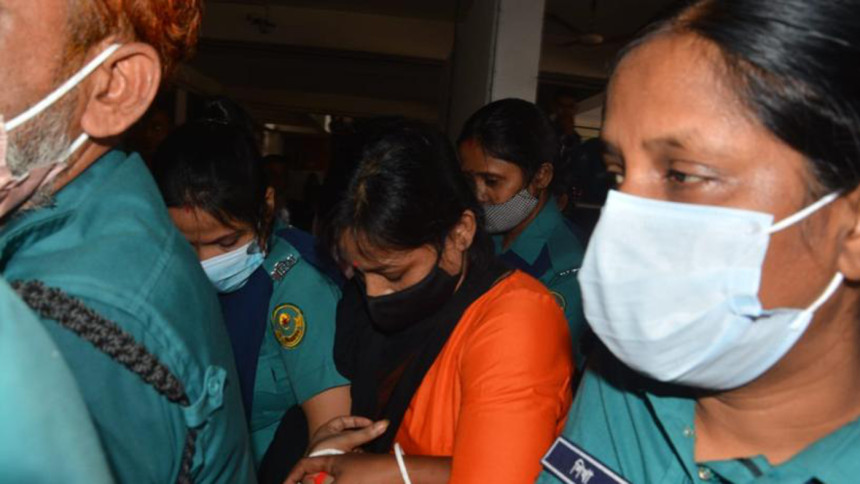
 A Chattogram court today (July 27, 2022) sentenced former Teknaf Police Station Officer-in-Charge (OC) Pradeep Kumar Das to 20 years in prison and his wife Chumki Karan to 21 years in jail in a corruption case filed by the Anti-Corruption Commission (ACC).

Chattogram Divisional Special Judge Munshi Abdul Majid passed the order this afternoon. The court has also instructed concerned authorities to confiscate all assets owned by the couple.

OC Pradeep and his wife were present in the court during the verdict. They were sent to jail afterwards.

Photo: Collected

OC Pradeep had been awarded death penalty on January 31 for the brutal murder of former army officer Maj (retd) Sinha Rashed Khan in Cox’s Bazar.

Israeli spyware company floods Washington with lobbyists despite blacklist by Nick Cleveland-Stout


Media Release from Burmese Rohingya Organisation UK (BROUK)

  UN rights chief calls for ‘reality check’ on Burma as BROUK warns Rohingya face erasure The Burmese Rohingya Organisation UK (BROUK) today...