Monday, May 30, 2022

In Order to Change the Past, Remember the Future Now BY PETER BACH


Photograph Source: Bracodbk – CC BY-SA 3.0

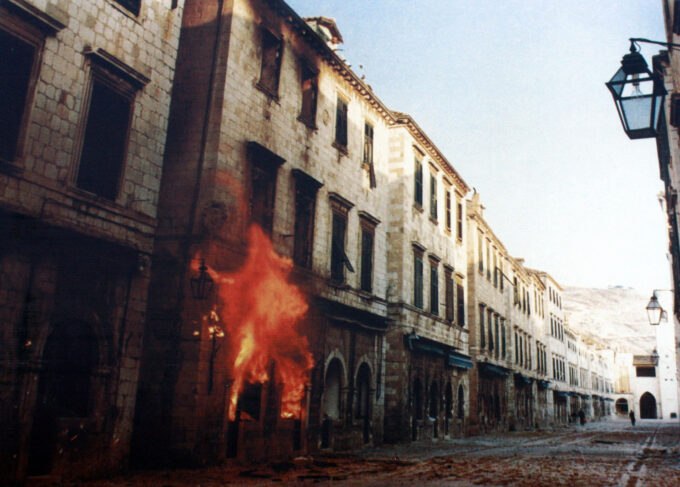
With all this talk of Ukraine as the first major European war since the Second World War, I can’t stop thinking about the shelling of Dubrovnik on December 6th 1991. Not Sarajevo, admittedly, but raining down nonetheless were what became a total of 727 shells on the Dalmatian city. These were each fired by the Yugoslav People’s Army (JNA), by this stage composed mainly of Serbs, whose president at the weekend of course has just announced that he has secured an “extremely favorable” natural gas deal with Russia. Fires in Dubrovnik burned out of control. Young blood splattered the coveted marble streets. This was followed by 122 days without water.

One local 21 year-old woman I met lost fourteen close friends all in their 20s. For a while, the sea was the only toilet, bread the only food. Talk about trouble in paradise. People scanned the horizon for the United States Sixth Fleet and no one came. This was a conflict which — in the face of Ukraine today — is not only forgotten now but was already forgotten back then when it was still taking place.

I was one of only five guests in Hotel Excelsior. Out of 214 rooms, 209 were still unoccupied. The Excelsior had seen much better days. It was where the Queen and Duke of Edinburgh, Margaret Thatcher, Willy Brandt, Sophia Loren, Richard Burton and Elizabeth Taylor had all stayed. The hotel alone received twenty-one direct hits. When news teams of the world pack up their metal cases and leave, all that is left is personal scrutiny. Who cares now about continued shelling in Syria? The recent Islamic State explosions in Afghanistan? In honour of those we will soon forget again, I want here to remember those who were already forgotten in the past. Or, as one Ghanaian said to me on another trip close to the Ivorian border: ‘In order to change the past, remember the future now.’

In this particular remembrance, barman Tihomir Topic was freshly back from the front line. He said that mine was the first gin and tonic he’d mixed in months. Outside, the Adriatic Sea smashed against the rocks. Sunlight picked at the spume. I’d been travelling the coastline with German photographer Florian Denk who would go on to make a photographic record of the mortuaries in Bosnia-Herzegovina. I had a contact at ABC News given to me by writer Adrian Dannatt and had just picked up a Hi8 camera from them in Split, the man teaching me how to use it saying, ‘Fuck the war.’ Tihomir at the bar then told me that all the hotel staff ran relays of buckets of water when the place was hit. ‘We nearly lost the Excelsior,’ he said, a quick glance at the mirror. The fact Dubrovnik was no longer considered newsworthy was like a double-blow for everyone still living there.

I remember hating myself for willing nothing but ill upon those wishing only to destroy. Though it is easy to feel the same about Ukraine, I am more circumspect now. The Dubrovnik sun was setting almost wearily above the Adriatic Sea. On the hotel verandah, a small private party was being prepared. This was to celebrate the hotel’s premature re-opening and it would prove an evening of pure nostalgia, as late-night bathers plunged into the sea and memories returned thick and fast. I was alerted to the presence of a pony-tailed Serb enjoying Croat protection and watched as he sat down and picked up an acoustic guitar. As he played, the lights of a small fishing boat dipped behind the island of Lokrum. ‘I pay for the musician myself,’ said the manageress, a tall woman who told me she had taken her shoes off during one attack and ran back to the hotel with bread in her hands: ‘I feel this place protected me,’ she said, smoothing the pleats of her jet-black skirt. Later, she serenaded a friend with a kind of under-used flourish.‘We mustn’t forget each other in this dirty war,’ she sighed. ‘We have become strange and far off but that doesn’t mean we have forgotten friendship.’ How such impressions chime with what can be imagined in Ukraine. A conflict where women as much as men show steel and non-Ukrainians bay for blood, too. As the song goes, when will we ever learn? The manageress at the Excelsior described herself as a Croat and Bosnian with a hint of Franco-Russian. I imagine Ukraine a bit like that too. Division is illusory or the construct of a madman. ‘Please keep me nameless,’ said the manageress. ‘Even I don’t know to whom I am talking.’

With his thick-lensed glasses and Abraham Lincoln beard, local poet Luko Paljetak told me he didn’t care who he was talking to. In the fading light, he was kissing everybody. So upset was he during the attacks on his city, he dispatched a letter to Buckingham Palace: ‘And I can only hope Her Majesty did not reply because Her Majesty did not receive it,’ he said. ‘I thought she might understand, especially after the fire at her beautiful Windsor Castle.’ Luko Paljetak had translated Chaucer, Shakespeare, Joyce, as well as a former favourite of mine, Malcolm Lowry. What he couldn’t translate was his withering love for western culture with what he was describing to me as its shameful lack of a response. ‘The world doesn’t want to show its red colours,’ he said, knocking over some red wine. ‘Look!’ he squealed at the tablecloth: ‘I’ve made a map of America! The land of the Coca-holics! No,’ he said, re-composing himself, ‘just because the people of Dubrovnik do not beg, it does not mean there is nothing that they need. All it means is that they’re proud.’

Many of the people of Dubrovnik seemed to harbour a kind of philosophical arrangement with themselves made during the worst of the attacks. This was to believe in hope or else go mad themselves. I have seen this in the strongest Afghan woman I know and in a former soldier now a man of peace. Hope does exist. Some in Dubrovnik did go mad, though. Suicide among the young was still on the rise when I was there, even if others took the less violent option of simply fleeing. Indeed, before Brexit, I knew of some of these people in London.

The military situation remained bleak but few people were conceding this. Had the TV cameras still been around, would they have conceded more? Were they saved, perversely, by the lack of a limelight? Croat forces still held the former Serb positions in the surrounding mountains. It was the kind of menacing stalemate that people see returning to Ukraine. All the Serbs had done was to withdraw into a large triangular formation in Trebinje, twenty or so miles away. They could pound the city whenever they wished. It was mercy not victory calling the shots, in other words, though mercy perhaps too strong a word. From the hotel verandah, I could certainly hear distant shelling. Indeed, I lay awake that night with my hands behind my head, listening to what I was unconvinced was thunder.

Next morning, the sun rose from the aforementioned Serb positions in the east. My German photographer friend and I caught a bus along a coastal highway still marked with shell holes. A yellow-painted bridge marked the spot of a recent assault. Nor was it such a leap to think back to thirteen centuries ago when this same coastal route would have been filled with refugees fleeing the barbarians. As it happened, we were not so far away from tourist-dependent places today like Budva over the border in Montenegro, where an expatriate community of several thousand Russians have been living. It is a mistake to believe the Russians are friendless.

After a bend in the road above some Croat army barracks in the outlying town of Cavtat, we came across Hotel Croatia. The driveway was worse than a building site. The pool was bone-dry. This image made quite an impression on me. What really set it apart was the torturing of staff. At least six members had their legs broken. The Serb commander at the time was unwilling to restrain his men from what was described as a two-week binge, not so unlike the Bucha massacre in Ukraine where civilians were killed by Russians called drunk. The Serb commander when he was at Hotel Croatia went so far as to tell everyone to prepare for tourists. ‘We believed him,’ said the only person there when we entered. Surveying the rubble, this woman, who was part of the remaining management team, looked at such a loss that everything she said was a victory in itself. ‘Prince Charles stayed here,’ she told me, trying to sound upbeat. She also said they probably needed seventeen million pounds to refurbish the place. Row upon row of empty rooms stared out at an empty sea. Unrolled carpets lined the corridors like giant cigars. ‘English Club,’ yawned a sign. It was so quiet you could have heard a grenade-pin drop. ‘Two hotel workers were targeted ten days ago,’ she said, 60mm Serb shells having hit the building: ‘There is no justice in the world. Believe me.’ On the verge of tears, she pulled back. Watching the news today from Ukraine, I think of so many people pulling back.

In the opposite direction, on the other side of the Excelsior, was Hotel Dubrovnik President, a huge industrial-type fortress on the estranged Babin Kuk peninsula. Wherever we looked, there was no end to unhappiness. Driving towards it was like approaching a large beached whale. Walking through it, I felt like Jonah. At reception, a figure stirred. ‘Oh,’ is all this person said. The charade of business as usual in what were basically bomb sites was for staff morale. Out of 70,000 beds in the area, only 500 were filled, and these mostly by Croats visiting ailing or displaced relatives. The only thing keeping people busy was repairing the place. Once done, no one dared predict the outcome, suffice to say everyone was broke and hundreds of lives depended on the hotels recovering. Only now do we know a full recovery was made, despite Covid. The figure at reception introduced himself as Mario Brnad before offering me a game of tennis. ‘Welcome,’ he added, endearingly. It was as though he’d been practicing this for years. Stepping out from his polished cocoon, he sidestepped a trail of fresh bricks while absentmindedly counting them. War does strange things to people.

He began telling me about the time locals were tearing down bushes for firewood while Serb fighters backed up by Montenegrin reservists attacked from land and sea. Straightening his short-sleeved shirt, he said he wanted to commemorate the Bokuns, a family whose father and son were killed by a single grenade. This was while playing with their radio on their balcony. Mario Brnad bowed his head. ‘And just so you know what kind of war this has been,’ he said, ‘the survivors of the family have the name, address and telephone number of the man from Titograd [Podgorica, its old name, had since been restored] who did this.’ He inhaled the fresh sea air with a kind of loathing. A lone speedboat spluttered across the blue water. ‘Many of those attacked knew their attackers by name,’ he said. According to him, often resentful Serbs and Montenegrins who once lived and worked among them. This doesn’t sound dissimilar to Russians believing Ukraine an intrinsic part of Russia. Two days before the first attack in Dubrovnik, many Serbs and Montenegrins left for what was euphemistically called ‘a holiday.’ Those who came back, came back as soldiers. ‘Are you sure you don’t want a game of tennis?’ I was asked again.

Back at the bar of Hotel Excelsior, I was told by his replacement that Tihomir had returned to the front line. The hotel was close to empty. A man who introduced himself as Captain Bozo Buric standing next to me was playing with the ice in his glass. At least it wasn’t his pistol, I was thinking. Buric was a Dubrovnik man. Within its tight community, he commanded considerable respect. ‘I had to learn to be a soldier fast,’ he told me, scratching the badge of his maroon beret. Buric was one of the so-called Famous Thirty. In December 1991, these were the people who defended the 1812 Napoleonic Fort representing Dubrovnik’s last line of defence. Ironically, it was a Dubrovnik Serb who fired the last mortar. Proof, if you like, of the area’s previously harmonious integration. ‘You see, we can all live together,’ he said. ‘We are different to the other side. For example, a Dubrovnik soldier would never shoot a civilian target.’ As the tiny crucifix dangling from his ear caught the last of the sunlight, there was no mention of Bosnian Croats backed by the Croatian army attacking civilians in Mostar. ‘I feel sad,’ he said, referring to family members killed in the conflict. He had lost four relatives, including a 40 year-old uncle and 30 year-old cousin, one of whom was butchered with a knife. ‘But I don’t have any hate,’ he said, ‘I just want this story to end.’ The barman squeezed lemon on my ice and Captain Buric said he longed for the day when he could return to the beach, his former playground: ‘Or start working again in a hotel, my former job.’ When this would be, he said he didn’t know. ‘But it has to be soon,’ he concluded, slapping the bar.

As I left the bar for an evening stroll, the only sound was the sea. By reception, a local Muslim man in a freshly laundered shirt looked up and nodded. By the exit, a woman was doing crochet, the small hooked needle working its way through a painstaking criss-cross of thread. ‘I hope you are going to say something positive about Dubrovnik,’ she said, not looking up: ‘Because if you don’t, we will kill you,’ she add with a mischievous chuckle.

Around the corner from Sponza Palace, up a half-deserted side street close to Dubrovnik’s one and only synagogue, I watched a group of troops weave past. They told me they were from Split. They stood briefly by some children on scaffolding pretending to be monkeys. One girl with neat blonde hair was playing with a doll. The doll was one of many given recently by the people of Italy. The soldiers moved on to a nearby bar and the manageress cleared two tables. They had a few hours to spare, they said, before returning to the front line. They were mentioning the word ‘snipers’ in English a lot. I wondered if this was for my benefit. They had just returned from visiting one of their men in a local hospital. Another of them was a former black belt champion now gently waving away a fly with his hand. The oldest pulled out a wicker chair for me and scratched his scalp and spat. A sergeant called Ivan meanwhile bullied his way into the conversation: ‘We heard Russian on the walkie-talkie today,’ he said. ‘There is Russia out there. They are working for Serb.’ He mentioned shouting to one Serb and asking what he was fighting for. ‘“Twenty beers,” he shouted back,’ he said, restlessly shaking his leg. ‘I don’t feel welcome in Dubrovnik. Every day I want go home,’ he added, harshly. They only felt welcome in this bar, they told me. ‘Maybe the people of Dubrovnik don’t like soldiers,’ he said. ‘Or they worry we will get drunk and wreck their beautiful city.’

One night, the Zagreb Philharmonic came to Dubrovnik and we were handed free tickets. Such attempts at cultural morale-boosting is no doubt not unknown today in western Ukraine. As the sun sank once more into the sea, crowds with glowing faces gathered by a flaming torch opposite a boarded-up fountain. This was in front of the famous 15th century Franciscan Church. The orchestra was attending the 44th Dubrovnik Festival. Officers, still in uniform, their boots still dirty from the front line, squeezed into dark-hued pews. My German friend was taking photographs, the red laser light of his camera settling on the skull of one senior member of the Croatian military, sending ripples of fear through the audience. This kind of technology was relatively new, and perhaps ambiguous.

Conductor Pavle Despalj appeared. He was so moved by the time he returned for a second encore dripping with sweat. In addition, no one dared stop clapping. It was as if to do so might risk losing contact with the outside world. ‘We love our music and we love our city,’ said one local afterwards. ‘That is all.’ It was the same with the Medelin Fortress. During the worst attacks, thousands huddled inside its thick walls. One morning, I met an old woman who had been living there. She was wearing black and grey and was too scared to leave. She was sitting on freshly repaired steps. ‘Hello,’ she said. ‘I love you. Help me.’

Through the Medelin Fortress, past the shielded 15th century Orlando’s Pillar, across the scarred white marble of the main street, sat Oxford don Kathy Wilkes in her cramped office at the top of several flights of stairs. Wilkes was famous for delivering philosophy lectures that veered in and out of politics like some Bodicean Sartre. These days, she was most famous for refusing to leave Dubrovnik when the city was under its greatest attack. Nor had the locals forgotten this, bestowing upon her honorary citizenship as well as making her an official member of the army. When we met, she had just arranged delivery of twenty-five mine detectors. Too modest to go into any kind of detail, I never got to hear about the time she drove an old British ambulance packed with medical supplies all the way from England.

What Wilkes did say was that she planned to stay in Dubrovnik until at least December when she would return to St Hilda’s College in Oxford. She recalled one incident in Oxford that came after a guest lecture. She was approached by a young man, a well-dressed Serb, who asked if she was Kathy Wilkes. ‘Yes,’ she said. She was then immediately called ‘a fucking Ustasha fascist bitch’. According to Wilkes, this person pushed her to the ground and kicked her in the face. ‘The Serbs in Oxford and London are very well organised,’ she said, dusting some cigarette ash from her sleeve. ‘We’ll look after her,’ reassured Ivan Burdulez, one of her colleagues. ‘No one will hurt her here.’ The nearby Inter University Centre had been heavily bombed and was now just a tall imposing shell with a large yellow crane above it. Nearly thirty-thousand books had been destroyed by the subsequent fire that raged for two days. The only section not consumed was the inner courtyard. There, six out of seven caged songbirds survived. ‘They were still singing but their feathers were matted with soot,’ said Kathy. Kathy Wilkes died in August 2003. I wonder if she would have gone to Ukraine.

I visited St Blasius Hospital one day, an overstretched bastion of goodwill. Each surviving ward was overcrowded. (The rest were destroyed.) They reckoned fifty-million dollars was needed to repair the deliberately targeted building. The most immediate concern was one hundred and fifty cubic feet of hazardous waste material from the incinerated bandages and outdated drugs. ‘We have a major problem,’ said a white-jacketed Dr Anton Car. Dr Car was renowned for crossing into Montenegrin- and Serb-held positions under fire to retrieve the wounded. With a marked absence of hatred, it was easy to forget villages had over half their populations tortured or killed. In fact, he wanted to talk about the shells which didn’t hit the city. Evidence, in other words, he claimed, of Serbs and Montenegrins not wishing to hurt Dubrovnik. ‘Best to think this way,’ he added. ‘To concentrate on the good.’

‘Humanitarian aid gets less and less by the day,’ warned Dr Liljana Betica-Radic. As she spoke, a middle-aged man suffering extreme psychosis lay strapped to a bed. Next door in a ward full of groaning women overcome with panic attacks was one woman with a sheet over her head. This was because she was dead. ‘As you can see, it is not only the soldiers who suffer in war,’ said Dr Betica-Radic. When I asked for a list of what was immediately needed, five pages of text were produced: anaesthetics, analgetics, anti-paretics, anti-epileptics, anti-bacterials, diuretics, gastro-intestinal drugs, infusion pumps. I took this list back to England and gave it to a well known charity.

Sick to the stomach, I returned to Hotel Excelsior. All I could do was swim. It was like a punishment of luxury. I was a wreck and yet was just an observer. For a while, I floated there, dumbstruck from a soul-sapping day. There was no let-up for the locals. In the boulderised village of Cilipi, only the church had been left unbombed. The effigy of Mary had an eye gouged out, her fingers were cut off, and Jesus and Joseph had been ‘beheaded’. In Slano, to the north, the only money passing hands was in the main square, where four children pretended to run a small bar, using torn up newspapers as cash and cups of sand as tea. In a farmhouse in Konavle, a family still kept all their lights out at night because they were frightened of being attacked. In the destroyed towns of Zupa Dubrovska, Srebreno and Blini, only the dogs seemed to know their way around. In the town of Zvecokica, one hundred and fifty-three houses had been burned and over one thousand people evacuated. You could smell this place before you even saw it. I wonder if we’ll ever have the luxury of forgetting Ukraine.

Peter Bach lives in London.

Tunisia: Ennahda party leader Rached Ghannouchi banned from travel, court says

 Rached Ghannouchi is a fierce critic of President Kais Saied, who in July 2021 suspended the Ennahda-dominated parliament, sacked the prime minister, and assumed executive powers.

A Tunisian court has imposed a travel ban on the speaker of the country's now-dissolved parliament, a court spokeswoman said.

The interdiction against Rached Ghannouchi is part of an inquiry into alleged obstruction of justice in connection with the assassination in 2013 of two left-wing figures, the court spokesman said on Friday.

The travel ban was imposed on "34 suspects in this case, including Rached Ghannouchi," Fatima Bouqtaya, spokeswoman for the court in the Tunis suburb of Ariana, told AFP.

Ghannouchi heads the Islamist-inspired Ennahda party that has dominated Tunisia's post-revolution politics.

Ghannouchi, 81, is a fierce critic of President Kais Saied, who in July 2021 suspended the Ennahda-dominated parliament, sacked the prime minister and assumed executive powers.

Saied then dissolved parliament in March this year. His moves have stoked fears of a return to autocracy in a country where a revolution in 2011 triggered the pro-democracy Arab Spring movement in the wider region.

Tunisia's judiciary in January opened an investigation against the suspects for allegedly "concealing information" linked to the killing nine years ago of Chokri Belaid and Mohamed Brahmi.


The Islamic State group claimed both killings but Ennahda critics including a brother of one of the victims accused the party of having "manipulated and slowed down" the case.

Israeli flag raised in al-Aqsa Mosque storming ahead of far-right parade

 Hundreds of Israeli far-right activists and settlers stormed al-Aqsa Mosque on Sunday, performed group prayers and raised the Israeli flag ahead of a mass parade in occupied Jerusalem later in the day. 

Palestinians in the mosque were assaulted by Israeli forces, who tried to empty the courtyards of Muslim worshippers to make way for the settlers. 

Around 20 Palestinians had been arrested while at least 2,600 heavily protected settlers toured the courtyards of the mosque between 7am and 11am local time and later between 1:30pm and 2:30pm, according to Palestinian and Israeli reports.

"The scenes were painful to see," said Aida Saidawi, a Palestinian activist who lives metres away from al-Aqsa. 

"The settlers can't enter on their own, they have to be protected by hundreds of police officers," she told Middle East Eye, adding that Palestinians were prevented from entering the mosque earlier in the day. 

Earlier, Israeli forces stopped Muslim worshippers from entering the mosque ahead of dawn and noon prayers. According to Palestinian sources, all men under the age of 50 were turned back, while some elders and women were also denied access.

During the five hours of incursions, some settlers were seen performing religious rituals and singing inside the courtyards of the mosque, which violates international agreements over the status quo in al-Aqsa, as well as Israeli bans.

They also raised the Israeli flag in groups for the first time in recent memory, without interference from the police.

Nabil Abu Rudeineh, a spokesperson for Palestinian Authority President Mahmoud Abbas, said Israel is "playing with fire" by allowing "settlers to desecrate holy sites".

Jordan's foreign ministry also denounced the raids and "demanded of Israel that it cease all practices and violations of al-Aqsa Mosque".

'Breach of international agreements'

Far-right lawmaker Itamar Ben-Gvir led one of the groups that stormed the mosque, in what Palestinians see as a provocation of their feelings and a desecration of the sanctity of the place, the third holiest site in Islam.

Ben-Gvir, who lives in an illegal settlement in the occupied West Bank, is the head of the small Jewish Power party and is associated with the hardline anti-Palestinian Kahanist ideology

Biden is fiddling as Jerusalem burns
Read More »

"Clearly there's an implicit order by police to allow [these violations] to pass," said Fakhri Abu Diab, the head of the Silwan Lands Defence Committee. 

"This is a breach of international agreements... and also provokes the feelings of all Muslims."

As part of a decades-old understanding between Jordan – the custodian of Islamic and Christian sites in Jerusalem – and Israel, non-Muslims are not allowed to perform any religious rituals inside the confines of al-Aqsa Mosque, nor Israeli symbols are allowed to be displayed.

Non-Muslims can visit the mosque under the supervision of the Waqf, a joint Jordanian-Palestinian Islamic trust that manages the affairs of the mosque.

In 2003, the Waqf's management of al-Aqsa visits was rescinded by Israeli authorities. Since then, Israeli police have allowed settlers and far-right activists to storm the site on a near-daily basis. 

In recent years, police have "quietly" been allowing settlers to perform Jewish prayer without publicising it. 

Last week, Jerusalem's lower court ruled in favour of allowing Jewish prayer at al-Aqsa Mosque, a move that provoked heavy criticism from Palestinians.


The ruling was overturned by an Israeli appeals court on Wednesday.The Magistrate's Court overturned a police restraining order against three Israeli far-right activists from praying at al-Aqsa Mosque, saying their prayer did not "raise worry of harm befalling national security, public safety or individual security".

Far-right march puts city on edge

The Aqsa raids only added fuel to tensions that have already been high in Jerusalem. 

Later in the afternoon, thousands of Israelis will commence celebrations across Jerusalem to mark "Jerusalem Day," a holiday that commemorates the occupation of the city. 

The events will include the notorious Flag March, a far-right parade associated with the violence against Palestinians and the "display of incitement, Jewish dominance, and racism," according to Israeli NGO Ir Amim

Up to 16,000 ultra-nationalists are set to pass through the Muslim quarter of Jerusalem's Old City starting at 6pm local time, entering from Jaffa Gate and Damascus Gate, a well-known Palestinian monument. 

Waving the Israeli flag while dancing and singing, marchers have in the past attacked Palestinian shops in the Old City and chanted anti-Muslim and anti-Palestinian slogans. 


.The march has the city on edge as Palestinians vow to counter it with a pro-Palestine demonstration and Israeli forces ramp up security across the city. 

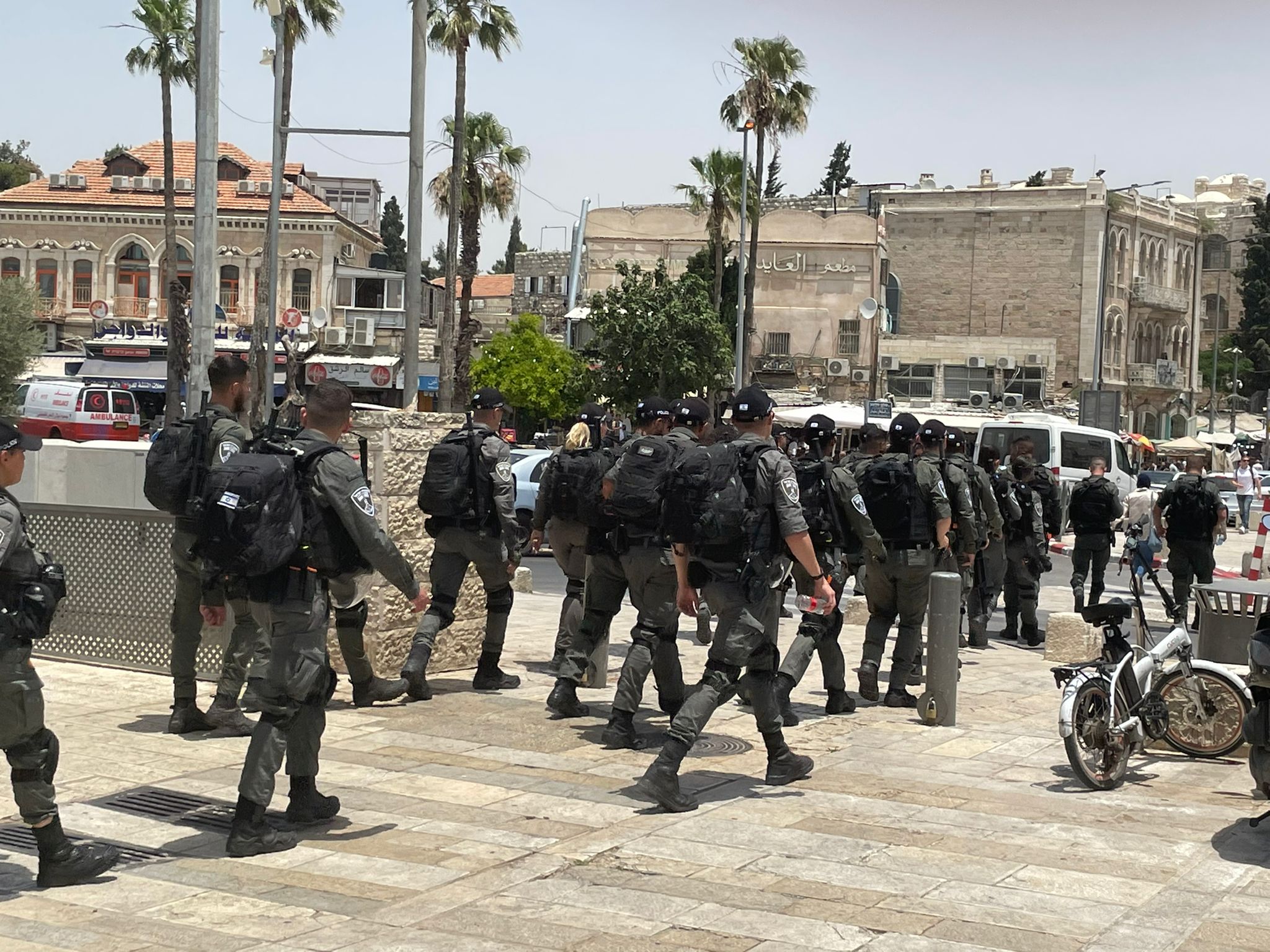
Large groups of heavily armed officers, including special forces, arrive at Damascus Gate ahead of the Flag March (MEE/Lubna Masarwa)

More than 3,000 officers have been deployed to guard the march. MEE saw dozens of metal barricades set up across the Old City, exceedingly impeding the movement of Palestinians.

Several units of heavily armed officers, including special forces, began arriving at Damascus Gate, which has been closed off.

Access to the plaza in front of the gate, which is one the main entrance leading to al-Aqsa, has also been restricted with barriers.

Meanwhile, flag-waving Israelis have started to congregate within and outside the walls of the Old City, leading to minor altercations with Palestinians.


Flanked by police, crowds marched through the city and chanted anti-Palestinian slogans, according Palestinian news website Arab48. In the city of Lydd, also known as Lod, which saw violent riots between Palestinian citizens of Israel and ultra-nationalist Israelis last year, more than 3,000 began a similar flag rally. 

Israeli Nationalists Chant Racist Slogans in Jerusalem March

 
The Associated Press

Israelis wave national flags in front of Damascus Gate outside Jerusalem's Old City to mark Jerusalem Day, an Israeli holiday celebrating the capture of the Old City during the 1967 Mideast war, Sunday, May 29, 2022. Israel claims all of Jerusalem as its capital. But Palestinians, who seek east Jerusalem as the capital of a future state, see the march as a provocation. Last year, the parade helped trigger an 11-day war between Israel and Gaza militants. (AP Photo/Ariel Schalit) THE ASSOCIATED PRESS

By JOSEF FEDERMAN, Associated Press

JERUSALEM (AP) — Thousands of Israeli nationalists, some of them chanting “Death to Arabs,” paraded through the heart of the main Palestinian thoroughfare in Jerusalem’s Old City on Sunday, in a show of force that risked setting off a new wave of violence in the tense city.

The crowds, who were overwhelmingly young Orthodox Jewish men, were celebrating Jerusalem Day -- an Israeli holiday that marks the capture of the Old City in the 1967 Mideast war. Palestinians see the event, which passes through the heart of the Muslim Quarter, as a provocation. Last year, the parade helped trigger an 11-day war with Gaza militants, and this year's march drew condemnations from the Palestinians and neighboring Jordan.

Israel said it deployed thousands of police and security forces for the event, and violent scuffles between Jewish and Palestinian groups erupted inside the Old City before the parade began.

As the march got underway, groups of Orthodox Jewish youths gathered outside Damascus Gate, waving flags, singing religious and nationalistic songs, and shouting “the Jewish nation lives” before entering the Muslim Quarter. One large group chanted “Death to Arabs,” and “Let your village burn down” before descending into the Old City.

Political Cartoons on World Leaders

Political Cartoons

Police cleared Palestinians out of the area, which is normally a bustling Palestinian thoroughfare. At one point, a drone flying a Palestinian flag flew overhead before police intercepted it.

Ahead of the march, Prime Minister Naftali Bennett said that “flying the flag of Israel in the capital of Israel is an obvious thing,” but also urged participants to celebrate in a “responsible and respectful manner.”

Bennett later issued a statement instructing police to show “no tolerance” toward the racist groups. He described them as a “minority that came to set the area on fire” and vowed to prosecute violent extremists — a step that few Israeli governments have taken in the past. Foreign Minister Yair Lapid called the racist groups “a disgrace.”

Thousands of people normally take part in the march through the Muslim Quarter, including some who shout out nationalistic or racist slogans toward the Palestinians, before making their way to the Western Wall in the Jewish Quarter on the other side of the Old City.

Last year, after weeks of Israeli-Palestinian unrest in Jerusalem, authorities changed the route of the march at the last minute to avoid the Muslim Quarter. But it was too late by then, and Hamas militants in Gaza fired a barrage of rockets toward Jerusalem as the procession was getting underway. That set off 11 days of heavy fighting.

Sunday’s march came at a time of heightened tensions. Israeli police have repeatedly confronted stone-throwing Palestinian demonstrators in the disputed compound in recent months, often firing rubber bullets and stun grenades.

At the same time, some 19 Israelis have been killed by Palestinian attackers in Israel and the occupied West Bank in recent weeks, while over 35 Palestinians have been killed in Israeli military operations in the occupied West Bank. Some were armed, while others were shot while allegedly throwing stones or firebombs at troops. But several appear appear to have been uninvolved in any violence, including Shireen Abu Akleh, a well-known correspondent for the Al Jazeera satellite channel.

Jerusalem police were criticized internationally for beating mourners at Abu Akleh’s funeral two weeks ago.

Despite the recent unrest, Israeli leaders decided to allow this year's parade to take place along its traditional route through the Muslim Quarter. Ahead the march, there were small scuffles between Israeli nationalists and Palestinians, who threw chairs and bottles and shouted “God is great” at the marchers. Some marchers sprayed pepper spray at Palestinians and journalists. In one video shared on social media, a young Jewish man kicked and sprayed an older Palestinian woman in the face, sending her crumbling to the ground.

Police also fired rubber-tipped bullets and used clubs and pepper spray to disperse Palestinian protesters from the area.

The Palestinian Red Crescent rescue service said 62 people were injured, including 23 who needed hospitalization.

Israeli police said they arrested over 50 suspects suspected of disorderly conduct or assaulting police officers. It said five officers were injured.

Ahead of the march, over 2,500 Jews visited Jerusalem’s most sensitive holy site inside the Old City, as Palestinians barricaded inside the Al Aqsa Mosque threw rocks and fireworks.

Al Aqsa is situated on a hilltop compound revered by Muslims and Jews. The mosque is the third-holiest site in Islam, and the Palestinians are fiercely protective over what they consider to be a potent symbol of their national aspirations.

The compound also is the holiest site for Jews, who call it the Temple Mount and revere it as the home of the biblical Temples. The competing claims to the site lie at the heart of the Israeli-Palestinian conflict and have triggered numerous rounds of violence.

Police also said one of the Jewish groups “violated visitation rules” and was removed. Israeli media said the group had unfurled Israeli flags in the compound.

Under longstanding arrangements known as the “status quo,” Jews are allowed to visit the compound but not pray. In recent years, however, the number of Jewish visitors has grown significantly, including some who have been spotted quietly praying.

Such scenes have sparked Palestinian fears that Israel is plotting to take over or divide the area. Israel denies such claims, saying it remains committed to the status quo.

Among the visitors was Itamar Ben-Gvir, leader of a small ultranationalist opposition party and a follower of the late racist rabbi, Meir Kahane, who entered with dozens of supporters under heavy police guard.

Palestinians shouted “God is great” as Ben-Gvir, accompanied by Israeli police, shouted “the Jewish people live.” Police said they locked the gates of the mosque and said they made 18 arrests.

Nabil Abu Rdeneh, spokesman for Palestinian President Mahmoud Abbas, accused Israel of “playing with fire irresponsibily and recklessly.”

Jordan condemned Ben-Gvir’s visit to the site and warned that the “provocative and escalating march” could make things deteriorate further. Jordan controlled east Jerusalem until Israel captured it in 1967 and it remains the custodian over Muslim holy sites.

Israel captured east Jerusalem, including the Old City, in the 1967 Mideast war. Israel has annexed east Jerusalem in a move that isn’t internationally recognized and claims all of the city as its capital. The Palestinians seek east Jerusalem as the capital of a future state.

Gaza’s Hamas rulers praised what they called “the great heroism” shown by Palestinians at Al Aqsa earlier Sunday. “The Islamic Palestinian Arab identity of the Al Aqsa Mosque will be protected by our people and their valiant resistance with all their might,” said Hazem Qassem, a spokesman for the group.

The group, however, may be wary of getting involved in another round of fighting. Gaza was hard hit in last year’s war, and the territory is still struggling to repair the damage. In addition, some 12,000 Gazan laborers are now permitted to work inside Israel as part of efforts to maintain calm between the enemies. Renewed fighting could risk losing those jobs, which have given a small boost to Gaza’s devastated economy.

___

AP correspondents Alon Bernstein and Ariel Schalit contributed reporting.


Nationalist Flag March Returns to Jerusalem in All Its Ugliness

 After a few relatively quiet years, then a year in which the parade was cancelled due to the coronavirus pandemic, and a year in which it was rerouted due to security tensions, the Flag March returned to Jerusalem’s Damascus Gate and Muslim Quarter, in all its ugliness.
In the years before 2020, under pressure from the High Court of Justice, the media and police, organizers of the march tried hard to minimize the violently racist chants of participants, and it seemed to work. Marchers who started singing “Death to the Arabs” and “May your village burn” were silenced by organizers and threatened with arrest by police. The marches continued in relative quiet, with some Palestinian stores along the route even remaining open.
This year, everything was reversed. From the morning hours, hundreds of marchers and celebrants started filling the streets of the Old City. At Moghrabi Gate, Temple Mount organizations racked up the highest number of Jews coming to the Mount in one day since 1967, with 2,600 arriving at the compound. Some of them bowed, some raised flags.
In nearby alleys, dozens of groups of Jewish youths chanted, cursed and blocked access to Palestinians. Police officers started to remove Palestinians from the streets and merchants understood what was about to happen and closed their shops. Some groups found alleys with no policemen and entered private yards, cursing and confronting Arab residents. But this was only the beginning.

Get breaking news and analyses delivered to your inbox

Please enter a valid email address
At noon, other groups of Jews started streaming into the Old City, and the tide grew until the march began. Thousands of people passed through Damascus Gate, with the most popular song on their lips being a religious song that was sung at the ill-famed wedding of hate, following the lethal arson attack in Duma, ending with Biblical words taken out of context, calling for blinding Palestinians, “may their name be accursed,” the last words uttered in a scream. This song has replaced a song extolling Jerusalem, which used to be sung on this march in earlier years.
The more extremist groups went through the gate with ecstatic enthusiasm, singing “Death to the Arabs” and “May your village burn,” “Mohammed is dead,” “Shoafat is burning” and more. Other less extreme groups, singing less inflammatory songs, couldn't walk by without banging on the tin doors of the shuttered stores. One can only imagine what this sounded like to the hundreds of Palestinian families who were locked in their homes for hours.
At times it seemed the police had lost control. In one case, an elderly Palestinian woman raised her arms in response to the cursing and was met with pepper spray and kicks by the celebrants. When she was evacuated on a stretcher, water bottles were thrown at it. The Palestinians responded by throwing chairs and other objects. The Jews used tear gas. In another case, a Palestinian journalist was attacked, and in a third instance, a marcher pulled a gun and threatened Palestinians in the plaza outside Damascus Gate.
Clashes erupted in adjacent streets, with some injuries reported after both sides threw stones. Towards the end of the march, dozens of Jews attacked Palestinian houses and vehicles in Sheikh Jarrah. Palestinians responded by throwing stones. One Jew was injured.
The answer to the question of why did the march return to its earlier format this year can be found in two places. The first is the extremist campaign by Bibi-ists, which has been sweeping over the right wing in the course of the last year. Among Israeli flags there were three other flags at the march – Likud flags, flags with Benjamin Netanyahu’s face, and flags of the Lehava Jewish supremacist organization.
It seems that the hatred toward anything perceived as Arab, leftist or linked to the media has percolated for many months in the minds of the marchers, finding a vent as soon as they crossed Damascus Gate or encountered Palestinian passersby.
The second explanation is what happened to the march last year. The fact that after 30 years the march did not go through the gate and the Muslim Quarter was perceived as a debacle that must be amended, by holding a larger, more extremist march this year.
Here and there were people trying to silence the racist cries and calm things down, but this was usually met with disdain, if not vilification. One such person was Yaki Saada from the religious village Givat Washington, who argued with dozens of youths in an effort to stop the racist chants. “It drives me crazy,” he said. “I come here every year, it’s important for me to celebrate but not to provoke people. These are small children with no shepherd, it’s not Judaism,” he says. But voices such as his were drowned out by the banging of doors and racist chants.
In the days preceding Jerusalem Day, a war of flags broke out in Jerusalem. It began with the funeral of journalist Shireen Abu Akleh, which included the flying of Palestinian flags on the Temple Mount and in Palestinian neighborhoods. Jews responded with thousands of flags during the march, but also with huge flags hung on the old municipality and on the Chords Bridge at the entrance to Jerusalem.
The Old City walls were illuminated with Israeli flags as well. It seemed Israelis were winning this war. But then Palestinian activists managed to fly a drone carrying the Palestinian flag above the celebrants at Damascus Gate. This was no simple feat, requiring the evasion of police monitoring. Police managed to bring it down using technological methods, but it still amounted to a small Palestinian victory.
At the end of the day, at the time of this writing, Jerusalem Day ended in a relatively calm manner. It may be too early to say a blessing, since past experience shows that thugs will roam the streets of Jerusalem at night, looking for Palestinian victims.
In Sheikh Jarrah, stone throwing was intensifying. Hamas, as expected, did not launch a new round of hostilities and police managed to control most of the incidents without serious injuries. The marchers will return home and we’ll move on to the next story. It’s Shavuot soon, with people going to the Temple Mount amid more tension.
But what are the real implications of such a march? What imprint will it leave in the minds of thousands of youths who were fired up with racist and ultra-nationalist hatred? What imprint will it leave on Palestinian residents? At 8:30 P.M., outside Damascus Gate, the ground covered with plastic bottles, stickers and broken flag poles, with the last celebrants walking by, the future looked grim.

Israel’s road to genocide by Avi Shlaim and Jamie Stern-Weiner

  In inflicting overwhelming force on Gaza’s civilian population with the intention of expelling it abroad, Israel’s devastating response to...