Tuesday, February 28, 2023

Between the Two Partitions of Bengal (1905 & 1947) by Prof. M. Rashiduzzaman


This is a fused essay—a review of contemporary volumes/essays on British India and Colonial Bengal as well as the oral narratives of that yore combined with a sequel to my recently published books IDENTITY OF A MUSLIM FAMILY IN COLONIAL BENGAL: Between Memories and History, (2021, Peter Lang, NYC) and  THE CENTRAL LEGISLATURE IN BRITISH INDIA 1921-47: Parliamentary Experiences under the Raj, (2019, Peter Lang, NYC). In the aftermath of the abortive Indian “Mutiny” in 1857, a new Colonial imagination was signaled through a set of reforms by the Raj. However, a typically British drip by drip response to the rising political tide in India initially brought the Muslims few tangible benefits. For an example, thru the years from 1893 to 1903,  the Muslim members of the Indian Legislative Council were about 12% of their cohorts whereas 23% of  the country’s total population were then Muslims. Worse was the Muslim presence in Bengal’s law-making body. Nearly 52% of the inhabitants in Bengal were Muslims during that era, but their representation in the Bengal Legislative Council was equivalent to only 5.7% of the legislators. [Data based on my volume on The Indian Central Legislature in British India…ibid).

Ironically, the Muslim enfranchisement augmented by the 1909 Morley-Minto Reforms’ separate electorate turned into a political thorn between the Hindus and Muslims in British India. An array of decentralization, electoral expansion  and legislative changes that followed through the 1920s and 1930s further empowered the Muslims in the Muslim-majority provinces. My pre-1947  Indian legislative delineation was originally my Ph.D. thesis in the early 1960s in England.  But the newly published volume (Identity of a Muslim Family in Colonial Bengal: Between Memories and History), centered on pre-partitioned Bengal, trekked through old family recollections, oral anecdotes, memoirs and other available books, interviews, and documents. The grassroots’ remembrances from diverse sources, including those of my parents, were deftly blended with the larger history of British Indian Bengal; but this is not a chronological memoir.

The legislative prominence of the Bengali Muslims—a legacy from the contentious separate electorate (1909)—developed further when the trailblazing Muslim leaders like A. K. Fazlul Huq (Huq) from Bengal and a couple of pioneers from the Punjab  asserted their political demands. Maulana A.K. Azad’s India Wins Freedom and later Ayesha Jalal’s Jinnah, the Sole Spokesman: The Muslim League and the Demand for Pakistan unveiled more details about those leaders’ wrangling with Jinnah, who was then consolidating the Muslim League in Bengal and the Punjab.  Most Muslim members of the central and provincial legislatures vented their constituents’ existential grievances—-those were, however, not the bursts of Muslim bigotry!

As many as 30 elected and 3 nominated Muslim members of the Indian Legislative Assembly did not have unbending partisan lines until the late 1930s and 1940s. Those Muslim lawmakers who endorsed the Indian National Congress pushing for the country’s Swaraj were known as the Nationalists.  Jinnah became the acknowledged leader of the Indian Legislature’s prominent Muslim bloc. His legislative vocabularies in 1920s and 1930s usually avoided the communal postures—he was also less than excited about agitational politics in 1920s and 1930s. Jinnah then bargained more for the larger Muslim community in India, not for any specific province. Ayesha Jalal’s groundbreaking book: Jinnah, the Sole Spokesman: The Muslim League and the Demand for Pakistan is a vindication of what I had earlier read through the legislative debates. For my research in 1963, I interviewed Lord M. Hailey, once a powerful Member of the Viceroy’s Executive Council; he remembered that Jinnah was amongst the outstanding parliamentarians in the central legislature. Until Sir A. Rahim became the President (Speaker) of the Indian Legislative Assembly (1935-45), there was no outstanding Bengali Muslim leader in the Indian Legislature except Fazlul Huq’s stint there (1934-36). Noticeably, the ablest amongst the Bengali Hindu and Muslim politicians preferred to stay in Bengal politics, not at the all-Indian legislature in New Delhi!

In the new edition of my old thesis-based book on the British Indian Central Legislature, I reassessed my old findings and added a fresh resonance to the narrative. But IDENTITY OF A MUSLIM FAMILY IN COLONIAL BENGAL: Between Memories and History, (2021), is a fresh volume, built around parallel memories and Muslim identity imagination in Colonial Bengal. The old Bengal, wracked by religious, social, and political turmoil between its 1905 and 1947 divisions, comes alive in this volume. My father’s personal remembrances cut through the history of undivided Bengal and beyond. This enthralling recount swathes across British Indian and Colonial Bengal’s politics—even more decisively, this trajectory aims at the Bangladeshi amnesia about its inheritances from the past.

Both of my latest volumes entail a tormenting relevance to our contemporary times while India’s surging Hindutva reverberate the old Hindu-Muslim acrimony. By the 1940s, the Muslim politicians were at the cusp of two seismic outlooks: (1) independent India led by the Congress Party in a likely alliance with the Muslim League and other parties or (2) a partitioned India with Pakistan, a separate Muslim state with divided Bengal and the Punjab.  However, there was indeed a last minute, now in obscurity, alternative to the division of Bengal floated by an alliance of Sarat Bose, Abul Hashem, H.S. Suhrawardy and Kiran Sankar Roy—-the well-known actors in pre-1947 Bengal politics.

Two not-so-distant commentaries by Shyamali Ghosh and Sana Aiyar (details provided below) wondered if Fazlul Huq’s (Huq) controversial coalition (1940-43) with Shyama Prashad Mukherjee  (Hindu Mahasabha) was a shaky venture for an undivided Bengal through a Hindu-Muslim power sharing. My father remembered that even some of the ardent supporters of Huq did not like that unnerving collaboration.  One of the key reasons of such negativity was the Hindu Mahasabha’s deep unpopularity with the Muslims of Bengal. Was Huq’s short-lived Hindu-Muslim partnership, though prickly, a predecessor to the subsequent Bose-Hashem thrust for a “united and sovereign” Bengal? Well-known as it was, Fazlul Huq had a nearly emotional “dream” about undivided Bengal sprawling through the Bengal Pact (1923) and the previous Lucknow Pact (1916).

Nonetheless, Fazlul Huq’s Krishak Proja Party’s (KPP) main electoral hold was in the Muslim majority districts in East Bengal—he was politically and personally more active in Dhaka than Calcutta for a stretch since the 1905 Bengal division.  And he was married to a scion of a khandani family in Dhaka. He was proud of his Muslim heritage and he made no secrets about it: visiting ancestral burial grounds of the Muslim constituents was among his campaign postures, my father mentioned. Fazlul Huq’s son late Faizul Huq (Faizul), a former student of mine at Dhaka University, once told me that one of his father’s last tips was: “Don’t Apologize for being a Muslim!” Sometime in the late 1960s, Faizul showed me his father’s sparsely written diary from 1940s, which also had this message written multiple times.

How and why did Fazlul Huq’s … “Alternative of 1940-43” did not gain political traction? Why and how did the Bose-Hashem-Suhrawardy-Roy backed “third way” for united Bengal collapse? In his The Autobiography of an Unknown Indian (Autobiography), Nirad C. Chaudhuri (Nirad) did not hide his discontent for the British-introduced parliamentary institutions that had certainly challenged the Hindu bhadralok’s eminence in Bengal. In his memoir, Amar Dekha Rajnitir Panchash Bochhor, Dhaka, 1968, Abul Mansur Ahmed, an avid writer, an activist, and a far-sighted politician, tackled a few of those gripes. Fascinatingly, Ayesha Jalal’s Jinnah, the Sole Spokesman: The Muslim League and the Demand for Pakistan, adds original information on the closing days of undivided Bengal while she claims that Jinnah finally accepted the (1947) “partition” when negotiations for the anticipated post-independence federal and provincial configurations disappointingly collapsed.

Joya Chatterji’s (Joya) Bengal Divided: Hindu communalism and partition 1932-1947, Cambridge, 1994 spurned the popular view that Muslims carried the exclusive baggage for the 1947 division of Bengal. My Identity of a Muslim Family in Colonial Bengal: Between Memories and History matched assorted memories in old Bengal and I compared a part of her findings with what my father M. Badruzzaman (1893-1975) recalled since I was a school student. An inquisitive schoolteacher with predilections for history and Sufism as well as a pull for writing Bengali essays, he periodically alleged that most well-known Bengali writers did not tolerably project Muslim experiences in their genre—he regretted that the Muslims were the shadowy “others” in most notable fictions. Such “literary disenfranchisement” also spurred the Bengali Muslims more towards identity politics. Taj ul Islam Hashmi weaved the rural subalterns, mostly the peasant Muslims, in his  PAKISTAN AS PEASANT UTOPIA: The Communalization of Class Politics in East Bengal 1920-47, Routledge, 1919; his tome recorded their voices with their not-so-hidden emotions. Joya skillfully bared the Hindu intelligentsia’s panic at the Bose-Hashem-Suhrawardy-Roy’s rush to save Bengal from its impending split—to them, an undivided Bengal, with a Muslim majority, would have been a “Pakistan by another name”!

A few influential zamindar-politicians like Nawab Salimullah of Dhaka, Nawab Nawab Ali Chaudhuri and Nawab Shamsul Huda earlier helped numerous Muslim young men with jobs and encouraged education among Muslims. Such patronages indeed helped the rising educated Muslim middle class mainly from the strapped ryots. Fazlul Huq boosted Muslim educational interests, and individually, he helped countless young men and women with jobs—several autobiographies/personal recollections from 1920s confirmed this. My father remembered that while the Muslims usually approached the Nawabs or senior Muslim politicians and officials for government jobs, the Hindus usually contacted their Hindu patrons for such favors. Roots of the educated Bangladeshi Muslim middle class could still be traced to their predecessors who had experienced their uphill slog in Colonial Bengal—most of their accomplishments were the fruits of their family sacrifices, and many of them were the likely patronage receivers from the Muslim feudal/political elite of the time.

A few younger scholars, in their fresh essays/articles, exposed more on Muslim history, identity quest and politics in old Bengal.  Such dissertation/essays include: (a) Zaheer Abbas, “Construction of Bengali Muslim Identity in Colonial Bengal 1870-1920,” A Master’s dissertation at the University of North Carolina, Chapel Hill, NC, 2010; (b) Shyamoli Ghosh, “Fazlul Huq: Muslim Politics in Pre-Partition Bengal,” International Studies, JNU, Delhi, July 1, 1974; (c)  Mosarrap H. Khan, “The Construction of Bengali Muslim Identity in the Late Nineteenth and Early Twentieth Century,” CafĂ© Dissensus Every Day, (an online liberal magazine, New York), July 15, 2017 and (d) Sana Aiyar, “Fazlul Huq, Region and Religion in Bengal: The Forgotten Alternative of 1940-43,” Modern Asian Studies, Vol. 42, No.6, November 2008.

Not long ago, I came across Asok Mitra’s extra-ordinary newspaper article “MAROONED IN THEIR MYTHS—if the partition of 1905 were allowed to stand,” (The Telegraph, Calcutta, 06/27/05). He reprimanded the “cult of patriotic fervor” raised against the 1905 split that defined “the Hindu Bengali psyche” for over a century. While political rumors made their rounds among the villagers in those days, one morning, a casual visitor told my grandfather about the 1905 Bengal division that made Dhaka, the capital of the new province. Then, according to family anecdotes, he excitedly told the visiting friend: “It’s good news for  our children—they will get jobs when they finish school!” While my father was a Dhaka College student (1915-19), the Muslims were yet to recuperate from their despair over the 1905 Partition’s annulment in 1911. The creation of the Muslim League (1906) was a reaction to the Congress Party’s uncompromising rejection of the split— the subsequent cancellation of the Partition became a “historical wound” for the Muslims of East Bengal. Nostalgic questions still yearn why Bengal was divided in 1905 and why was it terminated—for genuine administrative reasons for the Raj or for “divide and rule,” and, above all, who were the losers and winners of that exploding episode of Bengal’s history.

With such grassroots vibrations, oral recounts, legislative research, recalls from Colonial Bengal and the bigger pre-1947 India, books, essays, and diaries, I feel that Muslim politics in British India and pre-partition Bengal had multiple layers—religion was not its exclusive raison d’etre.


*M. Rashiduzzaman Ph.D. is Professor Emeritus in Political Science at Rowan University, Glassboro, New Jersey, USA.  An author of several books, scholarly essays and numerous newspaper/magazine articles on British India, Bangladesh, and Pakistan, his more recent works are: Identity of a Muslim Family in Colonial Bengal: Between Memories and History (Peter Lang, NYC 2021, and The Central Legislature in British India 1921-47: Parliamentary Experiences under the Raj, Peter Lang, NYC, 2019.

Rohingyas — a forgotten chapter?


SHIHAB SARKAR

Published : Feb 27, 2023 06:23 AM


Even 2/3 years ago, the Rohingya refugees in Bangladesh occupied a remarkable place in the world news media. After the Covid-19 pandemic and the outbreak of the Ukraine war, a fatigue appears to have gripped nations, especially those in the greater south and south-east Asian regions. Almost all of them have been hard hit by the post-corona economic impasse. Coming to the Rohingya crisis, many would like to describe the present situation as something like 'all quiet on the Rohingya front'. More than a couple of months after the Rohingya border guards' firing of shells visibly targeting the refugees, no major incidents occurred in Teknaf's Ukhiya area. The said area hosts 750,000 refugees who arrived in Bangladesh in 2017 fleeing the Myanmar Army's genocide in their native villages in the Rakhine state of the country.

It's after a considerably long hiatus, that Bangladesh has raised the refugee issue. News reports have it that Prime Minister Sheikh Hasina on February 22 urged the United Nations to help Bangladesh in relocating Rohingyas to Bhasan Char, a coastal island in the Bay of Bengal. The Prime Minister made the plea while UN Resident Coordinator Gwyn Lewis called on her at her official residence Ganobhaban on the day. Elaborating, the Prime Minister mentioned that over one million Myanmar nationals, the Rohingyas, were now a big burden for Bangladesh. "Their return to their homeland soon is uncertain. So I am requesting the UN to help Bangladesh relocate the Rohingyas to Bhasan Char," the PM said adding the island had been developed to provide better living condition to the Myanmar nationals.

The PM said the forcibly displaced Rohingyas were living in an inhuman condition in Cox's Bazar amid uncertainty about their repatriation soon. Bangladesh has so far moved about 30,000 Rohingya refugees to Bhasan Char "to ease crowding in the camps at Cox's Bazar." The Prime Minister's reference to the Bhasan Char refugees is set to give a new lease of life for the hapless refugees. On the other hand, many of them are reluctant to go back to Myanmar, and face fresh rounds of ethnic persecutions in the forms of killings, arson and sexual harassments let lose by the members of the country's military junta. Moreover, there is the anti-repatriation insurgent group ARSA (Arakan Rohingya Salvation Army) whose members have allegedly killed the pro-repatriation leader Muhibullah. Majority of the Rohingya refugees are peaceful and love to remain settled in the Rakhine state of Myanmar.

With a view to making their life hazard-free, they wistfully looked to the democracy leader Aung San Suu Kyi. Her role as a silent spectator to the Rohingya 'ethnic cleansing' has only appalled them. In media interviews at the refugee camps in Bangladesh, the Rohingya Muslim refugees seemed unanimous in their view that they didn't want to leave Rakhine. They have extended full support to Suu Kyi as their liberator. They were puzzled to find a different'democracy icon' in the later times.

Many suspect that in spite of her humane and egalitarian policy, Suu Kyi used to oscillate between her youth's liberal humanism and her middle-age leaning towards extremism. Unfortunately, it has failed to save her. At the end, many feel like blaming Suu Kyi for driving a wedge between the common Rohingya Muslims and the Myanmar general people. It seems surprising that many countries around the world have extended their support to Bangladesh in its efforts to deal with the Rohingya refugee issue over the years; but finally they became less vocal. In the fast changing global scenario the Rohingya refugee issue began losing its relevance. In the meantime, the refugees still without regular shelters veritably swarmed on the Teknaf upazila's hilly areas and plain lands. Trees were felled indiscriminately and improvised huts built giving the neighbourhoods a shambolic look. It took a couple of years before the rehabilitation authorities were able to erect camps to house thousands of Rohingya refugees.

In time Bangladesh realised that it had been caught in the soup. Some of the refugees were found involved in various kinds of illicit activities like human and drug trafficking, infightings and militant activities. Bangladesh had never thought that it would ever be sucked into a maze created by the Myanmar refugees. The case for the involvement of Bangladesh in the Rohingya imbroglio was not accidental. Watching the streams of refugees from the Rakhine state in Myanmar pour into Bangladesh to flee genocidal killings, Bangladesh welcomed them. Itself a developing country, it provided them with initial relief goods and shelter. Bangladesh had never thought that the Rohingyas would one day prove themselves to be the old man on the shoulders of the Sindbad. At present, few nations and organisations are by its side; it has to devise its own way in dealing with the Myanmar nationals. The Bhasan Char island-based shelter is one of them.

Burdened with a total of one million Rohingya refugees including the earlier ones, Bangladesh now desperately looks for a way out of the deadlock. With few to turn to in these critical times, shelters on the islands may serve as a stopgap solution. It shouldn't stop Bangladesh or the regional powers from arranging meaningful talks with the Myanmar military junta. As a last resort, the nation can approach the West African nation Gambia to raise its voice one more time against Myanmar at the International Court of Justice.

Monday, February 27, 2023

Death toll climbs above 50,000 after Turkey, Syria earthquakes

 A magnitude 5.6 earthquake has hit eastern Turkey, killing at least one person and wounding dozens while causing some damaged buildings to collapse.
Monday’s earthquake became the latest major tremor to rock southern Turkey as the region rebuilds from earlier massive quakes that killed more than 50,000 people across southern Turkey and northwest Syria.

The latest quake was centred in the town of Yesilyurt in Malatya province, the country’s disaster management agency (AFAD) said, adding that one person was killed when a factory collapsed in Kahramanmaras, the epicentre of the magnitude 7.8 earthquake that hit the region on February 6, and 69 others were injured.

Yesilyurt’s Mayor Mehmet Cinar told HaberTurk television that a number of buildings in the town collapsed, including a four-storey building where a father and daughter were trapped.

Cinar said the pair had entered the damaged building to collect belongings.

AFAD said that 32 people were saved in Malatya after the latest tremor.

Television images showed the man being carried on a stretcher into an ambulance, while rescue teams were trying to make contact with his daughter inside the damaged building.

Turkish President Recep Tayyip Erdogan acknowledged the shortcomings of his government’s response to the February 6 earthquakes as he spoke at a news conference in Adiyaman, one of the provinces hardest hit by the disaster.

============
The number of people killed by the earthquakes that struck Turkey and Syria earlier this month has now passed 50,000, according to the latest figures from both countries.

In Turkey alone, 44,218 people died as a result of the earthquakes, the country’s Disaster and Emergency Management Authority (AFAD) said on Friday, while the latest announced death toll in Syria was 5,914.

The first earthquake on February 6 that hit southeastern Turkey and northern Syria measured a magnitude of 7.7 and a second, a little later, measured 7.6. The region has been rocked by more than 9,000 aftershocks since, according to the AFAD.

Nearly 240,000 rescue workers, including volunteers, continue to work in the 11 quake-hit provinces in Turkey. Some of the areas affected by the quakes were initially difficult to access but recovery efforts continue and casualty numbers are rising as they progress.

There have been no reports of survivors being rescued in recent days.

Nearly 530,000 people have been evacuated from the disaster area in Turkey alone and the Turkish government has said that 173,000 buildings have so far been recorded as collapsed or severely damaged, with more than 1.9 million people taking refuge in temporary shelters or hotels and public facilities.

Some 20 million people in Turkey have been affected by the quake, while the United Nations estimates 8.8 million people have been affected in Syria. Less information has come from Syria where many people were already living in precarious conditions after years of civil war.

Many survivors have left the parts of southern Turkey hit by the quake or have been settled in tents, container homes and other government-sponsored accommodation.

Turkish President Recep Tayyip Erdogan has pledged to rebuild homes within a year, although experts have said the authorities should put safety before speed.

“The government said they will lay down the new foundations of the new houses to be rebuilt by March, and that one year from now they will deliver the new houses to the people,” Al Jazeera’s Hashem Ahelbarra said, speaking from the city of Kahramanmaras which was at the epicentre of the quakes.

Privacy Policy

Some buildings that were meant to withstand tremors crumbled in the latest earthquakes.

Despite experts saying that rebuilding cannot happen unless all the aftershocks ebb away, the government is going to “contain the situation and do its best to build new houses”, he added.

SOURCE: AL JAZEERA AND NEWS AGENCIES

Far-Right Israeli Minister Says 'No' to West Bank Settlement Freeze

 JERUSALEM (Reuters) - Israel's far-right finance minister said on Sunday he would not agree to any freeze in settlement activity in the occupied West Bank, after Israeli officials committed during a summit in Jordan to hold off on such construction in the coming months.

"I have no idea what they spoke about or not in Jordan," said Finance Minister Bezalel Smotrich, who also has responsibilities over Jewish settlements in the West Bank.

"But one thing I do know: there will not be a freeze on the building and development in settlements, not even for one day (it is under my authority)," he wrote on Twitter.

(Reporting by Ari Rabinovitch; Editing by Jan Harvey)

Ukraine: The Violence Before the Violence


The violence in Ukraine is unimaginable. But before the violence, there was violence.

The military conflict in Ukraine has received an unprecedented amount of media coverage. The major US networks have given more coverage to Russia’s war in Ukraine than they did to America’s war in Iraq. But there were very important military dimensions prior to the war in Ukraine, many of them focussed around the coup of 2014, that have gone almost unreported. The lack of reporting is important because those events played a role in the lead up to the war.

The Economic Package

Long before the current strife in the Donbas, Ukraine has been a nation divided. Ethnic tensions have historically pulled the nation in opposite directions. The northwest and central Ukraine have always pulled west toward Europe; the southeast has always pulled east toward Russia. Prior to the Maidan protests and the coup of 2014, Ukrainian President Viktor Yanukovych was confronted with the choice of economic alliance with the European Union or with Russia. Following the historic pattern, polls at the time clearly showed that Ukrainians were nearly evenly split on which economic alliance to choose: pull west toward Europe or pull east toward Russia? Yanukovych was stuck in the middle of a tug of war. Choice of either package would have divided the country. It did more than divide it. It tore it apart.

But the coup and the civil war that followed were not the offspring of a choice between peaceful packages. There were military dimensions that did not get reported in the West. The economic alliance offered by the EU was also a military alliance. Princeton Professor Emeritus of Russian Studies Stephen Cohen wrote at the time that the EU economic proposal also “included ‘security policy’ provisions . . . that would apparently subordinate Ukraine to NATO.” The provisions compelled Ukraine to “adhere to Europe’s ‘military and security’ policies.” It was not a benign economic proposal: it had clear military dimensions. It was a Trojan horse, a military alliance in economic clothing.

Article 4 of the EU’s Association Agreement with Ukraine says the Agreement will "promote gradual convergence on foreign and security matters with the aim of Ukraine’s ever-deeper involvement in the European security area." Article 7 speaks of the convergence of security and defense, and Article 10 says that "the parties shall explore the potential of military and technological cooperation." The choice of the UE economic alliance would also be the choice of NATO expansion right up to Russia’s border. But the military dimensions of the choice of economic alliance went unreported in the Western media.

The Euromaidan

Western Ukraine and the Ukrainian nationalists saw Yanukovych’s delaying the signing of the EU Association Agreement as a betrayal of Ukraine’s nationalist choice to pull toward Europe and away from Russia. That would lead to the violence of the Euromaidan protests, the coup and then the autonomy of the Donbas and the militarization of the conflict.

The violence that followed in the Maidan protests was frequently covered, though the media failed to adequately report that it was the "the Far Right," in the words of Nicolai Petro in The Tragedy of Ukraine, who "tipped the dynamic of the Maidan away from peaceful protest. . . ." Volodymyr Ishchenko, a leading scholar on radical movements in Ukraine, says that "Right Sector . . . strategically scaled up the initial skirmishes into a full-scale riot." Dmytro Yarosh, the leader of Right Sector, a coalition of several far right paramilitary organizations, told Time in 2014 that Right Sector had "amassed a lethal arsenal of weapons." Ishchenko says they had "[a]t least 1,500 handguns, rifles, machine guns, hand grenades, and other weapons."

But it is what Right Sector was willing to do with those weapons that went so underreported. The goal of the Maidan protests was to remove Yanukovych from power in a coup. And the nationalists were prepared to use those lethal weapons to do it. The far right militias seized regional and city administration buildings all over central and western Ukraine. "These seizures were typically accompanied," Petro reports, "by declarations that, if Yanukovych refused to relinquish power immediately, these regions would secede." Yarosh told Time that they had enough guns "to defend all of Ukraine from the internal occupiers," meaning Yanukovych’s government, if negotiations didn’t go their way. "Had Yanukovych remained in power," Petro says, "Far Right leaders were prepared to conduct a ‘prolonged guerrilla warfare’ from western Ukraine, where several regional administrations were already on record as supporting armed insurrection and, if necessary, secession."

Far right groups said, according to Ishchenko, that they had "effectively taken power in Lviv . . . in anticipation of potential counter-insurgency operation if Maiden in Kiev was defeated." Andrii Parubii, the commander of Maidan Self-Defense, "publicly recognized that the opposition leaders planned for starting resistance in Western Ukraine in case of their defeat in Kiev. The Right Sector leaders were preparing to start a guerrilla war against the government."

The militarization of the far right nationalist opposition and the willingness and preparedness to go to war with the government and to secede is an underreported military dimension of the violence before the current violence.

The Minsk Deception

In the end, the coup did succeed, and it was the eastern, and not the western, regions of Ukraine who rebelled against the coup government and declared some form of autonomy.

The best available solution to the violence in the Donbas was the Minsk agreements. The Minsk agreements were brokered by France and Germany, agreed to by Ukraine and Russia, and accepted by the US and UN in 2014 and 2015. They gave Ukraine the opportunity to keep the Donbas and the Donbas the opportunity for peace and the governance they desire by peacefully returning the Donbas to Ukraine while granting it full autonomy.

The agreements were negotiated by Russian President Vladimir Putin, Ukrainian President Pyotr Poroshenko, German Chancellor Angela Merkel and French President François Hollande. But each of Putin’s interlocutors has recently claimed that the Minsk negotiations were a deliberate deception to lull Russia into a ceasefire with the promise of a peaceful settlement while buying Ukraine the time to build up an armed forces capable of achieving a military solution. If their claims are to be believed, the apparently peaceful negotiations were a cover for what was intended all along to be a military solution. Then and now, that violence has gone underreported.

The first to make the claim was Poroshenko. Poroshenko, who has said that he knew when he signed the Minks agreements that they would never be implemented, told the Financial Times that Ukraine “didn’t have an armed forces at all” and that the “great diplomatic achievement” of the Minsk agreement was that “we kept Russia away from our borders – not from our borders, but away from a full-sized war.” The agreement bought Ukraine time to build its army in preparation for a military solution. Poroshenko told the Ukrainian media and other news outlets that “We had achieved everything we wanted. Our goal was to, first, stop the threat, or at least to delay the war – to secure eight years to restore economic growth and create powerful armed forces.”

His European partners agree. In a December 1, 2022 interview, former German Chancellor Angela Merkel told Der Spiegel that she believes that "during the Minsk talks, she was able to buy the time Ukraine needed to better fend off the Russian attack. She says it is now a strong, well-fortified country. Back then, she is certain, it would have been overrun by Putin’s troops." On December 7, Merkel repeated that admission in an interview with Die Zeit. "[T]he 2014 Minsk agreement was an attempt to give Ukraine time," she said. Ukraine "used this time to get stronger, as you can see today. The Ukraine of 2014/15 is not the Ukraine of today."

That same month, the other European negotiator made the same claim. In a December 28 interview with The Kyiv Independent that went entirely unnoticed by the media outside of Ukraine and Russia, Hollande was asked if he “believe[s] that the negotiations in Minsk were intended to delay Russian advances in Ukraine.” He responded, "Yes, Angela Merkel is right on this point." He then said, "Since 2014, Ukraine has strengthened its military posture. Indeed, the Ukrainian army was completely different from that of 2014. It was better trained and equipped. It is the merit of the Minsk agreements to have given the Ukrainian army this opportunity."

Perhaps most unreported by the media is that Ukrainian President Voldymyr Zelensky has now made a related claim. He reportedly told Der Spiegel that he saw the agreements as a "concession" and that he "surprised" Merkel and Macron by telling them that "as for Minsk as a whole . . . We cannot implement it like this."

That completes the circle: every person involved in the negotiation or implementation of the Minsk agreement has said that they were never meant to peacefully resolve the conflict in the Donbas. Instead, they were another underreported preparation for a military solution. Their claims may or may not be true. If true, they planned for and contributed to the violence; if false, they are perpetuating the current violence by undercutting Putin’s trust in negotiating with Ukraine and the West.

Escalating War in the Donbas

On the eve of the Russian invasion of Ukraine, the build up of Russian troops on the eastern border of the Donbas was heavily reported. Unreported was the build up on Donbas’s western border that preceded it. Ukraine had massed 60,000 elite troops, accompanied by drones, along its eastern border with Donbas. According to Richard Sakwa, Professor of Russian and European Politics at Kent, there was "genuine alarm" that Ukraine was about to escalate the seven year old civil war and invade the largely ethnic Russian Donbas region.

And the Ukrainian troops were not just gathering on the border. According to UN data, 81.4% of ceasefire violations and civilian casualties in the past seven years had occurred in the “self-proclaimed ‘republics’.” Critically, though, In February 2022, the Border Observer Mission of the Organization for Security and Co-operation in Europe (OSCE) observed a dramatic increase in Ukrainian artillery shelling into the Donbas. According to OSCE monitors, between February 18 and February 20, two thirds to three quarters of the shelling was launched from the Ukrainian side of the line into the Russian side.

This violence that preceded the war by just days is another important military dimensions prior to the war that went almost unreported.

From the military dimensions of the economic package the West offered Ukraine, to the underreported nationalist militarization of the Euromaidan, to the buildup of Ukrainian troops at the Donbas border and the artillery shelling across it and the possible deception of the Minsk agreements and intended military solution, there were a number military dimensions prior to the war that went underreported. Reintroducing them to the history of the events leading up to the war may be important for understanding and resolving the causes of the war.

Ted Snider is a regular columnist on US foreign policy and history at Antiwar.com and The Libertarian Institute. He is also a frequent contributor to Responsible Statecraft and The American Conservative as well as other outlets.

Palestinian killed as Israeli settlers rampage through West Bank in 'revenge' attacks

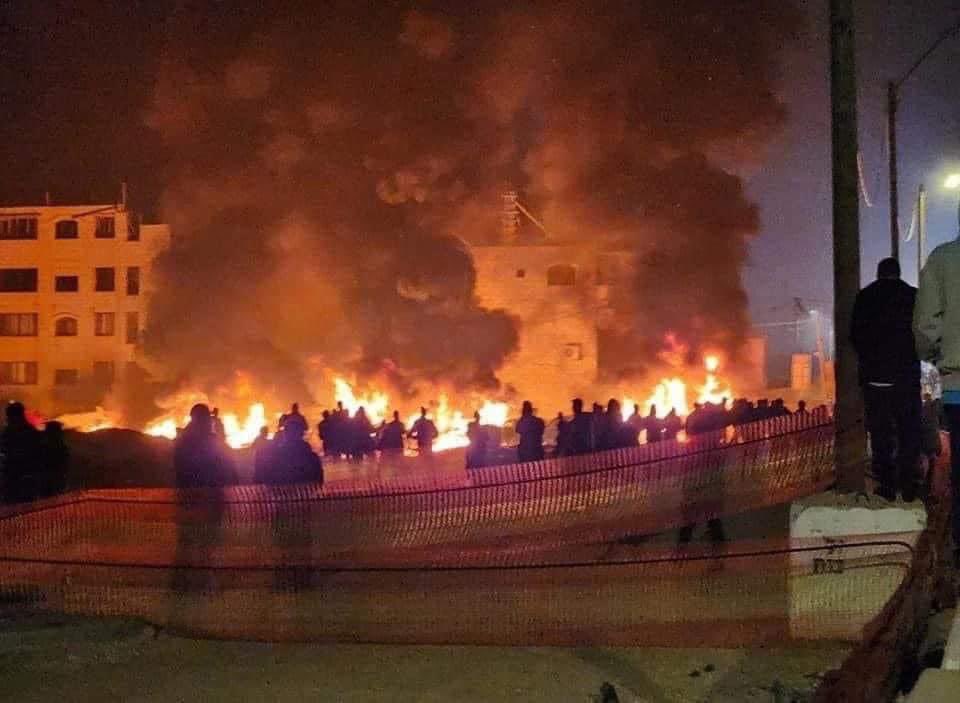
 Ramallah, occupied Palestine -  Israeli settlers rampaged through towns in the occupied West Bank on Sunday evening in revenge attacks, burning and attacking Palestinian homes and property for hours.

At least one Palestinian was killed and nearly 400 wounded in the attacks, Palestinian health officials said. 

Sameh Hamdullah Aktech, 37, was shot dead in Za'tara town near Nablus. The Palestine Red Crescent Society (PRCS) said its staff treated someone for stabbing wounds and at least two others suffered head injuries.  

Homes, shops, cars and agricultural land were set ablaze by settlers who roamed the streets of several Palestinians towns, mainly near Nablus. Attacks were reported in Ramallah and Salfit. 

PRCS said at least 35 homes were completely burned down and 40 others were partially damaged. More than 100 cars were burnt or destroyed, it added. 

The riots followed a shooting earlier in Huwwara town earlier in the day by a suspected Palestinian which left two Israeli settlers killed. 

An image shared on Twitter of the chaotic scene in the northern West Bank town of Hawara during an attack organised by Israeli settlers following an earlier fatal shooting (Twitter)
An image shared on Twitter of the chaotic scene in the northern West Bank town of Huwwara during an attack organised by Israeli settlers following an earlier fatal shooting (Twitter)

Ghassan Daghlas, a Palestinian activist monitoring the expansion of Israeli settlements in the north of the West Bank, told Middle East Eye at least one shop was burned down as of 9:15pm local time. 

"What the settlers are doing tonight are war crimes similar to the events of the Nakba and the attacks of the Zionist gangs," Daghlas said, referring to the violent "catastrophe" of 1948 that lead to the creation of the State of Israel. 

Nine Palestinian families have had to be rescued from their burning homes, Israel's Channel 12 news reported. 

'Our lives are in danger'

One Huwwara resident, Ziyad Dmaidi, told MEE that he barely got his family to safety before his home was set on fire. 

Dmaidi was returning from work when he saw a group of settlers heading towards his house, he said, recalling a feeling of panic as he rushed inside to gather his family.

Within minutes "dozens of settlers" began smashing in windows, breaking into the house. The family escaped just as burning rubber tyres were thrown inside. His home was completely destroyed. 

'Sounds of assault were louder than everything: swearing in Hebrew, smashing windows, burning ... It was very terrible'

- Fida Hamad, Huwwara resident

"I never thought about the house or all our stuff, I was only thinking about my children and how to save them from this nightmare," Dmaidi said.  

"We got out of the house and off to safety with the help of the ambulance crews who were also attacked while trying to evacuate us.

"Our lives are in danger and all this is happening while the Israeli soldiers stand around waiting only to protect the settlers," he continued. 

Fida Hamad, another resident, told MEE that the settlers' attack was the largest she had ever experienced and that houses were set on fire with families still inside. 

Large clouds of smoke billowed throughout the town to the constant sounds of screaming, she said. 

"We were sitting in our homes, and suddenly we heard explosions and screams of panic. We learnt that the settlers had attacked the town," Hamad recalled. 

"My children started crying and I tried to calm them down, but the sounds of assault were louder than everything: swearing in Hebrew, smashing windows, burning vehicles, homes, and shops ... It was very terrible."

Palestinian Prime Minister Mohammad Shtayyeh charged the Israeli government with full responsibility for the attacks in Huwwara and urged the international community to provide protection to the civilian population.

Meanwhile, Aida Touma-Suleiman, a Palestinian member of the Israeli parliament, condemned the attacks, tweeting: "The settlers are committing a horrific crime tonight in Huwwara - burning homes while families are inside and wreaking havoc.

"They are acting in the spirit of the fascist government," Touma-Suleiman said. "I spoke to several ambassadors and asked them to intervene."

At least one Palestinian fire truck attempting to respond to the fires was attacked and its windows smashed. Several ambulances were also damaged, according to reports on social media. PRCS said they were prevented from reaching areas affected by the attacks in Huwwara for two hours. 

Settlers 'seek revenge'

Earlier on Sunday, Hillel and Yagel Yaniv, two brothers from Har Bracha, an illegal settlement in the occupied West Bank, were fatally shot in their car while driving through Huwwara. 

The assailant rammed the vehicle, before shooting at the two and fleeing the scene. Just after the shooting, Israel's military said it was pursuing the perpetrator. 

Israeli settlers issued calls to organise a march to Huwwara on social media to "seek revenge" for the attacks.

"Israeli settlers have been terrorising the Palestinian communities today, in the occupied West Bank, attacking civilians and torching down houses and businesses," the official account of the Palestinian mission to the UK tweeted, sharing a video of one of the fires and tagging Foreign Secretary James Cleverly and two Foreign Office Twitter accounts. 

The occupied West Bank is home to about 2.9 million Palestinians as well as an estimated 475,000 Jewish settlers who live in state-approved settlements that are illegal under international law.

Israeli Prime Minister Benjamin Netanyahu released a joint statement following Sunday's initial shooting, announcing that parliament had passed legislation approving the death penalty for Palestinians convicted of terrorism offences against Israelis.

"On this difficult day when two Israeli citizens were murdered in a Palestinian terrorist attack, there is nothing more symbolic than passing a death penalty law for terrorists," the statement read.

Earlier on Sunday, Israeli and Palestinian officials held talks in Jordan to try to secure calm in the West Bank and the Gaza Strip. 

At least 62 Palestinians have been killed by Israelis this year, at a rate of more than one fatality per day. Meanwhile, 12 Israeli civilians and one police officer have been killed by Palestinians in the same period.

This follows a steep increase in violence in 2022 when at least 167 Palestinians were killed in the West Bank and East Jerusalem, the highest death toll in those territories in a single year since the Second Intifada. Palestinian attacks killed 30 Israelis last year.

Fayha Shalash reported from Ramallah and Sheren Khalel from Florida. 

Israel’s road to genocide by Avi Shlaim and Jamie Stern-Weiner

  In inflicting overwhelming force on Gaza’s civilian population with the intention of expelling it abroad, Israel’s devastating response to...