Tuesday, October 31, 2023

Erasing the Context BY LAWRENCE DAVIDSON

Paul Thornton, the Letters Editor of the Los Angeles Times was really angry. By 14 October 2023, he just had to vent, using the LA Times website to do so. So what had riled him up? Well, it had been a week during which he and others had watched as “hundreds of civilian Israelis were massacred for the crime of existing in the Jewish state.” Thornton was aware that this judgment flowed from “a purely gut-level emotion.” Here is how he describes that feeling: “disgust—not just over the attack, of course, but also disgust at the reaction by some…who reflexively blame the victims or engage in endless whataboutism.”

What, pray tell, is “whataboutism”? For Thornton, it is “the disgusting” practice of reminding us about Israeli policies toward the people of Gaza and suggesting that those policies, carried on consistently for decades, had something to do with the recent barbaric behavior of Hamas fighters. It would seem that for Thornton, you mustn’t argue this way—indeed, you are not supposed to raise any possible causal connections in the face of such slaughter, or what President Biden has called “sheer evil.”

Thornton refers us back to columnist Jonah Goldberg who complains about commentators who “insist that Hamas’ barbarity is what Israel should expect from its policies in Gaza” or characterize the Hamas attack as a “prison break.”

Goldberg’s point seems to be that cause and effect are irrelevant here. Or perhaps Thornton and Goldberg think that the relationship between Israeli policies and Palestinian responses is a mere correlation rather than a cause. Either way, their position is that the Palestinians and the Hamas fighters are all human beings. As such, they have “human agency.” They are capable of making moral choices. They made the choice to slaughter innocent people and the broader circumstances under which that choice was made is apparently not open for discussion. It is they, the Hamas fighters and their leaders, and not Israeli decision makers and their policies, who are responsible.

You can, of course, loudly proclaim this sort of stand-alone moral agency, detached from any historical context, but in the end, as Thornton realizes, it is just an emotionally fueled opinion. In practice—in a real conflict pitting oppressor and oppressed—such abstracted morality has no explanatory value. For instance, take the assertion that the Hamas fighters exercised “human agency” or the freedom to make “moral choices.” In this regard, one can ask, given an objective understanding of the history of the Gaza Strip over say the past 30 years, just how true such an assertion can be? How capable were the fighters, having literally grown up in this particular oppressive environment, of rendering moral decisions that would satisfy Jonah Goldberg? How much “moral responsibility” can the Zionists reasonably demand of them? Shall we set that bar at the amount of moral responsibility the Israelis accept for their terrorist operations during and right after the Nakba?

You know the common saying: “there are two sides to a story.” In this case, whether Paul Thornton or Jonah Goldberg like it or not, that adage is true. Moreover the stories on both sides of the Israeli-Palestinian struggle shape human responses. In other words, there is no way you can isolate one actor from the actions of the other. The violence used by both sides has been mutually reinforcing.

That is why the following statement made by David Grossman in the English edition of the Israeli newspaper Haaretz is hard to take seriously: “Even Israel’s conduct and its crimes in the occupied territories for 56 years cannot justify or soften what has been laid bare: the depth of hatred towards Israel, the painful understanding that we Israelis will always have to live here in heightened alertness and constant preparedness for war.” Why should he think this way? What exactly prevents decades of Israeli policies—which frequently killed, maimed, and imprisoned Palestinian civilians, demolished their homes, and generally impoverished an entire people—from “justifying” a homicidal reaction? Can a stand-alone, ahistorical moral code which one side uses to point fingers at the other, be used as convincing proof that the Hamas attack was unjustified? The truth is that Palestinian behavior is shaped by a context and that context has been shaped by the goals and behavior of Zionists. The Zionists, in turn, have their own explanatory context.

Grossman seems to think that this cycle of violence is going to be unending. But, if we take Israeli “moral agency” seriously, that does not have to be the case. If the side with most of the power exercises one of those Thornton/Goldberg/Grossman stand-alone moral capabilities (the same kind they think the Palestinians should exercise). And as a consequence, Israeli policy over the next 30 years is significantly more accommodating than in the past 30, then maybe the Israelis will not “always have to live here in heightened alertness and constant preparedness for war.” Yet I would not bet any money on such a turnaround. Grossman and other Zionists get hopping mad when you mention context. For them cause and effect has been rendered irrelevant.

The Importance of Context

The ability to contextualize a situation, that is to recognize historically relevant cause and effect, is key to understanding events. This has a lot to do with injunction to practice critical thinking. Nonetheless, hardly anyone, leader or follower, bothers to contextualize events that touch on their identity. How come? Here are a couple of reasons:

— When we are raised to one narrow worldview (via nationalism, religion, tribal aggrandizement, etc.), it becomes very difficult to accurately, objectively contextualize events touching on that storyline. The Israelis are taught an historical story from early childhood. That story becomes an identity affirming narrative. It provides an explanatory “moral” rationale for actions and policies toward the Palestinians. On the other hand, it is a struggle for the Palestinians to formally teach their own story, however they live it and learn it that way.

—When that worldview takes on a holy aura, or alternatively is presented as a “do or die” basis for group existence, critical thinking and contextualization become harder still. At this point, seeking an objective understanding of the conflict in question may identify you as a traitor. Under such circumstances, an environment that literally denies cause and effect can flourish. One wonders if President Biden has reached this stage.

—At the leadership level there is such a thing as “groupthink.” Decision making groups become united around a specific outlook. To disagree with the outlook is to disrupt the group, threaten unity, be seen as disloyal. This often leads to an inability to see a situation clearly and make adjustments in policy.

—The emotions of anger and frustration, the bloodlust that underlies the drive for revenge, etc. certainly obviate the ability to contextualize. Such emotions push us into the realms of the deadly and the absurd. We know where they pushed the Hamas fighters. They have also pushed Thornton/Goldberg/Grossman to insist that the Palestinians should behave as if they somehow stand outside the historical context that they share with the Israelis—and thereby only “resist ethically.” This is an impossibly absurd demand.

No One Deserved It

It is interesting that many of the Zionists interpret the demand that Israel face up to the part they have played in creating the present historical context, as a kind of trick. As if it is a gambit to get Israel and its supporters to admit that the victims of Hamas’ brief invasion “deserved what they got.” Yet, there is a difference between (1) being fatally caught up in a violent two-sided conflict made worse by the belligerent policies of the most powerful party, and (2) deserving to be slaughtered because of your citizenship/ethnicity. By the way, one version of this latter onslaught is historically known as a pogrom—a kind of massacre which is often carried out against Palestinians by Israel’s settlers on the West Bank.

Regardless of the fact that Israel has an almost universal draft, the civilians killed on 7 October 2023 did not “deserve what they got.” It is however true that an objective understanding of the context would have revealed their fate was becoming increasingly probable, and therefore perhaps preventable by a change in Israeli policies. Yet, to have done this, the Israelis would have had to break out of their present inability to see their own part in the shaping of the historical context. To the extent that they could not do this, despite countless warnings that they were courting an explosion, they have made themselves complicit in the gruesome fate of their fellow citizens.

Conclusion

It is heartening to see just how many diaspora Jews clearly understand the historical context that brought on the Hamas invasion and the horrible ensuing consequences. In the meantime almost every U.S. national and state official seems to have no problem getting into bed, so to speak, with a wretched apartheid state exercising the biggest act of ethnic cleansing since 1967.

In this regard, we note the New York Times indignation over a protest chant used against Israeli behavior: “From the river to the sea, Palestine will be free.” What is their problem with this chant? The NYT writers describe this as “a slogan that leaves no place for the State of Israel to exist in its own land.” No critical, much less historical, thinking here! Israeli policies  have made sure that only with the demise of the State of Israel can a democratic state for both Jews and Palestinians become possible.

Well, it used to be that everyone, low or high, would have bought into the NYT playing fast and loose with history. So let’s end on a positive note. Let’s be encouraged that despite the “full court press” of Zionist propaganda and the Western media demanding blindness to context, so many have stood up with the counter-demand that Palestinian lives matter and so does the context so brutally forced upon them.

Lawrence Davidson is a retired professor of history at West Chester University in West Chester, PA.

The World Does Not Need Illegal Sanctions. The World Needs Peace and Development. BY VIJAY PRASHAD

 (Statement made at the United Nations Economic and Social Council Chamber on October 30, 2023).

Good afternoon. My name is Vijay Prashad. I am the Director of Tricontinental: Institute for Social Research. I am grateful to the Group of Friends in Defence of the United Nations Charter, and in particular to Deputy Permanent Representative to the United Nations Joaquín Pérez Ayestarán of the Bolivarian Republic of Venezuela, for this invitation.

My institute, Tricontinental, has spent the past eight years closely studying the impact of unilateral sanctions, looking closely at the laws around these instruments and looking at their impact on the societies that have been sanctioned. Before I begin to present some of our thinking on these issues, I want to say that it is hard to focus on anything, really anything, while this cruel genocide takes place before our eyes in Gaza. That more Palestinian children have died in these three weeks due to the Israeli bombing than have died in total in conflict zones across the world since 2019 is shocking. No child should die so cruelly before they can flourish. Neither due to this incessant bombardment, nor by the hunger induced by unilateral sanctions.

There is no easy way to define sanctions. When a conflict arises between countries, any measure short of war belongs in the category of sanctions. Sanctions could be diplomatic (withdrawal of ambassadors) or economic (barriers on trade). Even though sanctions are not like bombs, their impact can be as lethal as has been demonstrated by the several reports by UN Special Rapporteur on the Negative Impact of Unilateral Coercive Measures on the Enjoyment of Human Rights, Professor Alena Douhan (for example, in her reports on IranSyriaVenezuela, and Zimbabwe).

Several questions emerge even with this basic definition of sanctions:

1) Who gets to determine when a country poses a danger or deserves to be sanctioned?

2) How does one differentiate between extreme economic sanctions and armed conflict? Is not a complete embargo tantamount to a declaration of war?

In the modern world, these questions are to be adjudicated by the United Nations. The United Nations Charter (1945) is the legal document that binds countries in the UN General Assembly and in the UN Security Council (UNSC) to consider cases of conflict and find measures to settle disputes or to pressure countries to reconsider their course of action.

The central text in the UN Charter is Article 41.

The Security Council may decide what measures not involving the use of armed force are to be employed to give effect to its decisions, and it may call upon the Members of the United Nations to apply such measures. These may include complete or partial interruption of economic relations and of rail, sea, air, postal, telegraphic, radio, and other means of communication, and the severance of diplomatic relations.

There are several important points raised in this article.

1) It is the Security Council that is given the authority to decide on a course of action based on the Council’s understanding of events in the world.

2) It is the Security Council that acts based on this interpretation.

3) Article 41 provides a list of possible tools to be used but suggests that these are not comprehensive.

Each member state of the United Nations must have faith in the Security Council if this procedure is to work. Sadly, the UNSC is not a perfect representative of world opinion. This is largely because the UNSC has an undemocratic structure. Of the fifteen seats on the Council, five are held by permanent members (China, France, Russia, the United Kingdom, and the United States). There are no permanent members from Africa or from Latin America, and the world’s most populous country – India – is not amongst their number. The composition of the permanent members (three of them NATO countries) does not provide confidence around the world. That these countries use their veto power to exercise their own narrow political agenda rather than to defend the UN Charter further delegitimizes the UNSC. Pressure by powerful countries – particularly the United States – has limited the UNSC’s ability to appear as a neutral arbiter.

Furthermore, the United States has – outside the UN system – exercised a sanctions policy in a unilateral manner. These US sanctions are not conducted through a discussion in the UNSC, nor have they any international credibility. In fact, US sanctions are illegal. They are a violation of the UN Charter and of a range of international treaties.

The impact of these sanctions is grotesque, and it has been documented by the United Nations and by the various human rights groups. Not only does the United States refuse to allow its nationals (including corporations) to conduct normal commercial activity with the country it decides to sanction, but it uses its power over the financial system to get other countries and firms from other countries to halt their trade relations. These are called secondary and tertiary sanctions, and they have the impact of a total blockade on countries by those who only act in this way out of fear or coercion by the United States. Overcompliance of the unilateral coercive measures becomes the rule, not the exception, as Special Rapporteur Dohan shows in her report to the 54th session of the UN Human Rights Council.

Realizing the harshness of these unilateral coercive measures, Western countries have argued for “humanitarian carve-outs” that allow food, medicine, and other essential goods to break the sanctions wall. This argument resulted in UN Resolution 2664 in December 2022 to allow exemptions to sanctions to “ensure the timely delivery of humanitarian assistance or to support other activities that support basic human needs.” But these “humanitarian carve-outs,” however well-intentioned, do not work since they only provided on a case-by-case basis and are used as “rewards” by the illegal party that operates the sanctions. These “humanitarian carve-outs” end up legitimizing an illegal process.

Since these unilateral sanctions are illegal, they need to be banned rather than accepted and then moderated with “humanitarian carve outs.” What is important to bear in mind is that the unilateral sanctions have undermined the ability of the sanctioned countries to meet their important obligations to the Sustainable Development Growth (SDG) agenda. We have seen a retreat in terms of meeting the SDG goals: only one-third of countries in the world would have halved their national poverty rates between 2015 and 2030 and nearly one in three (2.3 billion people) will remain moderately or severely food insecure. These basic developments are squandered by $2.3 trillion expenditure on weapons, more than 75% of that spending done by the United States and its NATO allies.

Why has there been this retreat in the SDGs, however limited they are in scope and ambition? Because of a range of factors, but sharply because of the permanent debt crisis enforced by the International Monetary Fund and by the illegal sanctions regime enforced by the United States.

The world needs peace.

The world needs development.

The world does not need war.

The world does not need poverty.

The world does not need illegal sanctions.

The world does not need despair.

The world needs hope.

Vijay Prashad’s most recent book (with Noam Chomsky) is The Withdrawal: Iraq, Libya, Afghanistan and the Fragility of US Power (New Press, August 2022).

Palestinian students were 'trapped' in a college dorm as Israeli mobs chanted ‘death to Arabs’

 An attack by hundreds of far-right Israelis on Palestinian students at the dorms of Netanya Academic College in central Israel on Saturday has left Arab students in Israel feeling profoundly unsafe on campus.

"One cannot overstate the fear we experienced," one student recounted to Middle East Eye. "I genuinely believed my life was in jeopardy. We were trapped in our dormitory rooms for over three hours with a hostile crowd outside, chanting 'death to Arabs,' while the police seemed unable to intervene."

The recent Hamas-led incursion into  Israel, resulting in the deaths of 1300 Israelis on 7 October, and the Israeli military response, which has thus far killed nearly 9000 Palestinians in Gaza, have sparked serious tensions between Jewish and Arab students at Israeli academic institutions.

Throughout these hostilities, many Palestinian students have reported facing suspensions, typically receiving notifications via email accusing them of "support for terrorism" due to their social media posts expressing their condemnation of the Israeli military's attacks on civilians in Gaza.

However, the attack in Netanya has been especially shocking for Palestinian students.

Stay informed with MEE's newsletters

Sign up to get the latest alerts, insights and analysis, starting with Turkey Unpacked


The incident began on Saturday morning when dormitory residents overheard commotion outside their building. A group of Jewish worshipers from an adjacent synagogue claimed that Arab students had thrown an egg at them during a Shabbat prayer service.

This information was shared through a student's testimony to MEE, who wished to remain anonymous for security reasons.

'Death to Arabs'

In the evening, several hundred Jewish protesters from the neighbourhood gathered outside the Netanya Academic College's dorms, with many of them chanting "Death to Arabs". Some even attempted to breach the building, as evidenced in video footage of the event.

Several students documented these events from their dorm balconies.

'I had never felt such fear before. I didn't even wait for the elevator; I sprinted up the stairs while fellow Arab students peered out from within'

- student, Netanya Academic College

"It appears that the worshippers waited until Motza'ei Shabbat [the evening following the Shabbat religious festival], as they are generally not permitted to use their phones during the day on Shabbat," the student added.

"I'm convinced this is a fabricated allegation because it seems their aim is simply to drive us away."

Later, the police conducted a search of the dorms in an attempt to determine who had thrown the egg but found no evidence to support the accusation.

The student recounted her experience, saying that she arrived at the dorms around 8pm by car. As soon as she reached the campus, she noticed an unusual gathering and heard arguments between some Arab students and Israeli police regarding an incident involving the throwing of an egg.

Upon entering the parking area, she recognised a security officer and attempted to engage with him to inquire about the situation. "I called him several times, but he didn't respond. He kept walking as if he couldn't hear anyone calling for him," she added.

This situation felt unsettling because security forces weren't a common presence on campus. However, she persisted in her efforts to identify the officer, feeling a growing sense of unease.

"After about five to six meters, he finally stopped and spoke to me while avoiding eye contact, looking at the ground. I asked why he seemed afraid and urged him to talk to me, assuring him of my respect. In English, not in Hebrew, he replied, 'Don't make trouble, you will be okay.'"

Israel-Palestine war: Palestine's top student killed by Israeli air strikes
Read More »

Approximately 20 minutes later, she stepped outside to dispose of rubbish within the campus area. Upon her return, she noticed that dozens of Israeli individuals were attempting to enter the dorms, while only one police officer was trying to prevent their entry.

"I had never felt such fear before. I didn't even wait for the elevator; I sprinted up the stairs while fellow Arab students peered out from within. We felt like prey being hunted."

During this time, a barrage of messages inundated the student WhatsApp group. "We were uncertain about what to do and how to protect ourselves. Meanwhile, the 'Death to Arabs' chants grew louder. We escaped to the rooftops and witnessed from there hundreds of Israelis attempting to enter the building, while police forces tried to block them."

Several police officers came to the rooftop and advised the students that it was not safe to remain there, as the protesters could see them. Consequently, they asked the students to descend to the lobby on the first floor.

"We contested with the police, as it didn't seem safe to go downstairs while protesters were also attempting to gain access to the building. Honestly, we didn't trust them either, even if the speaking officer was an Arab."

After nearly two hours, all the students gathered on the first floor, with police forces protecting them and attempting to find a solution for their evacuation.

"In the midst of all this chaos, I had to gather my composure to continue communicating with the local media and reassure my terrified family at home.

'We will remove them [Arab students] and bring residents from settlements around the Gaza Strip; only then will they comprehend'

- Miriam Fierberg, the mayor of Netanya

While students were gathering in the lobby, Miriam Fierberg, the mayor of Netanya, arrived, accompanied by a college administrator, in an attempt to defuse the situation.

She emphasised the importance of the students understanding the sensitivity of the issue, yet simultaneously accused them of instigating the turmoil based on the alleged egg-throwing incident.

Furthermore, she requested that the students refrain from returning to the dorms for at least a week. However, in a viral online video, she was seen addressing Israeli groups outside, seemingly before entering the student dorms, and she stated, "We will remove them and bring residents from settlements around the Gaza Strip; only then will they comprehend."

In the police statement issued after the event concluded, there was no mention of any arrests among the hundreds of individuals who were chanting "Death to Arabs". Moreover, there was no video evidence to substantiate the claim that one of the Arab students had thrown an egg.

The college, in a statement issued after the incident, noted that the police had dismissed claims by far-right Jewish protesters that Arab students had displayed Palestinian flags and played loud music. However, they acknowledged that two eggs had been thrown at worshipers that morning, without specifying the individuals responsible.

Amicable relations

The incident was particularly jarring for the students since this campus is typically regarded as a safe haven for Arab students.

"I've resided in the dorms for the past four years, and it's usually quite peaceful. I often felt safer here than in my own town due to organised crime violence," one student explained to MEE.

She went on to mention that Palestinian students have fostered positive relations with the Jewish religious community around the dorms. The campus even houses a synagogue and a bakery, frequented by students without any previous issues.

Additionally, the student stressed that students from various religious backgrounds at Netanya College are generally known to be "very peaceful" and unbiased.

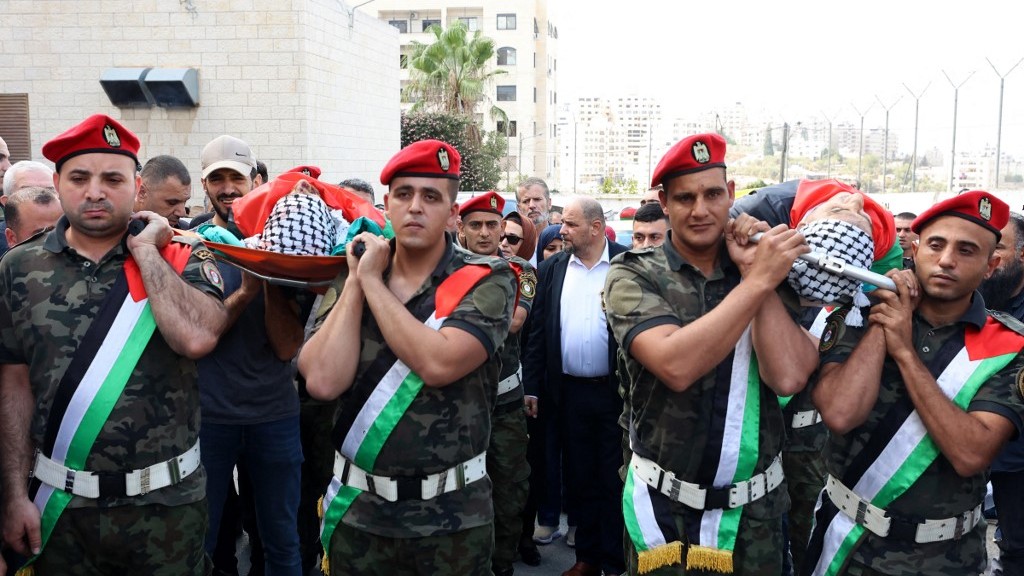
Palestinian security officers carry the bodies of Ibrahim Wadi, 62-years-old, and his son Ahmad Wadi, 25-years-old, two of four Palestinians killed by Jewish settlers the day before, during their funeral in the West Bank city of Nablus on October 12, 2023.
Palestinian security officers carry the bodies of Ibrahim Wadi, 62-years-old, and his son Ahmad Wadi, 25-years-old, killed by Jewish settlers the day before 12 October 2023 (AFP)

She pointed out that Palestinian students frequently self-censor, refraining from expressing their opinions to avoid backlash. Yet, this silence didn't shield them from the recent attack.

"We've essentially erased 'Freedom of Speech' from our lexicon. We seldom voice our thoughts because we are aware that it would make us the prime targets of Israeli anger. However, in spite of our silence, we were targeted and terrorised merely because we are Arab," she lamented.


Follow Middle East Eye's live coverage for the latest on the Israel-Palestine war


Anan Dabbah, a law student who also works in the dorms, echoed similar sentiments. "Typically, we have amicable relations with our neighbours," he told MEE.

Dabbah revealed that the police were present from the inception of the gathering and that the agitated mobs were participating in a protest approved by the Israeli police.

When the crowd attempted to breach the dorms, Dabbah reached out to Arab Knesset members such as Ayman Odeh and Mansour Abbas. In response, Odeh promptly arranged for a bus to evacuate the students, with the bus waiting at the city's entrance.

'What did we do wrong? All the measures resembled forced displacement. Our lives are in jeopardy, including our education, housing, and future'

- Palestinian student 

The student who did not wish to be named for safety concerns, conveyed her disappointment at the police's response. "Why should we be the ones forced to leave? Why are we not being adequately protected? What if the situation were reversed, and it was Arabs inciting against Jews?

"What did we do wrong? All the measures resembled forced displacement.

"Our lives are in jeopardy, including our education, housing, and future. Even if we sought to assert our Arab identity through academic achievements, staying apolitical, or refraining from expressing opinions, we're still at risk."

Youssif Taha, a volunteer with the Joint Coalition of Student Blocs, an organisation established to protect students after the outbreak of war, accused Netanya College of failing to safeguard Palestinian students.

"According to international academic norms, the institution has a duty to ensure the safety of its students," he said.

Taha underlined that students at this college are primarily apolitical, unlike other institutions. He also noted that the majority of Palestinian students work to cover their tuition expenses.

"Now, they may be unable to work because there is no one to protect them. This poses a significant economic setback for the students," Taha concluded.

Western coverage of Israel’s war on Gaza – bias or unprofessionalism?

 Publishing unsubstantiated claims, telling only one side of the story, and painting  Palestinians as nothing more than objects in Hamas’s hands are all unprofessional mistakes Western media makes while covering the conflict between Israel and Hamas, media experts and Arab journalists say.

Experts and journalists who spoke to Al Jazeera said the systemic “bias in favour of Israel” is “irreparably damaging” the credibility of news agencies considered “mainstream” in the eyes of Arabs and others.

As Western media organisations “dehumanise Palestinians” and “legitimise Israeli violations of international law” as Israel bombs Gaza, it is glaringly obvious that the vital historical context of the trauma Palestinians have been through for the past 75 years is being left out, experts say.

One-sided

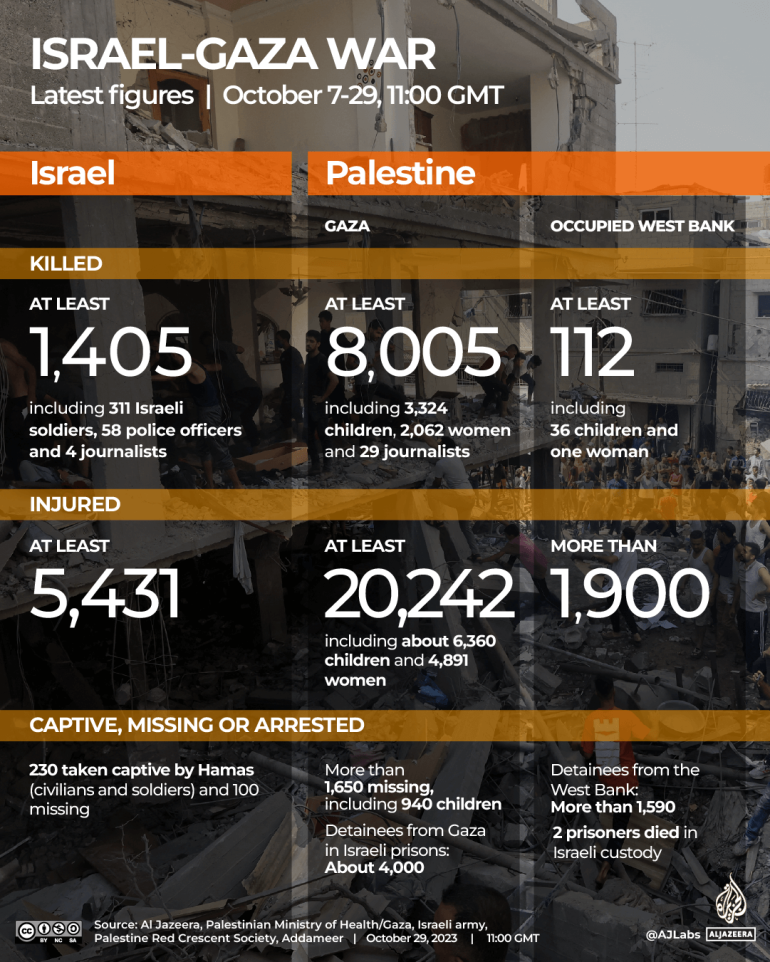
On October 7, Hamas launched an unprecedented attack on military outposts and communities in southern Israel, killing more than 1,400 Israelis and taking more than 200 hostages back to Gaza, according to Israeli officials.

The same day, Israel launched a relentless bombardment of Gaza that has killed more than 8,000 people, about 40 percent of whom are children.

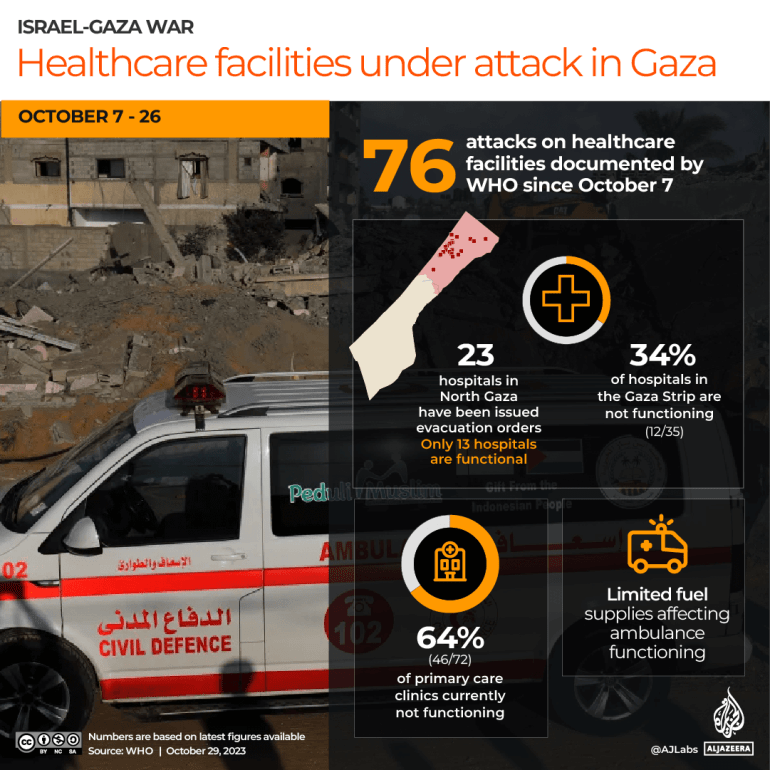
It also devastated Gaza’s health sector and flattened much of its infrastructure while strengthening its choke-hold siege by cutting off fuel, water and food – acts that may amount to war crimes under international humanitarian law.

INTERACTIVE-LIVE-TRACKER-GAZA 1080 x 1350-1698588923
(Al Jazeera)

United Nations experts say Palestinians in Gaza are facing the risk of genocide.

Western correspondents have gone to Israel where they reported extensively on the grief of Israeli families, but Israel has not allowed foreign journalists to enter Gaza, which means they’re missing a vital aspect of the story.

“If you don’t live in Gaza, if you don’t listen to the prayers Palestinians make when they lose loved ones, if you don’t learn about the life story of loved ones [who have been killed] …then the coverage [of Gaza] won’t be the same [as the coverage of Israel],” Taghreed El-Khodary, an analyst from Gaza, told Al Jazeera from her home in the Netherlands.

This means, she continued, that they “are not just covering the Israeli narrative, but they are living the Israeli narrative”.

When one trauma trumps another

Most of the people within Gaza are the children or grandchildren of Palestinians who were expelled from their homeland during the creation of Israel in 1948 – an event commemorated annually as the “Nakba” or catastrophe.

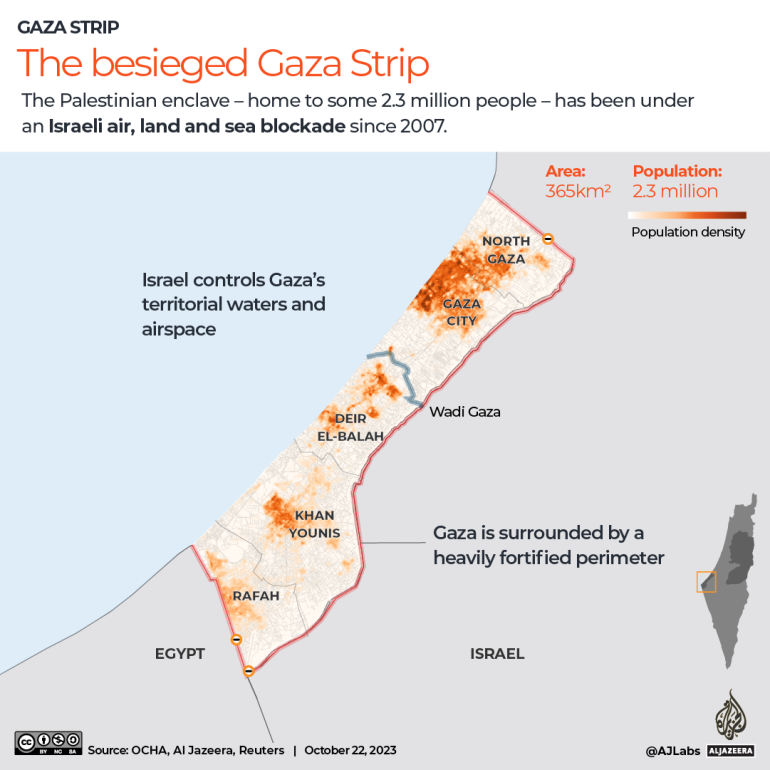
Rights groups refer to Gaza, where 2.3 million people are squeezed into a piece of land only 41km (25 miles) long and 10km (6 miles) wide, as the largest “open-air prison” in the world.

INTERACTIVE - Besieged Gaza Strip five governorates-1697994295
(Al Jazeera)

“You don’t hear the word ‘victims’ [in reference to Palestinians] as you hear [when there is reporting] about the Israeli side,” El-Khodary explained.

Rather than cover the human toll in Gaza, many Western media networks either refer to the Palestinians killed as numbers or echo American and Israeli talking points including Israel’s “right to defend” itself and Hamas using civilians in Gaza as “human shields”.

According to international law, Israel is an occupying force in the West Bank and Gaza. For decades, it has built and expanded illegal settlements in the former. It has maintained a suffocating siege on the latter since 2007.

Amnesty International has pointed to what it terms “damning evidence of war crimes as Israeli attacks wipe out entire families in Gaza”. Satellite imagery shows whole neighbourhoods in Gaza that have been flattened.

These “double standards” reflect a broader tendency of Western media organisations to portray Muslims and Arabs as “less than human”, said Arwa Damon, a former CNN correspondent and now a nonresident senior fellow at the Atlantic Council, a Washington, DC, think-tank.

“What we are seeing right now is a repeat – especially in terms of coverage – of what we saw on 9/11 where [Arabs and Muslims] were painted with this ‘terrorist’ brush and vilified,” she said.

Palestinians invited to speak to Western news channels are frequently asked if they “condemn Hamas”, while Israeli guests are seldom asked to condemn their government’s apartheid policies in the occupied West Bank or its siege and bombardment of Gaza, experts told Al Jazeera.

“In every [Western news] report, they keep mentioning that Hamas is [designated] a terrorist group,” said El-Khodary. “But what about mentioning what Israel is doing? It’s violating international law, it’s committing genocide. It has imposed an apartheid system [in the West Bank]. It has imposed a 16-year blockade on Gaza.”

“Where is the context? Only that Hamas is [a designated terrorist group] and that is the only context they are giving us here.”

Manufacturing support

Unsubstantiated claims made by Israeli parties have made their way to the front pages of Western news agencies, according to the experts Al Jazeera spoke to. A recent example was the oft-reported claim that Hamas “beheaded 40 babies”.

Despite the lack of evidence, the allegations were reported by The Independent, CNN, Fox News and the New York Post.

Even United States President Joe Biden implied he had seen pictures of dismembered babies on October 12. The White House later walked back his comments, saying Biden had seen no such images, and that he had seen news reports.

INTERACTIVE_HEALTHCARE_DAMAGE_GAZA_OCT29_2023-1698568247
(Al Jazeera)

That claim – and other unsubstantiated allegations like Hamas fighters raping hundreds of Israeli women – was an attempt to manufacture public support for Israel’s military response in Gaza, said Lina Mounzer, a Lebanese writer and critic who has written for major Western news organisations.

While an Amnesty International report concluded that children were killed in Hamas’s attack, neither Israeli authorities, Western journalists nor rights groups found any evidence of “beheaded babies”.

“When [Western outlets] focus on these claims of 40 beheaded babies and women being gang-raped, then what they are effectively doing is justifying the brutality of Israel’s counterattack,” Mounzer told Al Jazeera.

“How else do you sell the idea of self-defence when [Israel] is bombing what is basically a concentration camp?”

Fired for empathy

While some journalists at Western outlets may want to do more thorough reporting, many actually fear losing their livelihoods and careers if they speak out against their network’s pro-Israel bias, said Layla Maghribi, a British freelance journalist of Palestinian-Syrian descent.

A non-Jewish Arab colleague of hers, she told Al Jazeera, has been instructed by their news outlet not to attend any demonstrations or post anything on social media that suggests he empathises with Palestinians.

Her Jewish colleague, she continued, hates that he cannot tell his readers about the real human cost of Israel’s bombing of Gaza.

Journalist killed in the Israel-Gaza conflict

“My Jewish colleague is just mortified with his editor’s coverage of the conflict. That is, if you can even call it a conflict. It’s a massacre,” Maghribi said.

Other journalists who are not reporting on the conflict have been fired for comments or actions that imply empathy with victims in Gaza.

Michael Eisen, a Jewish journalist who was employed by the open-source scientific journal eLife, said he lost his job for sharing a headline on X (formerly Twitter) from the US satirical news website The Onion.

“Dying Gazans criticised for not using last words to condemn Hamas,” read The Onion headline, which was published on October 13.

Journalists at the BBC are understood to have objected to the United Kingdom broadcaster’s framing of the war in Gaza.

While the BBC has used words such as “massacre”, “slaughter” and “atrocities” when describing Hamas’s attack on Israel, it has refrained from describing Israel’s bombardment of Gaza in a similarly negative way, according to an email that staff at the network sent to Director-General Tim Davie, the UK’s Times reported.

Maghribi says she believes the climate of intimidation against journalists and the failure of mainstream outlets to humanise Palestinians is causing the Arabic-speaking world and Arab diaspora in the West to lose even more faith in the credibility of Western media coverage.

“We’re not just witnessing a breakdown in humanity,” she said. “We are witnessing a breakdown in the profession.”

SOURCE: AL JAZEERA

Netanyahu cites 'Amalek' Theory to justify Gaza Killings

Critics are accusing Israeli Prime Minister Benjamin Netanyahu of using "genocidal" language in a dramatic speech on Israel's war with Hamas in which he invoked the name of an ancient enemy of the Israelites from the Bible.

During a press conference Saturday in Tel Aviv in which he announced the commencement of an Israeli ground invasion into Gaza, Netanyahu said the military's objective remains the "destruction of Hamas' military and governing capabilities; and returning the hostages home."

The prime minister said both the government's war cabinet and security cabinet decided unanimously to launch the delayed ground invasion of Gaza, warning that this latest phase of the war could determine the fate of the state of Israel.

The invasion follows the launch of retaliatory airstrikes in response to the Hamas terrorist group's Oct. 7 attack that killed over 1,400 civilians in southern Israel. 

After quoting Ecclesiastes in his opposition to calls for a ceasefire, saying, "The Bible says that there is a time for peace and a time for war … this is a time for war," Netanyahu invoked the biblical name of Amalek in his address to the nation.

Amalek is one of Israel's archenemies in the Old Testament. 

"You must remember what Amalek has done to you, says our Holy Bible," Netanyahu said, echoing the words of  Deuteronomy 25:17, which states: "Remember what the Amalekites did to you along your way from Egypt."

Amalek, the 13th son born to Esau, the twin brother of Jacob, and his descendants are depicted in the scriptures as longtime rivals of the Israelites. In 2021, some military analysts speculated the war against the Islamic State terror group in Egypt was a reenactment of an ancient biblical confrontation between Israel and the Amalekites.

They also played a role in one of the more famous scenes from the book of Exodus when the Israelite army, led by Joshua, was attacked by the Amalekites while Moses, Aaron and Hur watched from a nearby hill. Moses noticed that when his arms were raised the Israelites gained the upper hand, but when they were lowered, the Amalekites prevailed (Exodus 17:8-13).

In 1 Samuel 15:3, God tells the prophet Samuel to instruct King Saul to "go, attack the Amalekites and totally destroy all that belongs to them. Do not spare them; put to death men and women, children and infants, cattle and sheep, camels and donkeys."

Last week, Netanyahu raised some eyebrows when he claimed the mission to defeat Hamas would go towards helping "realize the prophecy of Isaiah."

"It is now a time to come together for one purpose, to storm ahead and achieve victory with joint forces in a profound belief in our justice, a profound belief in the eternity of the Jewish people," said Netanyahu.  

"We shall realize the prophecy of Isaiah. There will no longer be stealing at your borders, and your gates will be of glory. Together, we will fight, together we will win."

These biblical parallels have not only been invoked by Israeli government officials but also pro-Israel Christian ministries as well.

Earlier this month, the International Christian Embassy Jerusalem (ICEJ), which represents "Christians around the world who stand with Israel and the Jewish people," called for an international "Esther Fast" to support Israel in what the organization described as a "battle against the genocidal spirit of Hamas terrorism."

Calling the Oct. 7 surprise attack by Hamas "without a doubt rooted in the demonic realm as a manifestation of the Spirit of Amalek," the ICEJ cited the book of Esther in which King Haman, an Amalekite, planned to annihilate the Jewish people only to be thwarted by unceasing prayer and fasting.

The ICEJ wrote, "This is a time when the Church is called to ascend to our spiritual vantage point and join in this battle, just as Moses prayed while Joshua was fighting Amalek on the ground! This is the time to call for an Esther Fast to approach the throne of God on behalf of His beloved people." 

Critics of Israel and its Gaza invasion have compared the Amalek language to a declaration of "holy war." 

Middle East Monitor accused Netanyahu of "calling for 'a holy war of annihilation' against the Palestinian people in the besieged Gaza Strip after he invoked the 'Amalek,' a nation in the Hebrew Bible."

Muslim apologist and author Hamza Tzortzis tweeted, "If it was not obvious from the carpet bombing, use of white phosphorus and indiscriminate killing that the Zionist government of Israel have clear genocidal intentions, then the following reference to Palestinians as Amalek in@netanyahu's speech describing his plans for Gaza should be enough to convince you. 

"The Biblical reference to Amalek is genocidal. The Bible commands to wipe out Amalek, including women, babies, children and animals."

Over the weekend, roughly 100 Israeli jets hit a reported 150 underground targets in Gaza, while footage released by the IDF showed tank columns operating in the Gaza Strip.

On Tuesday, Israeli troops attacked underground compounds in the northern Gaza Strip and battled Hamas militants, The Associated Press reports

The Hamas-run Palestinian health ministry states that 8,300 people in Gaza, including around 3,000 minors, have been killed since Israel's retaliatory airstrikes began. Another 21,000 have been wounded. Hamas' figures don't differentiate between combatants and civilians. 

The United Nations estimates that nearly 1.4 million Gaza residents have fled their homes.

Despite United Nations calls for a ceasefire, Netanyahu said Monday night that calling for a ceasefire is akin to asking Israel to surrender to terrorism. 

"I want to make clear Israel's position regarding a ceasefire. Just as the United States would not agree to a ceasefire after the bombing of Pearl Harbor, or after the terrorist attack of 9/11, Israel will not agree to a cessation of hostilities with Hamas," Netanyahu said during a press conference.

"After the horrific attacks of October 7, calls for a ceasefire are called for Israel to surrender to Hamas, to surrender to terrorism, to surrender to barbarism. That will not happen."

Ian M. Giatti is a reporter for The Christian Post and the author of BACKWARDS DAD

Smashing Patriarchy and Promoting Patriarchy: Diverse trends of Indian Society

Ram Puniyani   In pre-colonial India broad Hindu society was ruled by the laws of manusmiriti (MS) where caste and gender hierarchy was the ...