Monday, September 30, 2024

Apoorvanand on Why RSS Will Not Oust Modi as Prime Minister Just Yet

 This is an old article, but very important to understand BJP and RSS and their policy of hatred. - HS

=============

Apoorvanand on Why RSS Will Not Oust Modi as Prime Minister Just Yet

“At this juncture, unless the corporates withdraw support from Modi, RSS is not going to undermine Modi’s supremacy.”
Apoorvanand on Why RSS Will Not Oust Modi as Prime Minister Just Yet

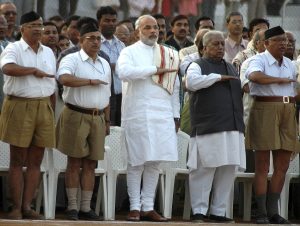
In this Jan. 1, 2006, file photo, then-Gujarat Chief Minister Narendra Modi, third left, former Chief Minister Keshubhai Patel, second right, and leaders of the Hindu nationalist Rashtriya Swayamsevak Sangh (RSS), in front, salute during the concluding ceremony of the eight-day RSS convention in Ahmedabad, India.

Credit: AP Photo/Ajit Solanki, File

Although India’s ruling Bharatiya Janata Party (BJP) won the most seats in the recent parliamentary elections, Prime Minister Narendra Modi, the BJP and its Hindutva politics emerged weaker from the election. The party failed to win an absolute majority and also, it lost the election in the Ayodhya Lok Sabha constituency. This was a humiliating blow to the BJP as it had made the consecration of the Ram idol and the building of a grand temple at the disputed site in Ayodhya a central campaign plank.

There have been several interesting developments in recent months. Modi was rapped on his knuckles for his hubris by Mohan Bhagwat, chief of the Rashtriya Swayamsevak Sangh (RSS), the BJP’s ideological mentor; there is talk of the RSS replacing Modi. Meanwhile, the BJP’s Uttar Pradesh unit infighting has come out in the open. Modi and Uttar Pradesh Chief Minister Yogi Adityanath are said to be at loggerheads.

So, what is happening in the BJP? After over a decade of living in Modi’s shadow, is the RSS re-asserting itself vis-à-vis a weakened Modi?

Apoorvanand, a professor at the Delhi University and a long-time observer of the BJP and the RSS, shares his insights into these issues. In an interview with The Diplomat’s South Asia editor Sudha Ramachandran, Apoorvanand said that “the RSS will be happy to see a restrained Modi.”

Why is the BJP’s defeat in the Ayodhya Lok Sabha constituency in the recent general elections important? Is it a turning point?

The Ayodhya Lok Sabha constituency is actually Faizabad constituency, and Ayodhya is just a part of the Faizabad constituency. In November 2018, the BJP renamed Faizabad [a Muslim name] as Ayodhya. It was part of the Hindufication of India. It has been erasing all Muslim identities, names, and monuments. Allahabad was changed to Prayagraj, Mughalsarai Junction was renamed as Pandit Deen Dayal Upadhyaya Junction. Babri Masjid (mosque) was erased by demolition.

But it must be regretting the move as it brought the focus on Ayodhya. What would have been a defeat in Faizabad became a defeat in Ayodhya, the purported place where the Hindu deity Ram is believed to have been born.

The BJP’s defeat here is not a turning point. Faizabad has not been a permanent BJP stronghold. It has been a seat where candidates from parties other than the Jana Sangh (as the BJP was known previously) and the BJP won elections. Candidates of the Communist Party of India (CPI) won the seat; the CPI candidate later contested from the Samajwadi Party and won. So, the recent defeat of the BJP candidate from the Ayodhya constituency is nothing new. It is not a turning point, as the BJP has been defeated repeatedly in the past.

However, the BJP’s defeat from Ayodhya has immense symbolic meaning. The BJP had made Ayodhya the centerpiece of its election campaign. In his speeches, Modi said that he has made Ayodhya a new pilgrimage destination for Hindus. He had been warning his Hindu electorate that his defeat would mean a lock would be put on the Ram Temple, which was built on the land of the Babri Masjid.

It was on January 22, 2024, the day that the Ram idol was consecrated at the temple in Ayodhya, that the BJP formally launched its election campaign. Since the BJP made the Ayodhya temple the centerpiece of its campaign, its defeat in Ayodhya conveyed the message that Ayodhya has rejected it.

This in turn brought focus on the voters of Ayodhya. It brought visibility to its people, whose lives were made miserable by the BJP. While making the town a destination for its brand of religious tourism, the BJP destroyed people’s houses and shops to make way for roads and builders or developers. People’s lives have been ruined. The BJP will regret drawing attention to this for a very long time.

This, in turn, brought focus to Kashi or Varanasi, to the BJP’s demolition of people’s homes and ancient temples, for construction of the Kashi Corridor. So, the defeat of the BJP in Ayodhya underscored that the BJP does not care for the Hindu people.

Days after the election results, RSS chief Mohan Bhagwat criticized Modi’s governance. Does this point to a rift between RSS and BJP? Or between Bhagwat and Modi? 

First, we must understand that RSS is the biggest beneficiary of the Modi regime. Under ten years of Modi rule, it has been flushed with funds and gained unprecedented access to resources. I’m told that its office in Jhandelwalan in New Delhi has been renovated for millions of rupees. The RSS chief enjoys national attention. Unlike previously, his speeches are telecast on all media platforms and published prominently in newspapers. Even if his utterances are meaningless, intellectuals try to get meaning out of it and make sense of it. He has become the most important spiritual leader of Hindus. He is treated as some old wise man of Hinduism. This is unprecedented. And the RSS is enjoying this newfound fortune.

And it is not only Mohan Bhagwat but also other RSS pracharaks (propagandists) who have benefited. Their fortunes have grown. Pracharaks get easy and unhindered access to top officials like university vice chancellors and district magistrates. Officials tell me that they have access to ministry files. The RSS has deputed its people in ministries.

During my recent visit to Bihar, I was told by theater activists that the chief of Sanskar Bharati, the cultural wing of RSS, summoned them and over a cup of tea told them to join the organization. And many joined. If you don’t, you will not be awarded government projects, So the Sanskar Bharati, the Vidya Bharati, and other educational institutions affiliated with the RSS have grown manifold.

The RSS in return provided Modi with its vast army of volunteers who became his propagandists. So, without any additional costs, Modi had at his disposal hundreds of thousands of RSS people who canvassed on his behalf, brought voters to polling booths and managed them. RSS became Modi’s biggest legitimizer in the Hindutva ecosystem and silenced the skeptics. Thus there is a mutually beneficial relationship between Modi and the RSS.

The RSS knew fully well that if Modi is promoted, it will be undermined. That was the experience in Gujarat. As chief minister of the state, Modi dominated and he made the RSS subservient to him. The RSS had to tolerate it. There was a trade-off — if the RSS accepted Modi’s supremacy, they could benefit materially. Also, they would get unhindered access to the state apparatus, which will be of immense benefit to it at all times, even when the BJP is not in power.

Importantly, Modi has enjoyed the support of Indian corporates. The RSS was aware that only Modi could bring money to the BJP and RSS. So, they accepted Modi’s leadership and promoted him as the BJP’s prime ministerial candidate for the 2014 general election.

I spoke to a leading RSS functionary before the 2014 elections. I asked him why the RSS was promoting Modi when he had humiliated it during his Gujarat days. He smiled and told me that there were two options before the RSS — become irrelevant under a Congress regime or become irrelevant under the Modi regime. They made their choice; clearly, the RSS is ready to be irrelevant under Modi because they have a lot to gain from him.

Yet, the feeling of humiliation is there. So, this shadow-boxing will keep happening. Bhagwat will make indirect statements critical of Modi, which the media would construe as a jibe against Modi because the Indian media is eager to prove that RSS is a powerful and sane body. Journalists want to be convinced and to convince others that whatever Bhagwat says holds great meaning and that the RSS determines the fate of the BJP. Also that the RSS has a civilizing role to play, to keep extremist tendencies in check.

For example, during the elections when there were signs that the BJP would not get an absolute majority, the RSS started spreading stories through its media that it had distanced itself from the elections. It wanted to convey the message that it was the support of the RSS that helped Modi win a majority in the past and that with the organization withdrawing from campaigning for the BJP, the number of seats the BJP won fell. They want to keep alive the illusion that they are very powerful. Their leaders pontificate and speak in a “spiritual” way, and the media is eager to accept that they are spiritual leaders and elevate them to that status.

Yes, there is tension between the RSS and BJP. There is conflict. There is unease in the RSS that the figure of Modi has become larger than the organization that made him what he is. In the past, they have never experienced a BJP leader, be it Atal Bihari Vajpayee or Lal Krishna Advani, ignoring their diktats.

Vajpayee was seen as someone who could stride both the RSS and the non-RSS worlds. He was useful to the RSS as he had influence across political parties. Vajpayee was acceptable even to the Communist Party of India-Marxists. When people commented that Vajpayee was the right person in the wrong party, he asserted that he was primarily a Swayamsevak. He did not distance himself from the parent organization.

Modi remains primarily an RSS man. It was the RSS that deputed him to the BJP. It was the RSS that forced the BJP to make him Gujarat chief minister and to retain him as chief minister after the 2002 mass violence against Muslims. So, Modi owes a lot to RSS and he, like Vajpayee, remains a Swayamsevak.

However, the RSS will be happy to see a restrained Modi.
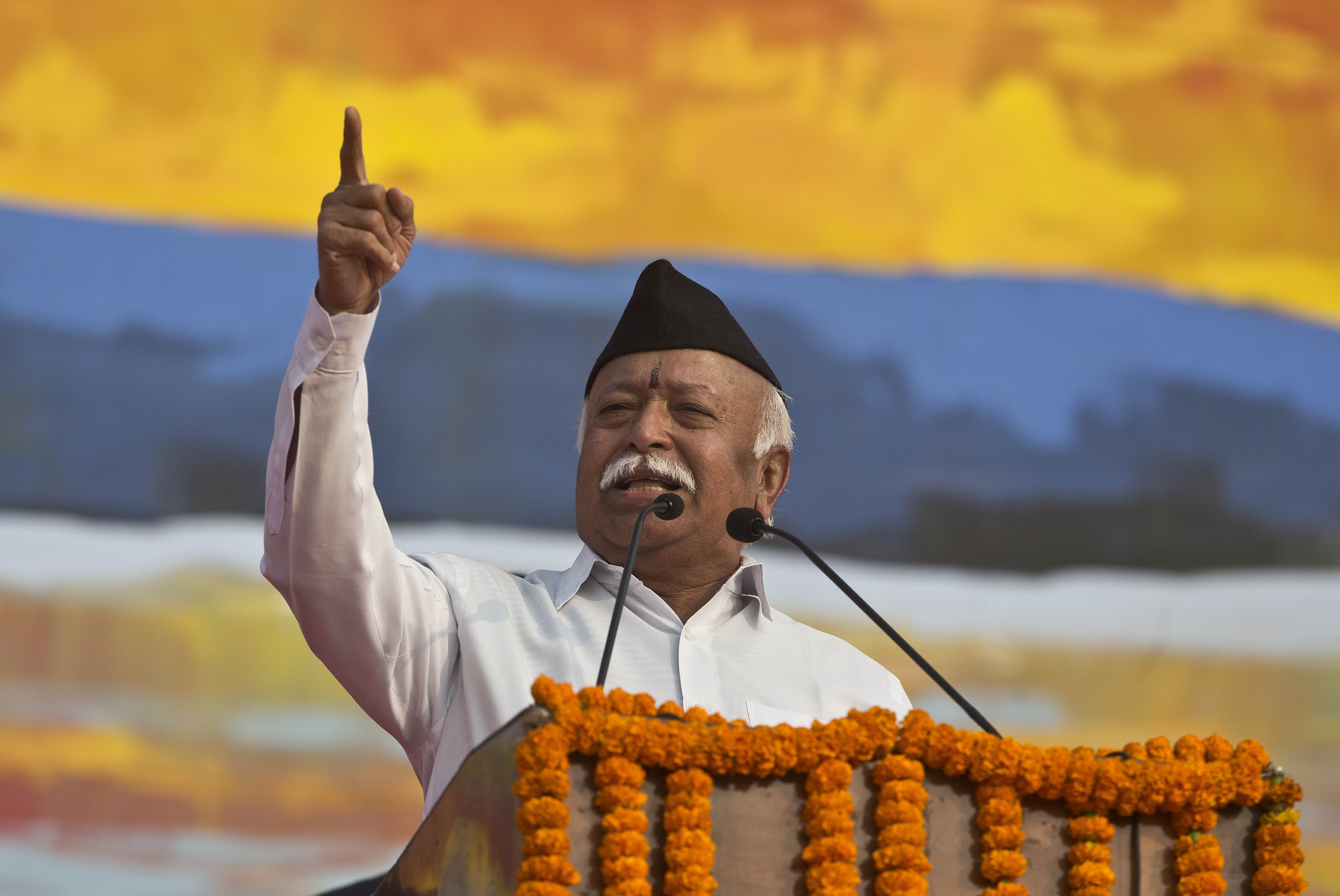
Hindu nationalist Rashtriya Swayamsevak Sangh (RSS), or the National Volunteers Force chief Mohan Bhagwat addresses a mega public rally in Gauhati, India, Sunday, Jan. 21, 2018. AP Photo/Anupam Nath

Does the RSS want to replace Modi with another leader?

At this juncture, unless the corporates withdraw support from Modi, the RSS is not going to undermine Modi’s supremacy. It will keep firing arrows at him. But it knows that real power comes from money and from the support of the corporate world.

Modi is Modi because of India’s corporates. They carried him on their shoulders to power in Delhi. It was Ratan Tata, then chairman of the Tata Group, India’s largest conglomerate, who in 2007 said Modi has the potential to become a good prime minister of India. So Indian corporates were promoting Modi from 2007 at least. The United Progressive Alliance, which was in power then in New Delhi, was enacting environment and forest laws, making it difficult for business corporations to access natural resources to exploit and grow their profits. But Modi, as chief minister of Gujarat, gave them access to rivers, land, and all public natural resources.

A lot of churning appears to be happening in the BJP/RSS in recent months. The Modi-Amit Shah combine is attacking Uttar Pradesh Chief Minister Yogi Adityanath. Could you shed light on what is happening?

Modi wants to shift responsibility for the BJP’s defeat in Uttar Pradesh [it won less than half the seats from what has been its stronghold] from himself to someone else. Hence the targeting of Adityanath. It is a power game.

Meanwhile, Adityanath fancies himself as a Hindu leader in his own right. He has the might of the powerful Hindu Yuva Vani supporting him. It was this that forced the RSS to accept him as chief minister of Uttar Pradesh in 2017, although Manoj Sinha was their first choice. Subsequently, with his bulldozing of Muslim properties, his cruelty and crudity, he proved that he is capable of being another Narendra Modi. He can match and even outdo Modi. So, RSS sees great potential in Adityanath.

But yes, Modi sees Adityanath as a threat. He is also keen to shift responsibility for the defeat in Uttar Pradesh and Adityanath is handy in this regard.

The spat between Modi and Adityanath is also useful to the latter. It has provided a boost to his stature. With Adityanath being pitted against Modi, he has become the most important person in the BJP, second only to Modi. The opposition leaders are making a big noise that Adityanath is being hounded by Modi. They are enjoying this infighting. But drawing attention to the Modi-Adityanath faceoff is elevating the latter’s stature. This is a win-win situation for both Modi and Adityanath.

We are told that RSS would be too happy this time to support Adityanath to restrain Modi. A very interesting situation is unfolding now: A diminished Modi threatened by Adityanath and RSS, a weak Adityanath being cornered by Modi, and a weak RSS trying to regain its hold over the BJP. But there has also emerged a radical Hindutva force that is not under the command of the RSS, but which the RSS is obliged to protect. That is how I see it.

Do you foresee a split in the BJP in the near future?

The BJP is the only party that has never split even once. Unlike the Congress party, the BJP top leaders have never left even if they have been relegated to the background. Vajpayee, for instance, didn’t dare leave the BJP. He could have. Lal Krishna Advani, the most powerful leader of the BJP, and Murli Manohar Joshi, were pushed to the margins. But they remained in the party.

There was opposition to Modi from within the BJP. There were challenges to his leadership from several BJP leaders. Modi dealt with this by reopening the Ayodhya conspiracy case, which relates to the demolition of the Babri Masjid in Ayodhya in December 1992. A special Central Bureau of Investigation court framed conspiracy charges against several leaders including Advani, Joshi and Uma Bharti in 2017. It was made clear to these leaders that if they took one wrong step, they would be jailed. With the sword of that case hanging over their head, they were forced to remain silent. Once it was clear that no harm would come from them to Modi, the court absolved them of conspiracy charges. By then, they had all become irrelevant and incapable of doing anything.

How is prejudice different from Hindutva hatred? 

Hindutva is a way of thinking of Hindus in which Muslims and Christians are the essential reference points. It does not think of Hindus in isolation; it is always in opposition to a Muslim or Christian. So, a Hindu in relation to a Muslim is what Hindutva is about. Apart from that it contains an element of Hindu supremacy that Hindus are the best in the world. A “Hindutvadi Hindu” is essentially one who hates Muslims.

For historical reasons, prejudice developed against Muslims and Christians in the minds of Hindus. These prejudices are very much a part of our Hindu common sense. But people have all kinds of prejudices. If you talk to a Bihari he will tell you jokingly that Bengalis are darpok (cowards). We can live with our prejudices.

But if there is a concerted effort to keep prejudices alive and make them the main element in our relationship with a community, then it becomes problematic. This is what the RSS does. It plays on the prejudices about Muslims and amplifies them to keep them alive and turns them into hatred.

For example, Shias and Sunnis have prejudices against each other. It becomes dangerous in Pakistan and Shias are in mortal danger because there is an anti-Shia ideology there that targets them. Shias and Sunnis are prejudiced against each other in India and they live with these prejudices in India.

So, Hindus and Muslims can live with their prejudices about each other. It becomes dangerous when it is turned into hate and it is very easy to turn it into hate if you make turning prejudice into hate your main work. And that is what the RSS is all about.

The RSS is not so much concerned about Hindus. It is more worried about Muslims and Christians and also about any possible proximity between Hindus and these two communities. It keeps working to ensure that Hindus do not become empathetic towards Muslims and do not see them as equal human beings.  Through thousands of its schools, shakhas (daily drills), and other institutions it is churning out Hindus who are essentially anti-Muslim.

The Modi government is even changing school curriculums to inculcate Hindutva and hatred of Muslims in the minds of youngsters. 

Yes, the situation is very dangerous. My students who have studied at the Saraswati Shishu Mandirs and other RSS-affiliated schools say that had they not come to Delhi University or gone to the Tata Institute of Social Sciences they would have remained Muslim haters like their co-schoolers in Bareilly or Meerut. They tell me that the magnitude of the danger posed by thousands of students who have been indoctrinated in the Hindutva ideology is unimaginable. A hate-generating machinery is in place and its fountainhead is the RSS.

Then you have Bollywood churning out film after film portraying Muslims as essentially anti-Hindu and anti-Indian, and warning Hindus to be wary of Muslims. And now you have the prime minister, the home minister, and even judges who say it is alright to hate Muslims. A judge in the Delhi High Court said that if you spread hatred with a smile on your lips it is not a crime. Spreading hatred against Muslims has become kosher.

How can this exclusivist ideology peddled by mass organizations be defeated? 

Hindu society has become dangerously radicalized and now it is for us to deradicalize Hindus, humanize them, and tell them it is not good to hate and exclude people. The way out is a counter-cultural and political movement to Hindutva, one which encompasses the whole life of Hindus and deradicalizes them.

The United Kingdom accepted Rishi Sunak as prime minister. We rejoice that the wife of the potential vice president of the U.S. is a practicing Hindu. Many Hindus think that this is because Hinduism is great, not because the British or Americans have been accommodative. We think we are supreme and so they accepted us. We have to get out of this supremacy syndrome and accept that accommodation is the best way out.

So, this counter-movement needs to be undertaken with great vigor, consistency, and belief.

RSS, the Ideological Mentor of India’s Ruling BJP, Enters its 100th Year by By Snigdhendu Bhattacharya

 Rarely does an organization get a chance to enjoy the pride of reaching its peak in its centenary year. India’s Rashtriya Swayamsevak Sangh (RSS), the ideological-organizational parent of Prime Minister Narendra Modi’s Bharatiya Janata Party (BJP), has achieved that feat.

In its 100th year, the RSS’ influence is not only widespread but also so well entrenched is its network across India that future governments will find it enormously challenging to shake off its grip over every aspect of Indian politics and life.

The RSS was founded during British colonial rule on September 25, 1925, to raise a disciplined and dedicated volunteer force for “Hindu revival” and to establish a Hindu Rashtra (Hindu nation). Although it was formed during British colonial rule, it did not participate in India’s anti-colonial freedom struggle.

It claims to be a socio-cultural organization and has sought to project itself as uninvolved in India’s politics. Yet, its role in the political arena is enormous; it now has a large presence across India and wields overwhelming influence on almost all spheres of governance at the federal level, and also in over a third of Indian states where BJP-led alliances are in power.

From ministries like educationcultureinformation, and science and technology to autonomous institutes like public universities, archeological and historical research institutes, and statutory bodies like the National Commission for Scheduled Tribes and National Commission for Minorities, RSS functionaries are at the helm of affairs in all of contemporary India’s institutions.

“The nature of democratic contest in India has completely changed and the reason is that one organization called RSS  a fundamentalist, fascist organization  has basically captured pretty much all of India’s institutions,” India’s key opposition leader Rahul Gandhi said in 2023.

It is a strictly male-only organization but has a separate women’s wing, Rashtra Sevika Samiti, while its affiliates like the BJP, Vishwa Hindu Parishad, and Sewa Bharti have women organizers.

Even in states ruled by parties opposed to the BJP, the RSS has made deep inroads through its work among different sections of society, working mostly through a network of organizations registered as nonprofits. This overwhelming control has been possible because, in these hundred years, the RSS has transformed into a massive banyan tree that stands on a hundred of its trunks.

While Hindu “revival” is the mainstay of all organizations affiliated to and inspired by the RSS, it is active among scientists, historians, archeologists, geologists, advocates, retired judges, civil servants, retired armed force personnel, farmers, formal and informal workers, tribal people, lower and upper Hindu castes, teachers, students, mothers, teenage and young adult women, the elderly, the differently abled, and expatriates.

It has a wing for every section of life and society – politics, religion, health, sports, science, formal and informal education, foreign policy, trade union, vocational training, nation-building, national security, prenatal care, civil service coaching, cow-centric village economy. It is now set to start residential schools to prepare children for a career in the army.

In its early years, the RSS is also said to have been influenced by the ideas of Italy’s fascist leader Benito Mussolini. In 1931, B.S. Moonje, one of India’s early Hindu nationalist leaders during the colonial period and a mentor of RSS founder K.B. Hedgewar, was deeply impressed by fascism after visiting a few military establishments in Italy and meeting.

To what extent Moonje influenced Hedgewar and the RSS functioning remains debatable. Nevertheless, Hedgewar’s successor, M.S. Golwalkar, who held the post between 1940 and 1973, did not hide his admiration for Germany’s Nazis on the building of national identity.

Teachings of all RSS-linked organizations emphasize duties over rights. This is reflected in Modi’s designating India’s current times as “Kartavya Kaal” or the age of duty.

RSS-linked organizations work in coordination. Full-time RSS members, called pracharak or campaigners, are routinely transferred from one organization to another. Modi himself was an RSS full-timer before he was transferred to the BJP, the political wing.

This massive RSS network of a range of apparently apolitical organizations gives the BJP an advantage over its political rivals in at least two ways — building public opinion on difficult issues with a long-term approach and controlling the government apparatus with an ideologically committed workforce.

While many RSS volunteers are leading various governments as BJP lawmakers, the organization itself does not interfere with routine affairs of governance. Through these lawmakers and the affiliated organizations, it shapes the formation and implementation of government policies in the spheres of religion, laws, education, culture, and information. The most common method is various government departments’ collaborations with RSS-linked nonprofits for the conceptualization and implementation of programs.

What unites the RSS’ diverse programs – from sewing training institutes to handicrafts cooperatives to yoga and archery clubs – is the unmissable presence of their ideology. At the core of their indoctrination program in all organizations lies developing a love for the saffron flag, which they describe as “the civilizational flag of Bharat,” and respect for traditional Hindu religious values, rituals, practices, and Hindu nationalist icons who fought against Mughals. In essence, through their work, they preach the idea of a Hindu-oriented India.

Hindus form four-fifths of India’s population but are known for being a greatly diverse society in rituals and practices – linguistic, cultural, dietary, and caste-wise.

“The BJP is not like other parties a power seeker, but is part of an ideological movement represented by the RSS whose ideology itself is inalienable from those of cultural nationalists,” senior RSS intellectual Rakesh Sinha wrote a quarter of a century ago.

Sinha named as “cultural nationalists” some of India’s early nationalists who, during the 1880s and 1890s, considered the period of Muslim rulers, especially the Mughal period, as a colonial rule. In reality, many of those Sinha named later changed their views and considered only British rule as India’s colonized period.

From the first decade of the 20th century, India’s leading nationalists considered Muslims to be as integral to India as the Hindus, and Mughal rule to be as much Indian as that of any Hindu ruler.

That the RSS and the BJP disagree with the top leaders of India’s freedom struggle is evident from Modi’s repeated reference to India’s “1,000 years of slavery,” indicating the entry of Muslims into India as the beginning of its subjugation.

While the RSS has been active since 1925 in creating new organizations and expanding its areas of operations, both geographically and in social sections, it remained in the margins for decades, largely because of Hindu nationalists’ role in the assassination of India’s founding father, Mohandas Karamchand Gandhi.

It began rising to prominence in India’s socio-political scene mainly from the early 1990s with the movement seeking the destruction of the 16th-century Babri mosque in Ayodhya, claiming it was built on the site of a temple dedicated to the Hindu deity Ram at his birthplace.

Through the work of its organizations, the RSS has spread the idea that India is the land of Hindu culture and it should be governed in the Hindu way. A look at the mottos of some of the organizations belonging to the RSS family would make it clearer.

The motto of Vidya Bharati, the school education wing, for example, is “to develop a national system of education which would help build a younger generation which is committed to Hindutva and infused with patriotic fervor; physically, vitally, mentally, and spiritually fully developed.”

Officials belonging to the Vidya Bharati school network are now playing key roles in rewriting India’s school textbooks and implementing the controversial National Education Policy (2020). The RSS history-rewriting wing, Akhil Bharatiya Itihas Sankalan Yojana (ABISY), aims to “reconstruct the authentic and truthful history of India according to the Indian chronology.”

Indian chronology means relying on ancient epics and mythologies as authentic sources of history, an approach that many of India’s stalwart historians have criticized for decades. The RSS, though, is fond of this approach as the interpretation of Indian mythologies allows them to portray ancient Vedic Hinduism as the pinnacle of world civilization. ABISY members are now at the helm of affairs at the Indian Council for Historical Research (ICHR), India’s top public institute for the promotion of historical research.

As for the RSS tribal wing, Vanvasi Kalyan Ashram (VKA), its main objective “is to eliminate the chasm between the Hindu community and their Vanvasi [forest dwellers] brethren with affection and good faith.” However, many tribal rights activists have accused the VKA and the VHP of converting tribals to Hinduism.

Vijnana Bharati, the science wing, describes itself as “a vibrant movement for the development of Swadeshi (national) Sciences.” It focuses on championing “the cause of Bharatiya Heritage with a harmonious synthesis of physical and spiritual sciences” and “interlinking traditional and modern sciences on the one hand, and natural and spiritual sciences on the other hand.” This organization now collaborates with India’s top science and research institutes, including the Indian Institutes of Technology, and the federal government on its mission “to spread the awareness of the unique contributions of ancient Bharat in the development of modern science.”

Samvardhini Nyas, one of its women’s organizations, teaches pregnant women how to imbibe cultural values and patriotism in the baby while still in the womb. RSS-run schools teach students that the whole of Asia was once under Hindu influence. Bajrang Dal and Durga Vahini “build awareness” against what they call “love jihad,” a conspiracy theory claiming that Muslim men entrap Hindu women as part of their jihad or religious war.

With the RSS grip strengthened in crucial federal ministries and appointments in autonomous and statutory bodies and educational institutions over the past 10 years of Modi rule, many observers believe the Hindu nationalist influence in all spheres of administration and governance will outlive the Modi government or BJP rule.

Dr Maung Zarni on martyrdom of Hasan NasraAllah and the Middle East

This message is a little bit old now. - HS

+++++++++++++ 

Dear friends--


A couple of hours ago, Hizbullah confirmed that its leader of the past 32 years, Sayyed Hassan Nasrallah, was killed, apparently in the massive air-raid the Israeli military launched against the Southern Beirut suburbs yesterday. That air-raid and the many others the Israelis have launched against Lebanon over the past week have killed hundreds-- or quite likely thousands-- of Lebanese people, maimed and displaced many more, and destroyed swathes of the country's vital infrastructure. Our deep condolences to all of them.

We can recall that the Israeli military's long-established "Dahiyeh Doctrine", which calls for pulverization of large portions of advanced urban infrastructure, was named after the assault it undertook against that same South Beirut "Dahiyeh" ("neighborhood") in 2006.  Over the past year, Israel has practiced the Doctrine relentlessly against the cities of the Gaza Strip and their residents and has faced ZERO actions from Washington to restrain those genocidal acts. Indeed, Pres. Biden has continued to provide Israel with everything it needed to keep on. committing them. And now Israel has also taken them (back?) to Lebanon-- and also to the West Bank.

The coming days and weeks will show where all this might lead-- including for the 40,000 U.S. service-members deployed throughout West Asia (the "Middle East".) A few things are worth bearing in mind, though:

(1) The broad destruction that Israel has wrought in Lebanon is highly unlikely to force Hizbullah and its many allies to capitulate-- just as Israel's pulverizing of Gaza has not brought Hamas to its knees.

(2) In 1992, Israel succeeded in killing Hizbullah's previous leader. That did not bring Hizbullah to its knees. Indeed, it brought Hassan Nasrallah to the leadership spot. Over the years that followed 1992 he built new capabilities for the party and its militia, which in 2000 was finally able to force an ignominious end to the occupation of South Lebanon that Israel had maintained since 1982.

(3) Hizbullah (like Hamas) has always paid great attention to training younger generations of cadres and fighters, in the clear knowledge that Israeli decapitation projects would be very likely.

(4) The Israelis have declared no clear political goals in Lebanon except the need to secure the "living space" (lebensraum?) of their citizens in the north of Israel. If a Somalia-style chaos ensues in Lebanon, which is one possibility among many, that seems to be of no concern to them.

(5) This crisis certainly affects the security of the numerous U.S. military and naval assets strung out throughout the region. Incidentally, it does so at a time when a vital piece of the US Navy's operational logistics, the sole USN "oiler" resupply ship in the whole region, is suddenly out of action.

Fyi, back on Monday I pulled together some of my own past writings on Hizbullah and the Lebanese Shiite community from which it arose, in this post on Globalities. The pieces linked to there are are from 1985, 2005, and 2006. That last one describes the last time Israel mounted an earlier major assault on Lebanon, back in 2006... and how it then took Hizbullah only 33 days to force Israel into a humiliating retreat.
...

And as the Israeli military continues to shift its forces toward the Lebanese border, it leaves behind in Gaza just enough forces to continue the slow, grinding genocide-by-starvation-and-disease of the Strip's remaining population.
 And as the Israeli military continues to shift its forces toward the Lebanese border, it leaves behind in Gaza just enough forces to continue the slow, grinding genocide-by-starvation-and-disease of the Strip's remaining population.

....

Meantime, Just World Ed's project to provide solid, analytically objective resources about the history and development of the widely demonized organization Hamas continues, right across the United States and worldwide:

This week: 'Understanding Hamas' book events in NYC (Wed.) and a NEW one in Washington DC (Thurs.)!

The big first launch for the book will be, as I've noted previously, on Wed., October 2, at the event space that our publisher, OR Books, runs on Manhattan's Lower East Side.

Where: 40 Avenue C, Manhattan
When: 5:30 pm
Who: My co-author Rami Khouri, our friend David Wildman, and myself
What: A discussion about the book-- which will be livestreamed, here, starting around 6 pm ET
Request: That live attendees send an RSVP beforehand to events@orbooks.com.

Washington DC, Thursday, Oct. 3:

I was delighted when the wellknown DC activists' hub (and great bookstore/restaurant) Busboys & Poets invited me to come and talk about the book with our old friend the Israeli-American justice activist Miko Peled. Busboys' owner Andy Shallal and I agreed that scheduling this as soon as possible would be great, and he picked his lovely Brooklands location to house it:

Where: Busboys, 625 Monroe St. NE, WDC
When: 6 pm
Who: Miko Peled and me
More info: Here
Request: That attendees RSVP beforehand by "buying" a FREE ticket via this form.


Why Did Tamils & Muslims Of The North & East Reject JVP-Led Alliance?

 By Imtiyaz Razak –


Introduction 

Sri Lanka’s recently concluded 9th presidential elections culminated in a notable victory for the Marxist JVP, led by Anura Kumara Dissanayake, who secured the presidency after a second ballot count. The election results underscore a significant electoral divide: while a majority of Southern Sinhala-Buddhists rallied behind Dissanayake, the Northern and Eastern Tamil and Muslim populations largely rejected the JVP. This rejection extended to the Tamils of Indian origin, often referred to as Upcountry Tamils.

Why?

Several factors contribute to this electoral split. Leaders from the North and East, particularly among Tamil and Muslim communities, aligned themselves with Sajith Premadasa, reflecting a deep-seated mistrust of the JVP. This skepticism stems from the JVP’s commitment to maintaining Sri Lanka’s unitary state structure—a cornerstone of Sinhala-Buddhist nationalism. The JVP views the ethnic conflict in Sri Lanka not as a struggle for rights and recognition but as an issue of terrorism, which has led them to support military actions against the LTTE and oppose the Indo-Lanka Peace Accord. Historically, their fierce opposition to this accord was marked by violent actions against its advocates, including the assassination of the charismatic leader Vijay Kumaratunga, who championed the accord aimed at mitigating ethnic tensions.

The rejection of the JVP by Tamil and Muslim communities raises a crucial question for the party: why have these groups consistently distanced themselves from their platform? If the JVP aspires to foster a more inclusive Sri Lanka, it must confront this question directly. To do so, the party should evolve beyond 19th-century Marxist ideology and cultivate a nuanced understanding of the grievances faced by the people of the North and East. This evolution demands political courage, creativity, and a sincere commitment to addressing the diverse issues affecting these communities.

What Can JVP Do To Win The Trust Of The Tamils And Muslims Of The North And East?

Furthermore, the election results indicate that the JVP has begun to penetrate the voter base of former President Mahinda Rajapaksa, a demographic predominantly composed of Sinhala-Buddhists who previously supported him in his efforts to defeat the LTTE and uphold the unitary state. However, given the JVP’s historical stance and current strategies, it appears unlikely that they will pursue meaningful political solutions to the ethnic conflict— a reality that could hinder their broader appeal and the potential for national reconciliation.

Moderate Tamil nationalists seek a comprehensive solution that does not compromise the unity of Sri Lanka. However, the Sinhalese majority has often overlooked the Tamils’ willingness to coexist peacefully on the island. For many Sinhalese, the constitution that enshrines the unitary state structure serves to reinforce a collective psychological security, deeply rooted in the historical narratives of the *Mahavamsa*, a 5th-century chronicle of Sinhalese history. Ordinary Sinhalese voters, particularly those from rural areas who supported the JVP, believe that the unitary constitution provides security and a pathway out of poverty. In contrast, Tamils view this situation as a manifestation of state oppression. Consequently, it seems improbable that the JVP will significantly alter its position on devolution or embrace policies that recognize the aspirations of minority communities.


Some Ways Forward For JVP

1. Acknowledge Historical Grievances

The JVP should openly recognize and address past injustices, including its historical opposition to the Indo-Lanka Peace Accord and violence against those advocating for Tamil rights. Acknowledging these grievances is a crucial step in building trust.

2. Promote a Federal Structure

Advocating for a federal system that grants significant autonomy to provinces could help address the aspirations of minority communities. This approach would signal a commitment to recognizing the unique cultural and political needs of Tamils and Muslims.

3. Engage in Constructive Dialogue

Establishing open lines of communication with community leaders and civil society organizations in the North and East can facilitate trust-building. Regular consultations can help the JVP understand the concerns and aspirations of these communities.

4. Focus on Economic Development

Implementing targeted economic development initiatives in the North and East can demonstrate a commitment to improving the living conditions of these communities. Economic empowerment can build goodwill and trust.

5. Champion Minority Rights

The JVP should actively promote policies that protect and enhance the rights of Tamils and Muslims. This includes advocating for language rights, cultural preservation, and equitable representation in government.

6. Adopt a Peace-Oriented Narrative

Reframing the party’s messaging to emphasize peace, reconciliation, and coexistence can help shift perceptions. The JVP should present itself as a party that prioritizes harmony among all ethnic groups.

7. Support Transitional Justice Mechanisms

Advocating for transitional justice measures to address past human rights violations can demonstrate a commitment to accountability and healing. This could involve supporting truth commissions or reparations for affected communities.

8. Educate and Raise Awareness

The JVP should engage in educational campaigns to raise awareness about the importance of ethnic harmony and the benefits of a united Sri Lanka. This can help counteract historical biases and misconceptions.

9. Collaborate with Civil Society

Partnering with local NGOs and community organizations can help the JVP build grassroots support and enhance its credibility in the North and East. Collaboration on community development projects can also foster trust.

10. Adapt Political Ideology

Evolving beyond strict 19th-century Marxist ideology to embrace a more inclusive and pragmatic political approach can help the JVP resonate better with diverse communities. This requires a willingness to learn and adapt to the complexities of Sri Lanka’s ethnic landscape.

Conclusion

Winning the trust of the Tamil and Muslim communities in the North and East is essential for the JVP’s long-term success and the broader goal of national reconciliation. By implementing these strategies, the JVP can demonstrate a genuine commitment to addressing the needs and concerns of all Sri Lankans, paving the way for a more inclusive political environment.

In summary, the results of the 9th presidential election illustrate not only the complexities of Sri Lanka’s political landscape but also the pressing need for all political parties, including the JVP, to engage constructively with the diverse voices of the nation. Addressing these disparities is essential for fostering a united and harmonious Sri Lanka.

*Dr. A.R.M. Imtiyaz research focuses on nationalism, ethnic conflict  in Sri Lanka and China. He has published widely in top-tier peer-reviewed journals, including World Affairs, Asian Ethnicity, Journal of Asian and African Studies, and South Asia. His articles often explore the intersection of politics, identity, and conflict, providing a nuanced understanding of the complex realities faced by ethnic minorities. He can be contacted at mohamedimtiyaz@yahoo.com

The Decline of Western Imperial Mythology in the Persian Gulf by Nicky Reid

  In case you haven’t noticed, things are going pretty badly for Donald Trump in the Middle East lately, and they just keep getting worse. A...