Thursday, January 30, 2025

A Fools Paradise: Thomas Friedman and the Middle East by Melvin Goodman

 “I am convinced that Bibi understands…that by significantly weakening Hezbollah and Iran, he has helped set in motion the possibility for Lebanon and Syria to restore their sovereignty and unity.  I think he is ready to complete Israel’s withdrawal [from Lebanon] and finalize the border….”

– Thomas Friedman, “How Trump Can Remake the Middle East,” New York Times, January 21, 2025,

Thomas Friedman, the New York Times’ most influential columnist, has comprehensively recorded his dreamscape for the Middle East.  It tells Donald Trump that “you have a chance to reshape this region in ways that could fundamentally enhance the peace and prosperity of Israelis, Palestinians and all the region’s people, as well as the national security interests of America.”  Friedman believes that Benjamin Netanyahu is “ready to complete Israel’s withdrawal and finalize the border” with Lebanon, and that the United States has an “enormous opportunity to truly end the civil war [in Lebanon] and put the country back together.”  Finally, he produces a threat: Iran’s nuclear program and malign regional strategy need to be eliminated, and if Trump can’t do this through “peaceful negotiations,” it needs to be “done kinetically.”  That’s right: Friedman is willing to commit the United States to a war against Iran.

Friedman’s dreamscape for the Middle East makes no sense on any level.  Even former secretary of state Antony Blinken eventually recognized that Israel has “systematically undermined the capacity and legitimacy of the only viable alternative to Hamas, the Palestinian Authority.”  What has happened to Friedman’s concerns about Netanyahu have no political solutions for Gaza on the “Day After” the fighting stopped.

Israel is expanding official settlements and nationalizing land on the West Bank at a “faster clip than at any time in the last decade, while turning a blind eye to an unprecedented growth in illegal outposts,” according to Blinken.  The attacks by extremist settlers on Palestinians, moreover, “have reached record levels.”  Friedman believes that the Jewish supremacists in Netanyahu’s cabinet are responsible for this aggression, but significant evidence points to Netanyahu himself as supporting these actions.

Friedman believes that Netanyahu is ready to withdraw from the border with Lebanon even as Israeli Defense Forces are ignoring the so-called cease fire agreement and continuing to bomb Lebanese villages.  On the very day that Israel was to withdraw from southern Lebanon, IDF forces killed at least 22 Lebanese civilians and injured more than 100.  The withdrawal agreement was fragile from the start, with no monitoring mechanism in place and no definition of what constitutes a violation of the agreement.

Netanyahu simply has no faith in the ability of the Lebanese Army to stymie the resurgence of Hezbollah in southern Lebanon.  Lebanon itself is a failed state, and there are no indications that Israel is preparing to withdraw its forces.  Meanwhile, the right-wing Israeli defense minister, Israel Katz, has warned that, if there is a resumption of fighting, Israeli strikes would no longer differentiate between Hezbollah and the Lebanese state.  That should come as no surprise as Israeli governments since the Israeli invasion of Lebanon in1982 have made no effort to protect Lebanese sovereignty.  Nor has the IDF moved to disable the six military bases built in recent months in southern Lebanon.

If Donald Trump had any interest in a solution to the crisis between Israel and the Palestinians, he never would have stated that he wanted to “clean out” Gaza by transferring some of its population to Egypt and Jordan.  I’m sure that Trump has no concern with the war crimes that would be committed to “clean out” Gaza.  Nor I’m sure does he understand  the “nakba” or catastrophe in 1948, when Israel began its policy of displacing Palestinians whose families had resided for hundreds of years in Palestine.

I’m also sure that moderate Arab leaders who might have worked with the United States to find a political solution realize that Trump has no understanding of the deep differences within the Arab community regarding a peaceful settlement.  But Arab leaders do agree that a solution cannot include a resettlement that would destabilize their own fragile governments.  Trump’s efforts to get Egypt and Jordan to take in more than a million Palestinians is not just one of the mistakes that he has made in less than two weeks in the White House.  In fact, it may be his biggest mistake thus far; it’ll remind people of Trump’s Muslim ban in the first few months of his first term.

Friedman’s apparent support of war against Iran, meanwhile, is his biggest mistake.  Iran is now more vulnerable than at any time since the war with Iraq in the 1980s.  It has lost its “axis of resistance” (Hamas, Hezbollah, and Syria) to counter the regional influence of the United States and Israel.  Iran could decide to weaponize its decades-old nuclear program, but it seems more interested in pursuing a comprehensive dialogue with the United States to get an end to the sanctions that have devastated Iran’s economy.  Unfortunately, Trump has stocked his government with militarists who favor a kinetic approach to the problem of Iran as does Friedman.

Ironically, Friedman has ignored the one step that Trump has taken that would augur for a more moderate approach to the Middle East as far as U.S. involvement is concerned.  In a step that has been totally ignored by the mainstream media, Trump has named Michael DiMino as the Assistant Secretary of Defense for the Middle East.  Not exactly a household name, DiMino has been skeptical regarding the close ties between the United States and Israel, and rejects the notion that the United States has “vital or existential” interests in the Middle East.  He favors the withdrawal of U.S. forces from Iraq and Syria, and he believes that Washington’s two primary interests in the region—energy resources and combatting terrorism—are exaggerations.  The fact that pro-Israel Republicans as well as Israel itself object to this appointment is noteworthy.  So perhaps Trump may consider ideas about the Middle East that are new and different.

Melvin A. Goodman is a senior fellow at the Center for International Policy and a professor of government at Johns Hopkins University.

“A City of Ghosts” — Returning to Rafah to Find Death and Destruction

 On the morning of January 19, Khalil Fahjan left his family’s small, damp tent in Deir al-Balah and quickly headed south to his family home in Rafah. The deadline for a “ceasefire” agreement to halt Israel’s genocidal assault on Gaza, at least temporarily, was supposed to go into effect at 8:30 a.m. that morning. He had not been to Rafah in more than seven months, since the Israeli military invaded the city, and he was desperate to go home.

Fahjan, 25, was unaware that the Israeli military had delayed the implementation of the deal by nearly three hours, attacking and killing Palestinians in Khan Younis and northern Gaza in the interim.

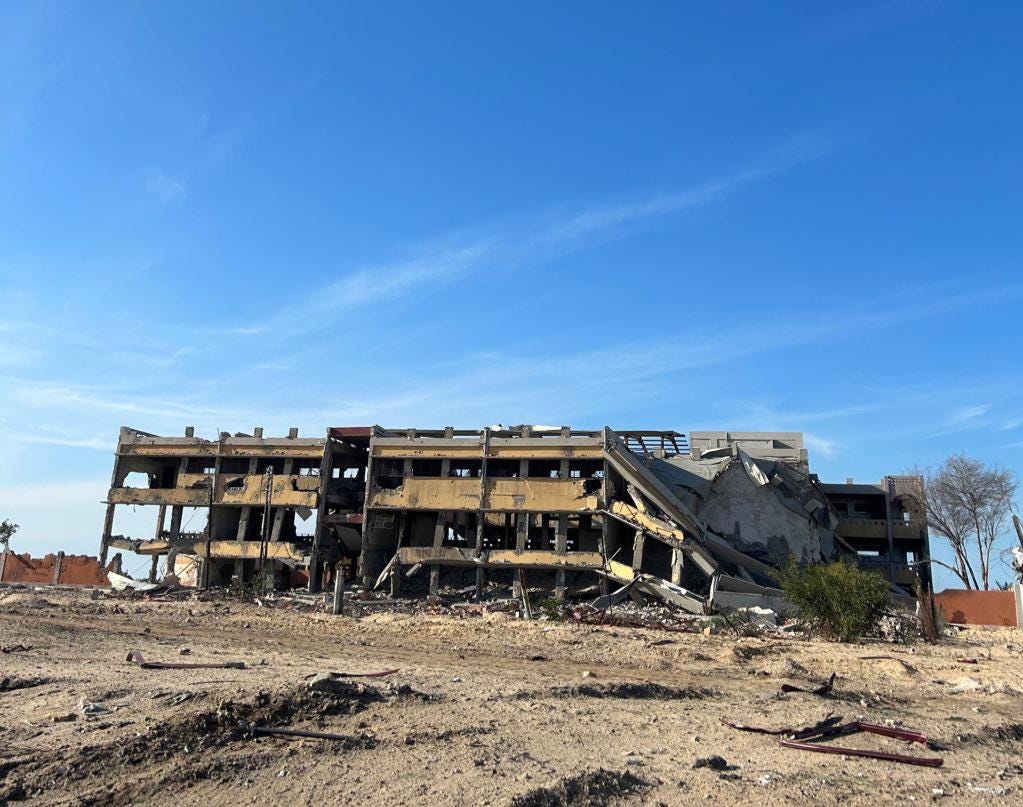
When he arrived in his neighborhood of Tal-al-Sultan, he struggled to comprehend the scene before him. “It was such utter devastation that I could see the sea from central Rafah, which is four kilometers away,” Fahjan told Drop Site News. “All the houses in my area were turned into piles of rubble. At first glance, I couldn’t identify my neighborhood or my home. Every landmark that I had once known was erased. It is now a city of ghosts.”

He described walking through an open graveyard, watching people collecting decomposing body parts and human remains in an effort to identify their loved ones amid unexploded munitions on the streets and inside buildings.

When he reached his home, it was barely standing. The interior was burnt out and charred, and the walls were crumbling and riddled with bullet holes. “My house, where all my memories, my work, my dreams, my certificate—where my entire life was—had simply vanished,” he said. “This war has stolen everything from us. I look at Rafah and ask myself whether or not I will stay in a tent for the next two or three years. The city needs 10 to 20 years to get back to a sense of what it was before.”

Al-Fardous school in Rafah, Gaza Strip. (Photo by Rola Sababah)

Before the war began 15 months ago, Rafah, the southernmost city in the Gaza Strip, was home to some 280,000 people; and the Rafah crossing on the border with Egypt was the only path into Gaza not controlled by Israel. All that was to violently change.

As Israel’s aerial bombardment intensified, Palestinians across Gaza were forcibly displaced southward, many to Khan Younis at first and then—as Israeli troops invaded Khan Younis in early December following a week-long ceasefire—to Rafah. The number of people in Rafah swelled to more than 1.5 million, nearly three quarters of Gaza’s population.

In April, Israel announced it would invade Rafah despite dire warnings from humanitarian organizations, the United Nations, and other international bodies. Even President Biden warned he would not supply offensive weapons to Israel if it invaded Rafah, only to characteristically backtrack.

The Israeli invasion, when it came in May, forced over a million Palestinians to be displaced yet again, many of them cramming into Deir al-Balah and Mawasi Khan Younis. The Israeli military took over the Philadelphi corridor that runs along the border with Egypt and shut down the Rafah border crossing. In the ensuing months, Israeli troops proceeded to systematically demolish much of the area. The Biden administration maintained the steady flow of U.S. weapons and political support to Israel.

According to a debris quantification assessment conducted by UN-Habitat and the UN Environment Program, the debris generated by the war on Gaza increased from 22.9 million tonnes on January 7 2024 to 50.8 million tonnes by December 1 2024, marking a 121 percent rise in 11 months. The most significant increase was observed in Rafah where the amount of debris grew by a staggering 1,898 percent—a nearly twenty-fold increase.

After the “ceasefire” went into effect last week, Israel repeatedly violated the agreement, killing dozens of civilians returning to their devastated neighborhoods, the majority of them in Rafah. More than 80 Palestinians have been killed across Gaza since the ceasefire took hold, Dr. Zaher al-Wahaidi, director of the information center at the Ministry of Health, told Drop Site News—49 of them in Rafah alone. Meanwhile, the official toll of confirmed deaths in Gaza continues to shoot up as dozens of bodies are retrieved from under the rubble. Over 470 bodies have been recovered since January 19, al-Wahaidi said—150 of them in Rafah.

“We need caterpillars and bulldozers to clear up the wreckage and recover these corpses. People are getting back to literally nothing. Rafah is destroyed, and the killing and bombing continue there,” al-Wahaidi told Drop Site. “Nearly 700 bodies are still trapped under the rubble in Rafah; retrieving them mainly depends on allowing this essential machinery that can help with this cumbersome mission."

A week into the “ceasefire”, some residents of Rafah are still unable to return to their devastated neighborhoods. Mostafa Sabasi, 33, was displaced four times along with his family after the Israeli invasion of Rafah in May. When the ceasefire went into effect, he finally returned to Rafah and found his home intact, albeit with the windows and doors blown out, the walls damaged, and the roof cracked. “I was lucky that my home was somehow still standing, but reconstructing it will need a lot of time and effort,” Sabasi told Drop Site. However, he said he was unable to stay in his damaged home as it is in al-Jneina, a neighborhood in eastern Rafah that Israeli troops have repeatedly fired upon over the past several days. Sabasi is now back, along with 10 members of his family in their shelter in Khan Younis.

“I know that the Israeli army leaves immense destruction behind in every place it enters, but Rafah was totally destroyed. I never predicted I would see that scale of destruction. The city has become a flat landscape with debris piled up everywhere,” Sabasi said. “All the public, educational, and health facilities were reduced to rubble. It really took me hours to realize that I was in Rafah. People went back to see their homes; however, nearly all people have lost theirs,” he said, adding, “along the streets were remains of people. I saw jaws, skulls, skeletons, limbs, and fingers. People simply don’t know where to go or what to do.”

“This war deprived us of everything and killed our dreams and passion. My house was damaged, my work stopped, my dreams faded away, and my family was separated. Several members of my relatives were also murdered during the genocide. That sense of tranquility, safety, and stability is all gone. I feel insecure living in a city that only paints a miserable and traumatic picture since many of my neighbors were killed and all of the neighborhoods have been leveled. In and around my home were multiple exploded shells, fired rounds, and undetonated and detonated missiles. I was very alarmed to walk the streets because I could lose my life at any moment.”

The Saudi neighborhood in Rafah, Gaza Strip. ((Photo by Rola Sababah)

When the initial phase of the ceasefire agreement officially took hold, 21-year-old Fedaa Sababah was elated—she could finally return to her home in Rafah after being displaced in Mwasi, Khan Younis for over eight months. Yet she soon discovered that on the second day of the ceasefire, Israeli tanks and troops had repositioned in an area near her home in the “Saudi” neighborhood and her house was inaccessible.

“When my grandfather first heard the news of the coming Rafah invasion, he couldn’t take it and died of a heart attack,” Sababah told Drop Site. “I feel like I’ve lost everything. The ceasefire was a breath of fresh air, but our happiness was incomplete because I lost irreplaceable things. Then came the return to Rafah, which was a journey mixed with pain and hope. When I entered it, I felt an enormous shock to see my home in ruins.”

“Explosives were everywhere. While we were heading towards our home, some people warned us against going to specific areas because many mines were planted there. We were about to walk across those areas. We’re really lucky to have escaped death. Loads of explosives, mines, bullets, and remains of grenades and weapons from the Israeli army were scattered all over our neighborhoods. We were terrified to walk the streets, so we followed the tank prints to avoid any unseen mines or explosives,” Sababah recalled. “The scenes of decomposing bodies being recovered from under the rubble were the most difficult ones I’ve had to see in my entire life. Everyone was picking up bodies and pieces. No one could know whose leg that is, whose hand that is, whose head that is.”

Ali Abunimah reveals how he was ambushed by Swiss police


In a special livestream on Tuesday, The Electronic Intifada’s executive director Ali Abunimah talked about his ordeal in Switzerland this past weekend.

You can watch the whole stream in the video above.

Defying international outrage, Abunimah was detained without charge on Saturday at the behest of Mario Fehr, a government official in charge of policing in the canton of Zurich. Fehr is an ardent Zionist who attends pro-Israel demonstrations.

After two nights in jail, Abunimah was deported from the country on Monday.

In the special livestream, Abunimah recounted what was effectively a kidnapping at the hands of undercover Swiss police, as well as his three days in an immigration jail.

With no warning, Abunimah was grabbed by police en route to a speaking venue, where he was due to address local Palestine solidarity campaigners.

“I thought I was being mugged,” Abunimah told us. At no point during his detention were any charges put to him and he was held in what the Swiss authorities call administrative detention until deportation.

In the presence of his lawyer, the police explained to Abunimah that on Friday – the same day he arrived into the country – he was issued with an entry ban, “to safeguard the internal and external security of Switzerland.”

“Solidarity is everywhere”

But despite being questioned for an hour upon arrival at the airport on Friday, he had been permitted entry to the country. It is currently unclear exactly what time that day the ban was issued, but it seems to have been issued after Abunimah’s entry.

He also revealed how Swiss intelligence agents attempted (and failed) to interview him without his lawyer present. One of the agents spoke Arabic with an Egyptian accent.

But there were also glimmers of hope, even in the darkest places. Abunimah’s cellmate Mustafa was pleased to learn he was sharing a cell with a Palestinian, and wrote a message on the cell’s window communicating as such to the other prisoners – who were mostly Arabs.

“All the other prisoners were just giving victory signs and waving,” Abunimah recalled. “And it was really one of the most touching things I’ve ever seen. So that tells you solidarity is everywhere.”

We also discussed the historic events in Gaza and Lebanon this weekend, as Palestinian and Lebanese people displaced by genocide and war began returning to their homes in northern Gaza and South Lebanon, as Israeli troops withdrew.

We will discuss all this more on Thursday’s regular livestream.

Elliott Abrams New neocon manifesto: Keep US troops in the Middle East forever by Jim Lobe

 A leading neoconservative for most of the last half century has released a comprehensive series of recommendations on Middle East policy for the new Trump administration nearly all of which are ideas that Israeli Prime Minister Benjamin Netanyahu and his Likud Party would happily embrace.

The 16-page report, entitled “Deals of the Century: Solving the Middle East,” is published by the Vandenberg Coalition, which was founded and chaired by Elliott Abrams, who has held senior foreign policy posts in every Republican administration since Ronald Reagan (except George H.W. Bush’s), including as Special Envoy for Venezuela and later for Iran during Trump’s first term.

Created shortly after former President Biden took office, the Coalition has acted as a latter-day Project for the New American Century, a letterhead organization that acted as a hub and platform for pro-Likud neoconservatives, aggressive nationalists, and the Christian Right in mobilizing public support for the “Global War on Terror,” the 2003 invasion of Iraq, and the move away from a two-state solution to the Israel-Palestine conflict, particularly under the George W. Bush administration in which Abrams served as Special Assistant to the President and Senior Director for Near East and North African Affairs, surviving a number of purges of leading neoconservatives in that administration after the Iraq occupation went south.

The new report predictably calls for the new administration to “use all elements of [U.S.] national power” to prevent Iran, “the greatest threat to American interests in the Middle East and the cause of most of the region’s security problems,” from acquiring a nuclear bomb. It describes Israel as “our cornerstone ally in the region” to which Washington should provide all “the weapons it needs [to] help it win the war and prevent wider escalation.”

The recommendations also call for Washington to maintain its military presence in both Iraq and Syria, to suspend all aid to the Lebanese Armed Forces (LAF) “until it demonstrates a willingness to oppose Hezbollah, accelerate U.S. arms sales and broaden intelligence cooperation with the UAE,” and enhance military and security cooperation with Saudi Arabia provided it “pivot[s] away from China and Russia.”

It also calls for the Saudis to “increase [its] foreign direct investment commitments in U.S industries,” and “cease public statements” critical of Israel and supportive of Iran. “…[En]hanced cooperation with Saudi Arabia,” the report insists, “should be contingent on their being unequivocal about what side they are on.”

Washington should also designate Iraq’s Iran-backed Popular Mobilization Forces (PMF) and related militias as Foreign Terrorist Organizations (FTO) and stop engaging with them politically, and work with Yemen’s Saudi-backed Presidential Leadership Council against the Houthis whose designation as an FTO by the Trump administration last week was applauded in the report. On the new government in Syria, the report says that ongoing sanctions, which helped cripple the country’s economy, should not be lifted “unless the new government proves to be a responsible actor,” although it does not describe what that would mean in any detail.

Aside from Iran’s status as Enemy Number One in the report, special scorn was reserved for Qatar, which has played a central role in mediating between Israel and Hamas regarding the fate of Israelis held in Gaza and Palestinians detained in Israel. Similar contempt is reserved for the Palestinian Authority headed by Mahmoud Abbas, for various U.N. agencies, notably “the nefariousness [sic] UNRWA,” which has worked with Palestinian refugees and their families across the Middle East for more than 70 years, and for senior UN human rights officials who deal with the Israel-Palestine conflict in particular. Washington “should immediately cease all funding to UNRWA” and also to UNIFIL, the U.N. peacekeeping force deployed along the Lebanese-Israeli border unless its troops are given the authority and demonstrate the will to confront Hezbollah forces in the area.

As for Qatar, it “has worked to undermine U.S. interests by cooperating with Iran and sheltering terrorist groups like Hamas,” according to the report. “With much better friends like the Saudis, Washington no longer needs to tolerate destabilizing Qatari behavior,” and thus should move U.S. Central Command’s forward headquarters out of Qatar’s Al Udeid Air Base and revoke Doha’s “Major Non-Nato Ally status unless its behavior changes.” That status should be conferred on the UAE instead, according to the report, provided that it “reduce [its] reliance on Russian and Chinese vendors” of military equipment.

The report, which describes the politics of the Biden administration in the Middle East on more than one occasion as “appeasement,” mainly of Iran, reminds the reader that Trump declared only last month that “the Middle East is going to get solved,” a phrase that undoubtedly inspired the report’s title: “Deals of the Century: Solving the Middle East.” While the report says it was the product of a “working group of Middle East experts,” no names other than Abrams, Gabriel Scheinemann, and Daniel Samet, the latter two neoconservatives from the Alexander Hamilton Society, appear in the report. Normally, reports by letterhead organizations list their contributors.

In presenting what it calls “key American interests in the Middle East,” the report puts “preventing Iran from developing n nuclear weapon at the top of the list” but also expresses alarm at Chinese Communist Party inroads in the region, noting that CCP is Washington’s “key global adversary.” In an echo of the Global War on Terror, Washington, it says, should also “deny jihadi terrorists a safe haven,” a reference in part to the necessity its authors feel to retain U.S. forces in Syria and Iraq.

But “America’s alliance with Israel is central to U.S. interests in the region, given that it promotes American values within the Middle East and provides the first line of defense against Iranian aggression.” Moreover, Washington should try to expand the Abraham Accords, and “the Palestinian question must not impede Israel’s normalization with Arab and Muslim countries or otherwise compromise its security.” Washington must “ensure Israel has the tools to defend itself.”

Yet another interest is to expand access of our allies and partners in Europe and elsewhere to the region’s energy supplies, according to the report.

To increase pressure on Iran, Washington should not only reinstate a Trump’s “ maximum pressure” campaign, but include within it convincing Britain, France, and Germany to “snapback sanctions” against Tehran at the U.N. Remarkably perhaps, it offers the possibility of a new nuclear agreement that would “forbid Iranian uranium enrichment beyond the small amounts need for a civilian nuclear program,” something that the 2015 JCPOA, which Trump withdrew from in 2018, actually accomplished before Trump, under the influence of neoconservatives like Abrams, withdrew from in 2018. If a deal can be reached, according to the report, it should be dealt with as a treaty; that is, made subject to a 2/3 majority vote in the Senate.

With respect to the Palestinians in the wake of the last 15 months of war in Gaza, “American policy toward the Palestinians must prioritize the security of Israel and our Arab partners.” Washington “must impose standards for good governance. The U.S. should “allow an Arab trusteeship to control Gaza after the war.” In words that must warm Netanyahu’s heart, the report notes “the weakness and incompetence of the PA mean it cannot govern Gaza,” and “Israel will need to maintain security control to prevent Hamas from rebuilding but should not and does not wish to govern Gaza itself.”

Abrams has a long history with both Palestine and Gaza, notably during the Bush administration. After Hamas was an unexpected election victor over its rival Fatah in the 2006 elections – which were hailed as the freest and fairest elections in the Arab world at the time – Abrams and other senior officials encouraged the mounting of an armed coup against Hamas led by Fatah’s local leader and Abrams’ favorite Muhammad Dahlan which, in turn, sparked a brief civil war in the enclave in which Hamas emerged victorious and stronger than ever. After the fiasco, Dahlan moved to the UAE, and there has been much speculation that he stands to play a key role on behalf of the Emirates if the kind of “Arab trusteeship” alongside Israeli security forces is established as recommended by the report.

Perhaps the most novel recommendation is based on the report's contention that Iran's non-state allies in the region typically use non-combatants as human shields -- an apparent endorsement of Israel's defense of its bombing of apartment houses, schools and other buildings in Gaza and Lebanon during the past 15 months that have killed well over 46,000 people, most of them women and children. "The United States should propose a Security Council resolution that states the use of human shields is a crime under international law and that those who use human shields are responsible for the civilian deaths in which they result," the report advised.

Vijay Prashad: Tears of Our Children

 study came out in December that made me cry.

Titled Needs Study: Impact of War in Gaza on Children with Vulnerabilities and Families, it was conducted by the Community Training Centre for Crisis Management (CTCCM) in Gaza. Written in a clinical style, nothing about the language should have impacted me in the way that it did.

But the study’s findings were shocking. Here are some of the cold facts:

  • 79 percent of the children in Gaza suffer from nightmares.
  • 87 percent of them experience severe fear.
  • 38 percent report bedwetting.
  • 49 percent of caregivers said that their children believed that they would die in the war.
  • 96 percent of the children in Gaza felt that death was imminent.

Put simply, every single child in Gaza feels that they are going to die.

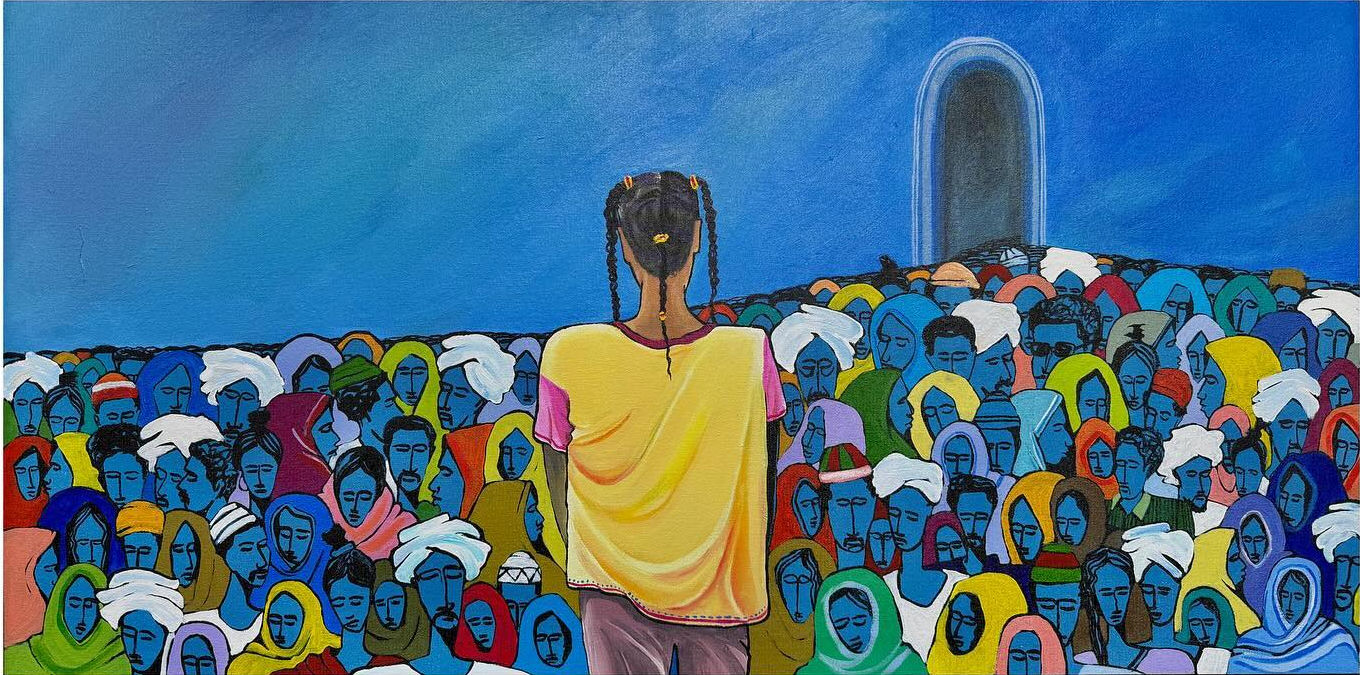
Galal Yousif Goly, Sudan, Untitled, 2024. (Via Tricontinental: Institute for Social Research)

This article, my first of 2025, could have ended after that last line. What more needs to be said? But there is more to say.

In March 2024, the United Nations Committee on the Rights of the Child released a sharp statement on the war in Sudan between the Sudanese Armed Forces and the paramilitary Rapid Support Forces, both backed by a range of foreign powers.

That statement had its own powerful facts:

  • 24 million children in Sudan – nearly half of the country’s total population of 50 million – are at risk of ‘generational catastrophe’.
  • 19 million children are out of school.
  • 4 million children are displaced.
  • 3.7 million children are acutely malnourished.

The first point refers to the totality of Sudan’s children, all of whom are at risk of a “generational catastrophe.”

This concept, which was first used by the United Nations to describe the trauma and setbacks that children experienced due to Covid-19 lockdowns, means that the children of Sudan will not recover from the ordeal that the war has inflicted upon them.

It will take generations before anything resembling normality returns to the country.

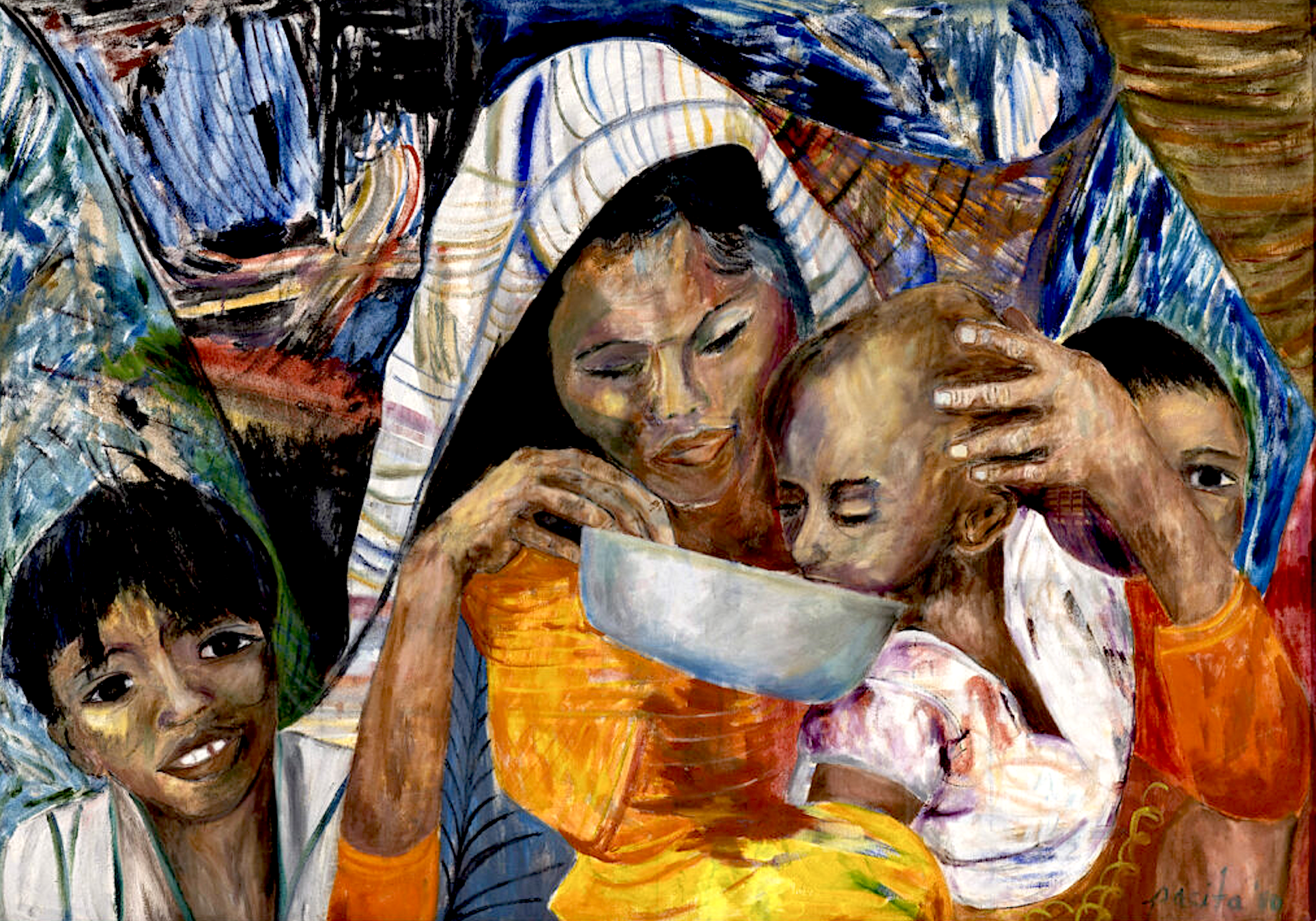
Pacita Abad, Philippines, Water of Life, 1980. (Via Tricontinental: Institute for Social Research)

A scientific study from 2017 found that deep childhood traumas can mark a person both physically and psychologically. Trauma reroutes children’s developing nervous systems, causing them to be highly alert and anxious even decades later.

This process, the authors write, generates a mechanism called “enhanced threat processing.” No wonder studies of children who lived through earlier wars show that they disproportionately suffer from medical conditions, including heart ailments and cancer.

In March 2022, five doctors from Afghanistan, India, Ireland and Sri Lanka wrote a heartfelt letter to The Lancet in which they reminded the world of the plight of the children of Afghanistan. 

As of 2019, every child in Afghanistan was born and raised during war. Not one of them had experienced peace. The authors noted that “studies on psychotherapeutic interventions in Afghan children and adolescents are rare, and the evidence they have produced is low quality.”

So, they proposed an integrated healthcare plan for Afghan children that relied upon telehealth care and non-medical professionals. In another world, the plan could have been debated.

Some of the funds that had enriched the arms merchants during that war would have instead been expended to realise this plan. But this is not the way forward in our world.

Mahoud Ahmad, Iraq, Title Not Known, “Ahmad 9,” 1976.

The statement about arms merchants is not made idly. According to a December 2024 fact sheet from the Stockholm International Peace Research Institute (SIPRI), the world’s top 100 largest arms-producing and military services companies increased their combined arms revenues by 4.2 percent in 2023, reaching a staggering $632 billion.

Five U.S.-based companies accounted for nearly a third of these revenues. These 100 companies increased their total arms revenues by 19 percent between 2015 and 2023.

Though the full numbers for 2024 are not yet available, if one looks at the quarterly filings from the main merchants of death, their earnings have spiked even further. Billions for warmongers, but nothing for children who are born into warzones.

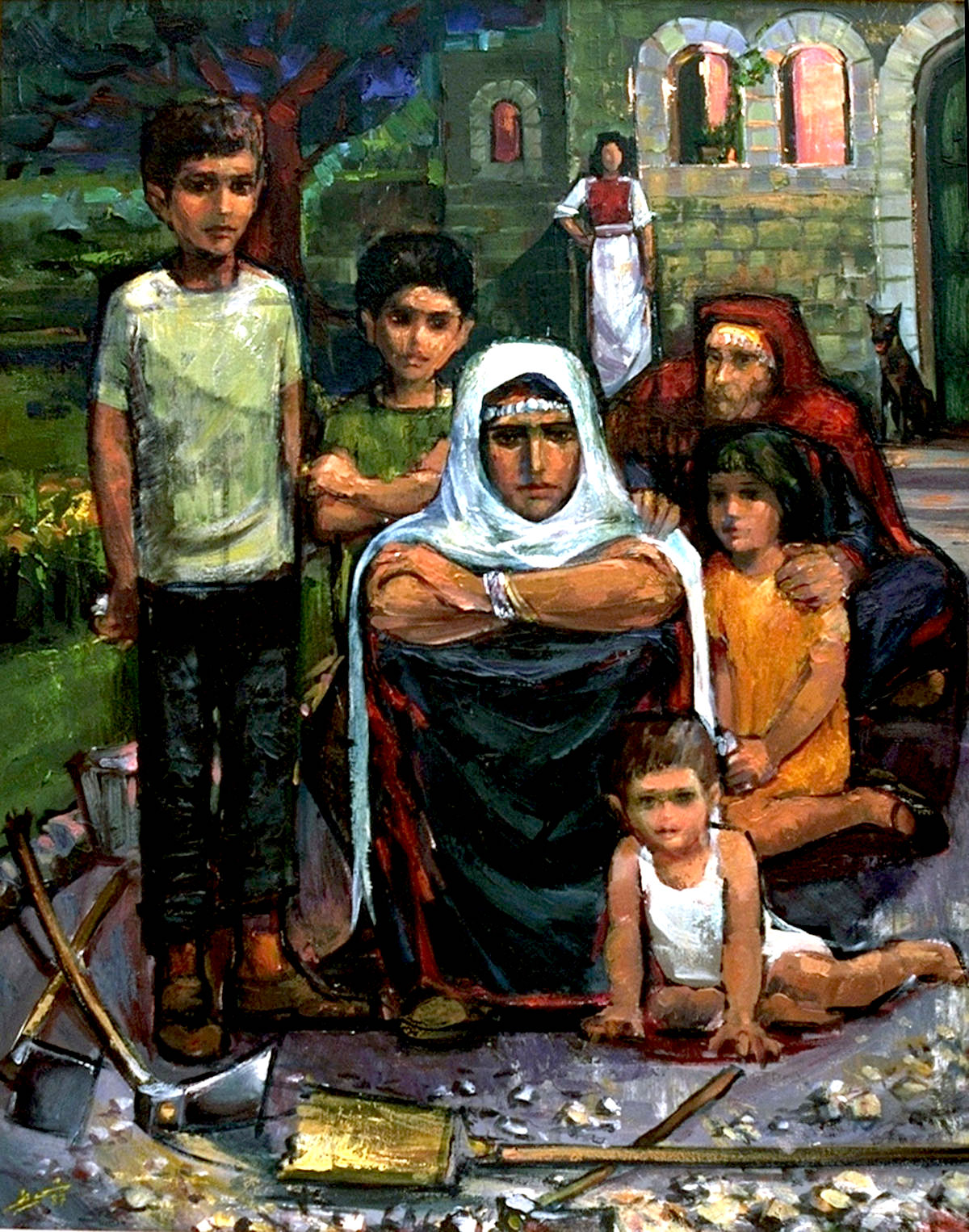
Ismail Shammout, Gaza, Occupied Palestinian Territory, We Will Not Leave, 1987. (Via Tricontinental: Institute for Social Research)

In 2014, Israel’s bombardment of Gaza resulted in the death of innocent children. Two incidents in July struck a special chord. First, Israel fired a missile that hit the Fun Time Beach Café (Waqt al-Marah) in Khan Younis at 11:30 p.m. on July 9. 

In the café, which was a makeshift structure about 30 metres from the Mediterranean Sea, several people had gathered to watch the 2014 FIFA World Cup semi-final match between Argentina and the Netherlands. They were all serious football fans.

The Israeli missile killed nine young people: Musa Astal (age 16), Suleiman Astal (age 16), Ahmed Astal (age 18), Mohammed Fawana (age 18), Hamid Sawalli (age 20), Mohammed Ganan (age 24), Ibrahim Ganan (age 25), and Ibrahim Sawalli (age 28).

They never got to watch Argentina win the match in the penalty stage or see Germany win the tournament in a tense match a few days later.

Israel’s bombing, meanwhile, was unabated. Three days later, on July 16, several boys were playing football — as if replaying the World Cup on Gaza’s beach — when an Israeli navy ship fired first at a jetty and then, as the boys ran from the explosion, at the boys.

Israel killed four of them — Ismail Mahmoud Bakr (age 9), Zakariya Ahed Bakr (age 10), Ahed Atef Bakr (age 10), and Mohammad Ramez Bakr (age 11) — and wounded others.

The 2014 Israeli barrage on Gaza killed at least 150 children in total. When the human rights group B’Tselem produced an advertisement to broadcast the names of the children on Israeli television, the Israel Broadcast Authority banned it.

The British poet Michael Rosen responded to the killings and the ban with the beautiful poem “Don’t Mention the Children.”

Don’t mention the children.
Don’t name the dead children.
The people must not know the names
of the dead children.
The names of the children must be hidden.
The children must be nameless.
The children must leave this world
having no names.
No one must know the names of
the dead children.
No one must say the names of
the dead children.
No one must even think that the children
have names.
People must understand that it would be dangerous
to know the names of the children.
The people must be protected from
knowing the names of the children.
The names of the children could spread
like wildfire.
The people would not be safe if they knew
the names of the children.
Don’t name the dead children.
Don’t remember the dead children.
Don’t think of the dead children.
Don’t say: ‘dead children’.

Yes, the children have names. We will continue to name all those whose names we can remember. We will not forget them.

In September 2024, the Palestinian Ministry of Health released an updated list of the names of Palestinians killed in the U.S.-Israeli genocide from October 2023 to August 2024.

On that list are 710 newborns whose ages are listed as zero. Many of them had only just been named.

Though the list is too long to reproduce here, the story of Ayssel and Asser Al-Qumsan is emblematic. On Aug. 13, 2024, Mohammed Abu Al-Qumsan left his apartment in Deir al-Balah, within central Gaza’s “safe zone,” to register the birth of his twin children Ayssel and Asser.

He left the twins with their mother, Dr. Jumana Arfa (age 29), who had given birth to them three days earlier at Al-Awda Hospital in Nuseirat. Dr. Jumann Arfa was a pharmacist trained at Al-Azhar University in Gaza. A few days before giving birth to her children, she posted on Facebook about Israel’s targeting of children, citing an interview with Jewish-American surgeon Dr. Mark Perlmutter on a powerful CBS News segment called Children of Gaza.

When Mohammed returned from registering the twins, he found that their home had been destroyed and that his wife, newborn children, and mother-in-law had all been killed in an Israeli strike.

Ayssel Al-Qumsan.
Asser Al-Qumsan.

We must name the dead children.

Malak Mattar, Gaza, Occupied Palestinian Territory, Tiger Embracing the Boy, 2024.

Bangladeshi shot by BSF dies in India

  A Bangladeshi man injured in firing by India’s Border Security Force (BSF) across the border in Thakurgaon’s Pirganj upazila has died whil...