Friday, August 29, 2025

Bangladesh: How the Taro Leaf became a symbol of Rohingya statelessness

 In June 2025, Rohingya photojournalist Sahat Zia Hero and Australian photographer Victor Caringal worked together to produce a series of photographs that showed how the Rohingya have adapted to daily life in the Kutapalong refugee camps in Bangladesh. This photo series is part of the taro leaf project that uses the taro leaf as a symbol to tell the story of Rohingya statelessness.

Eight years ago, more than 700,000 Rohingya fled a targeted campaign of extreme violence by the Myanmar military and crossed into neighbouring Bangladesh.

Zia and Victor reflect on their collaboration:

Zia: “Photographing together was really nice. The topic we chose was ‘making a mark’ because our ‘mark’, our identity, our culture and history is being erased. And we have the other challenges of life in the camps – lack of access to education, opportunities for livelihood, healthcare and many things. So we’re trying to make a mark through our art, drawing, poetry, and photography, to keep our culture alive, to keep our identity alive and to remind us who we are. We don’t want to be forgotten.”

Victor: “It was a privilege to walk through the camps with Zia. We spent a day photographing, yet only covered a fraction of the city-sized mega camp. But that short time was rich with stories and life, which I hope translates through in the images we’ve chosen.” The accompanying text to the following photos have been shared by Zia and Victor.

A Rohingya man walks through the Kutapalong refugee camps. Bangladesh, 2025. © Victor Caringal

A journey of statelesness

In 2017, large forest areas were cleared to make way for shelters as more than 700,000 Rohingya fled violence in Myanmar and sought refuge in neighbouring Bangladesh. The foliage has now regrown, providing much needed shade in the heat of the densely populated camps, but it also marks eight years of separation from their homeland that the Rohingya have faced.

We picked this image to show the densely packed setting of the camp shelters. The camps are overwhelmingly large, but at the same time, enclosed, restricted and overbearing. Zia notes that the beautiful greenery and regrowth is in stark contrast to the poor conditions of the temporary shelters that Rohingya live in.

A Rohingya woman walks into MSF’s Balukhali clinic in Kutapalong refugee camp. Bangladesh, 2025. © Victor Caringal

This image reminded us of conversations we had about Rohingya unable to leave their mark or legacy in the world. The woman walks through the camp with traceless steps, battered by rain. The rain is suspended, like how Rohingya feel about their situation, like their lives are on pause.

A man repairs his shelter in the Kutapalong camps. Bangladesh, 2025. © Victor Caringal

We spotted this man repairing his shelter while walking through the narrow streets of the camps. He appeared impressively strong, carrying out repairs to the temporary bamboo shelter that protects his family during monsoonal storms. It’s a type of strength and resilience that’s easy to photograph, but what this man represented for me, is how I see all Rohingya – a people who have to be strong to survive, to carry more emotional weight than anyone should ever have to carry

A shelter on an unstable slope. Bangladesh, 2025. © Sahat Zia Hero

Escalated violence in Myanmar’s Rakhine state has led to the recent arrival of more Rohingya seeking safety in Bangladesh. With little remaining space in the densely populated camps, these Rohingya built their shelter on an area of land prone to landslides. Their new home is far smaller than the one they left behind.

A Rohingya girl studies in her shelter. Bangladesh, 2025. © Sahat Zia Hero

With recent aid cuts in the camps, learning centres have closed contracts have been terminated for 1,179 local teachers within the camps. Education is seen in the camps as is one of the few opportunities for Rohingya youth have to improve their situation.

We chose this image because it showed the fragility and hope of young Rohingya and how decisions made today will have a ripple effect on future generations. 

Children play in a camp. Bangladesh, 2025. © Sahat Zia Hero

Children’s play and imagination create moments of relief from daily challenges in the camps. Their vision of a better future are not only expressions of hope but also a way to manage and process the difficult realities around them.

While we walked through the camps, we saw that children were everywhere – laughing, playing and sometimes being scolded. They brought life to the camps and pockets of joy. Zia noted that the reason there were so many kids was because of the school closures from aid cuts.

A child overlooks the camps from an eroded hill top. Bangladesh, 2025. © Sahat Zia Hero

We selected this image to share the threat of landslides that occur from monsoonal rain and flooding, and the eroded soil in the camps. Originally there were shelters built here, but they were lost in a landslide. The area now remains precarious and unoccupied, despite the child standing and smiling from the top of the hill.

Rayhana, a Rohingya food stall owner, in her shelter. Bangladesh, 2025. © Victor Caringal

I was impressed to see how much food Rayhana was able to prepare within the tight quarters of a shelter kitchen space. Rayhana opened a small food stall in the camps to financially support her family. While there is a food ration in place, it’s currently less than $14 a month per person, which is far below what’s needed to survive in the camps. The reduction of aid means lower amounts in the future.

A young child, seen through the tarpaulin. Bangladesh, 2025. © Sahat Zia Hero

We picked this pairing of images as they visually speak to a feeling of enclosure, a sentiment that many Rohingya in the camps talk about while living behind wired fences of the camps.

A chicken in a makeshift coop in front of a makeshift shelter. Bangladesh, 2025. ©Victor Caringal

Farming was an integral part of Rohingya life during Zia’s childhood. In the dense camps, where people have no permanent home, land or space, it is rare for people to raise livestock or grow enough vegetables to make a living or survive from.

A daily worker prepares bamboo materials for building and repairing shelters. Bangladesh, 2025. © Sahat Zia Hero 

Zia explained that bamboo was a traditional building material in Rohingya culture. In this picture, the bamboo looks fresh and green, but the quality of this bamboo is lower than what Rohingya would use for their homes and structures in Arakan, Myanmar.

A bridge crossing separates camp districts in Kutapalong refugee camp. Bangladesh, 2025. © Victor Caringal 

We watched as people crossed the bamboo bridge: two girls taking careful steps, two boys racing to the top, back-flipping into the water. Zia had taken photos of this crossing over the eight years he’d been in the camps. A wider bridge was once in place, but it eroded and was swept away over multiple flood seasons. While it looks precarious, the new bridge provides an important access route between the neighbouring camps.

A man is transported to a health facility. Bangladesh, 2025. © Sahat Zia Hero 

Non-government organization (NGO) workers and foreign visitors typically travel to the camps via arterial roads. But deep inside the camps, the throughways become much tighter, and Zia explained that many parts are only accessible on foot. When a medical need arises, people need to be carried to the nearest hospital, a difficult journey which can take hours in monsoonal conditions.

India-Pakistan missile race heats up, but China in crosshairs, too

 Islamabad, Pakistan – India on August 20 announced that it had successfully test-fired Agni-V, its intermediate-range ballistic missile, from a test range in Odisha on its eastern Bay of Bengal coast.

The Agni-V, meaning “fire” in Sanskrit, is 17.5 metres long, weighs 50,000kg, and can carry more than 1,000kg of nuclear or conventional payload. Capable of travelling more than 5,000km at hypersonic speeds of nearly 30,000km per hour, it is among the fastest ballistic missiles in the world.

The Agni test came exactly a week after Pakistan announced the formation of a new Army Rocket Force Command (ARFC), aimed, say experts, at plugging holes in its defensive posture exposed by India during the four-day conflict between the nuclear-armed neighbours in May.

But experts say the latest Indian test might be a message less for Pakistan and more for another neighbour that New Delhi is cautiously warming up to again: China.

The Agni’s range puts most of Asia, including China’s northern regions, and parts of Europe within reach. This was the missile’s 10th test since 2012 and its first since March last year, but its timing, say analysts, was significant.

It came just ahead of Indian Prime Minister Narendra Modi’s trip to China for the Shanghai Cooperation Organisation (SCO) summit, amid a thaw in ties – after years of tension over their disputed border – that has been accelerated by United States President Donald Trump’s tariff war against India. On Wednesday, the US tariffs on Indian goods doubled to 50 percent amid tensions over New Delhi’s oil purchases from Russia.

Yet despite that shift in ties with Beijing, India continues to view China as its primary threat in the neighbourhood, say experts, underscoring the complex relationship between the world’s two most populous nations. And it’s at China that India’s development of medium and long-range missiles is primarily aimed, they say.

India’s missile advantage over Pakistan

While India acknowledged losing an unspecified number of fighter jets during the May skirmish with Pakistan, it also inflicted significant damage on Pakistani military bases, particularly with its supersonic BrahMos cruise missiles.

The BrahMos, capable of carrying nuclear or conventional payloads of up to 300kg, has a range of about 500km. Its low altitude, terrain-hugging trajectory and blistering speed make it difficult to intercept, allowing it to penetrate Pakistani territory with relative ease.

Many experts argue that this context shows the Agni-V test is not directly linked to Pakistan’s announcement of the ARFC. Instead, they say, the test was likely a signal to China. Indian and Chinese troops were in an eyeball-to-eyeball standoff along their disputed Himalayan border for four years after a deadly clash in 2020, before Modi met Chinese President Xi Jinping in Russia in October 2024 to begin a process of detente.

Privacy Policy

Modi’s visit to China for the SCO summit on Sunday will be his first to that country since 2018. In the past, India has often felt betrayed by overtures to China, which, it claims, have frequently been followed by aggression from Beijing along their border.

“India’s requirement for a long-range, but not intercontinental, missile is dictated by its threat perception of China,” Manpreet Sethi, a distinguished fellow at the New Delhi-based Centre for Air Power Studies, told Al Jazeera.

“Agni-V is a nuclear-capable ballistic missile of 5,000km range, which India has been developing as part of its nuclear deterrence capability against China. It has no relevance to Pakistan,” Sethi added.

Christopher Clary, assistant professor of political science at the University at Albany, agreed.

“While the Agni-V might be usable against Pakistan, its primary mission would involve strikes on China,” he told Al Jazeera. “China’s east coast, where its most economically and politically important cities are situated, is hard to reach from India and requires long-range missiles.”

Interactive_Pakistan_India_Missiles_August25_2025-1755868832

Missile race across South Asia

India and Pakistan have been steadily expanding their missile arsenals in recent years, unveiling new systems with increasing reach.

Before announcing the ARFC, Pakistan showcased the Fatah-4, a cruise missile with a 750km range and the capability to carry both conventional and nuclear warheads.

India, meanwhile, is working on Agni-VI, which is expected to have a range exceeding 10,000km and carry multiple independently targetable reentry vehicles (MIRVs), a capability already present in Agni-V.

MIRV-enabled missiles can carry several nuclear warheads, each capable of striking a separate target, significantly boosting their destructive potential.

Mansoor Ahmed, an honorary lecturer at the Strategic and Defence Studies Centre, Australian National University, said India’s latest test demonstrates its growing intercontinental missile capabilities.

“With India working on different variants of Agni with multiple capabilities, this test was a technological demonstrator for India’s emerging submarine-launched ballistic missile (SLBM) capability,” Ahmed said.

“Depending on the configuration of the warheads for India’s SLBMs, India will be able to deploy anywhere between 200-300 warheads on its SSBN force alone over the next decade,” he added. SSBNs (ship, submersible, ballistic, nuclear) are nuclear-powered submarines designed to carry SLBMs armed with nuclear warheads. India currently has two SSBNs in service, with two more under construction.

Pakistan, by contrast, does not possess long-range missiles or nuclear submarines. Its longest-range operational ballistic missile, the Shaheen-III, has a range of 2,750km.

“Pakistan also has South Asia’s first MIRV-enabled ballistic missile called Ababeel, which can strike up to 2,200km range, but it is the shortest-ranged MIRV-enabled system deployed by any nuclear-armed state,” Ahmed said.

Tughral Yamin, a former Pakistani army brigadier and nuclear policy scholar, said the countries’ missile ambitions reflect divergent priorities.

“Pakistan’s programme is entirely Indian-specific and defensive in nature, while India’s ambitions extend beyond the subcontinent. Its long-range systems are designed for global power projection, particularly vis-a-vis China, and to establish itself as a great power with credible deterrence against major states,” said Yamin, author of The Evolution of Nuclear Deterrence in South Asia.

But some experts say Pakistan’s missile development programme isn’t only about India.

Ashley J Tellis, the Tata Chair for Strategic Affairs at the Carnegie Endowment for International Peace (CEIP), said that while “India wants to be able to range China and Pakistan,” Islamabad is building the capability to keep Israel – and even the US – in its range, in addition to India.

“The conventional missile force in both countries is designed to strike critical targets without putting manned strike aircraft at risk,” Tellis told Al Jazeera.

US concerns over Pakistan’s ambitions, quiet acceptance of India’s rise

Pakistan’s missile programme came under intense spotlight in December last year when a senior White House official warned of Islamabad’s growing ambitions.

Jon Finer, serving in the then-Biden administration, described Pakistan’s pursuit of advanced missile technology as an “emerging threat” to the United States.

Children pose for photograph with Hatf-IV, a land-based short-ranged ballistic missile, with launcher during a defense exhibition held as part of Pakistan's Independence Day celebrations, in Islamabad, Pakistan, Thursday, Aug. 14, 2025. (AP Photo/Anjum Naveed)
Pakistan publicly displayed its Fatah-4 missile on the eve of the country’s 78th Independence Day on August 14, 2025, in Islamabad [Anjum Naveed/AP Photo]

“If the trend continues, Pakistan will have the capability to strike targets well beyond South Asia, including in the United States,” Finer said during an event at the CEIP.

By contrast, Tellis said India’s growing arsenal is not viewed as destabilising by Washington or its allies.

“Pakistan’s capabilities in contrast are viewed as unsettling because the early history of its nuclear programme had anti-Western overtones, sentiments that have taken on a specific anti-US colouration after 9/11 and the Abbottabad raid,” Tellis explained, referring to the US capture of Osama bin Laden inside Pakistan in 2011.

Ahmed, the Canberra-based academic, said India’s long-range missile development is openly supported by Western powers as part of the US-led Asia Pacific strategy.

“The US and European powers have viewed and encouraged India to act as a net security provider. The India-US civil nuclear deal and the Nuclear Suppliers Group (NSG) waiver effectively gave India de facto nuclear weapons status without signing the Non-Proliferation Treaty (NPT),” he said.

The NPT is a Cold War-era treaty aimed at preventing the spread of nuclear weapons, promoting the peaceful use of nuclear energy and advancing the goal of nuclear disarmament. It formally recognises only the United States, Russia, China, France and Britain as nuclear weapons states.

But the 2008 waiver from the NSG – a club of 48 nations that sell nuclear material and technology – allowed India to engage in global nuclear trade despite not being an NPT signatory, a unique status that elevated its global standing.

Clary from the University of Albany, however, pointed out that unlike the Biden administration, the current Trump White House has not expressed any concerns about Pakistan’s missile programme – or about India’s Agni-V test.

“For now, so long as Pakistan keeps its missile tests limited to ranges already demonstrated by the Shaheen-III and Ababeel, I don’t expect Western governments to concern themselves overly with South Asia’s missile developments,” he said. “There are more than enough other problems to keep them busy.”

Source: Al Jazeera

DR Congo, M23 rebels resume talks in Qatar after renewed violence in east

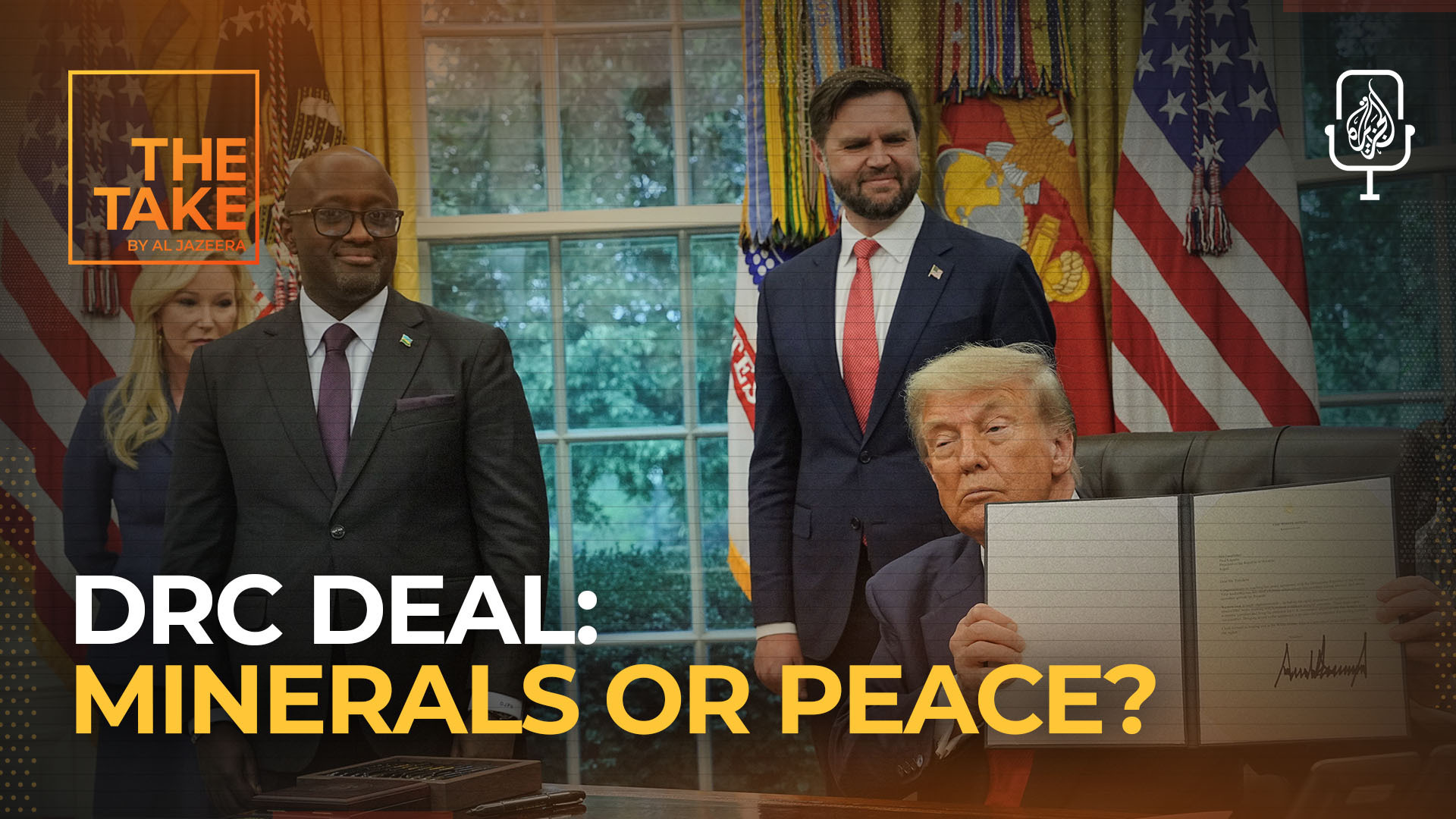
 The Democratic Republic of Congo (DRC) and the M23 armed group have resumed negotiations in Qatar as violence deepens in the country’s mineral-rich eastern provinces in spite of a recently signed an agreement to reach a full peace deal.

Qatari Ministry of Foreign Affairs spokesperson Majed al-Ansari said delegations from Kinshasa and the M23 were meeting in Doha to review the implementation of a truce signed in July. “We’ve received the two parties here in Doha to discuss the earlier agreement,” Ansari said at a news briefing on Tuesday.

The deal, brokered by Qatar, committed both sides to a ceasefire and a path to a final settlement. Under its terms, talks were supposed to begin on 8 August and conclude by 18 August. Both deadlines passed without progress, and the agreement has faltered amid accusations of violations from both sides.

Ansari said the current discussions include plans to create a mechanism for monitoring the truce, as well as an exchange of prisoners and detainees. He added that the United States and the International Committee of the Red Cross were closely involved in supporting the talks.

The Qatar-led initiative followed a separate ceasefire agreement signed in Washington between Rwanda, who back M23, and DRC in June. But the M23 rejected that deal, demanding direct negotiations with Kinshasa to address what it called unresolved political grievances.

US President Donald Trump has repeatedly claimed that he ended the conflict, and several others, describing DRC as the “darkest, deepest” part of Africa and asserting that he “saved lots of lives.” On Monday, Trump claimed that nine million people were “killed with machetes” during the decades-long war, insisting, “I stopped it.”

3:01
  • Now Playing
    03:01
    Rwandan refugees return home from DRC amid claims of forced repatriations

    Rwandan refugees return home from DRC amid claims of forced repatriations

  • Next
    08:27
    European defence ministers meet in Copenhagen amid Ukraine war

    European defence ministers meet in Copenhagen amid Ukraine war

  • 09:59
    Indonesia anti-govt protests: Anger grows after ride-share driver killed by police

    Indonesia anti-govt protests: Anger grows after ride-share driver killed by police

  • 04:13
    Thai Prime Minister Removed Amid Constitutional Crisis

    Thai Prime Minister Removed Amid Constitutional Crisis

  • 08:21
    Israeli attacks on Gaza City, northern Gaza becoming increasingly intense

    Israeli attacks on Gaza City, northern Gaza becoming increasingly intense

Rights groups have dismissed Trump’s claims as misleading. “It is far from the reality to say that he has ended the war,” said Christian Rumu of Amnesty International. “People on the ground continue to experience grave human rights violations, and some of these amount to crimes against humanity,” he added, calling on Washington to accelerate efforts to secure peace.

Despite multiple ceasefire attempts, fighting has intensified in North and South Kivu provinces, forcing more than two million people from their homes this year. Human Rights Watch last week accused the M23 of carrying out ethnically targeted “mass killings,” while United Nations experts have said Rwandan forces played a “critical” role in supporting the group’s offensive.

Rwanda denies involvement, but the M23’s capture of vast areas, including the regional capital Goma earlier this year, has fuelled fears of a wider regional conflict.

Privacy Policy

The DRC’s eastern region, home to some of the world’s richest deposits of gold, cobalt, and coltan, has been devastated by years of armed conflict, with civilians bearing the brunt of atrocities despite repeated international mediation efforts.

22:45

Source: Al Jazeera and news agencies

Why has South Africa’s Malema been found guilty of hate speech again?

 South African opposition leader Julius Malema was found guilty of hate speech by the country’s Equality Court on Wednesday this week over comments he made during a political rally in 2022.

This is the third such ruling for the frequently outspoken and controversial leader of the left-wing Economic Freedom Fighters (EFF) party.

In May, United States President Donald Trump accused South Africa of discriminating against whites in the country, citing Malema as the leader of an anti-white movement. Relations between the two countries soured dismally this year, with Washington cutting aid to Pretoria and imposing high tariffs.

28:10
  • Now Playing
    28:10
    Can a national dialogue solve South Africa's problems?

    Can a national dialogue solve South Africa's problems?

  • Next
    08:27
    European defence ministers meet in Copenhagen amid Ukraine war

    European defence ministers meet in Copenhagen amid Ukraine war

  • 09:59
    Indonesia anti-govt protests: Anger grows after ride-share driver killed by police

    Indonesia anti-govt protests: Anger grows after ride-share driver killed by police

  • 04:13
    Thai Prime Minister Removed Amid Constitutional Crisis

    Thai Prime Minister Removed Amid Constitutional Crisis

  • 08:21
    Israeli attacks on Gaza City, northern Gaza becoming increasingly intense

    Israeli attacks on Gaza City, northern Gaza becoming increasingly intense

Here’s what we know about the conviction and Malema’s run-ins with the law:

Who is Julius Malema?

Malema, 44, ​​is a longtime politician in South Africa and the founder of the EFF, a small leftist party that is notable for its focus on the rights of Black South Africans. Its members often don red berets or military-style clothing.

Malema is known for his outspoken criticism of the major governing party, the African National Congress (ANC). He was formerly president of the ANC Youth League, until he was expelled in 2012 for going against then-president Jacob Zuma.

The politician has championed controversial policies that many white South Africans see as targeting them, such as expropriating land without compensation and nationalising South African mines, both for the benefit of Black South Africans. Apartheid-era policies saw Blacks disadvantaged in access to wealth and land. That legacy persists today, with most of the country’s privately-owned land still being white-owned.

Malema’s vocal support for the Palestinian armed group, Hamas, has also drawn controversy.

In June, Malema was denied a visa to the United Kingdom because he was regarded as “non-conducive to the public good”, according to the UK Home Office. The EFF described the move as an act of “cowardice”.

Privacy Policy

The EFF has 39 members of parliament. It came fourth in South Africa’s general elections last May, and is not part of the governing coalition government.

Malema
An electoral poster of the Economic Freedom Fighters (EFF) leader Julius Malema is seen in Polokwane, on May 2, 2024, before the 2024 South African general election [File: Lucas Ledwaba/AFP]

What comments has Julius Malema been found guilty over?

On Wednesday, in a case brought by the South African Human Rights Commission, the Western Cape Division of South Africa’s Equality Court found Malema guilty of hate speech because of comments he made at a rally in Cape Town in October 2022, which the court said violated the country’s Promotion of Equality and Prevention of Unfair Discrimination Act.

At the time he made the comments, Malema was addressing EFF colleagues. He referred to an earlier incident in which party members had come to blows with some white residents outside the Brackenfell High School. Black protesters had gathered outside the school to protest against the alleged exclusion of Black students.

Afterwards, Malema criticised his colleagues for not retaliating more forcefully. He urged them to “follow up” with one white man seen in the footage so that the man could be “attended to properly”.

Malema went on to say that “revolutionaries must not be scared to kill,” and that racist acts should be interpreted as “an application to meet your maker with immediate effect”.

“No white man is going to beat me up…  Revolution demands that at some point there must be killing,” he said.

The statements, the court found on Wednesday, could be interpreted as “a clear intention to incite harm”.

“Whilst calling out someone who behaves as a racist may be acceptable, calling for them to be killed is not,” the court said in its ruling.

No punishment orders have been made yet, but Malema could face an order to apologise publicly, be forced to pay compensation or be recommended for criminal prosecution.

Malema
Julius Malema, leader of the Economic Freedom Fighters (EFF), arrives at Cape Town City Hall before the State Of The Nation (SONA) address by South African President Cyril Ramaphosa in Cape Town, South Africa, on February 6, 2025 [Nic Bothma/Reuters]

What have Malema and the EFF said about the court’s ruling?

In a statement reacting to the ruling on Wednesday, the EFF accused the court of presenting a “grave distortion” of history and political speech, and of “attacking” democracy.

Malema’s comments, the party argued, were made in relation to South Africa’s history of apartheid and subsequent liberation movements, and were meant “theoretically”. The EFF argued that the court had taken Malema’s words out of context and disregarded the events surrounding it, including the Brackenfell school incident and the country’s apartheid history.

“This decision is fundamentally flawed and deliberately misreads both the context and the meaning of the speech,” the EFF said.

“When Malema spoke of ‘war’, it was a reference to the irreconcilable conflict between white supremacy and Black consciousness, a war of ideas and systems, not an instruction to kill people,” the statement further read.

Has Malema been accused of hate speech before?

Yes, Malema has appeared in court several times for alleged hate speech. He has been found guilty twice, although one ruling was overturned.

In 2009, he was found guilty of hate speech against a woman who had accused former President Zuma of rape. At the time, Malema and Zuma were close. In a comment, Malema said the woman “had a nice time” with Zuma. The Equality Court ordered him to publicly apologise to the accuser, and to pay 50,000 rand ($2,824) to a centre for abused women.

He was again found guilty of hate speech in 2011 for singing the isiXhosa song Dubul’ibhunu or “Kill the Boer” at a rally. The song, which refers to white Afrikaans speakers, became popular in the 1980s when Black opposition to white minority rule was ramping up. The country’s apartheid government collapsed in 1994, when Black people were able to vote for the first time.

Later, in 2022, after Malema was once more taken to court for singing racially charged songs, the Equality Court overturned that earlier judgement, accepting Malema’s arguments that the lyrics were not meant literally, but as a metaphorical statement of resistance.

Afrikaner lobby groups, such as the AfriForum, have continued to appeal the overturning of that ruling. In May, the Constitutional Court dismissed another suit to appeal the case.

Has Trump cited Malema in his allegations of ‘white genocide’?

Yes, US President Donald Trump has referred to Malema’s speeches as evidence of an alleged “white genocide” in South Africa.

Trump, as well as senior officials in his administration, including former adviser Elon Musk, have also backed claims by fringe white South African groups that a genocide of white people is taking place in South Africa.

Several South African experts have debunked this claim, however, and say there is no evidence that white people are being targeted for their race in the country.

Despite this, Trump has used those claims to justify his cutting of foreign aid to South Africa in March and imposing high trade tariffs on the country. He also criticised South Africa for taking Israel to the International Court of Justice (ICJ) on allegations that it is committing genocide in Gaza.

2:21

In February, the Trump administration launched a refugee programme for white South Africans, even as the US halted migrant protection programmes for people from Afghanistan, for example. Some 59 white South Africans have since migrated to the US as refugees under the new programme. Additionally, the South African ambassador to the US, Ebrahim Rasool, was expelled in May.

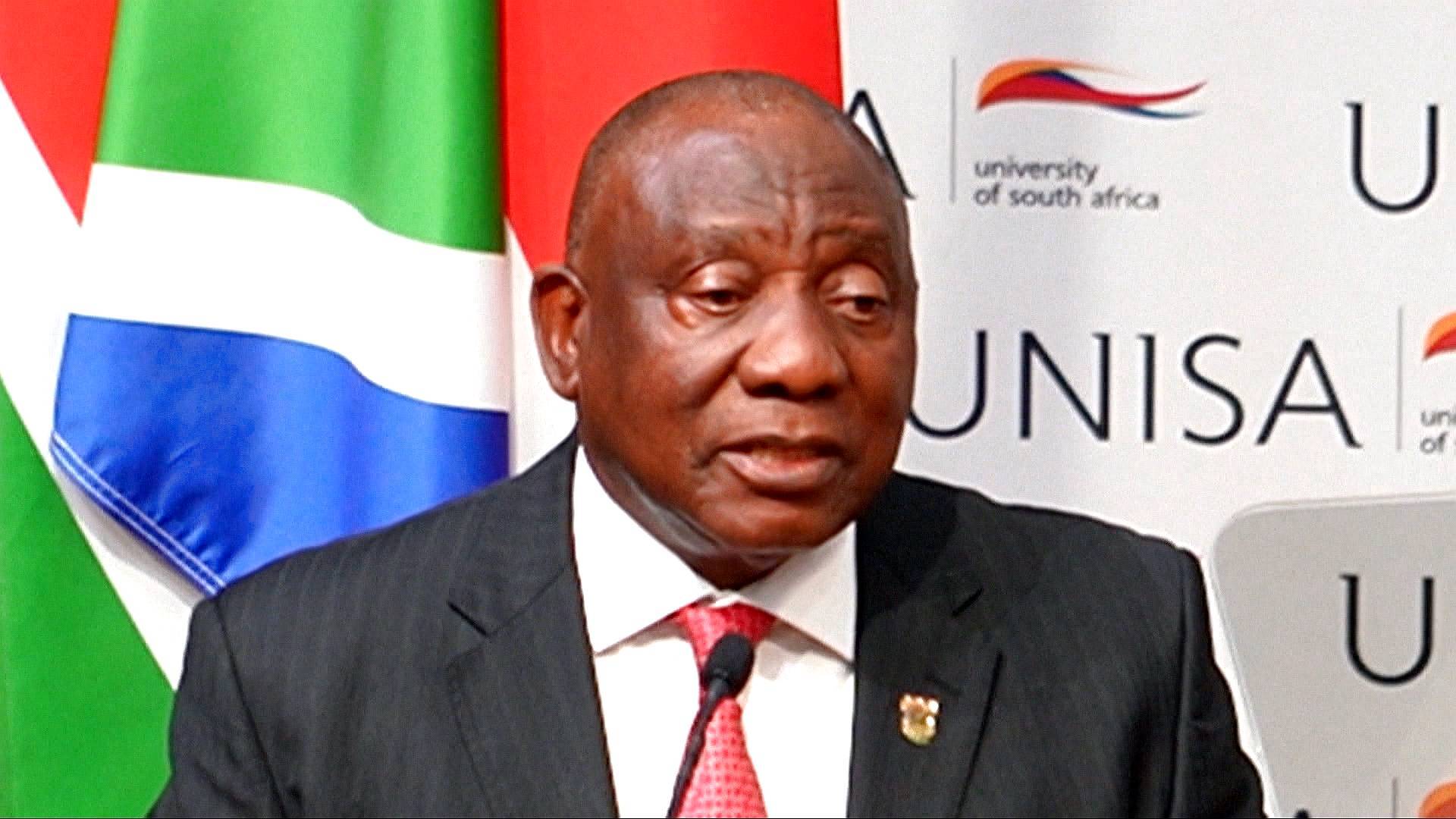
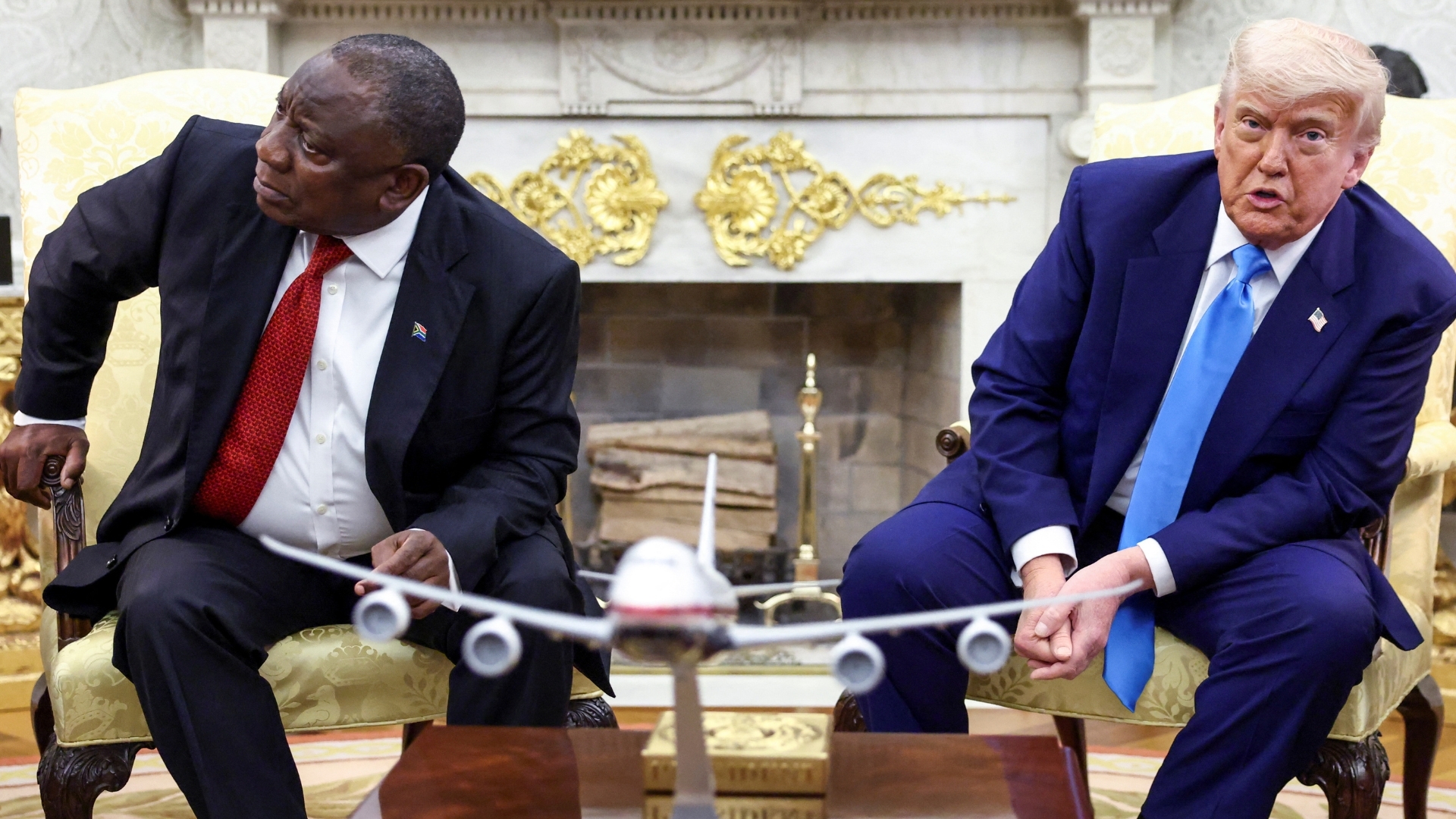
When President Cyril Ramaphosa visited the White House in May, in an attempt to rebuild the countries’ worsening relations, Trump confronted his counterpart with old clips of Malema’s rallies and songs and reiterated claims of whites being targeted.

Ramaphosa explained that Malema’s EFF is not part of the governing coalition government and is in opposition to the president’s ANC party. He also told Trump that claims of white South Africans being targeted were false, although he acknowledged that the country is facing high crime rates.

Musk, Trump’s former adviser, was also present at the high-profile meeting. Musk, who has South African citizenship, has in the past posted clips of Malema’s songs and accused the politician of “actively promoting white genocide”.

How are relations between South Africa and the US generally?

Tensions remain high between the US and South Africa. On Wednesday, South Africa’s foreign minister, Ronald Lamola, while speaking to the press, accused the US of preferential treatment of white South Africans and Washington of a second apartheid.

The “refugee programme is preferential treatment of Afrikaners”, Lamola said. “Preferential treatment of a particular privileged group, the Afrikaners, who are not running away from any genocide in this country, is definitely apartheid 2.0,” he added.

Fly Dubai emergency: Israeli claims face questions as investigation continues

Israeli officials have described the Flydubai FZ1073 incident as an attempted terrorist attack, but the airline and regional authorities hav...