Sunday, June 30, 2024


India Falls Two Ranks to 129 in Global Gender Gap Index
Although gender parity is headed in the right direction globally, it’s at a sluggish pace, with the World Economic Forum predicting that the gap will not be closed for another 134 years. But as the following infographic based on the organization’s Global Gender Gap 2024 report shows, the situation varies widely around the world.
Iceland has once been granted first place on the index, having taken pole position for a decade and a half so far. It is the only country to have closed over 90 percent of its gender gap and is followed by Finland, Norway, New Zealand and Sweden. By contrast, Guinea, Iran, Chad, Pakistan and Sudan are considered to be the furthest from what the WEF would consider full gender parity of the 146 countries and territories analyzed.
India isn’t close to the top of the ranking either though, placing in rank 129 based on the following metrics: Economic participation and opportunity, educational attainment, health and survival, political empowerment. The South Asian country fell two ranks lower than in 2023, with the decline mainly due to a slight backstepping in educational attainment and political empowerment, while economic participation and opportunity improved. While the share of women are high in primary, secondary and tertiary education enrollments, these figures have only been improving gradually, while the gap between men and women’s literacy rates remains wide (17.2 percentage points).
Israel destroys 11 homes in West Bank village amid spiralling violence
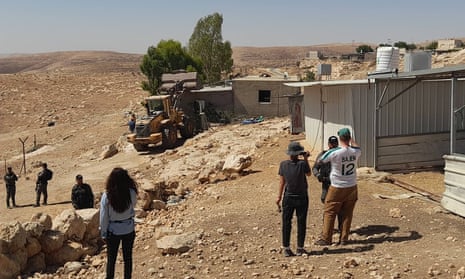
Israeli soldiers have destroyed 11 homes and other structures in an isolated community in the occupied West Bank, leaving 50 people homeless, amid a reported uptick in house demolitions and spiralling violence in the Palestinian territory.
The demolition has destroyed about a third of the village’s infrastructure.

“We have fought in the Israeli courts for years against this as most of the village is under threat of demolition and they have done this before,” said Eid Suleiman, a resident. “But they came this time without telling our lawyer. We didn’t have time to collect our belongings.
“We have put up some tents to keep the children cool in the heat. But we are afraid the soldiers will come back and take those too because they say we are building illegally.”
Masafer Yatta, a collection of shepherding hamlets including Umm al-Kheir, is located in area C, the sparsely populated 60% of the West Bank under full Israeli control. Palestinian infrastructure in the area is frequently demolished on the grounds that the residents do not have building permits, which are nearly impossible to obtain, while surrounding illegal Israeli settlements flourish. UN experts have said such demolitions can be considered war crimes.

Since 7 October, the situation has worsened. Settlers have stepped up beatings, attacks and vandalism, forcing isolated villagers to flee to nearby towns, and there has been an increase in army home demolitions. The IDF is engaged in fighting with Palestinian militant groups in several areas of the West Bank, including Jenin and Tulkarem.

Israel’s far-right finance minister, Bezalel Smotrich, recently described in explicit terms his active efforts to annex the West Bank. The Guardian reported last week on how the pro-settlement politician and his allies had quietly transferred significant legal powers from the military to pro-settler civil servants reporting to Smotrich, a move that international humanitarian law experts say amounts to de facto annexation.
On Wednesday, when Umm al-Kheir was targeted, a total of 17 Palestinian houses were destroyed on the same day, according to rights groups: another four homes were demolished in the Jericho area, one near Ramallah, and one in East Jerusalem.
“Those demolitions do not serve any Israeli interest but rather the settlers’ interests only. They are part of Israel’s ongoing campaign to displace Palestinians from area C,” said Hagit Ofran, a co-director of the settlements watch unit at the Israeli advocacy group Peace Now.
“As Smotrich recently stated in a recorded conversation we uncovered, in the West Bank demolitions are not about upholding the rule of law or ensuring equality; rather, they serve ‘geopolitical, strategic purposes.’”
The IDF did not immediately respond to a request for comment on Wednesday’s demolitions.
Israel occupied the Gaza Strip and West Bank, including East Jerusalem, after the war of 1967. Rightwing elements have long sought to find ways to permanently seize or annex swathes of the West Bank, and Israeli settlement building there has significantly accelerated in recent years.
Hindu nationalism now mainstream, thanks to Modi's decade in power
And no entity has had more influence on his political philosophy and ambitions than a paramilitary, right-wing group founded nearly a century ago and known as the RSS.
"We never imagined that we would get power in such a way," said Ambalal Koshti, 76, who says he first brought Modi into the political wing of the Rashtriya Swayamsevak Sangh in the late 1960s in their home state, Gujarat.
Modi was a teenager. Like other young men — and even boys — who joined, he would learn to march in formation, fight, meditate and protect their Hindu homeland.
A few decades earlier, while Mahatma Gandhi preached Hindu-Muslim unity, the RSS advocated for transforming India — by force, if necessary — into a Hindu nation. (A former RSS worker would fire three bullets into Gandhi’s chest in 1948, killing him months after India gained independence.)
Modi's spiritual and political upbringing from the RSS is the driving force, experts say, in everything he's done as prime minister over the past 10 years, a period that has seen India become a global power and the world’s fifth-largest economy.
At the same time, his rule has seen brazen attacks against minorities — particularly Muslims — from hate speech to lynchings. India's democracy, critics say, is faltering as the press, political opponents and courts face growing threats. And Modi has increasingly blurred the line between religion and state.
At 73, Modi is campaigning for a third term in a general election, which starts Friday. He and the ruling Bharatiya Janata Party are expected to win. He's challenged by a broad but divided alliance of regional parties.
Supporters and critics agree on one thing: Modi has achieved staying power by making Hindu nationalism acceptable — desirable, even — to a nation of 1.4 billion that for decades prided itself on pluralism and secularism. With that comes an immense vote bank: 80% of Indians are Hindu.
"He is 100% an ideological product of the RSS," said Nilanjan Mukhopadhyay, who wrote a Modi biography. "He has delivered their goals."
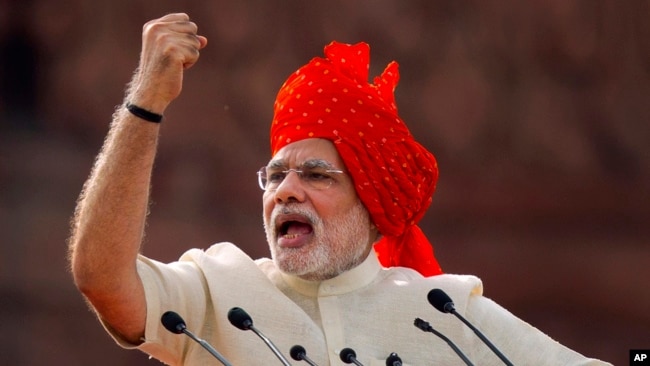
Uniting Hindus
Between deep breaths under the night sky in western India a few weeks ago, a group of boys recited an RSS prayer in Sanskrit: "All Hindus are the children of Mother India ... we have taken a vow to be equals and a promise to save our religion."
More than 65 years ago, Modi was one of them. Born in 1950 to a lower-caste family, his first exposure to the RSS was through shakhas — local units — that induct boys by combining religious education with self-defense skills and games.
By the 1970s, Modi was a full-time campaigner, canvassing neighborhoods on bicycle to raise RSS support.
"At that time, Hindus were scared to come together," Koshti said. "We were trying to unite them."
The RSS — formed in 1925, with the stated intent to strengthen the Hindu community — was hardly mainstream. It was tainted by links to Gandhi’s assassination and accused of stoking hatred against Muslims as periodic riots roiled India.
For the group, Indian civilization is inseparable from Hinduism, while critics say its philosophy is rooted in Hindu supremacy.
Today, the RSS has spawned a network of affiliated groups, from student and farmer unions to nonprofits and vigilante organizations often accused of violence. Their power — and legitimacy — ultimately comes from the BJP, which emerged from the RSS.
"Until Modi, the BJP had never won a majority on their own in India’s Parliament," said Christophe Jaffrelot, an expert on Modi and the Hindu right. "For the RSS, it is unprecedented."
Scaling his politics
Modi got his first big political break in 2001, becoming chief minister of home state Gujarat. A few months in, anti-Muslim riots ripped through the region, killing at least 1,000 people.
There were suspicions that Modi quietly supported the riots, but he denied the allegations and India's top court absolved him over lack of evidence.
Instead of crushing his political career, the riots boosted it.
Modi doubled down on Hindu nationalism, Jaffrelot said, capitalizing on religious tensions for political gain. Gujarat’s reputation suffered from the riots, so he turned to big businesses to build factories, create jobs and spur development.
"This created a political economy — he built close relations with capitalists who in turn backed him," Jaffrelot said.
Modi became increasingly authoritarian, Jaffrelot described, consolidating power over police and courts and bypassing the media to connect directly with voters.
The "Gujarat Model," as Modi coined it, portended what he would do as a prime minister.
"He gave Hindu nationalism a populist flavor," Jaffrelot said. "Modi invented it in Gujarat, and today he has scaled it across the country."
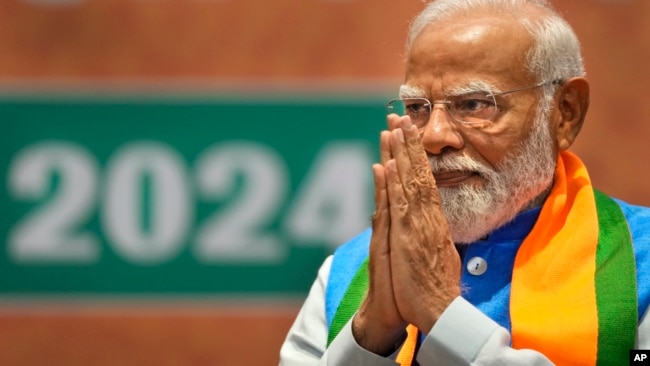
Big plans
In June, Modi aims not just to win a third time — he’s set a target of receiving two-thirds of the vote. And he’s touted big plans.
"I'm working every moment to make India a developed nation by 2047," Modi said at a rally. He also wants to abolish poverty and make the economy the world's third-largest.
If Modi wins, he’ll be the second Indian leader, after Jawaharlal Nehru, to retain power for a third term.
With approval ratings over 70%, Modi’s popularity has eclipsed that of his party. Supporters see him as a strongman leader, unafraid to take on India’s enemies, from Pakistan to the liberal elite. He’s backed by the rich, whose wealth has surged under him. For the poor, a slew of free programs, from food to housing, deflect the pain of high unemployment and inflation. Western leaders and companies line up to court him, turning to India as a counterweight against China.
He's meticulously built his reputation. In a nod to his Hinduism, he practices yoga in front of TV crews and the U.N., extols the virtues of a vegetarian diet and preaches about reclaiming India's glory. He refers to himself in the third person.
P.K. Laheri, a former senior bureaucrat in Gujarat, said Modi "does not risk anything" when it comes to winning — he goes into the election thinking the party won't miss a single seat.
The common thread of Modi's rise, analysts say, is that his most consequential policies are ambitions of the RSS.
In 2019, his government revoked the special status of disputed Kashmir, the country’s only Muslim-majority region. His government passed a citizenship law excluding Muslim migrants. In January, Modi delivered on a longstanding demand from the RSS — and millions of Hindus — when he opened a temple on the site of a razed mosque.
The BJP has denied enacting discriminatory policies and says its work benefits all Indians.
Last week, the BJP said it would pass a common legal code for all Indians — another RSS desire — to replace religious personal laws. Muslim leaders and others oppose it.
But Modi's politics are appealing to those well beyond right-wing nationalists — the issues have resonated deeply with regular Hindus. Unlike those before him, Modi paints a picture of a rising India as a Hindu one.
Satish Ahlani, a school principal, said he'll vote for Modi. Today, Ahlani said, Gujarat is thriving — as is India.
"Wherever our name hadn’t reached, it is now there," he said. "Being Hindu is our identity; that is why we want a Hindu country. ... For the progress of the country, Muslims will have to be with us. They should accept this and come along."
Arundhati Roy wins PEN Pinter Prize for 'powerful voice'
Set up in memory of playwright Harold Pinter, the award is for writers of "outstanding literary merit" who take an "unflinching" look at the world.
The announcement comes weeks after officials in India approved action against Roy under anti-terror laws for comments she made 14 years ago.
Roy is a Booker Prize-winning author and has written about human rights issues in India as well as war and capitalism globally.
English PEN chair Ruth Borthwick praised Roy for telling "urgent stories of injustice with wit and beauty".
"While India remains an important focus, she is truly an internationalist thinker, and her powerful voice is not to be silenced," Borthwick said.
Roy, 62, is an outspoken writer and activist and could face prosecution by the Narendra Modi government for comments she made in 2010 about Kashmir - a controversial topic in India.
She is a polarising figure and has often been targeted by right-wing groups for her speeches and writings.
Roy has been outspoken in her criticism about the ruling Bharatiya Janata Party (BJP) government's alleged targeting of Muslims and has also spoken about India's declining press freedoms during Mr Modi's tenure.
She will receive the PEN Pinter Prize on 10 October in a ceremony co-hosted by the British Library.
The prize was set up in 2009 by English PEN, a charity that says it defends freedom of expression and celebrates literature.
Previous winners include Michael Rosen, Malorie Blackman, Margaret Atwood, Salman Rushdie, Tom Stoppard and Carol Ann Duffy.
On winning the prize, Roy said: "I wish Harold Pinter were with us today to write about the almost incomprehensible turn the world is taking. Since he isn't, some of us must do our utmost to try to fill his shoes."
Roy has written numerous books and non-fiction essays, but she is best known for her novel, The God of Small Things, which won the Booker Prize in 1997.
Friday, June 28, 2024
The campus of Nalnda
was inaugurated formally by Prime Minister Mr. Narendra Modi on 19th June
(2024) in presence of Ambassadors of many countries like Myanmar, Srilanka,
Vietnam, Japan, Korea among others. Most of these countries are the ones where
Buddhism was spread by the preachers sent by Emperor Ashok. Initially the idea
of reviving Nalanda as a premier global University was floated by the then
President A.P.J Abul Kalam in 2006 and later ratified by Bihar Assembly and UPA
Government. On the occasion; Modi stated that this University was burnt by
foreign invaders in 12th Century. He was just parroting the popular
perception that Bakhtiyar Khilji, the courtier of Mahmud Ghori had burnt it.
This perception is an add-on to the other such ‘social common
sense’ that Muslim invaders destroyed the Hindu Temples and spread Islam by
force. Incidentally the propagation of these understandings began with the
introduction of communal historiography by the British and later picked up with
big gusto by the communal streams, Muslim communalism and Hindu Communalism. It is RSS which has played this up, leading
to Hate against Muslims in our society to the extent that Sardar Vallabh Bhai
Patel had to write this about RSS, “All their speeches were full of communal
poison. It was not necessary to spread poison in order to enthuse the Hindus
and organize for their protection. As a final result of the poison, the country had
to suffer the sacrifice of the invaluable life of Gandhiji.”
When Modi was mouthing that Nalanda was
burnt by foreign invaders, this falls in the same category of falsehoods which
are used to spread the Hatred against Muslims. Nalanda had a glorious
residential University, spread out in a large area in Rajgir Bihar, built by
Gupta's in the sixth century. It was a Buddhist center as Archeological
evidence shows. Primarily it was for study of Buddhist philosophy, in addition
Brahminical scriptures, mathematics, logic and health science were also taught.
Its tradition of open discussion and logic were so high that it attracted
students and scholars from various destinations. It was supported by the Kings,
later with the coming of Pala and Senaa dynasty its patronage was reduced and
withdrawn. Patronage was redirected to new Universities, like Odantpuri and
Vikramshila in particular.
This was the beginning of the decline of
Nalanda. Who set fire to the great library housing millions of books,
Manuscripts and rare collections? While it is being attributed to Khilji,
particularly after the coming of the British, there is no single primary source
mentioning this. Khilji’s primary goal was to loot and plunder. On route from
Ayodhya to Bengal he did attack Kila-i-Bihar thinking this is a forte with
wealth. On the way he plundered wealth and killed people. Nalanda was not on
the route, rather far away from the route, and he had no reason to attack a
University. Most of the primary sources related to history of that time do not
mention Khilaji coming to Nalanda. Tabakat-a-Nasiri written by Minhaj-e-Siraj
has no mention on these lines. Two Tibetean Scholars, Dharmaswamin and Sumpa
were keenly studying the history of India, particularly related to Buddhism, in
their books also; Khilji is not mentioned as the one who either came to Nalanda
or burnt it. Taranath, another well known Buddhist scholar from Tibet also does
not mention any such fact.
Interestingly Buddhist structures of
importance like Ajanta, Ellora, and Sanchi stupa were also not the subject of
ire of ‘invaders’! Nor do the Indian historians Jadunath Sarkar and R C
Majumdar endorse Nalanda being destroyed by Khilji. So how it got burnt and
lost its historical importance. Many stories abound apart from the Khilji
destroying it, being most prevalent.
Prof. D. N. Jha, the authority on Ancient
Indian History in his essay, ‘Responding to a communalist’ in compilation of
his essays (Against the Grain, Manohar 2020, pp 185 onwards) gives an excellent
summary of the relevant part of the book ‘History of Buddhism in Indian’ by
Tibetan monk Taranath. “During the consecration ceremony of the Temple built by
Kakutsiddha at Nalendra [Nalanda] ‘the young naughty Shamans threw slops at
tirthika beggars (Brahmins, added)…Angered by this one of them went for
arranging livelihood and the other sat in the deep pit and engaged himself in
‘Surya Sadhana)…He performed a sacrifice and scattered the charmed ashes all
around which resulted in the miraculous fire.”
History of Indian Logic p. 516, cited by D R
Patil, ‘The Antiquarian Remnant’ in Bihar says that this incidence refers to
the actual scuffle between Buddhist and Brahmanical mendicants. The latter
propitiated the Sun God, performed a sacrifice and threw the living ambers and
ashes from the sacrificial pit to Buddhist temples. This is what led to the
burning of the great collection of books at that time.
We also need to register that this was a
period when the attacks against Buddhism were coming up as the resurgence of
Brahmanism was coming up in a big way. After the period of Ashoka when India
became Buddhist in large measure, the notions of equality ruled in a big way.
Due to this the Brahamanical rituals declined leading to a big dissatisfaction
among Brahimins. A bit later when Ashoka’s grandson Brihdrath was ruling, his
commander-in-chief Pushyamitra Shung murdered Brihdrath and became the ruler
unleashing an anti Buddhist persecution.
All reliable sources point to the fact of
Brahmins burning the library as revenge. Bringing in Bakhtiar Khilji fits into
the general Islamophobic propaganda against Muslims and at the same time hides
the true story of persecution of Buddhism during that period.
What we need to preserve from the Buddhist
period is a spirit of free debate and logic as the underlying base of
education. In present times our Universities are being stifled by the
imposition of a culture of obedience and subordination in the matters of
academia. The knowledge cannot be imbibed or developed under such conditions.
If we can learn this from the tragic history of the struggle between Buddhism
and Brahmanism in India, it will be a crucial aspect of the development of
academia in the country.