Which BRICS Bark at Imperialism – and Which Are its Running Dogs? by Patrick Bond
Photograph Source: Prime Minister’s Office – GODL
Three months before taking power in 1949, Mao Tse-tung wrote of the solidarity required for the Chinese people’s revolution, remarking that a “principal and fundamental experience” was to “unite in a common struggle with those nations of the world which treat us as equals and unite with the peoples of all countries.”
Mao warned, though, of “domestic and foreign reactionaries, the imperialists and their running dogs.”
Fast forward to last week (March 9), as Indian writer Arundhati Roy rebuked Prime Minister Narendra Modi’s government: “Some of you will remember how we used to joke about that florid, overblown Chinese communist term, ‘Running Dog of Imperialism.’ But right now, I’d say, it describes us well.”
Are BRICS rising? Or spalling? Or running (dogs)?
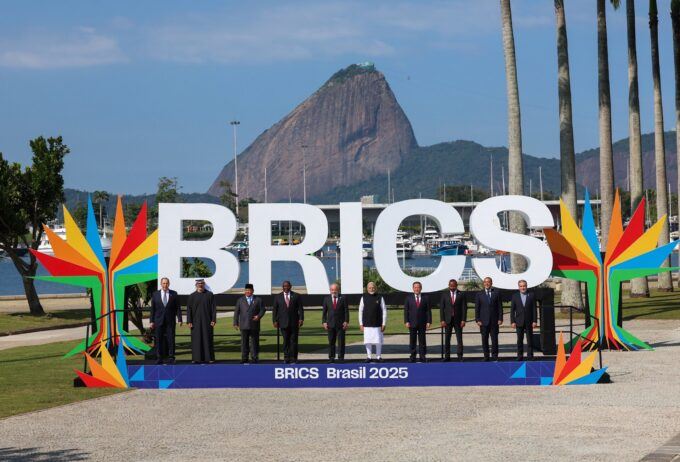
Does the critique of Modi’s allegiance to Donald Trump and Benjamin Netanyahu apply more broadly, when we consider the Brazil-Russia-India-China-South Africa (BRICS) bloc, now adorned with five (or six) others? In 2023 at the Johannesburg summit, new BRICS were added: Egypt, Ethiopia, Iran and the United Arab Emirates (UAE), with Saudi Arabia an ambiguous invitee (Riyadh has never formally accepted). In early 2025 another new full member joined: Indonesia.
And at the Kazan Summit in 2024 hosted by Vladimir Putin, there were more ‘partner’ invitations – a category reflecting the bloc’s indigestion after the 2023 expansion – offered to Belarus, Bolivia, Cuba, Kazakhstan, Malaysia, Nigeria, Thailand, Uganda, Uzbekistan and Vietnam, all of which were accepted. (Only Algeria and Turkiye turned down partner status.)
As a result of the apparent strengthening of the bloc, by July 2025, geopolitics podcaster Ben Norton could remark with unparalleled BRICS-hype:
The Non-Aligned Movement was founded in the 1960s by former formerly colonized countries almost all with socialist governments, the initial founders of the Non-Aligned Movement, saying that they refused to go along with US imperialism in the first cold war against the Soviet Union and other socialist countries. So, BRICS is now bringing back this anti-colonial mantle. They’ve picked up the anti-colonial mantle and they’re fighting against US dollar hegemony which is a which is a form of imperialism. They’re fighting against western imperialism.
But the BRICS bloc is not up for this fight, it is now apparent. In a March 9 Johannesburg discussion with leading local political broadcaster Mbuyiseni Ndlozi, Tricontinental director Vijay Prashad warned, “If the BRICS countries don’t wake up to the reality of trying to stop this conflict by any means possible, trying to stop this conflict now, if they don’t recognize this reality, the entire project of peace and development is in jeopardy.”
Likewise, just after the Trump-Netanyahu regimes began bombing Iran, ambitious hopes for BRICS were promoted by renowned economist Jeffrey Sachs on March 2:
It’s not only Trump but there’s no brake, there’s no foot on the brake. This is only an accelerator towards expanded war right now. And the only way that it can stop is if the BRICS countries – and that means India, that means Brazil, that means Russia, that means China, that means South Africa and others – and it’s Iran, which is a member of the BRICS, says, ‘This is not the way the world can work.’ They have to stand up to American hegemony. This is the only way the world can be safe. And so this is actually a responsibility of the BRICS right now, which is the only standing bulwark against America’s global empire.
This ‘only standing bulwark’ is, in reality breaking up, or ‘spalling,’ i.e. (as I’ve mentioned before), a construction-industry term referring to a process in which – mainly due to the freezing-thawing cycle – “a wall’s masonry and bricks crack, crumble, flake, and even pop out of the wall.”
Expel running-dog India, along with any other Israel-collaborationist (?)
From hype to hope to helplessness seems like the inevitable emotional slide-away for BRICS-watching multipolaristas. By March 11, one of the most ebullient of multipolar journalists, Thailand-based Brazilian journalist Pepe Escobar, despaired – on Danny Haiphong’s podcast – that the BRICS bloc was now spalling beyond repair. So Escobar boldly recommended that one in particular be popped out by the others:
India betrayed two top BRICS sequentially, Russia and Iran. That’s extremely serious. This would be grounds for expulsion of India from BRICS… The problem is what’s going to happen to BRICS this year, considering that India is the BRICS chair in this year when they betrayed two BRICS.
The next day, Escobar told a podcast hosted by a former Fox News legal commentator Judge Andrew Napolitano, “BRICS would have grounds to expel India considering that India betrayed sequentially two top BRICS, founding member Russia and a new member Iran in several levels because of American pressure. When the Trump administration told India you cannot buy Russian oil, the Indian said okay, okay, master.”
(Tehran was forgiving: on March 14 two tankers carrying liquefied natural gas to India were allowed through the Strait of Hormuz. Perhaps this reflected compensation for both countries’ pain when Tehran’s battleship Dena was sunk by a U.S. submarine’s torpedo on March 4 – killing 87 Iranians – just after it left naval exercises in the Indian city of Visakhapatnam. As a former Indian military officer, Arun Prakash, complained to The Guardian, “The U.S. navy could have sunk this ship anywhere on the way back to the Persian Gulf. We are supposed to be friends and partners of the USA. To bring the war to right to our doorstep was a perverse act.” But one that New Delhi didn’t have the guts to criticise.)
On March 11, Escobar diagnosed the bloc’s feebleness: “At the moment, BRICS is in a coma. It’s very painful to admit it, but we have to be realists. It’s in a deep, deep coma, blown up by one of its founding members. And obviously, don’t expect anything coming from Brazil or South Africa.”
Escobar recalled that on February 26,
48 hours before the decapitation strike that killed Ayatollah Khamenei and very important people at the top of the government in Tehran, Modi was in Israel being best buddies with the war criminal Netanyahu. Because he wanted to clinch weapons deals with Israel, which they did, by the way. So we have a founding BRICS member completely aligned with Israel, which for the other BRICS, practically, all the other ones and the partners as well, this is unthinkable.
But sadly, it’s not so ‘unthinkable’: the harsh realities of economic alignment to the Tel Aviv genocidaires can be discerned when BRICS hucksters open their minds and finally question the actual content of supposedly-multipolar ‘thinking’, which is oriented first and foremost to profiteering.
Since the outset of the BRICS bloc in the late 2000s, and even more so since the genocide began in late 2023, its capitalists and state agencies have increasingly linked themselves to Israel’s apartheid economy:
+ Since late 2023, more than 3 million tonnes of South African coal has been sent from mines owned jointly by Glencore and by the richest black South African, Patrice Motsepe (President Cyril Ramaphosa’s brother-in-law and potentially, his replacement in spite of recent denials) – providing the primary supply for 15% of Israel’s grid electricity by late 2025 (after Colombia finally imposed a boycott mid-year_ – and yet while the National Union of Metalworkers of SA and SA Transport and Allied Workers Union are both rhetorically opposed to genocide and some staff do protest alongside Palestine-solidarity activists, their members facilitate the supply by digging and transporting the coal, just as the rhetorically-solidaristic Hague Group has repeatedly turned a blind eye to co-chair Pretoria’s coal-fuelling of the Israeli military;
+ Russian-speakers in Israel, estimated at from 1.5 million to ‘nearly two million’ (according to Putin), provide the genocidal military with around 30,000 soldiers, and in addition to wheat and metals, Russia sells coal and – in just the two years since the genocide began in 2023 – made 105 oil transfers comprising 30% of Israel’s total crude and 45% of refined petroleum imported, via Novorossiysk (originating from BRICS-partner Kazakhstan);
+ Chinese drones (tens of thousands by now) made by DJI and Autel buzz Gaza and the West Bank, and are used to drop grenades on civilians (as Al Jazeera reported), in spite of activist and human-rights NGO demands their supply be halted (even before a DJI Avata helped kill Hamas leader Yahya Sinwar in October 2024), and moreover, a Chinese parastatal owns the new Haifa Bayport while another built the ‘union-busting’ Ashdod harbour, which together have facilitated a 5% annual increase in bilateral trade since 2021, confirming Netanyahu’s 2017 term for the two economies, namely, a “marriage made in heaven”;
+ Brazilian parastatal Petrobras supplies oil, at one point meeting 9% of Israeli needs directly, and from 2024 operating via Italian middlemen;
+ New Delhi assures a strengthened Israeli-Indian military alliance, the September 2025 Bilateral Investment Treaty, and Modi’s ‘Special Strategic Partnership’ solidaristic visit to the Knesset featuring ‘immense progress’ in ‘defence, security, and more’;
+ the UAE has, since the 2020 Abraham Accords, rapidly increased annual trade – led by Emirati exports including oil and diamonds – to more than $2 billion;
+ Egypt has made recent oil deals with Israel, agreeing in 2025 to facilitate $35 billion worth of Leviathan gas field exports, while not only opposing Iran’s firing on U.S. bases in the region, but also offering U.S.-German military logistical support for the Israeli genocidaires;
+ Given extremely warm Addis-Tel Aviv relations, Ethiopia abstained in 2024 and 2025 UN votes condemning Israeli’s occupation of Palestine, while 4% of the estimated 130,000 Israelis of Ethiopian descent serve in the Israel Defense Forces – losing their lives at more than double their rate of residency (4.5 to 2%) – not to mention their role as low-paid workers suffering systemic racism (a feature of Ehud Barak’s demographic discussions with Jeffrey Epstein in which, he said, a million more Russian immigrants were sought from Putin);
+ After the genocide began, there was rising Indonesian-Israeli trade, especially huge recent palm oil and electronics exports from Indonesia.
So they should all be expelled from the BRICS, by Escobar’s logic of banishing ‘unthinkable’ alliances with Israeli genocide-capitalism, especially since nearly all such relations have intensified since 2023, leaving only Iran in the bloc. But the very idea of Boycott Divestment Sanctions against the genocidaires, has been expelled by the BRICS elites.
Board of war, genocide and recolonization
Even more unthinkable would be formal membership in Trump’s sordid new ‘Board of Peace,’ a network of 28 imperialist, subimperialist and peripheral rightwing-ruled states, all of which are guilty of substantial human rights violations, according to The Intercept’s Nick Turse. Yet six of these are BRICS members and partners.
Trump announced the Board last October – and tellingly launched it at the Davos World Economic Forum on January 22 – in order, first, to recolonize Gaza under conditions of ongoing Israeli genocide and displacement, and to then extend its tentacles across the world as a mafioso-type enforcement gang. The Board may become an anti-UN run-around strategy in case the General Assembly belatedly grows hostile to Washington’s brazen imperialism, e.g. one day perhaps even attempting a ‘Uniting for Peace’ (U4P) strategy to counter U.S.-Israeli warring.
As Naomi Klein observed, the Board of Peace is a ‘parody of a colonial body’ and a form of ‘disaster capitalism.’ It’s obvious why the Board of Peace was invented:
They don’t want there to be a UN, because the UN represents as weak and disappointing as it is, it represents the possibility of accountability, whether it’s on a climate change, whether it’s on genocide.
The UN’s International Court of Justice in The Hague is one site for such accountability but on March 12, Washington joined Israel in opposing the South African case there – originally filed at the end of 2023 – because the slowpoke “Court should maintain its standard for inferring intent. Lowering the standard risks broadening the application of the term ‘genocide’ such that it no longer carries its original weight and meaning, and invites attempts to misuse the Genocide Convention as a gateway for bringing extraneous disputes before the Court.” (In reality, South Africa’s original statement to the Court proved genocide intent beyond a doubt.)
Trump’s genocide-denialism was, of course, expected. But perhaps as also would be expected, Pretoria found very limited support from the other 19 BRICS members and partners: only Brazil, Cuba, Egypt and Malaysia made official submissions backing the genocide charge.
Still, even without more BRICS allies, the slackers in Pretoria could and should have done far more on this front: first by going back to the Court for more injunctions against Israeli genocide, as Palestinian-American journalist Sam Husseini argued in his recent visit to South Africa, and second, by endorsing and activating U4P – so as to assert General Assembly jurisdiction against the Security Council (following Colombian leader Gustavo Petro’s unfulfilled promise to do so last September).
In contrast to offering Palestine solidarity, a half-dozen BRICS members and partners joined Trump at the Board of Peace inaugural February 19 conference at the ‘Trump Institute of Peace’ in Washington: Egypt, Indonesia, Kazakhstan, UAE, Uzbekistan and Vietnam. (On March 2, Indonesia temporarily paused its participation, yet in late February Jakarta’s nationalist-populist leader Prabowo Subianto had offered 8000 troops to enforce Trump’s ‘Riviera of the Middle East’ vision requiring massive forced displacements of Gazans.)
India was also a formal observer at that Board of Peace session, whereas – unlike European countries which turned down membership – Brazil, China and Russia were invited by Trump but did not immediately reject his overtures. Moscow even appeared open to spending Trump’s requested $1 billion membership fee – ‘to support the Palestinian people’ – using funds frozen after the February 2022 invasion of Ukraine.
Worse, Russia and China had let the malignant Board of Peace notion fester last November 17 at the Security Council, by failing to veto the Gaza re-colonization strategy Trump imposed, on grounds the deal was then actively supported by BRICS members Egypt, Indonesia and UAE (and other Arab tyrannies) as well as by the quisling Palestinian Authority.
(Three other BRICS members – South Africa, Ethiopia and Iran – did not receive invitations. Here, we are not counting as a BRICS member Saudi Arabia – which if included would dramatically increase the weight of the running-dog case – because it has an in-again out-again posture, going to many 2025 Brazil meetings and listed as a member by host India this year.)
The geopolitical economy of running dogs and their Western canine handlers
All this leaves an extremely complicated, contradiction-riddled political terrain on which the BRICS as a whole appears to have simply slipped from the earlier ‘alternative-to-Western-imperialism’ rhetorical foothold.
In a February 24 podcast introducing his latest book, The Story of Capital, Marxist geographer David Harvey explains why such geopolitical fracturing cannot simply be read off countries’ corporate economic interests:
The interplay between the capitalist and territorial logics of power is a defining feature of modern geopolitics. Marx noted that the concept of national wealth creeps into the work of the economist and its competition over that national wealth becomes predominant. But under the regime of competing ethnic nationalisms, the production of wealth by capital is primarily put to work to serve national interests rather than those of capital alone. These two logics are not merely competing forces, but ones that are deeply intertwined, influencing how states navigate global and domestic challenges. The dual role of the state-finance nexus becomes particularly evident during crisis. The state as both an enabler and a mediator of accumulation occupies a central political position in capital social formation. However, its dual logics of power, capitalist power and territorial power, create tensions that shape the trajectory of global and domestic politics.
In short, even if the BRICS are generally united (excepting Iran) as a subimperial pack of hounds when profiting from Israel’s genocide, naturally, there are bound to be major differences between the West and BRICS given the depth and breadth of world capitalist crisis. These differences include military and oil alliances, as are being played out in the Gulf now.
After all, in any imperial/subimperial relationship in which occasionally-divergent state-territorial logics and corporate expansionism generate all manner of frictions, there exists what Ruy Mauro Marini termed ‘antagonistic cooperation‘ (as he put it in his classic 1973 Dialectics of Dependency).
Such collaboration becomes, ultimately, more durable due to mutual interest in improving the global terrain for capital accumulation and profiteering, than might be suggested by multipolar rhetoric or than is indicated by sporadic sites of struggle:
+ the current Iranian fight-back and de facto closure of the Strait of Hormuz to U.S. allies;
+ China’s brief threat to ban sales of rare-earth minerals to Trump’s U.S. and its eventual retaking of Taiwan;
+ the South African case against Israeli genocide at The Hague; and
+ Russia’s 2014 and 2022 invasions of Ukraine.
These incidents of apparent anti-imperialism create genuine antagonisms, to be sure. But the overarching process is cooperation between imperial and subimperial powers, especially when it comes to surplus value extraction from the world’s workers, super-exploitation of the world’s women involved in social reproduction, and the abuse of nature as a ‘free gift,’ to quote Marx.
BRICS Promote Global-Corporate Power Under the Cover of Multipolarism
To those ends, the BRICS elites advance the agenda of corporate imperialism because they are completely committed to strengthening the tools of neoliberal multilateral power on behalf of their largest firms – especially the deadly fossil fuel industries – and banks.
Consider the case of the UN Framework Convention on Climate Change, so vital for the sake of future generations and potential avoidance of planetary ecocide. But the tragic conclusion we must draw is that both G7 Western politicians and BRICS ruling elites continue working closely together to prevent bans on fossil fuels or greenhouse-gas emissions cuts to the extent necessary for fending off climate catastrophe.
Starting with the 2009 Copenhagen climate summit, then U.S. President Barack Obama “blew up the United Nations,” as Bill McKibben explained at the time. “He formed a league of super-polluters, and would-be super-polluters. China, the U.S., and India don’t want anyone controlling their use of coal in any meaningful way. It is a coalition of foxes who will together govern the henhouse.” (The leaders of South Africa and Brazil were also part of formulating that deal in a secret side room.)
Since then, the G7 and BRICS have also been utterly unwilling to acknowledge polluter-pays climate-debt obligations to poorer countries and to their own internal victims of extreme weather – even after last July’s International Court of Justice advisory opinion insisting on the validity of reparations demands from 27 youth from a sinking Tuvalu.
Indeed, given how much the world’s corporations and banks rely upon the International Monetary Fund, World Bank and World Trade Organization (WTO) for a ‘rules-based order,’ it is no surprise to find BRICS leaders’ annual statements supporting these agencies of imperial power. The BRICS currently lead the calls for their refunding and relegitimization, even at a time Trump’s (occasional) paleo-conservative hatred of ‘globalists’ signals his retreat from climate summits, refusal to boost the Bretton Woods Institutions’ funding, and sabotage of the WTO.
Why, when neoliberal multilateral institutions are more shaky than ever, do the BRICS give them unwavering support? Simply, for the sake of their capitalists’ own accumulation strategies: global value chain exploitation, raw-materials extractivism, Intellectual Property protection, unchecked emissions and fossil fuel exploration, sleazy trade and investment deals, and debt squeezes on poorer economies where BRICS banks stand exposed.
If Mao warned against “domestic and foreign reactionaries, the imperialists and their running dogs,” maybe – in spite of select surface appearances – that epithet “describes the BRICS well,” as Arundhati Roy might also conclude.
Mostly, though, the subimperial BRICS bloc is the rabies-addled ‘dog that didn’t bark,’ when confronted by even Trump’s excesses of imperialism and Netanyahu’s genocide. But occasionally when some in the pack do bark left, we should not be distracted or surprised when – as any Palestinian knows – they simultaneously bite right.
Comments
Post a Comment