The Emerging Threat from Myanmar
India has been obsessed with two threats for many years. These were Pakistan to India’s West and China to its North. It was natural for these two countries to receive top priority in India’s defense strategies, foreign policy decisions, and national security concerns. But while New Delhi has been busy eyeing its western and northern neighbors, an alarming crisis has been unfolding on its eastern border. Myanmar, once viewed as just a buffer state between South Asia and Southeast Asia, is now in the grips of one of the world’s deadliest conflicts, and its extended civil war is fast becoming South Asia’s most pressing multidimensional threat. Coming in the forms of insurgency, illegal drug manufacturing, terrorism, and the refugee crisis, instability in Myanmar today poses the single greatest threat to India’s Northeast and Bangladesh.
Civil War, Refugee Crisis, Drug Trafficking, Terrorism: A Crisis Like No Other
Myanmar is not just suffering through a civil war. It hosts one of the worst humanitarian crises in the world. Because of its chaos, Myanmar is not just a source for narcotics trafficking. Myanmar’s problems extend to armed insurgency, proxy violence, and refugees. Instability in Myanmar threatens to directly bleed over into Indian soil as insurgency in Northeast India. Of all of India’s neighbors, however, it is Bangladesh that has suffered most from instability in Myanmar: Refugees.
Bangladesh is host to over one million Rohingya refugees who fled from the Myanmar Military attacks in Rakhine state. Drug trafficking, illegal weapons smuggling, refugees, and Myanmar-born insurgency plague India’s northeast.
The World Tunes into Democracy and Human Rights
Over the years, the West and many international entities have examined Myanmar through a single lens: democracy and human rights. It’s time for India and its neighbor, Bangladesh, to view it through a different lens: national security.
Historical Origins of Myanmar’s Crisis
To understand Myanmar’s ongoing conflict, it is necessary to look back. Myanmar is naturally split into two geographic areas. There are the more fertile central plains, where the Bamar Buddhists make up almost 70 percent of the population. This area is considered the center of Myanmar both politically and economically. Outside this central region are hilly and mountainous areas home to many ethnic minorities. These include, but are not limited to, the Kachin, Shan, Chin, Karen, Kayah, Mon, and Rakhine peoples. Many of these ethnic minorities have their own languages, cultures, and religions. Christianity was also spread among many of the hill people.
During British colonialism, they heavily employed what is known as “divide and rule.” Many ethnic minorities were used in both military and administrative roles, where the Bamar were mostly left out. During this time, there was no need to create a united Myanmar; therefore, the British’s division of the groups heightened ethnic distrust.
Knowing this, Aung San met with ethnic leaders in 1947 to sign the Panglong Agreement, which guaranteed autonomy to these ethnic states if they joined the Union of Burma as a federal state. This was Myanmar’s chance to create a nation that included all its people.
That opportunity vanished when Aung San was assassinated only months before independence. His vision of federalism died with him.
In 1962, General Ne Win seized power through a military coup, replacing federal aspirations with centralized military rule. Over the next six decades, military governments attempted to suppress ethnic identities rather than accommodate them, giving rise to one of the world’s longest-running civil wars.
Military Rule and the Collapse of Democracy
For decades, Myanmar’s military, the Tatmadaw, ruled over Myanmar either directly or by proxy. Despite some democratic reforms in the 2010s, the Tatmadaw maintained significant safeguards over its power.
One was Myanmar’s Constitution, written in 2008. It allocated 25 percent of all seats in parliament to military-appointed MPs. It also gave the military permanent control over three ministries: Defense, Home Affairs, and Border Affairs. Securing these three ministries allowed the Tatmadaw to rig any and every election. This meant that no matter which party won the election, an elected government could never truly have power.
In 2015 and 2020, Nobel Peace Prize laureate Aung San Suu Kyi’s party, the National League for Democracy (NLD), won landslide victories. The Tatmadaw became afraid it would lose its grip on power and began looking for ways to regain it.
Senior General Min Aung Hlaing seized power once again on 1 February 20 21. He detained civilian leaders and announced a nationwide state of emergency that will last for one year. People all around Myanmar took to the streets to protest. The Tatmadaw violently cracked down on the demonstrations.
Peaceful dissent persisted for months, with growing popular symbols like the three-finger salute seen in other pro-democratic movements across Asia. But with continued violent crackdowns, many protestors took up arms. Young civilians across Myanmar left cities to train in underground guerrilla groups, known as the People’s Defense Forces (PDF). Myanmar’s elected lawmakers also formed a parallel government, known as the National Unity Government (NUG), which today serves as the governing body for much of Myanmar’s opposition.
Today, the military controls major cities, while large portions of rural Myanmar remain under the influence of ethnic armed organizations and People’s Defense Forces.
Myanmar’s Humanitarian and Economic Collapse
Myanmar has descended into one of the world’s gravest humanitarian emergencies.
International organizations estimate that more than 100,000 people have lost their lives since the military takeover. Approximately 3.7 million people have been displaced internally, while more than one million have fled abroad. Over 80,000 homes have been destroyed during military operations.
Life here has gotten exponentially worse for the people. Over 50 percent of Myanmar’s population lives below the poverty line. Inflation, unemployment, and food insecurity are on the rise. Basic infrastructure, such as public health and education, has crumbled in conflict zones.
Top that off with internet blackouts, media censorship, and communications restrictions at the hands of the military. Preventing true independent journalism while they flood the feed with regime propaganda.
The resulting vacuum has encouraged the growth of organized crime, cyber scam operations, human trafficking, illicit mining, wildlife smuggling, and even reports of organ trafficking.
Myanmar increasingly resembles a fragmented state in which criminal enterprises often exert greater influence than formal institutions.
The World’s Largest Conflict Economy
Myanmar’s conflict is sustained not only by ideology but also by economics.
The country has become one of the world’s largest producers of methamphetamine tablets (Yaba) and crystal methamphetamine. It also remains a significant producer of opium, maintaining the Golden Triangle’s importance in global narcotics markets.
Control over valuable natural resources, including jade, gemstones, rare-earth minerals, copper, tin, timber, and gold, generates billions of dollars in revenue for both the military and numerous armed groups.
Ethnic militias have evolved into parallel governments that levy taxes, enforce cease-fires, operate unofficial border crossings, and dispense justice in areas under their control.
Crime online has also proven profitable. Scam compounds dotting Myanmar’s borders house trafficked laborers who operate internet scams against victims across Asia and beyond.
Crime fuels conflict and further fragments hopes for peace across the country.
India’s Northeastern States: The Frontline of Instability
India shares a porous border exceeding 1,500 kilometers with Myanmar across Arunachal Pradesh, Nagaland, Manipur, and Mizoram.
Unlike India’s western frontier, much of this border passes through dense forests, steep mountains, and remote valleys, making surveillance extremely difficult.
For decades, insurgent organizations operating in India’s Northeast have utilized sanctuaries inside Myanmar. Arms traffickers, narcotics networks, and organized criminal groups exploit these same routes.
Drug trafficking remains particularly worrying. Heroin and methamphetamine produced in Myanmar are finding their way into India increasingly via Manipur and Mizoram, and then being distributed throughout the country. Drug addiction, organized crime, and militant funding have become increasingly linked.
Ongoing instability has also led to refugees fleeing into India’s Northeastern states. These refugees often have ethnic links with people living in Northeastern states, especially in Mizoram, which has close cultural and family ties with people on the Myanmar side across the border who are predominantly Chin.
While humanitarian obligations remain important, prolonged instability is placing increasing pressure on local administrations, security forces, and social services.
Bangladesh: Bearing the Greatest Humanitarian Burden
No neighboring country has suffered more directly from Myanmar’s instability than Bangladesh.
Following the military’s operations against the Rohingya population beginning in 2017, more than one million refugees crossed into Bangladesh. The refugee settlements around Cox’s Bazar have become among the largest in the world.
These camps require enormous financial resources while creating long-term environmental, social, and security challenges.
The situation has become even more complicated because much of Myanmar’s Rakhine State is no longer controlled exclusively by the military. The Arakan Army has emerged as the dominant non-state actor across significant portions of the region, complicating future refugee repatriation efforts.
Bangladesh must therefore navigate relationships involving both Myanmar’s military authorities and emerging ethnic administrations.
The longer the crisis persists, the greater the risks of criminal activity, radicalization, trafficking, and regional instability.
Ethnic Armed Organizations: Beyond Traditional Insurgencies
Ethnic armed organizations in Myanmar have evolved beyond rebels fighting the central government. Some act like governing bodies with sovereign control over swaths of land.
Southeast Asia’s strongest non-state army, the United Wa State Army (UWSA), based out of Shan State, operates with relative independence. The group is notorious for heroin production and trafficking.
Operating in northern Myanmar, the Kachin Independence Army generates revenue through taxation of jade, wood, tin, copper, and other resources. It also influences border access points.
The Arakan Army now controls significant territory within Rakhine State. The group restricts transport along key roads and has sought to assert itself in projects connected to India’s infrastructure plans.
Based in western Myanmar, the Chin Brotherhood shares ethnic ties with populations along the border with India’s Mizoram state.
In addition to many People’s Defense Forces, these ethnic armed groups have consolidated control over territory within Myanmar.
Myanmar as a Geopolitical Battleground
Myanmar has become an arena where global powers pursue competing strategic interests.
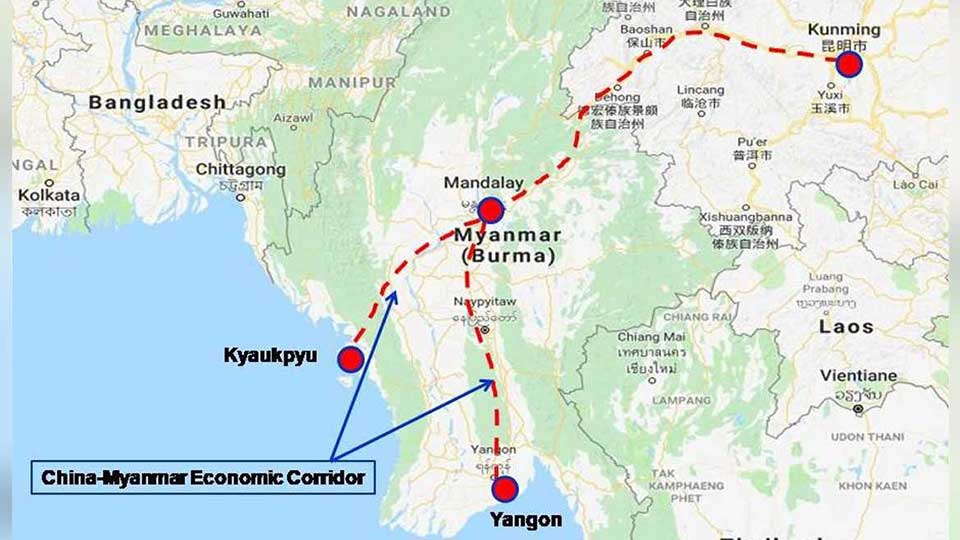
China views Myanmar as indispensable to its long-term strategic ambitions. Through the China–Myanmar Economic Corridor, Beijing seeks direct access from Yunnan Province to the Indian Ocean via pipelines, highways, railways, and the deep-sea port at Kyaukphyu. These projects reduce China’s dependence on the Strait of Malacca, one of the world’s most strategically vulnerable maritime chokepoints.
China has maintained pragmatic relations with both the military government and several ethnic armed organizations, seeking above all to protect its strategic investments.
Russia has become one of the Tatmadaw’s principal military suppliers, providing aircraft, helicopters, weapons systems, and diplomatic support.
Western nations have broadly favored the democratic movement in Myanmar, imposing sanctions on military officials, providing humanitarian aid, and engaging with democratically-elected institutions. Meanwhile, the degree of clandestine foreign interference by outside powers in Myanmar’s internal conflict remains disputed.
The convergence of competing foreign interests increasingly resembles the geopolitical rivalries seen in other conflict zones worldwide.
India’s Strategic Dilemma
India has a tough foreign policy balancing act on its hands. New Delhi seeks stability along its borders to keep its Northeastern states secure, finalize connectivity projects such as the India–Myanmar–Thailand Trilateral Highway and the Kaladan Multi-Modal Transit Transport Project, and check China’s rising influence. At the same time, it needs to work with Myanmar’s military leaders and engage ethnic organizations that control large swaths of borderland. Military means will not work on their own. India has discovered that reaching political settlements with separatist insurgencies in Nagaland, Mizoram, and Assam eases the situation, but that stability cannot be achieved through security operations alone without political dialogue. Border management, intelligence cooperation, stepped-up anti-drug patrols, and better coordination with Bangladesh will be essential.
The Way Forward
Military might alone will never solve Myanmar’s problems. Its complex ethnic geography requires strong federalism with real, local self-administration in ethnic minority regions of a united Myanmar. That we have not been able to uphold the Panglong spirit is regrettable. Myanmar’s neighbors also have a responsibility to cooperate on intelligence sharing, border management, refugee management, and counter-narcotics efforts. ASEAN can do more to constructively facilitate diplomacy, and the international community can continue to provide humanitarian aid and call for democratic reforms that include all of Myanmar’s communities. We must also ensure that illicit cash flows that fuel the conflict stop, and that reliance on the drug trade is lessened through alternative development.
Conclusion
After years of brutal military rule, civil war, illicit activity, and foreign meddling, Myanmar is no longer a domestic conflict. It has emerged as one of Asia’s most important geostrategic battlegrounds, with serious implications for the national security of India and Bangladesh. The humanitarian crisis continues to worsen in Rakhine State and across Myanmar. In many parts of the country, non-state armed groups, drug cartels, and great power rivalry are fast becoming the defining features of everyday life.
For Bangladesh, the Rohingya refugee crisis constitutes a serious humanitarian and national security threat that has persisted for far too long. For India and its Northeast in particular, Myanmar has evolved into a growing hotspot for insurgency, drug smuggling, illegal arms, refugees, and great power rivalry.
Consequently, stronger border management, combined with proactive diplomacy, humanitarian action, regional collaboration, and principled support for a political settlement that acknowledges Myanmar’s stunning ethnic diversity, will be required if Myanmar is ever to achieve lasting stability. Myanmar’s stability is synonymous with South Asian peace and prosperity. If Myanmar descends further into chaos, India and Bangladesh cannot expect to be fully insulated from the fallout. As such, the people and government of Myanmar should not have to deal with this crisis alone. It is now in the vital interests of the United States, India, and Bangladesh to promote a long-lasting political settlement to Myanmar’s numerous problems.
Comments
Post a Comment