Speaking out on the eve of the 2022 Winter Olympic Games
in Beijing, leading United States politicians and rights activists on Thursday
sharply criticised China’s abuse of its Uighur population, ethnic cleansing in
Tibet and suppression of democracy in Hong Kong.
House of Representatives Speaker Nancy Pelosi, the top
Democrat in Congress, slammed the Chinese government’s actions against Uighurs as
“horrible” and “diabolical” and called the camps in Xinjiang “slave labour”.
“The People’s Republic of China is perpetrating a
campaign of gross human rights violations, including genocide,” Pelosi said at
a panel hearing in Washington, DC, featuring testimony from Uighur, Tibetan and
Hong Kong rights activists.
Rights groups allege that since 2017 China has
arbitrarily detained or imprisoned up to a million Uighurs; placed many in
camps, subjecting them to tight surveillance and forced sterilizations; and
destroyed hundreds of mosques in Xinjiang.
China has denied the allegations of human rights abuses
and genocide.
“Over the next two weeks, it is our urgent moral duty to
shine a bright light on the many human rights violations being perpetrated by the
host nation,” Pelosi said.
With the opening ceremonies of the Winter Games set to
begin on Friday, antipathy towards China has been rising among US policymakers
amid growing evidence of the government’s repression of minorities in
Xinjiang and democracy in Hong Kong.
 Kamaltürk
Yalqun holds the aluminium Olympic torch he carried at the 2008 Beijing Olympic
Games. After seeing his family in Xinjiang split apart, he is a Uighur activist
in the US calling for a boycott of the 2022 Winter Games [Michael Dwyer/AP
Photo]
Kamaltürk
Yalqun holds the aluminium Olympic torch he carried at the 2008 Beijing Olympic
Games. After seeing his family in Xinjiang split apart, he is a Uighur activist
in the US calling for a boycott of the 2022 Winter Games [Michael Dwyer/AP
Photo]
President Joe Biden has said the US government would not
send officials to attend the games. Other nations joining the diplomatic boycott include
the United Kingdom, Canada, Australia, New Zealand, Belgium, the Netherlands,
Denmark, Sweden, Austria, Estonia, Latvia, Lithuania, the Czech Republic, and
Japan.
“While we fully support, and will root for our athletes,
we cannot and will not be silent on human rights in China just to bolster their
bottom line,” Pelosi said.
Pelosi’s remarks and testimony from activists came in a
hearing on Thursday of the Congressional-Executive Commission on China, an
independent US agency established by Congress when the US normalised trade
relations with China in 2000.
Jewher Ilham, the daughter of Uighur academic economist
Ilham Tohti who is serving a life sentence for advocating regional autonomy for
Xinxiang, told the panel that millions of Uighurs have been imprisoned in camps.
“We are talking about millions. Hundreds of thousands of
families, they don’t know if their families are alive. I don’t know if my
father is alive,” Ilham said.
Nathan Law, a Hong Kong democracy
activist who fled the city in 2020 amid a crackdown by Chinese authorities,
said pro-democracy activists who
were arrested remain jailed without trial and face the prospect of spending
decades in prison. “They may not survive,” he said.
Nyima Lhamo, niece of the late Tibetan Buddhist
leader Tenzin Delek Rinpoche who
died in prison in 2015, said that she had been warned not to continue speaking
out about his case. China has spies in many countries, and she could be killed,
Lhamo said she was told.
“Growing up in Tibet it was common
to hear of Tibetans dying in Chinese prisons without any justice,” she said.
“There were so many of them.”
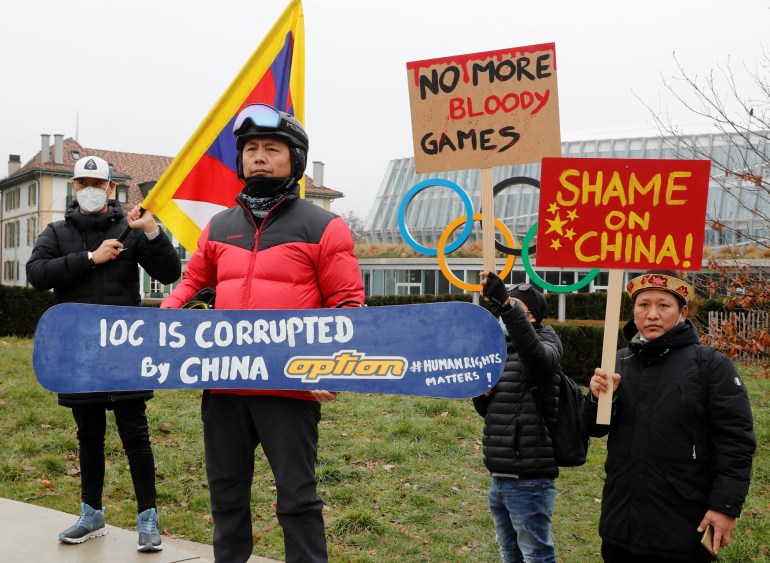 Migmar
Dengo, a Tibetan who got Swiss asylum two decades ago, and other members of the
Tibetan community living in Europe, protested outside the Chinese Olympic Committee
in Lausanne, Switzerland on February 3 [Arnd Wiegmann/Reuters]
Migmar
Dengo, a Tibetan who got Swiss asylum two decades ago, and other members of the
Tibetan community living in Europe, protested outside the Chinese Olympic Committee
in Lausanne, Switzerland on February 3 [Arnd Wiegmann/Reuters]
Pelosi issued a stark warning to athletes competing in
the games not to speak out about China’s rights abuses.
“I would say to athletes, ‘You’re there to compete. Do
not risk incurring the anger of the Chinese government, because they are
ruthless’,” she said.
The House is expected to vote this week on
a bill to provide US government funding for American semiconductor
manufacturers and support for technology businesses to better compete with Chinese
companies.
The Senate earlier passed a similar bill providing $52bn
in subsidies for US semiconductor makers and Biden has urged passage of the
legislation.
In December, Congress passed, and President Biden signed
the Uyghur Forced Labor Prevention Act.
The new law seeks to ban imports of products from Xinjiang unless producers can
demonstrate they were not made by forced labour.
SOURCE: AL JAZEERA


No comments:
Post a Comment