Southeast Asian states, stymied on how to address Myanmar’s coup
and its violent, destabilizing fallout, meet this week in Washington.
Thursday, May 12, 2022/ BY: Priscilla A.
Clapp; Jason Tower
PUBLICATION
TYPE: Analysis and Commentary
The February 2021 coup in
Myanmar, which overthrew an elected government and installed a brutal military
dictatorship, has posed an enormous challenge to the Association of Southeast
Asian States (ASEAN). The group has split on what — if any — action to take
regarding the coup. Meanwhile, the military’s unbridled violence against the
country’s citizens failed to suppress an increasingly militarized population
and the conflict now affects ASEAN states bordering Myanmar and those beyond.
As the U.S.-ASEAN Special Summit gets underway
this week in Washington, Myanmar will not be present, a symbol that the
organization — as a whole— does not accept the coup government’s legitimacy.
What’s next remains to be seen.
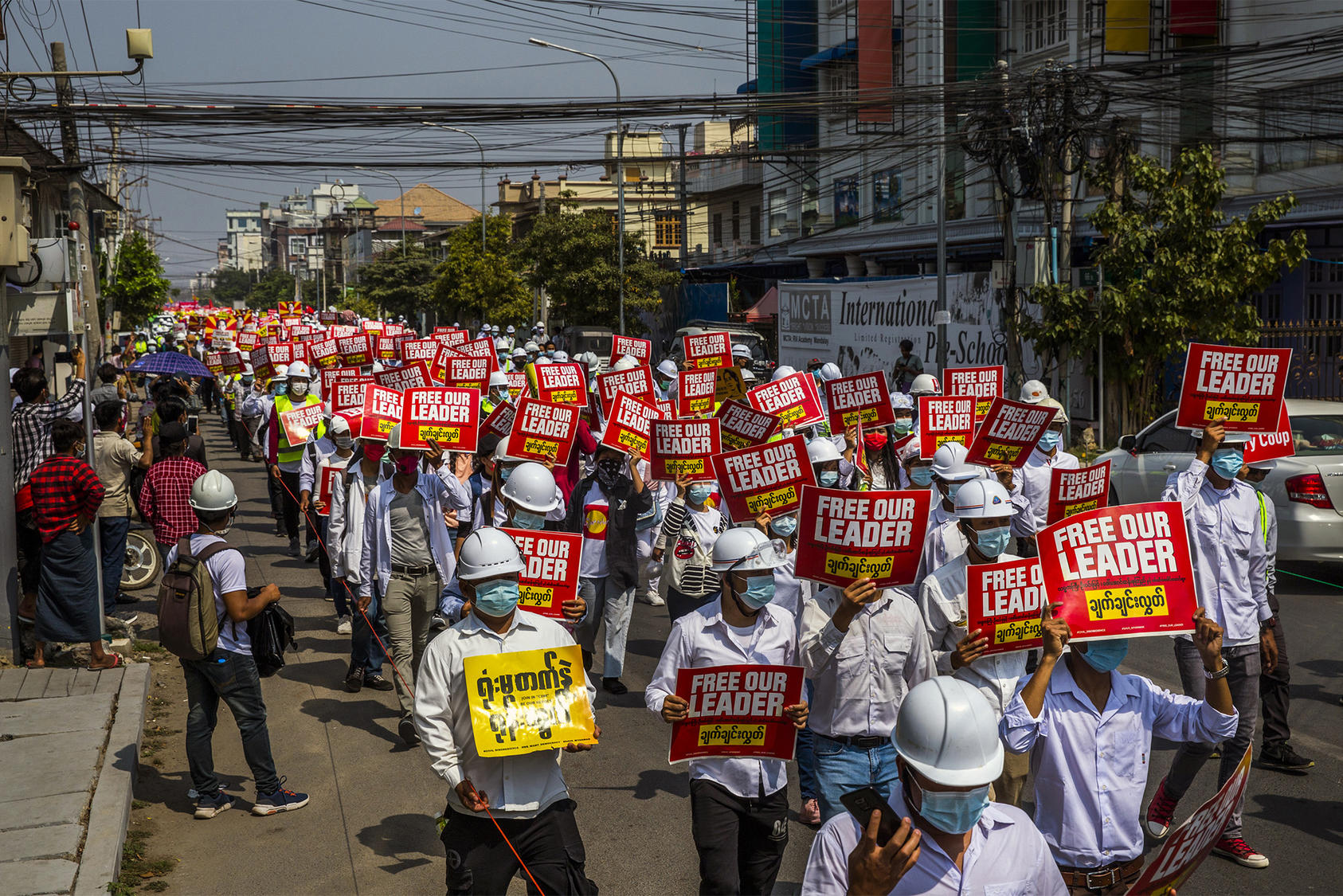 Medical
students, doctors and engineers march in Yangon, Myanmar, on Feb. 26, 2021 to
protest against the military coup earlier that month. (The New York Times)
Medical
students, doctors and engineers march in Yangon, Myanmar, on Feb. 26, 2021 to
protest against the military coup earlier that month. (The New York Times)
USIP’s Jason Tower and
Priscilla Clapp discuss ASEAN’s response to the coup, the international power
dynamics behind it, and how the putsch fits into a worldwide assault on
democracy.
Why
has ASEAN been unable to address the coup in Myanmar and its continuing
consequences?
ASEAN faces three key
challenges in responding to the regional crisis triggered by the Myanmar army’s
coup and the oppression, fear and extreme violence the generals employ to try
to enforce their authority.
First, ASEAN is a
consensus-based organization of 10 states that vary widely in socio-economic
and political development. Given that diversity, the bloc has developed what it
calls the “ASEAN way”— a pledge to avoid interfering in each other’s domestic
affairs and to focus largely on broad-based initiatives they all support. With
some ASEAN states facing troublesome domestic challenges of their own, the bloc
has been highly reluctant to abandon or revise this guiding principle.
Second, in retrospect the
steps ASEAN did take to address the coup were problematic. Immediately after
the military seized power in February 2021, ASEAN invited Myanmar’s military
chief — the architect of the coup — to a summit in Jakarta where the organization’s
leaders rolled out their so-called “Five Point Consensus” to
help stabilize the country. Unfortunately, no part of the opposition was
consulted before or during the meeting, creating the appearance that ASEAN was
conferring legitimacy on the junta. Subsequently, neither the coup leadership
nor the key components of Myanmar’s popular resistance — the National Unity
Government (NUG) and the ethnic armed organizations (EAOs) — accepted the terms
of the consensus. As opposition to the junta turned violent and grew
nationally, the other nine ASEAN states were left with a roadmap that neither
side viewed as their vision for the country’s future. Further neutering the
five-point plan, Myanmar’s self-appointed ruler proceeded shamelessly to
reframe the five points to meet his own objectives.
Third, key regional powers,
including China, India and Japan, have long-standing interests in Myanmar that
have been only marginally affected by the coup, presenting another challenge to
the ASEAN. Over nearly three decades, China has sought to harness Myanmar to
its southwestern provinces seeking to gain access to the Indian Ocean, open a
strategic energy corridor and boost development of its landlocked interior. As
with other countries on its periphery, China considers the China-Myanmar
borderlands critical to its national security and remains vigilant against any
form of Western encroachment. India and Japan — both of which have deep
economic and political interests in Myanmar’s geo-strategic position — have
strong national interests in presenting alternatives to China’s growing
influence in Myanmar.
The dynamic of great power
competition in Southeast Asia has thus worked to dilute the effectiveness of
efforts to isolate Myanmar’s coup leaders, adding to ASEAN’s difficulties in
finding a sustainable solution.
Has
the failure so far of ASEAN’s roadmap for the conflict harmed its reputation
and caused disunity within the bloc?
ASEAN is not the only
international actor that has failed to resolve the conflict in Myanmar, so it
is not fair that its reputation should be harmed. However, its response to the
coup has created division within ASEAN between two sets of states with
differing political interests.
On one side are the countries
of mainland Southeast Asia, the Mekong countries of Thailand, Cambodia, Laos
and Vietnam. They have little interest in pressuring Myanmar’s military for
fear of harming their own economic interests and political ties with the
generals. They also hesitate to become involved with issues of human rights and
democracy that could set an ASEAN precedent and one day might be turned back on
them. On the other side are the maritime countries of Malaysia, Indonesia,
Singapore, Philippines and Brunei. These countries tend to have more mature
political and governance systems; even before the coup they registered concerns
about the plight of the Rohingya and other Muslim and religious groups. They
have pushed resolutely to isolate the junta, demanding it be held accountable
to the Five Point Consensus and barring the junta leader from attending further
ASEAN meetings.
Pressure from the
international community has aggravated this division. On one end of the
spectrum, China has used its leverage with key ASEAN client states Laos and
Cambodia to prevent ASEAN from responding more robustly. It has pressed ASEAN
countries generally to follow its initiative to recognize the military’s
government, the State Administrative Council, and urged them not to isolate the
regime. On the other end, the United States, United Kingdom and European Union
have supported efforts by ASEAN countries like Malaysia and Indonesia to engage
the opposition, particularly the National Unity Government, and have raised
concerns when ASEAN states, especially the current ASEAN chair Cambodia, have
moved to legitimize the regime and offer it economic or political
support.
With
the U.S.-ASEAN Summit held in Washington this week, can the United States
influence ASEAN to adopt a bolder approach to the junta?
First, it is critical that
the Myanmar issue does not undermine progress with the already vibrant
cooperation between the United States and ASEAN, particularly when it comes to
economic and trade initiatives, connectivity, and addressing key global and
regional challenges such as climate change. The U.S. side has developed a robust and broad agenda for the summit to
address all these issues, as well as to advance understanding among ASEAN
leaders of the impact of U.S. domestic politics on the administration’s options
for pursing trade agreements and other policies in the region. In fact, the
bloc’s principled decision not to invite the military or senior political
representatives to occupy the Myanmar seat at ASEAN summits has contributed
significantly to setting the stage for a successful exchange at this bilateral
summit.
Secondly, it is important to
point out that the United States and many ASEAN states, especially Malaysia,
Indonesia and Singapore, share similar assessments of the situation in Myanmar.
They recognize that the military does not and will not constitute a legitimate
government and see the importance of engaging with the National Unity
Government, the National Unity Consultative Council and
other groups that have overwhelmingly rejected the military putsch. They also
recognize the importance of compelling the junta immediately to cease all
violence, to release all political prisoners, and to restore civilian
governance. It is therefore not a matter of the United States exerting pressure
on ASEAN, but rather an opportunity for participants in the summit to explore
what kind of additional steps might be more effective in resolving the conflict
and reigning in further brutality by the military toward its civilian
population.
Third, is the opportunity
provided by the summit to renew our commitment to the principle of ASEAN
centrality, while recognizing that this principle does not rise or fall on the
resolution of the Myanmar crisis. The Myanmar army’s assault on its people is
part of a worldwide assault on democracy by autocrats that presents a serious
global security threat, deeply damaging to the entire world’s economy and
stability. Without the tools and leverage to address problems of this
magnitude, ASEAN is left in a vulnerable position when other states outsource
responsibility to it without mobilizing their own robust responses to the
crisis in support of ASEAN’s efforts.
The United States also has
the opportunity in the context of the summit to demonstrate high-level
engagement with the NUG and other stakeholders in the resistance. As
representatives of the government elected by the people and of many of the key
ethnic nationality groups that have been struggling against military rule for
decades, these platforms have much more legitimacy in the eyes of the Myanmar
population than the military. Any efforts by the international community to
address the situation in Myanmar will need to involve close and careful
consultation and coordination with these stakeholders who will determine
Myanmar’s future.
Key
actors in the international community have deferred to ASEAN to address the
crisis in Myanmar. Meanwhile, as the war in Ukraine preoccupies the West, China
has signaled even more overt backing for the junta. How can concerned nations
best respond?
This is a problem than must
be addressed at the highest level because the dual crises in Europe and Asia
are a clear signal to the world’s democracies that we are all at risk. The
U.S.-ASEAN Special Summit affords the perfect opportunity for the United States
to demonstrate its capacity for responding broadly to this threat in more than
one theater. While the assault on Ukraine is unquestionably a bold attack on
the entire system underlying peaceful coexistence in post-World War II Europe,
the military assault on elected government in Myanmar is an equal challenge to
peace and stability if it cannot be effectively addressed by the international community of
democracies. It will become the harbinger of yet more such assaults
on democracy and international stability in Asia if we fail.


No comments:
Post a Comment