Friday, September 27, 2019

Will Canada take Myanmar to the ICJ for genocide?

Susan Hutchinson - 27 Sep, 2019

We have now passed the anniversary of the ‘clearance operations’ that saw nearly a million of Myanmar’s Rohingya flee to neighbouring Bangladesh. The violence included rape, other forms of sexual violence, arson, torture and a range of physical violence and harassment that amounted to genocide of a unique ethnic and religious group. Prospects for individual, criminal accountability for the genocide seem slim. But a movement in Canada is seriously agitating for their government to take the government of Myanmar to the International Court of Justice to hold the state accountable for its role in the genocide.
Because Myanmar isn’t a state party to the International Criminal Court (ICC) and China and Russia have been acting to prevent the Security Council referring the matter to the ICC, no individuals can be charged with genocide at that court. The ICC is only able to pursue related investigations into forced deportation. But that doesn’t mean States Parties to the Rome Statute can’t prosecute Burmese nationals for genocide under the principle of universal jurisdiction in their own national courts. The work of the new Independent Investigative Mechanism for Myanmar would make this easier. But such cases cannot be tried in absentia, and the countries most likely to pursue such prosecutions have implemented sanctions that involve travel restrictions against key leaders of the Tatmadaw.
However, the obligation to prosecute the crime of genocide predates the Rome Statute of the International Criminal Court to the much older Convention on the Prevention and Punishment of the Crime of Genocide which contains not only individual responsibility, but also state responsibility. In their final report, the UN’s Independent International Fact-Finding Mission on Myanmar, specifically stated that “acts of the Tatmadaw and other security forces of Myanmar, as well as acts of their subordinate units during security operations, are attributable to the State and incur State responsibility.”
Myanmar voluntarily consented to the jurisdiction of the International Court of Justice (ICJ) by ratifying the Genocide Convention in 1957. This treaty has what is known as a compromissory clause, stating that “Disputes between Contracting Parties relating to the interpretation, application or fulfilment of the present Convention, including those relating to the responsibility of a State for genocide or for any of the other acts enumerated in article III, shall be submitted to the International Court of Justice at the request of any parties to the dispute.”
Myanmar has made several reservations to the Genocide Convention, including one to article six, intending that individuals charged with genocide perpetrated in Myanmar would fall solely under the jurisdiction of national courts. However, they have made no reservation to the compromissory clause in article nine. As such, the government of Myanmar can be taken to the ICJ by any State Party to the Genocide Convention. The countries most likely to do so are those with a strong current and/or historical interest in Myanmar. As the former colonial power, home to a sizeable Rohingya community, and agitator for EU sanctions against Tatmadaw leaders, the UK is a possible candidate.
Assessing the Rohingya crisis
With the expulsion of the Rohingya largely a fait accompli, the world must face up to engaging with a very different Myanmar.
Canada is also home of a sizeable Rohingya diaspora and was the first country to independently pass sanctions against serving leaders of the Tatmadaw. On 25 June 2018, the Governor-General of Canada signed into effect sanctions against Lieutenant General Aung Kyaw Zaw, Major General Maung Maung Soe, Brigadier General Aung Aung, Brigadier General Than Oo and Brigadier General Khin Maung Soe from the military; and Brigadier General Thura San Lwin and Commander Thant Zin Oo from the police. At the time, the government stated the objectives of the sanctions were to “signal Canada’s international condemnation of the situation in Myanmar” and to “end impunity for the individuals responsible for, or complicit in, these acts.”
There is certainly a national effort to get the government to bring such a case. In April this year, Independent Senator Marilou McPhedran introduced a parliamentary motion for Canada to initiate proceedings before the ICJ for Myanmar’s breach of the Genocide Convention. Over 140 Canadian Senators, Civil Society Organisations and other individuals signed an open letter to the Minister of Foreign Affairs, Chrystia Freeland. In May, the All-Party Parliamentary Group for the Prevention of Genocide and other Crimes Against Humanity wrote to the Minister, detailing such a proposal, with the rationale that an ICJ case “would provide a more expeditious, easily accessible and appropriate venue to pursue justice on behalf of the Rohingya” than the ICC.
The only other genocide cases heard by the ICJ related to crimes committed during the war in the Balkans. There were two separate cases involving, Bosnia, Serbia and Croatia. According to the All-Party Parliamentary Group, an ICJ case has the capacity to offer some immediate remedy to the human rights situation on the ground that the UN has otherwise been unable to achieve. In their letter to the Minister, they referred to an example from the Bosnian case where the court ruled, within just three weeks of being asked about the matter, that Serbia immediately “take all measures within its power to prevent commission of the crime of genocide” including through the actions of military and police forces.
So, there are reasons to hope that an ICJ case could bring some justice for the genocide perpetrated against Myanmar’s Rohingya. It would certainly be an important step toward showing when the world said “never again” after the genocide in Rwanda, we actually meant to take action against genocide in the future. Now we need to wait and see if the next Canadian government will take such a case to the ICJ and support civil society efforts to pressure them to do so.

More on Myanmar

Twin authoritarianisms in Myanmar  Myanmar's symbiotic civil-military authoritarianism is the root of its political failures and its ethnic tensions.   13 Sep, 2019
A small hope: the extension of the Tatmadaw’s unilateral ceasefire  

Despite recent attacks by the Northern Alliance, Myanmar's military has extended its unilateral ceasefire.  06 Sep, 2019Notes from the Salween Peace Park Weary of Myanmar’s elite-driven peace process, some communities in Karen State are trying something different. 27 May, 2019
About the Author
  • Susan Hutchinson is a PhD scholar in the Coral Bell School of Asia Pacific Affairs at the Australian National University. Most of her work is in the intersection of gender and security studies. She is also the architect of the prosecute; don’t perpetrate campaign to help end impunity for conflict related sexual violence. Susan is a member of the Australian Civil Society Coalition on Women, Peace and Security, as well as the Australian Arms Control Coalition. Her professional experience spans military, government and non-government organisations.OL OF ASIA PACIFIC AFFAIRS © Copyright 2019 New Mandala | Web Design: Code and Visual ShareThis Copy and Paste

Bangladesh - the reluctant host of the Rohingya genocide survivors

Bangladesh government is increasingly behaving like a reluctant host. I am ashamed of saying this because I know that its people are better than what's happening to the Rohingyas now encamped in Cox's Bazar, disconnected from the rest of the world via phone and internet. It's like detention. Really shameful and inexcusable for a government that under international pressure allowed the Rohingyas to cross into Bangladesh from the killing fields in Myanmar. That gesture of Sheikh Hasina endeared her, some hoping, perhaps including some within her cabinet, that she may get nominated for the prestigious Nobel Prize. Obviously, that award never came through, and her government's bilateral agreement with the Myanmar government was too weak and too immature to create a conducive situation for repatriation of those who survived the genocide.
Her government has failed to generate the kind of international support, esp. from next door India and China, both with their own Muslim problem where instead of integrating the persecuted minority these governments have found it easy to rob their human rights. Thus, frustrated as the government is with Myanmar's unwillingness to allow repatriation of the Rohingya with their citizenship rights, which remains the key issue, it is showing its ugly self. I am concerned and disappointed on the government's move.
Read the report below:
=================
DHAKA, Bangladesh — Authorities in Bangladesh will build barbed-wire fences around sprawling camps housing Rohingya refugees to stop their expansion, a Cabinet minister said Thursday.
Home Minister Asaduzzaman Khan said the fences were ordered by Prime Minister Sheikh Hasina, who had earlier told authorities to open the border to allow hundreds of thousands of Muslim Rohingya to escape from a harsh military crackdown in neighboring Myanmar two years ago.
Khan did not say exactly when construction of the fences would begin at more than 30 camps near the border.
Last year, the U.N.-established Independent International Fact-Finding Mission on Myanmar recommended the prosecution of top Myanmar military commanders on charges of genocide, war crimes and crimes against humanity. Myanmar has rejected the allegations.
Earlier this month, Bangladesh’s telecommunication regulator asked cellphone companies to halt service in the camps and restrict internet access because of a “security threat.” The regulator said a recent survey in the camps revealed that cellphones are being used there illegally.
In recent months, more than 40 Rohingya have been killed amid concerns that some refugees are involved in smuggling illegal drugs from Myanmar. At least five Rohingya have been killed in recent weeks in what police described as shootouts between suspected Rohingya criminals and law enforcers.
The government is investigating allegations against some middlemen and officials of the national identity card and passport authority of making fake documents for Rohingya in exchange for bribes. Police have arrested several people and say many Rohingya are desperate to go abroad using Bangladeshi passports.
Bangladesh and Myanmar attempted for a second time to begin repatriating the refugees to Myanmar in August but failed after no one agreed to return voluntarily.
Bangladesh says it will not force any Rohingya to return to Myanmar.

Thursday, September 26, 2019

The Rohingya problem: Is there an ASEAN solution in sight?

By Hirubalan V P, Former Deputy Secretary-General of ASEAN Political-Security Community Department
On 22 August 2019, Myanmar’s authorities launched a third repatriation attempt to facilitate the return of displaced Rohingya Muslims. The government dispatched buses to Cox’s Bazaar tasked with bringing back some 3,000 Rohingya refugees to their place of abode in Rakhine State. Not a single refugee boarded the transportation provided.
Unlike the first two repatriation attempts, this third attempt was of heightened significance. A team from ASEAN was at the Myanmar reception centres to witness the repatriation exercise. For Myanmar, the presence of ASEAN officials was an opportunity to validate its preparations for the repatriation exercise and to affirm that Myanmar was serious in facilitating the return of the displaced Rohingya. In this sense, the presence of ASEAN officials had good public relations value for Myanmar.
Reactions to the failed repatriation attempt have been varied. The Myanmar authorities expressed surprise at the refugees’ refusal to return to Rakhine. They blamed the presence of the Arakan Rohingya Salvation Army (ARSA) for this failure, asserting that the group was active in Cox’s Bazaar, deterring Rohingya from returning home. The Myanmar government accused the Bangladeshi authorities of not doing enough to counter its activities and facilitating the return of the Rohingya Muslims.
Rohingya refugees in Cox’s Bazar, Bangladesh carrying a piece of cloth with demands in protest of repatriation to Myanmar, which many in the community see as a dangerous return trip. Photo: Jafor Islam/VOA
The Bangladeshi government maintained that it upheld its end of the agreement and had taken the necessary steps to facilitate this round of repatriation. There was no official reaction from ASEAN. ASEAN Ministers can be expected to discuss this matter when they meet later this month in New York for the Special ASEAN Ministerial Meeting.  
ASEAN’s involvement was good publicity for the organisation and the Myanmar government
ASEAN’s involvement in this third repatriation attempt began in May 2019 when Myanmar allowed an ASEAN team into the country to carry out a needs assessment and assess the preparations Myanmar was undertaking to receive the displaced Rohingyas. This arrangement reflected ASEAN’s hope that its involvement on the ground would inspire confidence in the Rohingya to participate in the repatriation exercise. It was also an opportunity to mitigate criticisms that ASEAN was not playing a greater role in trying to solve the crisis taking place in its backyard.
ASEAN had to tread carefully. The language was carefully designed to make clear that it was Myanmar that invited ASEAN’s involvement. This protected the ASEAN mantra of non-interference in the internal affairs of individual Member States without a specific request.
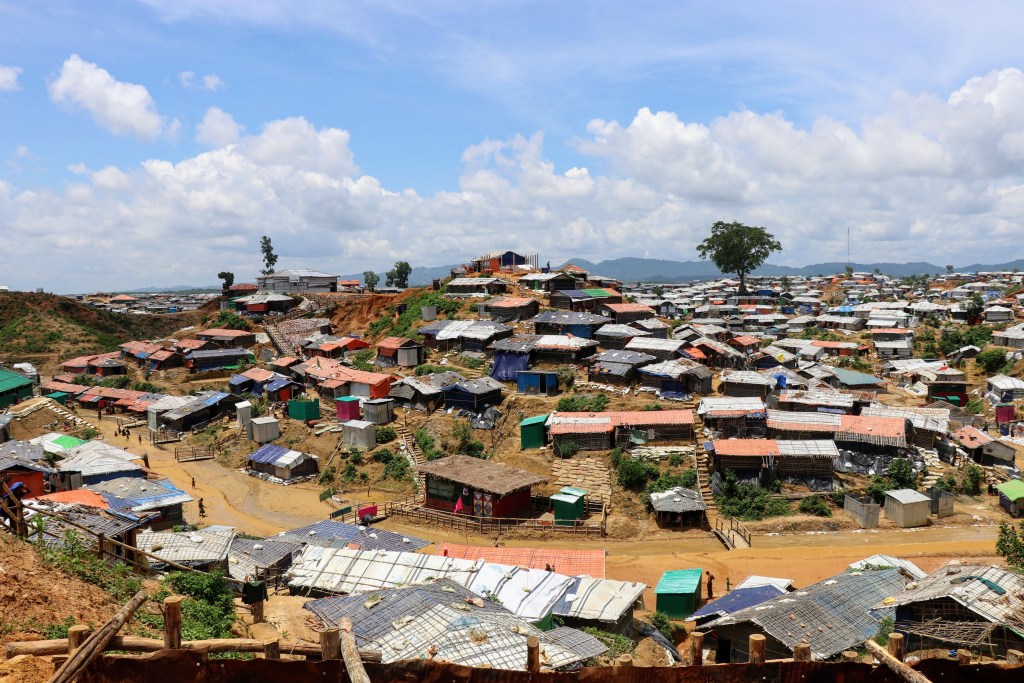
Rohingya camps in Cox’s Bazaar. Photo: Mohammad Tauheed
The ASEAN Team’s preliminary needs assessment focused on the ongoing preparations to process and house the incoming refugees. It made the seemingly objective observation that the Government of Myanmar had invested significant effort into its repatriation plan, including the preparation of facilities, humanitarian assistance and human resources.
As Myanmar officials were part of the team, it is reasonable to conclude that the ASEAN Team’s assessment could not have taken a critical tone, nor given the impression that Myanmar was unprepared or disinclined to facilitate the return of the refugees.
The leaked ASEAN assessment received significant flak from NGOs and the displaced Rohingya, who criticised it as being insufficient and merely an attempt to legitimise Myanmar’s repatriation process. A joint statement by ASEAN Civil Societies and Rohingya Organisations called the assessment a “whitewash” that had drastically overestimated the ease with which the Rohingya could return to Myanmar and was caustic in its observation that the “report at times reads more as if it is designed to please the Government of Myanmar than a product from members of a reputable institution.”Rohingya refugees in Bangladesh. Photo: EU Civil Protection and Humanitarian Aid
Repatriation involves more than merely facilitating the return of displaced persons
The failure of the third attempt at repatriation reflects the complexity and difficulties involved in allowing the displaced Rohingya to return to their homelands. The Rohingya do not trust the authorities in Myanmar, who were complicit in their persecution. Their core concerns over their safety remain, and there are still uncertainties over their livelihoods and whether they would be granted citizenship. Even though conditions in Cox’s Bazaar are dismal and squalid, the displaced Rohingya fearful that their situation would be worse if they returned to Myanmar.
The Myanmar government has never recognised the Rohingya as a legitimate ethnic group but instead sees them as refugees from Bangladesh, referring to them as Bengalis. In this light, Myanmar cannot be displeased that the displaced Rohingya are not willing to participate in repatriation efforts. ASEAN’s involvement allowed Myanmar to create the façade of legitimacy and promote the notion that it has made preparations to receive the displaced Rohingya. But the Rohingya remain unconvinced that their reasons for fleeing have been adequately resolved.
It is difficult for ASEAN to do more without Myanmar’s concurrence
For ASEAN as an organization, the Rohingya problem is a thorn in its side. Its critics hold it up as evidence that ASEAN is unable to effectively handle a serious human rights crisis in its own backyard.
ASEAN member states remain committed to its cardinal principle of non-interference in the internal affairs of a member state, stifling resolution capabilities. Additionally, ASEAN’s principle of decision-by-consensus means Myanmar has to agree to any action. As a result, the ASEAN Chair, which is responsible for ASEAN Statements and Communiques, is struggling to strike a balance – the issue has to be mentioned in ASEAN documents so as not to damage ASEAN’s credibility over a crisis with serious human rights implications, but the framing of the ASEAN message on this issue has to have Myanmar’s concurrence.
It is probably on Myanmar’s insistence that the paragraphs on the Rohingya issue were placed in the social and cultural section of the ASEAN Summit and Ministerial statements, presenting the matter as a social and cultural issue rather than a political, security or human rights issue. Nevertheless, regardless of where the paragraphs on the Rohingya issue are placed in ASEAN documents, it is still an acknowledgement that ASEAN must have a position on the situation to maintain at least a semblance of credibility.
There have been occasions when differences have emerged between members states. For instance, in September 2017, when the ASEAN Ministers meeting in New York issued a statement on the subject, Malaysia publicly disassociated itself from the document a few hours after it was released. The Malaysian government argued that the statement did not accurately reflect developments on the ground.
Differences over this issue also surfaced during the ASEAN Inter-Parliamentary Assembly (AIPA). At its recent meeting in Bangkok on 25 August, a resolution entitled: “Responding to the Humanitarian Crisis of the Rohingya People” proposed by Indonesian delegates was rejected because there was no consensus.
ASEAN’s constraints in managing the Rohingya problem were best summed up by Singapore’s Foreign Minister Vivian Balakrishnan on 2 October 2018, when Singapore was still the ASEAN Chair. In replying to a question in the Singapore Parliament on whether Myanmar can be compelled to act in line with the relevant sections in the ASEAN Charter and the ASEAN Human Rights Declaration, Minister Vivian said “ASEAN is an association that makes decision by consensus, and once you understand that every decision requires consensus, it effectively means every single country has a veto. So that acts as a constraint to the legal options available…Compulsion, tempting as it is, usually never works in these sorts of situations.”      
Nevertheless, ASEAN has made some effort to show that it is trying to play a role in finding a resolution to the Rohingya crisis while adhering to the organisation’s commitment to non-interference and decision-by-consensus. The agreement to dispatch an ASEAN Team to witness Myanmar’s preparation for the repatriation exercise and to conduct a needs assessment was a recent example of these efforts. Earlier in October 2017, ASEAN Ministers also agreed to dispatch 80 tons of relief aid to assist internally displaced persons in Rakhine State.
Individual ASEAN member states have made bilateral contributions to Myanmar, Bangladesh and International relief organisations to provide aid to displaced persons. Within ASEAN, there are efforts to keep Myanmar engaged on the issue. The Rohingya issue is discussed each time ASEAN Leaders and foreign ministers meet. It is important for ASEAN to keep the topic on the agenda to continuously impress upon Myanmar the gravity of the situation and its impact on ASEAN, in addition to the need to alleviate the suffering of the displaced Rohingya.
The issue has all the makings of a long-term challenge for ASEAN
The failure of the most recent repatriation exercise is a setback but not a disaster. The lessons learnt from the episode will guide ASEAN in its future approaches and provide additional information on how it can be involved to best assist Myanmar and the repatriation process. However, the key driver must be Myanmar.
As long as Myanmar continues to insist on measures that are restrictive and onerous, the refugees will be reluctant to return.  Clearly more work is required to engage the displaced persons and to ensure that sufficient resources and preparations are in place to provide the smooth return of refugees.
Realistically, this problem is beyond ASEAN’s capacity to handle by itself. Vast resources are needed to facilitate the return of the displaced persons. Massive support from the international community, UN agencies, international NGOs and aid agencies is required.
Facilitating the Rohingya’s return is only one facet of the solution. Long-term solutions within Myanmar will also be required to ensure that the incoming Rohingya are able to live in dignity, with a sustainable livelihood, and access to social amenities. These are crucial issues to be addressed over the long term. As long as the displaced persons lack confidence and trust in the process and continue to fear for their safety if they return, then even the immediate issue of voluntary repatriation will be impossible to realise.
The concern is that if the issue continues to persist, then fatigue might set in. ASEAN already has to deal with a host of other challenges. In the face of other pressing matters, the bloc might lose focus on this devastating issue. It would be a tragedy if the displaced Rohingya become a permanent fixture in Cox’s Bazaar, eking out their existence as a forgotten and downtrodden population. ASEAN should build on its initial involvement of deploying an assessment team to Myanmar and determine further steps it could take to move the repatriation process forward.    

World must pressure Myanmar to end Rohingya crisis

UALA LUMPUR, Sept 26 -- The international community needs to be more coherent in urging international bodies to pressure the Myanmar government to act on resolving the Rohingya humanitarian crisis that has erupted in Rakhine state since 2017.

Professor in the Department of Government and Civilisation at the Faculty of Human Ecology of Universiti Putra Malaysia (UPM), Prof Dr Zaid Ahmad, said the global bodies must coerce Myanmar in order to force the country to act.

“The world needs to put pressure on Myanmar. It may be through economic pressure or diplomacy as the last resort.

"The UN and ASEAN need to go out of their way to call on Myanmar to come up with a solution to the Rohingya crisis," he said when contacted by Bernama International News Service, today.

The Rohingya crisis once again attracted the attention of the world when Prime Minister Tun Dr Mahahtir Mohamad, in a high-level event billed 'Rohingya Crisis - A Way Forward' at UN headquarters in New York on Tuesday, criticised the UN and Myanmar's failure to take action to resolve the problem.

Although it has been reported that Myanmar has taken several steps, including signing an agreement with the government of Bangladesh to allow Rohingya refugees in Cox's Bazar to return to their home country, the move is largely seen as a cosmetic solution as the majority of refugees are refusing to accept the offer due to security concerns and the fear of continuous repression.

An estimated 1.2 million Rohingya refugees are still living in refugee camps throughout the Cox's Bazar in Bangladesh.

"Various efforts and approaches have been taken by the parties in the past but to no avail. Moreover, the UN is seen as toothless, thus making Myanmar more courageous and ignoring the world's call to action on this issue," Zaid said.

Meanwhile, analyst Oh Ei Sun said Dr Mahathir's speech at the event is timely and necessary, and should serve as a wake-up call for the world bodies and the global community to act.

“It is not just the UN, but the global community as a whole which is still hesitating whether to impose harsh sanctions against Myanmar for its treatment of the Rohingyas, or to continue with ‘nurturing’ Myanmar’s supposedly burgeoning democracy,” he said.

Oh, who is a senior fellow with the Singapore Institute of International Affairs, also said the situation had worsened as Myanmar does not see it as a crisis, but a problem which should be resolved by getting the Rohingyas to assimilate into mainstream Myanmar cultural identity through suppressing the Rohingya inspiration using military means as it had been doing with its other minorities.

He also proposed that the UN should have a mandate and corresponding resources to provide humanitarian aids, both inside and outside of Myanmar, and to deploy sizeable peacekeepers to make sure that the atrocities are not repeated.

He is optimistic that the UN has the means and resources to do so in order to help end the persecution faced by the Rohingyas.

“UN has been doing similar things in many parts of the world, including the Middle East and Africa, for quite a long time, so is quite experienced in it,” Oh added.

Wednesday, September 25, 2019

H.R. 3190 (BURMA Act) of 2019

Last night, the U.S. House of Representatives voted on H.R. 3190, Burma Unified through Rigorous Military Accountability Act (BURMA Act) of 2019.  Congratulations! A big thank you to everyone who called, emailed, met with their U.S. representative in support of this bill, and joined us on the lobby days twice.

While we celebrate this we can not stop. The Senate is where the real fight is. The House and Senate are negotiating a final bill in considering the fiscal year 2020 National Defense Authorization Act (NDAA).  The next step is for a conference committee to reconcile the House and Senate versions of the NDAA.  Our bill is already on the NDAA. Let's make sure it stays there.


URGENT: If you are in any of these states or have contacts with any of these Senators in the Armed Service Committee: https://www.armed-services.senate.gov/about/members

Mahathir blasts Myanmar and United Nations over Rohingya ‘genocide’


Inline image
Rights activists have welcomed remarks by Malaysian Prime Minister Mahathir Mohamad [1] in which he refers to the targeting of Myanmar’s Rohingya [2] as “genocide” and “institutionalised terrorism”, but have called on his government to reassess its own treatment of refugees.

“What took place were mass killings, systematic rape and other gross violations of human rights [that] resulted in Rohingya fleeing the country on masse,” Mahathir told a high-profile event on the sidelines of the United Nations General Assembly in New York, as he described violence against the community in Rakhine state by military forces and Buddhist extremists.
Two years on, has the world forgotten the Rohingya children?
He slammed the Myanmar [4] government, led by Aung San Suu Kyi [5], for being unwilling to take any action to “resolve the crisis” – and the United Nations [6]for its “deafening” silence.

He also praised the Organisation of Islamic Conference (OIC) for attempting to seek legal redress for the stateless Rohingya through the International Court of Justice, saying that other countries should support the OIC “to ensure that the perpetrators do not get away with the heinous crimes they have committed”.
“It is left up to us – the international community, to do something about the situation. For a start, the UN should play its role, taking into account that it was established in the hope of preventing future human-made miseries … Without Security Council action, others must do their part to resolve the crisis and bring perpetrators to justice,” Mahathir said.

He commended Bangladesh [7] for hosting 1.2 million refugees and said Malaysia was committed to helping its own Rohingya community.

Among those present at the meeting organised by the OIC secretariat was Sheikh Hasina Wazed, the prime minister of Bangladesh.

In Myanmar, signs the Rohingya ever existed are being erased

Malaysia is home to 177,690 refugees and asylum seekers officially registered with the UN’s refugee agency, although the true figure including unregistered people is much higher. Of those officially registered, 97,750 are Rohingya. Several years ago, the government agreed to allow 3,000 Syrian refugees to enter and work in Malaysia to alleviate the global migration crisis.

In Malaysia, which is yet to ratify the UN Refugee Convention, refugees are unable to work, attend school, or access public health care. Complaints of police harassment are common, particularly from those waiting for official UNHCR cards legally confirming their status.Inline image
Rohingya refugees in a temporary settlement camp in a border zone between Myanmar and Bangladesh. Photo: AFP

Many refugees turn to informal, low-skilled labour where they are vulnerable to physical and economic exploitation. Recently, a pilot project offered a few hundred Rohingya the opportunity to work on palm oil plantations, although few took up the offer as they were not allowed to bring their families with them.

Critics have rounded on such problems, with activists insisting Malaysia has a humanitarian obligation to “provide basic necessities and protection”.

“As we call on international communities to support refugee communities in Malaysia, let’s also look at our own resources to support them. We can make a difference in providing a safe space, the right to work, and formal education – an inalienable right,” said Glorene Das, director at local NGO Tenaganita, which protects the rights of women, migrants and refugees.

Glorene said the non-interference policy of the
Association of Southeast Asian Nations [9]
had only made matters worse.

Inline image
Rohingya refugees pray in Cox's Bazar, Bangladesh. Photo: Reuters

“While we speak at the UN and among international communities, we also have an obligation to do so on the Asean platform. As a member of Asean we must continue to question Myanmar, and if they do not prioritise seeking solutions we must demand they leave the bloc. Trade agreements cannot be the only motivator for Asean – we must put people before profits.”

Mahathir’s remarks come amid an impasse in the crisis, said Lilianne Fan, chairwoman of the Asia Pacific Refugee Rights Network’s Rohingya working group. She said Bangladesh, which hosts the majority of Rohingya refugees, was “increasingly frustrated with the lack of tangible action on the Myanmar side”.
“It is also excellent that Mahathir mentioned Malaysia’s commitment to assist Rohingya refugees in our territory. The national framework for refugees is, indeed, being developed by the government at the moment.”

Described by the UN as one of the most persecuted minorities in the world, the Rohingya are not recognised by Myanmar and have been systematically driven out of the country into neighbouring Bangladesh. In military-led ethnic cleansing operations against the community, hundreds of thousands have been killed, tortured, injured, raped or displaced – and villages razed to the ground.


A Free Press, Until the Coverage Gets Uncomfortable?

  A Free Press, Until the Coverage Gets Uncomfortable? On September 18, President Trump barred CNN, MS NOW and Politico reporters from the ...