Saturday, February 28, 2026

Why are the US and Israel attacking Iran? What we know so far

The United States and Israel have struck multiple locations across Iran, including the capital, Tehran, in what US President Donald Trump described as “major combat operations”.

The attacks come amid negotiations between the US and Iran over the latter’s nuclear and ballistic missiles programmes, after weeks of mounting threats from Trump – and eight months after the US and Israel waged a 12-day war against Iran.

Recommended Stories

list of 3 itemsend of list

Iran has struck back with missiles aimed at northern Israel and at US military bases in the Middle East. Details of casualties and damage in Iran and Israel are sparse at the moment.

Here’s what we know so far:

What happened in Iran?

At about 9:27am (06:27 GMT), Iran’s Fars news agency reported a series of explosions in the capital, Tehran.

Al Jazeera’s correspondent in western Tehran said he heard two explosions, while videos shared on social media showed smoke rising from several parts of the city.

Israel first announced that it had launched missile strikes on targets inside Iran.

A US official told Al Jazeera that the strikes were carried out as part of a joint military operation with Israel. In recent weeks, Washington has assembled a large fleet of fighter jets and warships in the region, its most significant military buildup there since the Iraq War.

Trump described the operation as “massive and ongoing”.

The US Department of Defense later said the mission was named “Operation Epic Fury”, in the first public statement from the US military since the start of the joint US-Israeli attack.

Where in Iran have the US and Israel attacked?

Several missiles struck University Street and the Jomhouri area in Tehran, and close to Iran’s Islamic Revolutionary Guard Corps headquarters, Fars reported.

The Associated Press news agency reported that a strike in Iran’s capital happened near the offices of Supreme Leader Ayatollah Ali Khamenei.

Iran’s semiofficial Tasnim news agency reported that explosions also occurred in Tehran’s northern Seyyed Khandan area.

Explosions have also been reported in the cities of Kermanshah, Qom, Tabriz, Isfahan, Ilam and Karaj, as well as in Lorestan province, according to local media.

INTERACTIVE - IRAN ATTACKS BY ISRAEL - FEB28 2026 map-1772278937


What did Trump say?

While announcing “major combat operations”, Trump said the aim of the US campaign was to “destroy their missiles and raze their missile industry to the ground”.

“We are going to annihilate their navy,” Trump added.

Here are the key points of his message:

  • The US has begun major combat operations in Iran, describing them as “massive and ongoing”.
  • The stated aim is to eliminate what Washington calls imminent threats from the Iranian government.

Trump said the campaign’s military objectives include:

  • Destroying Iran’s missile capabilities.
  • Target Iran’s navy.
  • Disrupting Iran-backed armed groups in the region.
  • Making sure that Iran does not obtain a nuclear weapon.

He also laid out a warning-cum-offer to Iran’s military personnel. If they laid down their weapons, Trump said, he would ensure they had amnesty. But if they did not, he warned, they would face “certain death”. He acknowledged US forces could face casualties.

Reuters quoted a US official as saying that the Trump administration was planning a “multiday operation”.

The US president’s comments suggest that Trump was setting “the table for a revolution in Iran” — 73 years after the CIA orchestrated a coup against democratically elected Iranian Prime Minister Mohammad Mosaddegh, Al Jazeera’s Alan Fisher reported from Washington.

“They’ve done it before. This time, they’re doing it with weapons and bombs rather than covertly through the CIA,” Fisher said. “It’s clear that this is going to be a continuous military operation, with Donald Trump accepting the fact that there may be casualties.”

How are the US and Israel justifying their attack on Iran?

US and Israeli attacks on Iran follow years of confrontation over Tehran’s nuclear programme and regional influence.

The two allies have long claimed that Iran’s advancing enrichment activities and missile capabilities pose a threat to them, and they have repeatedly warned that they could use force against Tehran. Iran has publicly committed — repeatedly — that it has no intention of building a nuclear bomb. Israel is the only Middle Eastern nation to have nuclear weapons.

In June last year, Israel and the US attacked Iranian nuclear and military sites, assassinating several senior commanders.

The current escalation began after Omani mediators announced progress in Geneva negotiations, where Iran had reportedly agreed to zero uranium stockpiling and full verification by the International Atomic Energy Agency (IAEA).

Both the US and Israel have also argued that this is an opportunity for Iranians to “take over” the government.

“When we are finished, take over your government. It will be yours to take. This will be, probably, your only chance for generations,” Trump said.

What is Iran’s response?

Iran retaliated by first launching missiles towards Israel, according to the Israeli military. Air-raid sirens sounded in several parts of the country, and explosions were reported in northern Israel.

“The public is requested to follow the instructions of the Home Front Command,” Israel’s military said in a statement. “At this time, the Israeli Air Force is operating to intercept and strike threats where necessary to remove the threat.”

But soon after, Iranian forces launched missiles at several locations linked to US military operations across the region, including:

  • Al Udeid airbase in Qatar.
  • Al-Salem airbase in Kuwait.
  • Al-Dhafra airbase in the United Arab Emirates.
  • The US Fifth Fleet headquarters in Bahrain.
  • Explosions were also heard in Riyadh, Saudi Arabia
  • US bases were also reportedly attacked in Jordan

Earlier, Ebrahim Azizi, head of the Iranian parliament’s national security commission, threatened a “crushing” response. “We warned you!” Azizi wrote on social media. “Now you have started down a path whose end is no longer in your control.”⁠

What did Israel’s Netanyahu say?

In a statement, Israel’s Prime Minister Benjamin Netanyahu said that the military operation “will continue as long as necessary.” He said the Israeli operation was called “Lion’s Roar”.

Where are Iran’s leaders?

It is not immediately clear where the 86-year-old Khamenei is. He hasn’t been seen publicly in days as tensions with the United States have grown.

Roads to Khamenei’s compound in downtown Tehran were shut down by authorities as blasts rang out across the capital.

Meanwhile, Iran’s state-run IRNA news agency quoted a source in the presidential office as saying that President Masoud Pezeshkian was unharmed.

How has the world reacted?

  • Oman: Foreign Minister Badr Albusaidi said that active and serious negotiations mediated by his country between Iran and the US were “yet again undermined” amid the ongoing escalation, and urged the US “not to get sucked in further”.

  • Qatar condemned the Iranian attack, describing it as “a flagrant violation of its national sovereignty,” while adding that the country reserves the right of response in according with international law.
  • The United Arab Emirates condemned the Iranian missile attacks that reportedly killed a Pakistani national earlier, warning of “grave consequences” if such violations continue.
  • European Union foreign policy chief Kaja Kallas described the situation as “perilous” and called for civilians to be protected and international law to be upheld.
  • French President Emmanuel Macron warned that the conflict involving the US, Israel and Iran carries “grave consequences for international peace and security”, adding, “The current escalation is dangerous for everyone. It must stop.”
  • In Russia, Security Council Deputy Chairman Dmitry Medvedev criticised Trump, accusing Washington of using negotiations with Iran as a “cover operation” and questioning how the confrontation would unfold in the long term.
  • The UK said that Iran must never be allowed to develop nuclear weapons and stood ready to defend its interests.
  • Canada’s Prime Minister Mark Carney said the country supports US efforts to prevent Iran from obtaining a nuclear weapon and from further threatening international peace and security.

Israel strikes two schools in Iran, killing more than 50 people

An Israeli strike has hit an elementary girls’ school in Minab, a city in the Hormozgan province of southern Iran, killing at least 53 people, according to state media, as the immediate civilian cost from Israel and the United States’s huge bombardment of Iran comes into sharper focus. Workers are continuing to clear wreckage from the site, where 63 others were injured on Saturday, said Iran’s state-run IRNA news agency. The strike is part of a wave of joint US-Israeli military attacks across Iran that has triggered an outbreak of regional violence. Iranian Foreign Minister Abbas Araghchi shared a photo of the attack, which he said destroyed the girls’ school and killed “innocent children”. “These crimes against the Iranian People will not go unanswered,” Araghchi wrote in a post on X. Iran’s Foreign Ministry spokesperson Esmaeil Baghaei also slammed the “blatant crime” and urged action from the United Nations Security Council. Separately, Iran’s Mehr news agency reported that at least two students were killed by another Israeli attack that hit a school east of the capital, Tehran.

CAIR Condemns murder of School students in Iran by Israel-US forces

Muslim civil rights and advocacy group condemns reported slaughter of dozens of girls at Iranian school in U.S.-Israeli bombing The Council on American-Islamic Relations (CAIR), the nation’s largest Muslim civil rights and advocacy organization, today encouraged all Americans to contact the White House and their members of Congress to demand an end to the Trump administration's “unnecessary, unjustified, and unconstitutional" regime-change war launched against Iran for Israel's benefit. CAIR also condemned the reported slaughter of dozens of girls at an Iranian school in the U.S.-Israeli bombing. The Muslim civil rights organization noted that the attacks were carried out during active negotiations and in the Islamic holy month of Ramadan. Associated Press reports: “Forty people were reported killed at a girls’ school in southern Iran in the Israeli-U.S. strikes...” TAKE ACTION NOW: TELL CONGRESS: NO U.S. WAR WITH IRAN In a statement, Washington, D.C., based CAIR said: "The Trump administration has completed its transformation into the Bush administration by starting another unnecessary, unjustified and unconstitutional regime-change war in the Middle East under pressure from the Israeli government and its supporters. "We call on the American people to vocally oppose this illegal war before American soldiers and more people across the Middle East lose their lives. We call on Congress - especially Democratic leaders - to reject the demands of AIPAC, listen to the American people, and take every action possible to stop this war of choice, including by supporting the Massie-Khanna War Powers Resolution. "We call on the Trump administration to stop doing the bidding of indicted war criminal Benjamin Netanyahu, regardless of whatever threats he has made or whatever blackmail his government wields, and to instead start serving the American people.” CAIR added, "Dozens of schoolgirls in Iran have already reportedly been slaughtered in this U.S.-Israel bombing campaign and many more people are at risk of dying every hour this goes on." Last week, CAIR urged all Americans to contact their members of Congress and demand support for the bipartisan Khanna–Massie War Powers Resolution to block President Trump from launching an unauthorized war against Iran.

Friday, February 27, 2026

What is Christian Zionism, the pro-Israel ideology invoked by US ambassador By Urooba Jamal

 United States Ambassador to Israel Mike Huckabee has faced condemnation from Arab and Muslim countries after suggesting Israel has a biblical right to much of the Middle East.

In an interview with prominent right-wing American commentator Tucker Carlson, Huckabee suggested that Israel has a God-given right to land stretching from the Euphrates River to the Nile, which would encompass Lebanon, Syria, Jordan and parts of Saudi Arabia.

Recommended Stories

list of 3 itemsend of list

It would be fine if they took it all,” he said, arguing that the geographical borders of Israel are rooted in the Bible, a belief shared by Christian Zionists.

The US diplomat, a self-professed Christian Zionist and staunch supporter of Israel, later walked back his comments, calling them “somewhat hyperbolic” and adding that Israel is not seeking expansion but has a right to security within its current borders.

But were his comments indeed hyperbolic in the Christian Zionist worldview? Or is that precisely what he and his fellow proponents of the ideology believe?

How did Christian Zionism begin, and what are its tenets?

In 1878, William Blackstone, a student of the prominent American evangelist Dwight Moody and a believer in the biblical restoration of Israel, published a book titled Jesus Is Coming. The best-selling work popularised among Americans a belief held by some Christian leaders: that God had given the land of Israel to the Jewish people.

This conviction, often taken from a Protestant evangelical perspective, draws on the ancient biblical idea that, nearly four millennia ago, God promised the land to the Jews, who would rule it until the return of Jesus to Jerusalem for the rapture. According to this theology, Christians will be saved upon Christ’s return while non-Christians who do not convert will face damnation.

The most commonly quoted Bible verse relating to this covenant is Genesis 12:3, in which God tells Abraham: “I will bless those who bless you and I will curse those who curse you and in you all the families of the earth will be blessed,” according to the Religion Media Centre.

According to ChristianZionism.org, a website run by professors, pastors and leaders of church-related organisations, four themes can be found in Christian Zionist thought: One, the founding of today’s nation-state of Israel in 1948 marked the final human era and signals an end of times. Two, the ongoing conflict in the Middle East is a part of God’s plan with a great and final war preceding the second coming of Christ. Three, God’s covenant with Israel is eternal and unconditional. And four, failing to support Israel’s political dominance today will incur divine judgement.

Writer and historian David Swift said that although many Christians – evangelical or otherwise – supported the creation of Israel before 1948, they cannot be called Christian Zionists in the modern parlance.

“This is because Christian Zionism essentially fuses religious belief with a military, strategic and even economic programme,” Swift told Al Jazeera.

“Specifically, Christian Zionism is not just the belief that the biblical land of Israel is the ordained country of the Jewish people but that it is in America’s strategic, military and economic interest to support the expansion of Israel.”

Fathi Nimer, a policy fellow at Al-Shabaka: The Palestinian Policy Network, described the movement as one that “translates into absolute unquestioning support for the Israeli regime”.

He described hearing a podcast about a Christian Zionist woman visiting Bethlehem who, after seeing the separation wall, Israeli soldiers and the harsh conditions in Palestinian refugee camps, remarked: “I feel bad for them, but scripture is scripture.”

“‘Scripture is scripture’ – that overrides everything,” Nimer told Al Jazeera.

“That’s why it’s such a powerful tool for brainwashing.”

4:43
  • Now Playing
    04:43
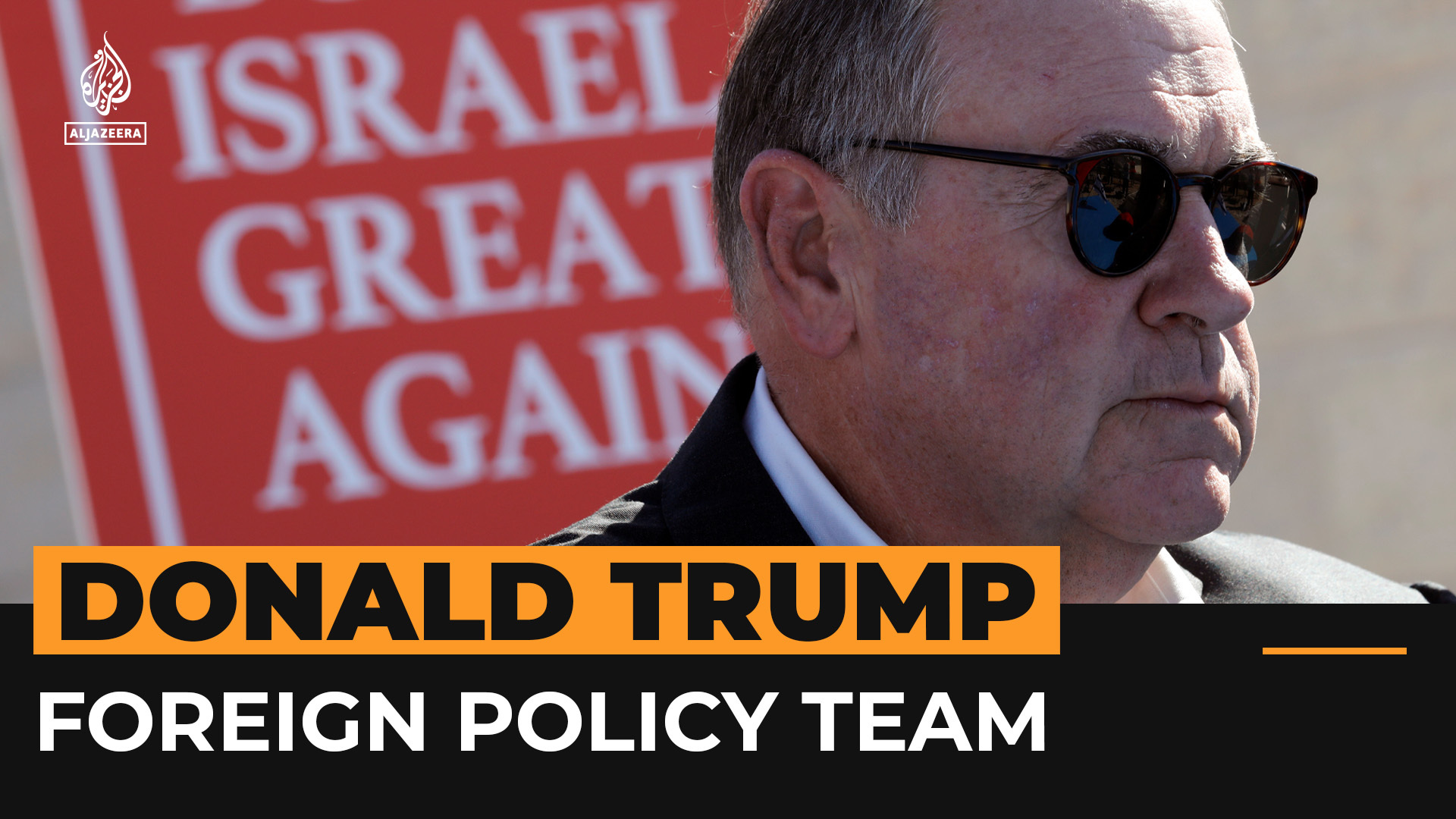
    What does Trump’s foreign policy team mean for the Middle East?

    What does Trump’s foreign policy team mean for the Middle East?

  • Next
    25:59
    Trump, Iran and geopolitical mind games

    Trump, Iran and geopolitical mind games

  • 02:02
    Near-blind Rohingya refugee found dead after border patrol release

    Near-blind Rohingya refugee found dead after border patrol release

  • 50:20
    Who runs Venezuela now? Trump, oil and the fight for power

    Who runs Venezuela now? Trump, oil and the fight for power

  • 00:51
    Trump says ‘friendly takeover of Cuba’ possible

    Trump says ‘friendly takeover of Cuba’ possible

How many American Christian Zionists are there?

According to author and academic Tristan Sturm, the largest population of Christian Zionists is in the US, and it numbers more than 30 million. Most are affiliated with evangelical churches in the southeast and south-central regions, often referred to as the “Bible Belt”.

The biggest organisation is Christians United for Israel, which itself boasts 10 million members, Nimer said.

“They are overwhelmingly conservative Republicans, found mostly in the Bible Belt, but also other places in the United States, and they form one of the most formidable voting blocs in the Republican Party,” he said.

Swift stated that only a few million from this group, however, are “fully signed up to the political, military and religious aspects of Christian Zionism”.

What impact do Christian Zionists have on US policy?

Nimer argued that Christian Zionists are “deeply intertwined” with American politics. “A lot of the major donors to the Republican Party and also the Democratic Party are Christian Zionists,” Nimer said.

According to the analyst, Christian Zionists are a cornerstone of Israeli lobbying groups, ranging from the American Israel Public Affairs Committee (AIPAC) to the Anti-Defamation League, “that work to spread the Israeli narrative” in American society.

Meanwhile, a lot of members of the US Congress are “openly” Christian Zionist, Nimer said.

“[Politicians like] Mike Huckabee, … they reached the highest echelons of the state. And they bring these beliefs into their politics, into their policies,” the analyst said.

US foreign policy on Israel is, therefore, heavily influenced and shaped around the underlying biblical premise that the Jewish people are divinely destined to be restored to Palestine, he argued.

“When it comes to Palestine and the region in general, as you see right now with the [potential] war in Iran, they’re saying that the ballistic missile programme is now on the table,” Nimer said.

“It has nothing to do with the nuclear deal, … but the idea is that Israel must be able to maintain its superiority over every country in the region, and that’s a decree by God because if Israel prospers, then that’s another step towards the end of the world.”

Christian Zionist groups have also backed Israel’s illegal settlement project in the occupied West Bank and other measures that they see as reinforcing Israeli Jewish sovereignty.

Furthermore, for two decades, organisations such as HaYovel have been bringing in hundreds of American Christian volunteers to work in Israeli settlement agricultural projects, especially during the genocidal war on Gaza, when Jewish Israelis were called for military duty. Many also strongly endorsed US President Donald Trump’s moving of the US embassy from Tel Aviv to Jerusalem in 2017.

Swift, however, said Christian Zionists have played only a minor role in shaping US support for Israel and their influence is waning.

He argued that while Christian Zionism is integrated with a “broader neoconservative foreign policy agenda” also tied to the “US defence industry and broader military-industrial complex”, the group does not have much influence in American politics, and, in fact, it is declining.

Traditionally, US government support for Israel was driven by Cold War considerations and by pressure from the Jewish community within the US and lobbying groups like AIPAC. What played less of a role was support for Israel from evangelical Christians and the smaller community of Christian Zionists, Swift said.

“The US president is finally de facto abandoning the previous theoretical support for a two-state solution – although not for Christian Zionist reasons. When Trump talks of ethnically cleansing Gaza and turning it into a beach resort, he uses the language of real estate, not the Old Testament,” the historian said.

How representative are Huckabee’s comments of what Christian Zionists believe?

According to the analysts, very representative.

“It is pretty representative: Christian Zionists derive their understanding of the proper borders of Israel from the same place as people like [Israeli National Security Minister] Itamar Ben-Gvir and [Israeli Finance Minister] Bezalel Smotrich: the Old Testament. Therefore, they think Israel should expand to include all of the territory of ‘biblical Israel’,” Swift said, referring to the far-right Israeli cabinet members who have worked to expand and protect Israeli settlements and outposts in the occupied West Bank, which are illegal under international law.

Nimer said Huckabee’s statement is also not something that can be criticised within the Christian Zionist community.

“You’re not allowed to criticise that because it’s like you’re criticising prophecy and you’re criticising God and the return of Jesus,” he said.

Huckabee’s comments, therefore, come as no surprise despite infringing upon the sovereignty of US allies in the Middle East, Nimer said.

On Monday, Smotrich said Israel would eventually occupy the Gaza Strip and establish a Jewish settlement there despite a “ceasefire” that went into effect in October.

“We are giving US President Donald Trump the opportunity to do it in his own way. If he does not succeed in eliminating Hamas, the Israeli army will get international legitimacy and American support to do it,” he said in statements to Israeli radio.

24:58
Why is Trump upending 80 years of US foreign policy?

How do Jewish Israelis view Christian Zionists?

Mimi Kirk, the director of the Institute for the Study of Christian Zionism and the associate director of Georgetown University’s Center for Contemporary Arab Studies, writes that “despite the matter of their supposed end-of-times demise according to this view, Jewish Israeli leaders have embraced the money and influence on US foreign policy that Christian Zionists offer,” especially as its adherents include top officials from the first Trump administration, including former Vice President Mike Pence and Secretary of State Mike Pompeo.

Nimer said it’s a rather “cynical relationship”, given that the Christian Zionist worldview, which sees all non-Christians going to hell, is “anti-Semitic to the bone”.

“But they support Israel, so it’s fine,” the policy analyst said.

“They care about what they can get out of them right now as the biggest support base in the West currently.”

Israel is further banking on this support because it is quickly losing its “progressive facade” of a “liberal democracy” with “all these progressive rights”, Nimer added.

“This has completely faded over the last few decades, and especially since the genocide in Gaza, this has become completely unacceptable.”

How do Christians in Palestine view Christian Zionists?

Palestinian Christians have long voiced concern that the Christian Zionist position threatens their existence, further entrenching Israel’s occupation while marginalising their community and undermining the historic churches of the Holy Land.

Just last month, the Patriarchs and Heads of the Churches in Jerusalem said activities by local individuals advancing “damaging ideologies, such as Christian Zionism” “mislead the public, sow confusion, and harm the unity of our flock”.

The Christian leaders warned that these efforts could undermine the Christian presence not only in the Holy Land but across the wider Middle East.

The statement came amid growing concern among Palestinian Christians that Israel’s policies – including land confiscation, settlement expansion and pressure on church property – are accelerating the erosion of one of the world’s oldest Christian communities.

Are there critiques of Christian Zionism among other Christians?

Criticism of Christian Zionists from within Christianity is abundant.

In the US, the Institute for the Study of Christian Zionism was created to critique and combat the movement through liberation theology, seeking justice for Palestinians and a resolution to the ongoing conflict.

Swift pointed out that many of the world’s most Catholic countries, from Ireland to those in South America and Southern Europe, “tend to be quite pro-Palestinian”.

Meanwhile, Palestinian Christian scholars “have written very detailed theological critiques of Christian Zionism”, Nimer said, as have pastors from other parts of the Global South.

A prize awarded by the Nelson Mandela Foundation last year was explicitly aimed at initiatives working against Christian Zionism, and a conference next month in Turkiye is being organised to combat the ideology, Nimer said.

“The world is waking up to how insidious this ideology is and how it creeps into societies and makes it impossible to have any kind of solidarity with Palestinians as long as they believe it,” he said.

CAIR Calls House Democrats’ Appointment of Israel’s ‘Most Committed Enablers’ to Foreign Affairs Committee an Insult to Voters and Desperate Attempt to Shield Israel from Accountability

The Council on American-Islamic Relations (CAIR), the nation’s largest Muslim civil rights and advocacy organization, today expressed deep c...