Saturday, September 19, 2026

What is terrorism?

 Left-wing streamer Hasan Piker set off a political firestorm after telling Axios this week that the United States has killed more people than al-Qaeda “pound for pound.”

The comment came during the September 17 episode of The Axios Show. Correspondent Alex Thompson asked Piker point-blank: “You once said that America is the top dog in terrorism. Do you think America then is worse than al Qaeda?”

“Pound for pound as far as the number of deaths, yes,” Piker answered. “We have caused tremendous terror all around the world.” He pointed to the February 2026 strike on a girls’ school in Minab, Iran, which Iranian authorities say killed more than 140 students.

“If you’re killing 140 schoolgirls, that is an act of terror,” he said, adding that he did not “mean that all Americans are terrorists.”

By the next morning, the clip was everywhere, and the remark set off immediate backlash from both parties. The Republican Party’s official account demanded that “every single Democrat” disavow him. New Jersey Representative Josh Gottheimer, a Democrat, wrote that “comparing America to al-Qaeda wasn’t an accident. Piker has built a brand on anti-American hate.”

While Michigan Senate candidate Mike Rogers, a Republican, tried to tie the remark to Democratic candidate Abdul El-Sayed, closely tied with Piker, Piker responded that he did not “agree with this statement” and gave “much weight to the statements made by a social media streamer.”

Piker, who faced similar criticism after saying on Twitch in 2019 that “America deserved 9/11,” a remark he later called imprecise and walked back, later wrote on X that Axios had turned “a nuanced answer about acts of terror this admin has caused” into “clickbait.”

Hasan Piker attends the 2026 Vanity Fair Oscar Party Hosted By Mark Guiducci at Los Angeles County Museum of Art on March 15, 202


A Term That Gained New Weight After 9/11

The word “terrorism” existed in law and scholarship long before September 11, 2001, but the attacks reshaped how central it became to American politics, policy and everyday language.

Nine days after the towers fell, President George W. Bush stood before Congress and declared a “war on terror,” a phrase that would define two decades of U.S. foreign policy, two invasions and a sprawling expansion of federal counterterrorism law and agencies. The word itself, already unsettled in legal and academic circles, took on new political stakes it has never fully shed.

Newsweek asked three of the country’s leading authorities on terrorism and the laws of war to explain how their fields actually define the term, and where the legal and academic lines fall.

“There is no universally accepted definition of terrorism,” Geoffrey Corn, a professor at Texas Tech University School of Law and director of its Center for Military Law and Policy, told Newsweek. Corn spent 21 years as a U.S. Army officer, finishing his military career as the Army’s senior law of war advisor. “Who gets to decide? Usually the government condemning it.”

A rough consensus does exist, Corn said. Terrorism generally involves “the use of unlawful violence, usually intentionally targeting people or things, to influence the policies and actions of governments or to simply spread terror.”

Bruce Hoffman, a Georgetown University professor and author of Inside Terrorism, a book that has stayed in print for nearly 30 years, defines it somewhat differently: “the deliberate creation and exploitation of fear through violence or the threat of violence by non-state actors in the pursuit of political change.”

“That is more or less the normative definition among scholars,” Hoffman said. “The legal definition is not terribly different, but there is no universal consensus or a single agreed upon definition of terrorism.”

Mary Ellen O’Connell, the Robert and Marion Short Professor of Law at the University of Notre Dame, starts from a different premise than Corn or Hoffman. International law, she argues, not any single country’s domestic statute, is the framework that settles these questions for everyone.

“It is the only authoritative source of rights, duties, and definitions for all. Within international law we have had a consensus definition of terrorism since the 1930s. It is not considered technically binding because so many different states tend to support one national liberation organization or another,” she said.

The Numbers Behind the Claim

Brown University’s Costs of War Project found that more than 940,000 people were killed by direct violence in post-9/11 wars across Iraq, Afghanistan, Syria, Yemen and Pakistan, including more than 432,000 civilians. Add indirect deaths from disease, displacement and the collapse of health systems, and the project’s total climbs past 4.5 million.

Al-Qaeda’s confirmed toll is smaller by orders of magnitude. The September 11 attacks killed 2,977 people. Its other major operations, the 1998 East Africa embassy bombings, the USS Cole and the 2004 Madrid train bombings, add a few hundred more.

But the Costs of War Project has repeatedly cautioned against reading its own numbers as a body count attributable to the United States specifically. Project director Stephanie Savell has said the research “does not ascribe blame to a country” because multiple armed parties fought in every one of these wars.

A 2011 peer-reviewed study in PLOS Medicine, built on the Iraq Body Count database, found that coalition forces were directly responsible for about 12 percent of more than 92,000 documented Iraqi civilian deaths between 2003 and 2008. Sectarian violence and unidentified perpetrators caused 74 percent. Al-Qaeda in Iraq and other insurgent groups caused roughly 11 percent.

London-based monitoring group Airwars puts U.S. airstrike deaths at a minimum of 22,000 civilians across six countries since 2001, with some estimates running as high as 48,000. The United Nations mission in Afghanistan found that in most years, the Taliban and other anti-government forces killed the clear majority of civilians there, though American airstrikes closed that gap in 2019.

Al-Qaeda’s own toll grows considerably once its offshoots are counted. A database maintained by the French think tank Fondapol attributes roughly 14,900 deaths to al-Qaeda directly and nearly 70,000 more to the Islamic State, which grew out of al-Qaeda’s Iraq branch. About 90 percent of Islamist terrorism’s victims have died in Muslim-majority countries, and most of them were Muslim themselves.

Intent, Not Body Count

Corn walked through the legal mechanics dividing the two categories of violence. International humanitarian law bars intentionally attacking anyone who doesn’t qualify as a lawful military target, and civilians fall into that protected category unless they take a direct part in hostilities.

“The law does not prohibit inflicting civilian casualties as long as they were not the intentional target, and killed or injured incidentally to an attack on a proximate lawful target, unless the civilian risk was assessed as excessive in comparison to the anticipated military advantage of attacking the target,” he said. “This is called the proportionality rule, but the test of legality is excessive imbalance.”

He added a caveat about a live example: the ongoing U.S. campaign of lethal strikes on alleged drug-trafficking vessels, which he said he would treat separately from that framework. “U.S. forces don’t intentionally target civilians or other protected persons or things,” he said of the broader military. “And when there is an outlier who does, he or she faces criminal consequences.”

Hoffman frames the divide through who is doing the killing. “Terrorism is mostly seen as a criminal act. Wars not necessarily so,” he said. “International law does allow countries to use violence in self-defense, but it is supposed to be proportional, and civilians should not be deliberately targeted. If they are, it is a war crime, not terrorism.”

He draws a further line that terrorism scholars have long debated among themselves. “The distinction that many terrorism scholars draw is between terrorism, violence by non-state actors, and state terror, violence committed by states designed to terrorize a population of its own citizens or foreigners and that is perpetrated by state agents or proxies on behalf of that state,” Hoffman said.

Why “State Terrorism” Never Made It Into Law

Piker’s comparison touches, whether he intended it or not, on a concept scholars call state terrorism. The term carries rhetorical force, but it carries almost no legal one.

The United Nations has tried and failed for more than two decades to pass a Comprehensive Convention on International Terrorism, largely because member states can’t agree on whether a state’s own armed forces should ever fall under the term. Corn said the standstill reflects a hard truth.

“States cannot agree on a consensus general definition for international law purposes,” he said. The term can carry weight in narrower domestic contexts, he added, “for example by triggering sanctions or criminal liabilities,” but beyond that, “it is primarily a symbolic term.”

Hoffman agreed the label rarely produces legal consequences for state actors. “It is rhetorical,” he said, “since states or the leaders are rarely charged with terrorist offenses but with crimes against humanity or genocide for wantonly and deliberately targeting civilians.”

O’Connell rejects the idea that this gap is only political. “Regardless of this political stumbling block, there is plenty of solid law that makes the violence involved in terrorism always unlawful, whether by a state or non-state actor and whether perpetrated during armed conflict hostilities or in peace,” she said.

Applied to recent events, her framework leads somewhere Corn and Hoffman do not go. “Every person killed in the Iran War has been killed unlawfully,” she said, referring to recent U.S. strikes inside Iran, including the one on the school in Minab that Piker cited. “Some of those deaths were also war crimes.”

The Accountability Record

Separate from the legal definitions, a documented record exists on how the United States has handled its own civilian casualty cases. The Pentagon’s own internal files, obtained by The New York Times in 2021 and 2022, showed more than 1,300 civilian casualty allegations with few substantiated findings and rare disciplinary action.

In the 2021 Kabul drone strike that killed aid worker Zemari Ahmadi and seven children, an Air Force investigation concluded it was an honest mistake with no violation of the law of war. No one was disciplined. In the 2015 U.S. strike on a Doctors Without Borders hospital in Kunduz, Afghanistan, that killed 42 people, sixteen personnel received administrative punishments and none faced criminal charges.

The 2007 Nisour Square shooting by Blackwater contractors in Baghdad, which killed 14 to 17 Iraqi civilians, produced convictions that President Trump later pardoned in 2020, a move United Nations experts called “an affront to justice.”

By comparison, no accountability mechanism exists for al-Qaeda’s leadership beyond military and intelligence operations aimed at killing or capturing them, since the group operates outside any state or legal system that could prosecute its members through conventional courts.

Corn and Hoffman both describe Piker’s numerical comparison as resting on a mistaken equivalence, between incidental civilian deaths under a body of law built around intent, and deliberate civilian killing that defines terrorism by most accepted measures. O’Connell draws her line elsewhere, not at whether a death was intentional, but at whether the use of force behind it was lawful to begin with.

Newsweek’s reporters and editors used Martyn, our AI assistant, to produce this story. Learn more about Martyn here

The Palestinian-American residents of this West Bank town are wondering: Where is Trump?


The West Bank town of Turmus Ayya has been plagued by settler violence since 2020. More than 80 percent of residents are Americans who feel abandoned – despite Ambassador Mike Huckabee's recent visit

September 18th, 17PM September 18th, 20PM

Samir Juma'a Hazmeh's four-story house in Turmus Ayya overlooks the fields that surround the town. From his balcony, we can see some of the town's 18,000 dunams of land (roughly 4,500 acres). The land is lush, perfect for growing olives, figs and citrus. The August heat ripens the olives, just before harvest season.

Hazmeh's house is opulent, like many in this West Bank town filled with villas only a 25-minute drive north of Ramallah, where American flags fly from the roofs of many houses.

A car approaches the house. A man gets out and walks into the inner courtyard. It's Hazmeh's neighbor; he's flying to Texas tomorrow, and if settlers break in while he's gone, the neighbor says, someone needs to get inside.


Most of the houses in Turmus Ayya are multi-story villas, many of which fly the American flag. Credit: Itay Cohen

"Under American law, the U.S. Embassy and government must protect their citizens wherever they are in the world," says Hamzeh. "Sometimes I think: Where are you, Trump? Look at how an American passport is treated here." A few days before Haaretz visited Turmus Ayya, U.S. Ambassador to Israel Mike Huckabee came to hear them out.

Hazmeh, a retiree who splits his time between the U.S. and the West Bank, hosted Huckabee at his house. From his balcony, Huckabee surveyed the land and Emek Shiloh Farm, the illegal outpost on the edge of the olive grove, which residents say is responsible for the constant attacks on the village. The outpost, known alternatively as HaNekuda BaEmek in Hebrew, was founded by Amishav Melet in 2024 on land classified as Area B by the Oslo Accords.

The edge of the territory taken by the outpost lies only 300 meters from the town. Melet – whose brother, Benayahu Melet, was shot dead in July during a clash in Tell – is said to be the ringleader of settler attacks and land grabs. During Huckabee's visit, he drove an ATV past the house, even though it was Shabbat and the outposts claim to be religiously observant.

The U.S. ambassador took out his camera and recorded a video, saying he would show it to President Donald Trump directly.

Speaking to residents afterward, Huckabee didn't mince words. He said the acts of settlers who have seized homes, attacked residents, burned cars and torched a mosque go beyond criminal acts. "It's an act of terror," said Huckabee.

Yet he stopped short of calling for action. He said he blamed the terrorism on a "minority," and said the U.S. Embassy cannot investigate or prosecute; it can only express its concerns to the Israeli government, and press for proper investigations and prosecutions.

As we survey the area, Melet appears with his flock: like a specter, walking through the grove, slowly closing in on the house, kicking up dirt and throwing pebbles at the unruly goats.

Awad Abu Samra, a municipal council member who documents settler attacks, films his every step. The footage is shared to a WhatsApp group. As a councilmember, he is in constant contact with the U.S. Embassy and with the Palestinian authorities in Nablus and Ramallah that liaise with Israel, sending videos of attacks, which have become commonplace.

"The provocations are almost daily: arson, theft and looting. Homes have been looted in the eastern part of the town and in its northern area," Abu Samra says.

The U.S. Embassy in Jerusalem and the IDF Spokesperson's Unit did not respond to requests for comment by publication.

What it means to be American in Palestine

For residents who split their time between the United States and the West Bank, their American passport is only worth something until they land in Tel Aviv.

"If you carry a hawiyya [Palestinian ID card], even if you carry an American passport, or German, or French, or any kind of passport, it means you are a Palestinian," says Wadi Alqam Abu Awad, also a dual citizen. "They don't recognize the other citizenship you carry. They say, as long as you carry the hawiyya, you are Palestinian."

Since the U.S. doesn't recognize Palestine, the U.S. passport is all they have, Abu Awad adds. "If you, the United States, do not recognize Palestinian passports, then what are we? We're only U.S. citizens – the country meant to help us.

"We're not Palestinians anymore, because you don't recognize a Palestinian state. We don't have Israeli passports. The only passport we have that the U.S. acknowledges is the American one. So help us."

Hassan Shukri, a neurologist based in Syracuse, New York, was born in Turmus Ayya and has lived in New York since 1991. He was napping at home during a visit last summer when a knock at the door woke him. His wife answered. It was Israeli soldiers.

"I said, What's going on? They said, 'We need to take the house,'" Shukri says in a phone call from his practice in New York.

Shukri says they gave them one hour to pack up and leave. They refused to say why and for how long. Shukri went to his brother's house on the other side of town.

Only after media reports and pressure from Washington, which Shukri said he wasn't aware of at the time, did the soldiers leave after a few hours.

He said this isn't the first time the military has entered his house. "Last year, I wasn't there, but I had a camera outside my house. I saw someone force the main entrance, and three jeeps with 10 to 15 soldiers entered. They forced into the main door."

Shukri says he was never given reasons for the military entering his house. He says it's a jarring feeling: In the United States, he has close relationships with Jews and Israelis, including many patients, and yet here, he is treated as expendable.

"I'm lucky to be an American citizen. What about people who don't have American citizenship?"

Abu Awad was born in Turmus Ayya when it was under Jordanian control. He immigrated to the United States as a young man, became a civil engineer, and settled in Little Rock, Arkansas. He began dividing his time between Little Rock and Turmus Ayya.

In August 2025, settlers broke into his farmhouse, set it on fire and graffitied the Hebrew words "Revenge" and "Price Tag" on its walls

Despite the attack, he kept on going. That changed when they broke in again four months ago. They cut the lock on the main gate, put their own lock on it, and stole the generator. "The generator was on top of the building. I don't know how they carried it down. And they stole everything in my farmhouse. They stole the seats, the tables, everything."

Abu Awad contacted Israeli police and the military, who told him to report a complaint at the police station in Sha'ar Binyamin, the closest settler municipality.

"I told [the officer]: Everybody knows who is doing this, who is attacking the farmers, who burns cars, who burns houses. They do nothing to him."

"If a guy or a child throws a stone at an army vehicle, they will turn up the whole village until they get him. But the settlers burned around 15 to 18 farmhouses, and they're cutting thousands of olive trees, and since the 7th of October, they've taken [most of] the land in this village. No one is doing anything."

While escalating Israeli settler violence is often connected to the aftermath of October 7, Yasser Alqam, the town's spokesperson, points to a pogrom in summer 2023 that proves otherwise.

On June 21, 2023, around 250 armed settlers descended into Turmus Ayya and began attacking homes with women and children inside, and setting fires. During the rampage, security forces clashed with local residents. Omar Ketin, a 27-year-old electrician and father of two, was killed by a police officer.

The Israeli human rights group B'Tselem recorded 60 settler attacks in Turmus Ayya between January 2020 and October 2022. From the data, the violence appears to have peaked in 2022 at 18 incidents in a single year, ranging from vandalized vineyards and torched cars to a mob attack on an olive harvest; more than 715 olive trees were cut down, according to the B'Tselem tally.

Abu Awad says the situation has only worsened since October 7. "We have no rights. We can't live peacefully in our houses. Settlers with an ATV, a four-wheel drive, come over to two or three villages and threaten everybody, and nobody can do anything to him."

During Huckabee's visit, Alqam handed him a 13-page file documenting every attack in recent years. "We're Americans. We're like you. In fact, we are paying [Huckabee's] salary," he says. "I thought we got him, or he got the message on that day. But after a while, you listen to his statements again, and nothing changes."

One of the 10 houses in Turmus Ayya that was set on fire by Israeli settlers on June 21, 2023. Thirty houses were atta... Credit: Moti Milrod

Alqam gives Huckabee a bit of credit – "We have taken the first step in the right direction, which is our ambassador starting to call these people terrorists" – but the spokesperson rejects Huckabee's description of settler terrorism as coming from a small minority.

"We're talking about thousands and thousands of these terrorists who were terrorizing locals even before October 7th. You have groups all over the West Bank. They're not 150 outlaws like [Israeli Prime Minister Benjamin] Netanyahu claims. There are thousands of them," says Alqam.

Alqam was born in Turmus Ayya and immigrated to the United States in 1987 when he was 17. He went to law school, opened a firm and lived in Anaheim, California, for 35 years. "I lived in the United States longer than I lived here," he says.


Alqam points to a half-constructed building with an Israeli flag on top. He says the owner, an American citizen, began construction but stopped midway due to the never-ending violence. "That's a sign that says this belongs to the settlers now. Do not come close to it. They've taken it over. They seized it," says Alqam.

He then points to a section in the barren grove, flanked by a concrete wall. "That's my personal land. I cannot access it."

"If you try to reach your land, something is going to happen to you. Your car is going to be broken. You're going to be physically beaten. You're going to be shot. Or the army is going to show up and tell you, 'get out of here, this is a closed military zone.' They started using that term, closed military zone, to kick Palestinians out of these areas."

Huckabee's words ring hollow in the face of selective enforcement and collective punishment. "Huckabee said that you reward good behavior and punish bad behavior," Alqam says. "I told him: Your administration did the exact opposite, because the first thing Trump did was remove the sanctions against settlers Biden had put in place."

A few days after Huckabee's visit, any hope for a change on the ground via American diplomatic pressure was already looking moot.

He attacked the U.K.'s decision to ban trade with the settlement, accusing its government of "Jew hate," pushed the Israeli right's narrative of an "imbalance of reporting regarding violence in Judea and Samaria," and made a visit to "Ancient Shiloh."

Meanwhile, a few days after Huckabee called the settlers in the outposts "terrorists," his pro-annexation predecessor, former U.S. ambassador to Israel David Friedman, took a friendly selfie with the man Huckabee called a terrorist only a few days before.

"Amishav is a vegan, a pacifist and a farmer. He wants nothing more than to work the land promised to the Jewish people by God," Friedman wrote on X.

We met Mayor Nawwaf Zaghloul, in his office. In the waiting room, there are photos of Yasser Arafat, maps of the land, and, oddly, a TV looping footage from a dashcam driving through suburban Sarasota, Florida. In Turmus Ayya, America is never too far.

Zaghloul, an American citizen, has been mayor for four months; before that, he exported Palestinian olives and olive oil to the United States. As a boy, he plowed the land. In 1978, when he was 14, a caravan with settlers came to Shiloh. They said they would stay for a week. Since then, the settlement has expanded, seizing land.

Now, hilltop youth and outposts are shutting them out of the land they still own. "We used to reach our lands with permits and coordination," granted by Israel, he says. "Now it's simply closed."

The closure has hit Turmus Ayya hard. For decades, residents working in the United States have sent money home. Instead of putting it into the bank, residents bought land. Its value rose.

Now, much of that land is out of reach, causing great financial loss to residents. They are also barred from accessing land they bought in neighboring villages.

"We are not even asking Huckabee to remove the settlement," the mayor says, referring to nearby Shiloh, a religious Israeli settlement of 6,000 that was established on lands expropriated by Israel in the 1970s from Turmus Ayya and nearby Qaryut. "We are asking them to stop attacking us and allow us to exercise our rights on the land we own."

"I am an American citizen. My sons and daughters are American citizens. Much of our life is there, but one's homeland remains precious. No matter where a person lives or is raised, the homeland remains above all."

Even for those who left Turmus Ayya and have not returned, being American is always conditional.

Nasser Jaber, 42, grew up in Turmus Ayya. Like many others in his generation, he does not plan to move back permanently any time soon. "I would be afraid to go back to my hometown, to my home, because I'm afraid that a settler who recently made aliyah from Brooklyn could go and kill a kid."

Jaber says he had an "American upbringing," and studied an American curriculum at the Quaker high school in Ramallah, as the promise of Oslo fizzled out.

Jaber left for the U.S. in 2001, just before 9/11, as the second intifada was raging. Coming to the United States, he saw a shift in the way Arabs and Palestinians navigated the new political landscape.

"Before 9/11, a lot of them were Republican. Then of course, that completely switched, and they were always trying to find a political outlet for representation."

Jaber began working in disaster relief and worked with the State Department. He is a former founder of the nonprofit The Migrant Kitchen and has been involved in what he calls "gastro-diplomacy," like fellow chef and World Central Kitchen founder José Andrés.

"I was proud to represent the United States in many different places, using food as a tool to bridge cultures, to solve problems," he says.

Things have changed since October 7 and Trump's second term, and he says his American nationality is secondary to him being Palestinian. When returning to the U.S. from Amman in April via John F. Kennedy International Airport, Jaber was stopped by U.S. Customs and Border Protection for 45 minutes.

The conversation was about Israel.

"It got to a point where I, an American national, asked them, I'm sorry, are you a service officer of the United States, or are you a service officer of Israel? Why are you asking me about the war? Why are you asking me about social media about Israel? Because there's a narrative being pushed by the administration, particularly by people like Stephen Miller, which says that if you're not loyal to Israel, you're not loyal to America."

'We have nothing to lose'

While U.S. citizens in Turmus Ayya are frustrated with the Trump administration, residents say they're encouraged by the shift in U.S. public opinion.

"We're paying very close attention to the elections, to the Congress people, who's being elected, who's being supported by whom," says Alqam.

Alqam says he isn't afraid to push the American government. "We have nothing to lose. Either sit in your house and wait for a terrorist settler to come and burn your house and burn you alive, or do something about it."

He points to the vineyards. "These are planted on Palestinian stolen land. You know what the grapes are used for? Shiloh Winery."

"It's time to start sanctioning the products from the settlements. Because guess what? If it's sheep, milk, cheese or grapes, where is it coming from? Palestinian stolen land."

Shukri says that with the discourse polarizing the U.S. around Israel and Palestine, he's afraid for his children and grandchildren. He confesses to voting for Trump in 2016 and has questioned his choice.

"It feels that we've veered off course, and I worry about this country's future with rising racism, anti-Islam, and anti-Jewish sentiments. Just look at social media, I'm nearly 70, and honestly, it doesn't impact me much personally, but I am genuinely worried about the younger generations."

Shukri and Hamzeh say they will vote in the U.S. midterms; Alqam plans to cast his midterm ballot online from Turmus Ayya.

Alqam says Palestinians in America are mobilized in a way they weren't before. "Groups of activists are going house to house, to Palestinian houses, registering them to vote and asking them to vote. There's a movement out there."

"My vote matters. That's what every Palestinian should start saying: My vote matters. Even if it's one vote, it matters."

More than 80 percent of its roughly 3,000 year-round residents, like Hazmeh, are American citizens; the population can swell to 12,000 in the summer, when expats return for months-long visits. Those citizens have been asking the U.S. Embassy, the State Department and the Trump administration to intervene and de-escalate the record-setting state-backed settler violence that continues to accelerate across the West Bank.


When multiple Americans died, Israel called it a mistake

Israel's Mossad built its fearsome reputation through operations ranging from the capture of Nazi war criminal Adolf Eichmann to the global campaign that followed the 1972 Munich massacre and the intelligence behind the Entebbe rescue. But this video focuses on a darker question: what happens when one of America's closest allies turns its intelligence apparatus toward the United States? It examines the 1967 USS Liberty attack that left 34 Americans dead and 171 wounded, the Jonathan Pollard espionage case, and unresolved suspicions surrounding missing highly enriched uranium from a Pennsylvania facility. Through these cases and testimony from a former CIA officer, the video asks whether Washington has repeatedly allowed its strategic relationship with Israel to override accountability .

Click the video link: When multiple Americans died, Israel called it a mistake | Watch

A hijab clad Virginia woman was told she has 'no right to be in this country' in a diner

 A Virginia woman who posts on TikTok as @politicallypali, also called Pali, said she was waiting to be seated for lunch at a diner when another customer spoke to her after seeing her hijab. According to The Nerd Stash, Pali said the woman looked her in the eye and told her to “go home.”

Pali said she recorded the exchange. She stated that when she confronted the woman on camera, the woman acted as if she did not know what Pali was talking about and tried to shame her for recording. Pali said she asked, “Why did you feel like you had to tell me to go home?” She said the woman’s husband then moved his wife toward the exit.

In her video caption, Pali said her hijab “does not make me a stranger” and that she will never feel “ashamed” for who she is. She also thanked the diner for “not putting up with it.” The TikTok video is no longer available.

The dispute moved from the diner floor to the parking lot

In the video, Pali said she was not willing to drop the matter. She called the woman a “racist piece of [expletive].” She said the husband kept walking his wife out and closed the door on her. Pali said the two sides kept arguing outside the diner. She stated that the woman then said, “You have no right to be in this country. Because you’re an American hater.”

She said the husband got in her face and yelled for her to “GO!” and leave them alone. She said he kept pulling his wife toward their vehicle. Such public confrontations over identity have occurred elsewhere, as a Pennsylvania woman was told on a bus to go back to Haiti. 

Pali said the woman kept talking anyway and told her she was “proud” of how she felt toward Pali and others who share her background. Pali said she kept calling the woman “racist” until the woman was in the vehicle with the door closed. 

Viewers who commented on the post expressed support for Pali and criticized the other customer. One commenter wrote that the couple should lose their jobs if they work, saying, “Him and her need to be fired from their jobs if they even work he think the same way she do.” Other commenters joked that the pair probably do not work because of how “old and decrepit” they looked. Some framed the incident in political terms. 

One commenter wrote, “Racists should NEVER feel comfortable EVER!!” Public confrontations over perceived slights have occurred elsewhere, such as when a Virginia woman confronted a Food Lion manager over a racial slur. 

More U.S. troops have died amid Iran war than Pentagon has disclosed publicly

 More U.S. troops have died amid Iran war than Pentagon has disclosed publicly - The Washington Post


More American service members have died in the Middle East during the ongoing Iran war than the Pentagon has disclosed publicly, according to six U.S. officials familiar with the Defense Department’s internal casualty accounting data.

Five of the officials said there have been at least 22 military fatalities — four more than what appears in the Pentagon’s public database, known as the Defense Casualty Analysis System, or DCAS.

A sixth official, who like the others spoke on the condition of anonymity to discuss the figures, said 23 service members have died since Feb. 28, when the Trump administration, in concert with Israel, initiated the Iran war. Not all of the undisclosed deaths are directly tied to the conflict but have involved U.S. personnel who were in the Middle East amid ongoing hostilities, this person said.

Additionally, the official said, three U.S. contractors who were based in the region have died since combat operations began.

As of Friday, the Pentagon’s DCAS database lists 18 U.S. military fatalities, including deaths caused by hostile and nonhostile action dating to the start of the Iran conflict.

Details surrounding the undisclosed deaths — including the service members’ identities, as well as when, how and where they died — remain unclear. Officials familiar with the higher casualty number expressed frustration that the additional loss of life is not reflected in the Pentagon’s public casualty portal.

The Pentagon declined to address questions about the accounting discrepancy.

The Iran war, which polls show is deeply unpopular with the American public, has become a political liability for President Donald Trump and the Republican Party ahead of November’s midterm elections. The administration’s casualty accounting practices faced intense scrutiny earlier this year when the names of four U.S. troops who died as a result of the Iran war were briefly excluded from the Pentagon’s official tally.

The proper accounting of military fatalities has implications beyond public transparency. Whenever a U.S. service member dies, the military conducts a line of duty investigation to determine whether the death occurred while performing official duties. Those findings affect the survivor benefits for which service members’ families are eligible.

As of Friday, 14 fatalities are listed in the database as having occurred during Operation Epic Fury, the Trump administration’s name for the Iran war. Four others, reflected in a separate category called Overseas Operations, date to a July ceasefire between Washington and Tehran that later collapsed leading to the resumption of attacks.

Separately, the Pentagon has said that, since February, two U.S. service members died in the Middle East while participating in missions unrelated to the Iran war. Their deaths, which occurred at bases that have been attacked by Iranian forces, are not reflected by name in the DCAS database either.

Sgt. Devin Seibel died in Irbil, Iraq, on May 31 in a training accident, the Defense Department said in a news release. The announcement specified he was assigned to Operation Inherent Resolve, the ongoing campaign against Islamic State militants. Seibel’s name is not included among the Inherent Resolve tally in DCAS.

Maj. Sorffly Davius suffered an unspecified medical emergency in Kuwait and died on March 6. It is unclear whether his death was tied to an Iranian attack. An announcement of Davius’s death said he deployed under Operation Spartan Shield, a mission to partner with regional militaries.

More than 820 U.S. service members have been wounded in action since the Iran conflict began, the public casualty database says. Many have suffered traumatic brain injuries as a result of Iranian counterstrikes on U.S. bases throughout the Middle East. 

Defense Secretary Pete Hegseth, left, and Joint Chiefs Chairman Gen. Dan Caine at a ceremony at the Pentagon on Friday. (Andrew Harnik/Getty Images)

The war has taxed the military’s stocks of precision weapons, damaged U.S. bases across the Persian Gulf and roiled global energy markets after Tehran closed the Strait of Hormuz, a vital waterway for oil and fertilizer.

According to a document reviewed by The Washington Post, U.S. Central Command, which oversees operations in the Middle East, has estimated that the Iran war has cost about $43.6 billion through early September. The total includes $28 billion in munitions expended during the conflict but does not account for the damage to U.S. bases.

As The Post reported last month, several top U.S. military officials have warned Defense Secretary Pete Hegseth that prolonging large-scale operations against Iran is unsustainable and risks weakening their ability to confront threats elsewhere, including the U.S. homeland.

According to a September Reuters-Ipsos poll, 28 percent of Americans support Trump’s approach to Iran, whereas 62 percent disapprove.
On Tuesday, a record seven GOP lawmakers joined Democrats and helped pass a largely symbolic measure intended to halt the war — the latest of several war powers resolutions to advance in Congress.

All war deaths and injuries are supposed to be publicly reported on the Pentagon’s public DCAS system, where the military accounts for personnel lost or injured in its conflicts.

Over the summer, when the four combat deaths were temporarily excluded from the casualty database, the Trump administration reclassified renewed hostilities with Iran as Overseas Operations instead of being tied to Operation Epic Fury.

The change, which occurred as U.S. negotiators struggled to broker a permanent peace deal with Tehran, coincided with efforts by the administration to portray the war as a success even as Iran continued to fire on American forces and continued to target shipping in the Strait of Hormuz.

Senate Democrats have pledged to investigate the Pentagon’s handling of casualty notifications if they retake the majority after the midterms.

Reps. Pat Ryan (New York), Jason Crow (Colorado) and 10 other House Democrats, all of them military veterans, on Friday said they were pursuing legislation that would prevent the Pentagon from manipulating government data on troop casualties.

One Republican, Rep. Thomas Massie (Kentucky), moved this week to force a House vote on impeaching Hegseth over the war, alleging the defense secretary violated provisions of the War Powers Resolution of 1973 by pursuing hostilities without congressional authorization.

Israeli attacks kill four Palestinians including son of Gaza’s health chief

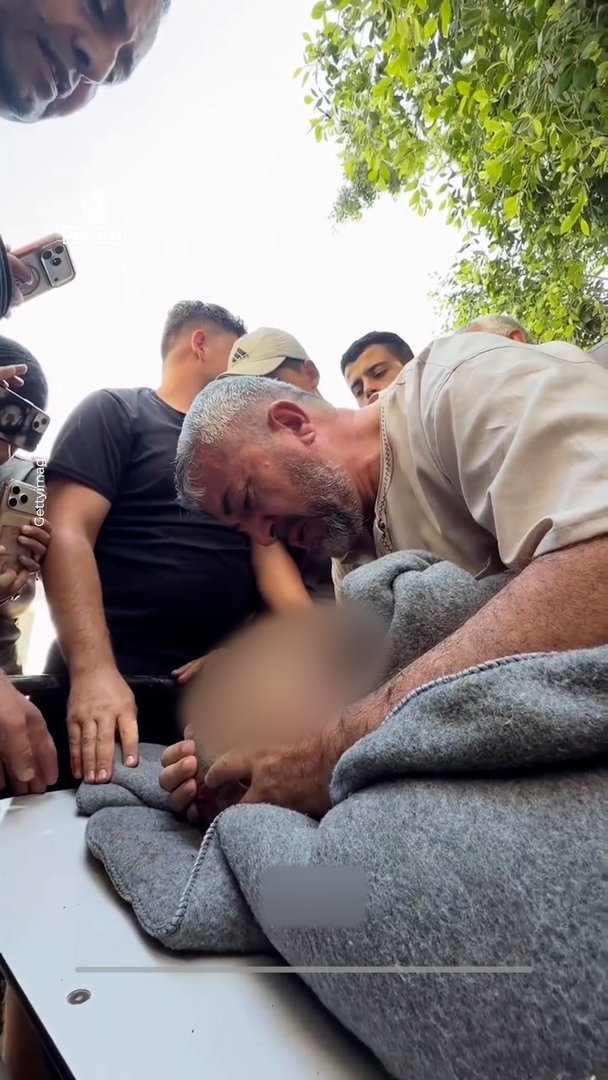
  At least four Palestinians, including a child and the son of Gaza’s health chief, have been killed in a wave of Israeli attacks across the...