Experts say unease over military representatives appearing for
country should not detract from goal of achieving justice for Rohingya.
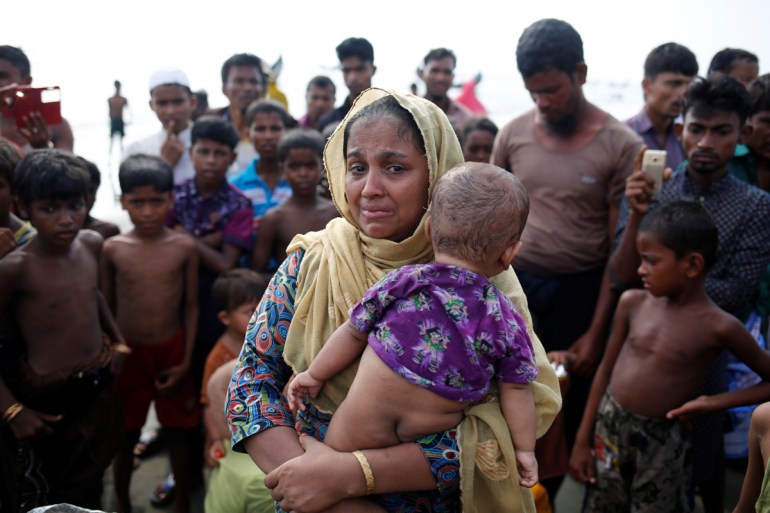
A Rohingya woman cries
after safely crossing the border to safety in Bangladesh [File: Mohammad Ponir
Hossain/Reuters]
By
21
Feb 2022
The International Court of Justice (ICJ) begins hearings
on Monday over Myanmar’s preliminary objections to a genocide case brought over
the military’s brutal 2017 crackdown on the mostly Muslim Rohingya. The
proceedings have been given added urgency and complicated by the coup that took
place in Myanmar a little more than a year ago.
The case was filed by The Gambia, a small West African
country, with the backing of the Organisation for Islamic Cooperation (OIC)
after more than 700,000 Rohingya fled into
neighbouring Bangladesh amid reports the Myanmar military burned entire
villages and carried out “large-scale” killings, gang rape and other abuses.
KEEP READING
.Bangladesh arrests brother of Rohingya armed group leader
.Bangladesh Rohingya refugee camp fire leaves thousands
homeless
.Myanmar’s military coup prolongs misery for Rohingya in
Rakhine
.Rohingya refugees brought ashore after dramatic Indonesia
rescue
A United Nations investigation found the crackdown had
been carried out with “genocidal intent” and
recommended Commander in Chief Min Aung Hlaing, and five generals be
prosecuted.
Then civilian leader Aung San Suu Kyi travelled to The
Hague to lead Myanmar’s defence in December 2019, but after removing her from
office in a coup in February last year, Myanmar’s military leaders said their
representatives would argue the preliminary objections in
court.
The National Unity Government (NUG), which includes
elected legislators who were removed by the military, announced last week that
it was withdrawing the objections and wanted the ICJ to proceed to the merits
of the case.
It has said UN Ambassador Kyaw Moe Tun, who was
appointed by Aung San Suu Kyi’s government and remains in office, is “the only
person authorised to engage with the Court on behalf of Myanmar”. The UN
General Assembly’s credentials committee in December said Kyaw Moe Tun can remain
in his post until it decides who should represent Myanmar.
A briefing from Human Rights Watch and Global Justice
Center said that the military’s participation at the ICJ hearings would have
“no bearing on its recognition at the United Nations” noting that under ICJ
rules “[s]tates have no permanent representatives accredited to the court. They
normally communicate with the Registrar through their Minister for Foreign
Affairs, or their ambassador accredited to the Netherlands”.
Rohingya and rights groups say despite the issue of
representation, the case has gained added urgency because of the crackdown on
the anti-coup movement since February 1, 2021. The Assistance Association for
Political Prisoners (AAPP), which has been tracking developments, says more than
1,560 people have been killed since the generals seized power, and that
violence has also increased in ethnic minority areas.
“As the Myanmar military continues to commit atrocities
against anti-coup protesters and ethnic minorities, it should be put on notice
there will be consequences for these actions — past, present, and future,” said
Akila Radhakrishnan, president of the Global Justice Center. “The ICJ’s
proceedings are laying the groundwork for accountability in Myanmar — not only
for the Rohingya, but for all others who have suffered at the hands of the
military.”
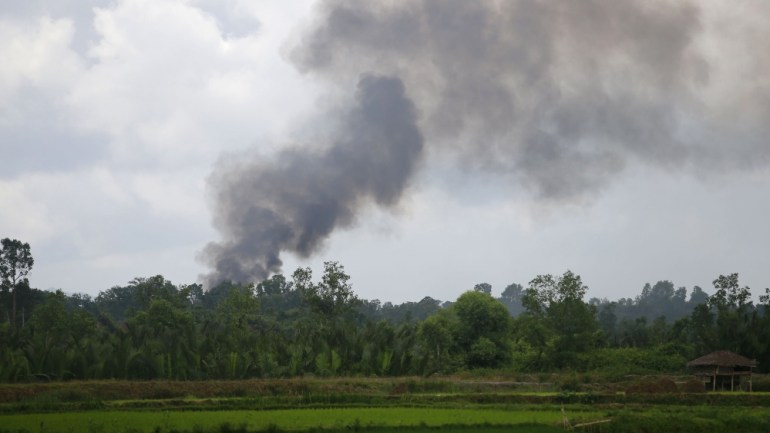 Clouds of smoke rise into the air from
Myanmar as a brutal military crackdown led hundreds of thousands of Rohingya to
flee across the border to Bangladesh [File: Suvra Kanti Das/AP]
Clouds of smoke rise into the air from
Myanmar as a brutal military crackdown led hundreds of thousands of Rohingya to
flee across the border to Bangladesh [File: Suvra Kanti Das/AP]
The estimated 600,000 Rohingya who remain in western
Rakhine State also continue to live under severe restrictions on their
movement and increasing military intimidation.
Tun Khin, president of United Kingdom rights
organisation BROUK, says the hearings “are an important opportunity for justice
for the Rohingya people, more than four years after the military committed its
atrocities against them” adding that “genocidal acts” were still being
committed against the minority group inside Myanmar.
“The Myanmar people have clearly rejected the junta,
making it clear the military does not represent them,” Tun Khin said in an
email to Al Jazeera. “All in the international community, including ICJ, should
hear this, and not lend any form of legitimacy to the junta. However, we
mustn’t lose sight of the fact that this case is about justice for the
Rohingya.”
‘Irreparable damage’
Myanmar’s preliminary objections in the case have not
been made public, but they relate to issues of jurisdiction and whether The
Gambia’s application is admissible.
Both countries are parties to the 1948 Genocide
Convention, and The Gambia considers Myanmar to have violated its obligations
under the convention, building its case on the evidence gathered by the UN
investigators.
When Aung San Suu Kyi spoke in court in 2019,
she said the situation was “complex” and that the military had been responding
to attacks by Rohingya “militants”.
She said Myanmar had taken steps to investigate the
crackdown and take action against the perpetrators.
“Can there be genocidal intent on the part of the state
that actively investigates, prosecutes and punishes soldiers and officers, who
are accused of wrongdoing?” asked the Nobel Peace Prize laureate who shocked
many human rights advocates by defending the military at The Hague. “Although
the focus here is on members of the military, I can assure you that appropriate
action will be taken on civilian offenders, in line with due process.”
A month after she addressed the court, the ICJ ordered
Myanmar to protect the Rohingya, with presiding Judge Abdulqawi Ahmed Yusuf
saying Myanmar had “caused irreparable damage to the
rights of the Rohingya”.
According to the ICJ’s statutes, the court has the power
to order provisional measures when “irreparable prejudice could be caused to
rights which are the subject of judicial proceedings”.
The court found that the condition of urgency had been
met in the case and required that the country prevent all genocidal acts
against the Rohingya, ensure that the military and other security forces do not
commit acts of genocide, and take steps to preserve evidence related to the
case.
Myanmar was also told to provide an initial report on
its compliance within four months and updates every six months.
“The International Court of Justice hearings are the
next step in the landmark case to break the cycle of violence and impunity in
Myanmar,” Nushin Sarkarati, associate international justice director at Human
Rights Watch said in a statement. “The case could build a pathway to justice,
not only for the Rohingya, but for everyone in the country.”
The hybrid hearings are due to start at 1:30pm local
time (12:30 GMT) and will continue for a week.
SOURCE: AL
JAZEERA


No comments:
Post a Comment