Five years since
brutal attacks by Myanmar's military forced more than 700,000 Rohingya refugees
to flee their homes, the United States has finally recognized those horrors as
genocide. This determination
is a historic and profound step toward justice for the Rohingya people. But
those were words. Now we need action. This momentous assessment must serve as a
catalyst to hold the Myanmar military accountable for its unceasing atrocities against
people across Myanmar and to take urgent steps to end them.
As a Myanmar-born
Rohingya activist now living in the United Kingdom and a refugee advocate in
Washington, we have frequently visited the Rohingya camps in Bangladesh and
spoken with countless genocide survivors. Nearly all of them have asked the
international community first for justice, and usually, the chance to return to
their homes when safe to do so. The U.S. decision to describe their plight as
genocide means a lot to them. As one refugee told us in the days following the
announcement, "[We are] very happy and hoping for justice and early
repatriation."
But the impact of the
declaration must not end there. The expectations it has raised among Rohingya
refugees must be carefully managed, to avoid further disappointing and
despairing people who have already suffered too much. One path is to take a
series of meaningful actions.
U.S. Secretary of
State Antony Blinken's promise of nearly $1 million to help investigate and collect evidence
for future prosecutions was welcome. But it was his only concrete commitment.
There are several steps the Biden administration can and must take to put heft
behind its words.
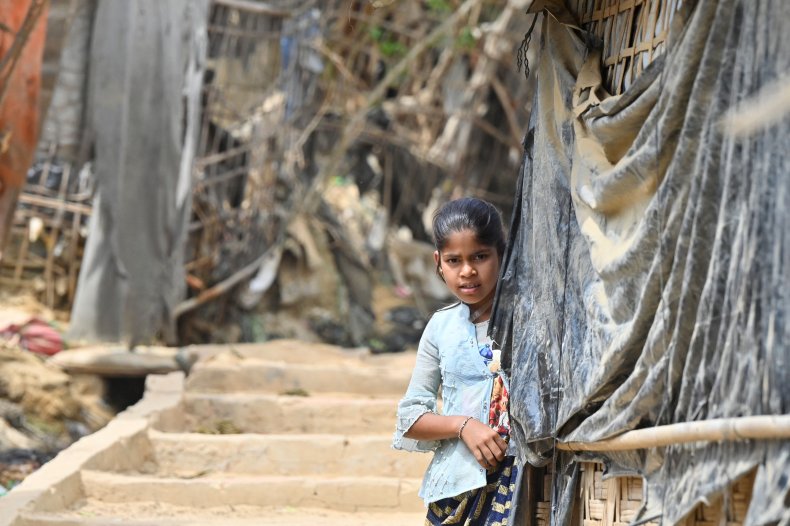 A Rohingya refugee child
looks out from her home in Bangladesh.MUNIR UZ ZAMAN/AFP
VIA GETTY IMAGES
A Rohingya refugee child
looks out from her home in Bangladesh.MUNIR UZ ZAMAN/AFP
VIA GETTY IMAGES
First, all avenues
toward justice must be explored and supported. The United States should provide
financial and legal assistance for the genocide trial now under way against Myanmar before the
International Court of Justice. It should also push for the U.N. Security
Council to refer the case to the International Criminal Court, where
individuals can be held accountable. The United States and other countries
should also pursue cases under the principle of universal jurisdiction—which
allows any nation to try perpetrators of the worst crimes anywhere under their
own jurisdiction—as one of the authors is currently leading in Argentina. Similar legal efforts must be made to hold
the military accountable for the crimes it has committed against civilians
across Myanmar since its coup in February 2021.
Second, the United
States must lead diplomatic efforts to increase international pressure on the
military junta. The recent announcements by the United States, Canada and the
United Kingdom of new targeted sanctions, in response to documented abuses in
recent months, is a useful step. But more can be done to cut off the flow of
money and weapons that allow the military to continue its abuses. Start with
sanctions against the state-owned oil and gas sector along with increased U.S.
bilateral efforts to stop the supply of arms to the junta. These sanctions
would address the continuing atrocities and also contribute toward the
long-term goal of safely returning Rohingya refugees to their homeland.
READ MORE
·
How
to Prevent China from Coming to Russia's Rescue
·
China's
TikTok Is Russia's New Disinformation Machine
·
'I
Was Not Put on This Earth to Be Invisible.' Where Are the Girls?
Third, the recognition
of genocide must bring sustained efforts to help survivors. The United States
has been the leading donor of humanitarian aid for Rohingya refugees, some $1.6 billion since 2017. But competing emergencies in
Afghanistan, Ethiopia and Ukraine, to name a few, will test the ability to keep
this aid coming.
Finally, if the United
States is to truly support the survivors of genocide, it must help them build
their lives back. Approximately 1 million
Rohingyas now live in
Bangladesh, mostly in the largest refugee settlement in the world. While they
have found refuge, they have been denied access to education, skills training
and the opportunity to earn a living. Half of the refugees are children, with
their futures—and thus the Rohingyas'—at stake. The United States should work
with Bangladesh to provide these opportunities and to offer other options for
refugees, including resettlement for some in the United States and other
countries.
In calling it
genocide, Blinken also spoke of a path out of genocide. It is now incumbent on
the world to keep seeking accountability and to support survivors in rebuilding
their lives. This declaration was Washington's first big step on that path. The
next steps can't come too soon.
Daniel P. Sullivan is the deputy director for
Africa, Asia and the Middle East at Refugees International.
Tun Khin is a leading Rohingya activist,
president of the Burmese Rohingya Organization UK, and a member of Refugees International's
Advisory Council.


No comments:
Post a Comment