A new genocide bill is given a second reading by UK Lords and goes
through to the next round. It can hit China, and other rogue states.
by Ruth Ingram
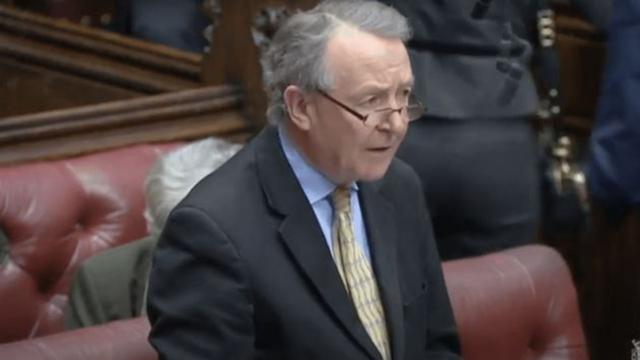 Lord Alton
addressing the House of Lords with his new bill. Courtesy of Lord David Alton.
Lord Alton
addressing the House of Lords with his new bill. Courtesy of Lord David Alton.
Genocide is firmly back on the U.K. government’s agenda
following the famous three-round ping pong battle last year over an amendment
to the post-Brexit Trade Bill addressing trade with genocidal states.
A new Genocide Determination Bill, introduced last
week by Lord David Alton to compel the UK government to call out genocide where
it exists was backed enthusiastically during an impassioned debate in the House
of Lords where it
was committed to a Committee of the Whole House for further
consideration.
 Uyghur demonstrations in support of
the anti-genocide bill: mother and daughter Hadiqe and Dilnaz mourn relatives
who “disappeared” in Xinjiang (all
photos except #1 by Ruth Ingram).
Uyghur demonstrations in support of
the anti-genocide bill: mother and daughter Hadiqe and Dilnaz mourn relatives
who “disappeared” in Xinjiang (all
photos except #1 by Ruth Ingram).
Bitter
Winter reported the “nail biting denouement” in March last year
of several months of back-and-forth struggle to push through a proposed ban on
trade with states deemed “genocidal” by a UK court set up for that purpose. The
anti-climactic finale, a considerably watered-down version of campaigner Lord
David Alton’s original proposal, was defeated by 318 votes to 300 on the back
of an eleventh-hour UK government compromise to join forces with 29 states to
sanction Chinese officials complicit in Uyghur atrocities. Wavering MPs came
down on the side of their government.
Proponents were undeterred and resolved nevertheless
to continue the struggle against genocidal states and compromised trade deals.
Their campaign has borne fruit in a fifth Private Member’s Bill brought by Lord
Alton’s on the issue, designed to provide once and for all a mechanism for
genocide determination.
Veto powers of Russia and China have to date made a
mockery of the UK government’s insistence that only international courts can
determine genocide, creating a stalemate over genocide and causing
parliamentarians’ dogged attempts so far to call out rogue states to fail.
Framing the debate in the context of next year’s
75th anniversary of the UN Convention on the Prevention and Punishment of
the Crime of Genocide, Lord Alton pointed out the “solemn and binding” duty of
the UK to use its voice and place among nations to prevent the constant
recurrence of the “crime above all crimes.”
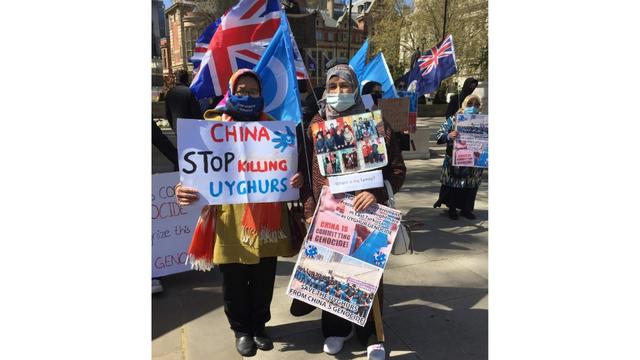 Another Uyghur woman whose relatives
have disappeared in Xinjiang.
Another Uyghur woman whose relatives
have disappeared in Xinjiang.
The “dismal failure” to make determinations of
genocide have had harrowing repercussions for “the Uyghurs in
China, the Yazidis in Iraq, the Rohingya in Myanmar, the Tigrayans in Ethiopia,
Christians in Nigeria and North Korea, the ‘reviled’ Hazara in Afghanistan and
the suffering people of Ukraine,” he said.
Litanies of mass killings, rape, deportation of
children, compulsory birth control, torture and the like were “pressing needs.”
he said, that demanded investigation. Victims needed to know that those
responsible for the atrocities might one day face justice.
In the light of a genocide on our doorstep in Ukraine,
“If this has not concentrated our minds on the urgency of a new approach to
genocide in this country,” he said, “most likely nothing ever will.” Instead of
offering the same old platitudes, he said, “it is time to open our eyes to
the evidence that is before us, recognize it for what it is, and act upon it.”
Lord Alton’s proposed Bill would empower individuals
or communities to apply to a court for a preliminary determination where there
was a serious risk of genocide or where a genocide was being or had been
committed. The verdict would then be referred to the country standing accused
of the crime, to other countries that are parties to the Genocide Convention
and to the International Court of Justice and the UN Security Council. Clause
two of the Bill would ensure checks and balances, transparency and oversight
over government responses to genocide globally by way of expanding the already
existing mechanism for genocide responses in Section 3 of the Trade Act 2021.
 Eziz Isa Elkun, left, exiled Uyghur
poet and writer, expressing support for the Bill.
Eziz Isa Elkun, left, exiled Uyghur
poet and writer, expressing support for the Bill.
Inaction emboldens the perpetrators, said Baroness
Sugg, “it sends the message that people can get away with it; a message that is
the opposite of “Never again.” Genocide determination should not be left to
international judicial systems, she insisted, adding that there were still many
atrocities without a genocide determination from an international body.
Lord Browne of Ladyton pointed out that despite the
issue of genocide having been raised 300 times by Lord Alton in the House,
there had been an inadequate response from the government. “The UK has a duty
to prevent and punish the crime of genocide,” he said. Under the terms of the
Genocide Convention, he said, “the instant that the State learns of, or should
normally have learned of, the existence of a serious risk that genocide will be
committed.”
Not having a mechanism or procedure to determine
genocide, means that the UK risks a de facto breach of its international law
obligations under the convention, he said.
The Lord Bishop of Exeter reminded peers, “in today’s
interconnected age it is no longer possible to claim ignorance of these
terrible events.” He quoted William Wilberforce who said, “You may choose to
look the other way, but you can never say again that you did not know.”
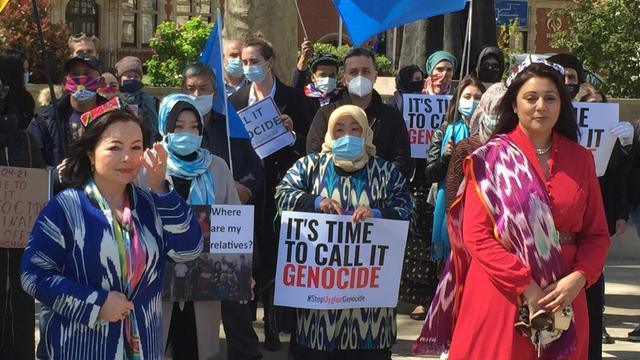 Rahima Mahmut (left), Director of
the UK branch of the World
Uyghur Congress, shoulder to shoulder with a Uyghur mother and
daughter whose relatives have “disappeared” in Xinjiang,
and MP Nus Ghani, a stalwart supporter of the cause.
Rahima Mahmut (left), Director of
the UK branch of the World
Uyghur Congress, shoulder to shoulder with a Uyghur mother and
daughter whose relatives have “disappeared” in Xinjiang,
and MP Nus Ghani, a stalwart supporter of the cause.
Lord Hannah of Chiswick bemoaned the fact that although
the Rwanda, Cambodia and Srebrenica genocides had been punished, shameful
omissions were the genocide against Iraqi Yazidis by IS and the treatment of
Rohingya Muslims in Burma. He said the UK government was embroiled in a
shameful and convoluted Catch 22 whereby nothing was being done to determine
whether a genocide was taking place, “even when we know that it is.”
Baroness Smith of Newnham said it was time the
government stopped picking holes in moves to address genocide brought before
the house. “This is a Bill whose time has come, and we need His Majesty’s
Government to step up to the plate and help us to ensure that the United
Kingdom is abiding by our international obligations and that we lead on these
international obligations,” she said.
In supporting the Bill, Lord Shinkwin urged the
government to get off its “increasingly flimsy and uncomfortable fence.”
Lord Mann pointed out, “there is a pathway to
genocide. It does not start with mass murder or gas chambers; it starts with
abuse, disrespect and all kinds of actions that can accumulate. It is really
important that we look at that sort of pathway.”


No comments:
Post a Comment