SINGAPORE: Myanmar's new gun ownership
policy, which lets civilians bear arms, risks worsening conflict in the country, observers said.
The country has been ravaged by violence since
the military took power in a coup more than two years ago.
The move could embolden pro-junta groups, and
further bloodshed could hamper much-needed relief efforts after Cyclone Mocha
battered western Myanmar on May 14.
Violence in Myanmar expected to
worsen as civilians given ...

Myanmar's gun laws were changed last month, as the
junta faces growing pressure to stamp out opposition in multiple battlegrounds.
YouTube · CNA · 4 hours ago
The latest changes to the gun laws last
month came as the army faces growing pressure to stamp out opposition in
multiple battlegrounds.
Observers said the move is targeted at
boosting the firepower of supporters of the junta, who fear being attacked.
SIGN OF DESPERATION
Experts said the new gun laws are a sign
that the junta is under pressure to hold on to power.
Mr Aaron Connelly, senior fellow of
Southeast Asian Politics and Foreign Policy at the International Institute for
Strategic Studies, said the military has never had to fight on multiple fronts.
“These new gun laws appear to be an effort
to create a legal mechanism to arm people who are supportive of the junta, in
order to defend areas which they have taken back from the PDF (People's Defence
Force) or local defence forces,” he told CNA.
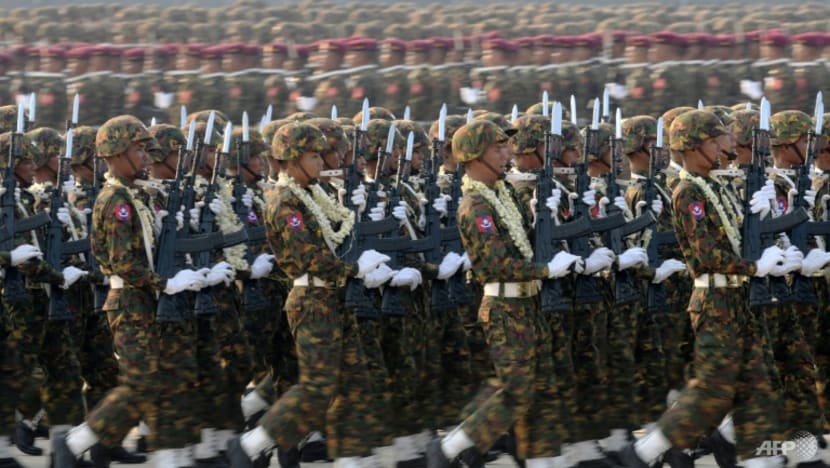 Experts said the new
gun laws are a sign that the junta is under pressure to hold on to power. (Photo:
AFP/File/STR)
Experts said the new
gun laws are a sign that the junta is under pressure to hold on to power. (Photo:
AFP/File/STR)
Ms Moe Thuzar, senior fellow and
coordinator of the Myanmar Studies Programme at the ISEAS - Yusof Ishak
Institute, said questions remain over who actually needs to use guns in the
country.
"Looking back at past practice (and)
past precedents, we do see that the people who were holding arms were either
those that were very much close to or connected to the military authorities, or
people who were military personnel or ex-military personnel, veterans and so
on,” she noted.
For locals, the new policy adds another
layer of fear to their lives. Many said there is no rule of law, and they feel
unsafe even when doing basic daily chores such as going to the market.
Occasional attacks and assassinations on
supporters of the junta have also occurred, even before the new gun law was
introduced.
An urban guerrilla group, for instance, claimed responsibility for the death of an elections
official in Yangon in April this year. He was a witness in the
electoral fraud case surrounding ousted leader Aung San Suu Kyi.
Cyclone Mocha relief efforts
hampered by politics in Myanma

Myanmar residents continue bearing the brunt in the
aftermath of Cyclone Mocha, which battered the country's western regions last
month.
YouTube · CNA · 3 hours ago
Last month, a 58-year-old celebrity, known
for being a staunch supporter of the Myanmar army, was gunned down near her
home in Yangon.
Some owners of commercial buildings and
shops are also concerned, saying they are still figuring out the relevant
security processes and safety protocols, since they have never had to worry
about weapons on their premises.
CYCLONE RELIEF
Meanwhile, Myanmar residents continue
bearing the brunt in the aftermath of Cyclone Mocha,
the worst natural disaster to hit the country since Cyclone Nargis in
2008.
There is a fear of politics coming into
play as victims look to rebuild their lives with foreign aid, according to
experts.
The ruling military government was already
lacking in its response, only allowing international aid into
the country after the crucial first weeks, slowing down relief
efforts.
I’m 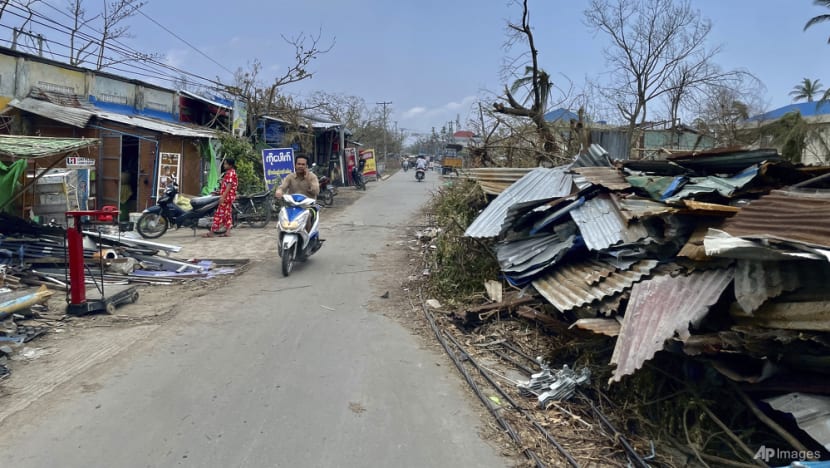 Locals riding a
motorbike along a roadside with damaged buildings in Sittwe township in Rakhine
State, after Cyclone Mocha struck. (AP Photo, File)
Locals riding a
motorbike along a roadside with damaged buildings in Sittwe township in Rakhine
State, after Cyclone Mocha struck. (AP Photo, File)
Ms Moe Thuzar said the junta has figured
out “how that ASEAN space for humanitarian assistance could
be used, manoeuvered (and) leveraged”.
One key difference between aid response
for cyclones Nargis and Mocha is that this year’s disaster hit an area that is
not entirely under the control of the governing State Administration Council
(SAC), noted Mr Connelly.
“This is a more complicated situation
because the Arakan Army or the ULA (United League of Arakan), its political
arm, is in control of much of Rakhine State,” he said.
The Arakan Army is an armed ethnic group
that has wrestled control of much of Rakhine State from the military junta.
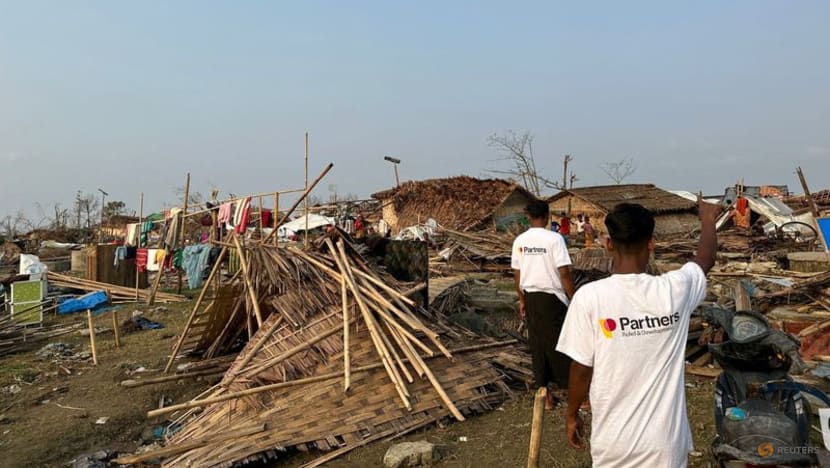 The area hit by
Cyclone Mocha is not entirely under the control of the governing State
Administration Council. (Photo: Partners Relief and Development/Handout via
REUTERS)
The area hit by
Cyclone Mocha is not entirely under the control of the governing State
Administration Council. (Photo: Partners Relief and Development/Handout via
REUTERS)
MYANMAR JUNTA CONTROL
Some had hoped a ceasefire in place in
Rakhine State would put a halt to the violence as relief efforts are rolled
out.
However, Mr Connelly noted that even when
flooding occurred in the cities of Sagaing and Magway, the SAC actually carried
out more attacks in those places.
Resistance forces have also stepped up
their offensives against the Myanmar army amid post-cyclone relief efforts.
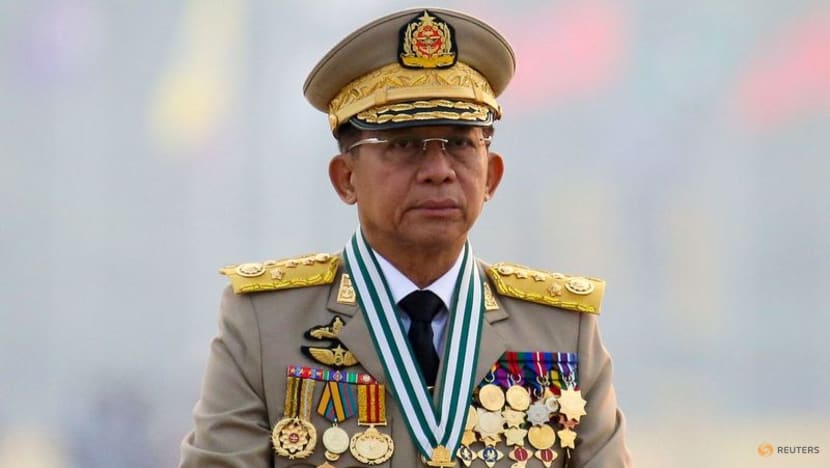 Myanmar's junta chief
Min Aung Hlaing. (REUTERS/Stringer/File Photo)
Myanmar's junta chief
Min Aung Hlaing. (REUTERS/Stringer/File Photo)
As aid from ASEAN and the United Nations
trickle into the country, there are concerns it would be politicised, with help
going only to those selected by the Myanmar military.
The junta had also introduced a law late
last year making the registration of non-governmental organisations compulsory.
Some fear the law would be used by the
military as a tool to crush its opposition.
Source: CNA/fk(dn)


No comments:
Post a Comment