Thursday, October 1, 2026

Minaret of Indian mosque collapses during controversial demolition

 Navigation menu

NewsFeed

Minaret of Indian mosque collapses during controversial demolition

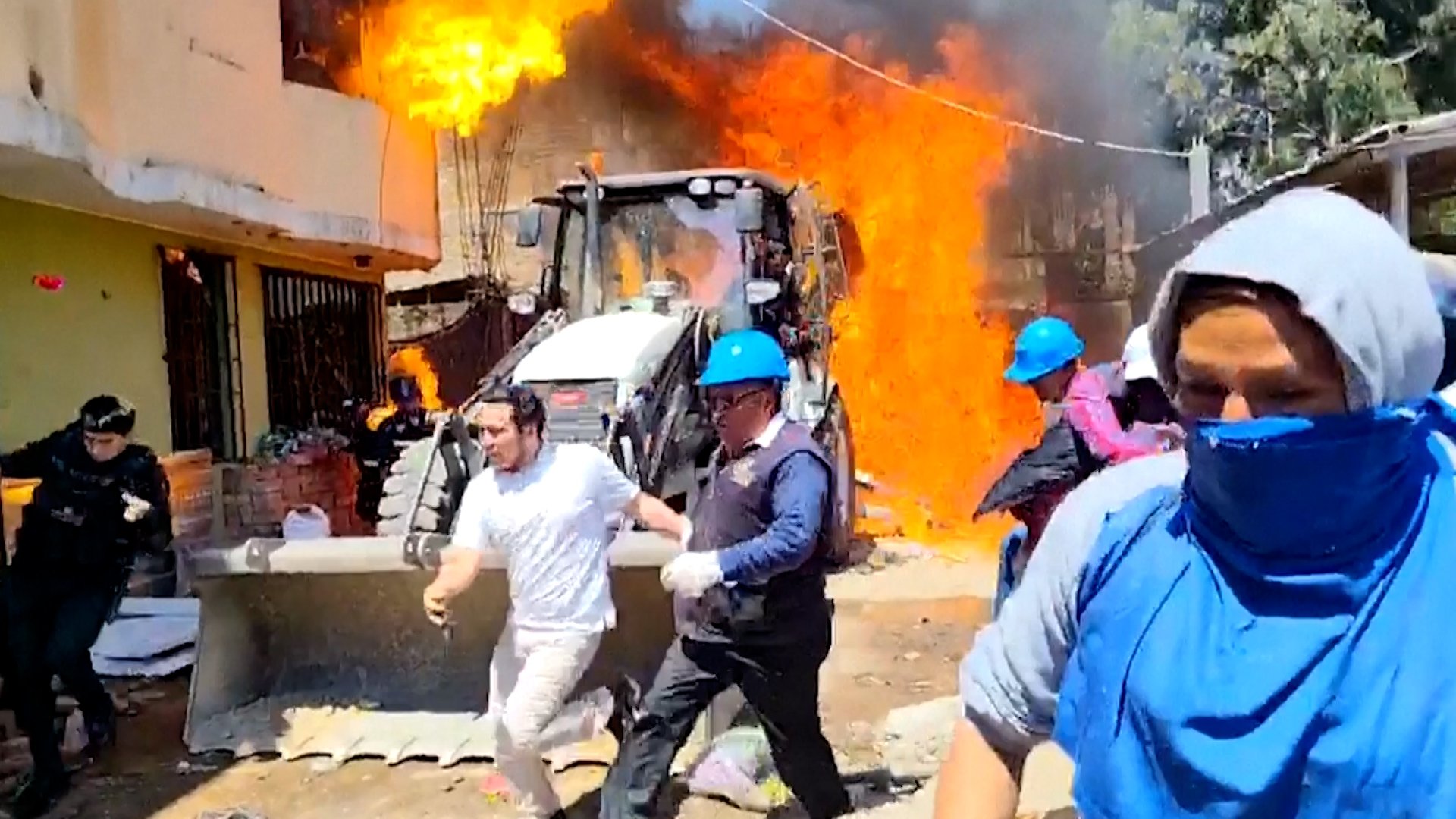
Video shows the moment the minaret of India’s 600-year-old Ujjain mosque collapsed during demolition work for a road-widening project for a Hindu pilgrimage, triggering despair among Muslims onlookers. Officials described it as an accident caused by faulty machinery.

Will Democrats move beyond rhetoric on Israel’s illegal settlements?

 A shift is taking place in Washington. Senate Democrats are moving to sanction individuals and entities involved in Israel’s E1 settlement project, one of the most consequential efforts to reshape the occupied West Bank. The timing is significant. Reports that the project may have been put on hold raise the question of whether the pause represents a substantive policy change or merely a tactical delay. Meanwhile, the Senate is preparing to leave Washington this week, narrowing the immediate window for action. The question is no longer simply whether Democrats object to illegal settlement expansion, but whether they are prepared to turn those objections into consequences.

The legislation, introduced on September 23 by Senators Chris Coons, Elizabeth Warren, Ron Wyden and Ruben Gallego, would target individuals and entities involved in facilitating settlement construction in E1. It has at least 10 Democratic cosponsors and was referred to the Senate Banking, Housing, and Urban Affairs Committee.

E1 lies between occupied East Jerusalem and the major illegal settlement of Maale Adumim. Its development has long been viewed by Palestinian officials, foreign governments and advocates of a two-state solution as particularly consequential because construction there could disrupt territorial continuity between northern and southern parts of the occupied West Bank while further isolating East Jerusalem. The issue, therefore, is not simply another settlement project, but whether the geography of the West Bank is being altered in ways that could make Palestinian territorial self-determination increasingly difficult.

Advertisement

From condemnation to accountability

The proposed legislation would impose sanctions on foreign individuals and entities determined by the Treasury Department to have facilitated settlement construction or related activity in E1, including participation in tenders. It would also target those involved in organising, financing or facilitating the transfer of Israeli civilians into illegal settlements in the area.

That would represent a departure from the traditional Washington response. A government can dismiss a diplomatic protest; sanctions affecting companies, individuals or access to the US financial system are harder to ignore. Yet the measure remains a proposal, its prospects are uncertain, and the House of Representatives is out of session. The Senate’s impending departure means the immediate political opportunity is narrowing, although the legislation will remain alive during the recess.

Its significance, therefore, may depend as much on what happens when Congress returns as on what happens before it leaves.

What does an E1 pause actually mean?

Reports that the E1 project may have been put on hold deserve attention, but also caution. A suspension, delay in tenders or postponement would not necessarily amount to abandonment. Nor would it reverse settlement expansion already approved or resolve the broader question of the West Bank’s territorial future.

If E1 has merely been deferred, Washington should not mistake a pause for a policy change. But if the project has genuinely been halted, the moment presents an opportunity to test whether US pressure can help turn temporary restraint into a durable decision.

That is where sanctions could matter. Their significance would not necessarily lie in punishing a project after the fact, but in establishing that settlement expansion can carry consequences before the process becomes irreversible.

The Democratic contradiction

The Democratic debate must also confront the Biden administration’s record. The administration repeatedly stated that settlements were inconsistent with international law and harmful to the prospects for a two-state solution. Yet those objections coexisted with continued military assistance and a broader strategic relationship with Israel. Washington thus continued to articulate support for Palestinian statehood while doing relatively little to prevent developments that could make such a state increasingly difficult to realise.

That contradiction has not been confined to one administration. Successive US governments have often treated settlement expansion as an obstacle to peace while stopping short of using significant leverage to prevent it.

Advertisement

The political environment within the Democratic Party, however, is changing. A growing number of Democratic lawmakers are challenging aspects of Israeli policy, including settlement expansion and pogroms. The E1 legislation reflects a broader debate over whether support for Israel must also mean insulating Israeli government policies from meaningful US consequences.

What would meaningful change require?

For the E1 initiative to become more than symbolism, Congress would have to establish clear criteria for sanctions, consistent enforcement and the political willingness to sustain them. More fundamentally, Washington would have to confront the larger framework of its relationship with Israel.

If Palestinian self-determination remains a US policy objective, a basic question follows: what happens when an ally pursues policies that American officials themselves say undermine that objective?

For decades, the answer has mostly been diplomatic objection without corresponding leverage. The proposed sanctions would introduce something largely missing from US settlement policy: the possibility that settlement activity could carry a tangible cost in the United States.

That does not guarantee passage, nor would sanctions by themselves resolve the Israeli-Palestinian conflict. But they would alter the terms of the debate by linking Washington’s stated policy to an instrument capable of imposing consequences.

The test comes after the headlines

The E1 initiative should therefore be neither exaggerated nor dismissed. It remains at the beginning of the congressional process, with the House out of session and the Senate preparing to leave Washington. The immediate prospects for enactment may be uncertain. But the more important test is whether its sponsors continue to press the issue after the current political moment has passed.

If E1 has been temporarily put on hold, Washington has an opportunity to press for a permanent halt rather than treating the pause as sufficient. “If the project proceeds, Congress will face a clearer choice over whether settlement activity should continue to be met with statements of concern or tangible consequences.

Ultimately, E1 is about more than a strip of land between Jerusalem and Maale Adumim. It is a test of whether US foreign policy means what it says. Washington has spent decades declaring that settlement expansion undermines Palestinian self-determination and the prospects for a negotiated peace, while rarely attaching a meaningful cost to it.

The E1 legislation offers Democrats an opportunity to begin closing that gap. The decisive question is not whether Washington can issue another warning, but whether it is finally prepared to make its own stated principles matter and make clear that a US commitment to Palestinian self-determination cannot remain a diplomatic phrase while the realities on the ground move in the opposite direction.

Message from Electronic Intifada


Israeli Prime Minister Benjamin Netanyahu faced a walkout at the UN, but still took the podium despite a warrant for his arrest. What will it take to turn Israel’s growing isolation into real accountability?

On today’s show, human rights lawyer and former UN official Craig Mokhiber joins us to discuss the gap between diplomatic condemnation and action, the “Board of Peace” plans for Gaza and Nicaragua’s case against Germany.

Jon Elmer reports on US losses of aircraft, equipment and personnel in Iranian operations against American bases across the Middle East and in the Strait of Hormuz.

Nora Barrows-Friedman brings the latest news from Palestine and Lebanon, including Israel’s continuing killings of children and journalists in Gaza, with an audio report from Roqayah Chamseddine in Beirut.

Join Jon, Nora, Ali Abunimah and Tamara Nassar for all this and more.

Thank you for reading, listening to and sharing all our original news and analysis at The Electronic Intifada.

60 Incidents in 4 Months: Anti-Christian Attacks Surge Across West Bengal

 Since the Bharatiya Janata Party (BJP) formed the government in West Bengal, the state has witnessed a sharp escalation in vigilante violence by Hindu nationalist organizations targeting Christians. These incidents have included raids on prayer meetings and churches, harassment and interrogation of worshippers, vandalism, physical assaults, and public humiliation, frequently justified through allegations of “religious conversion.”

Between May 13 and September 20, 2026, India Hate Lab (IHL) documented at least 60 incidents across 13 districts, including 52 raids on private prayer meetings, homes, churches, and other Christian gatherings, and eight incidents involving physical assault, mob violence, or vandalism. During the same period, IHL documented five public hate speech events explicitly targeting Christians, sometimes alongside Muslims, and three protests focused exclusively on alleged religious conversion.

The timing and rhetoric surrounding these incidents are significant. The documented surge began after the change in state government, and perpetrators have themselves invoked the BJP’s assumption of power while targeting Christians. In Panskura, Paschim Medinipur, on September 3, Vishwa Hindu Parishad (VHP) and Bajrang Dal members, while interrupting a Christian gathering at a rental guest house, warned that no conversion activities in “New Bengal” would be allowed, invoking Chief Minister Suvendu Adhikari’s public opposition to alleged religious conversion. In Barasat on July 12, members of Hindu Jagaran Manch, while threatening Auxilium Salesian Sisters over a private prayer cemetery, declared that their activities “would not be tolerated now that BJP is in power.” 

Expanding Pattern

The incidents documented by IHL were distributed across 13 districts but showed notable geographic concentration. South 24 Parganas and Paschim Medinipur each recorded 13 raids on Christian prayer meetings. The organizations most frequently involved included Hindu Jagaran Manch/Bangiya Hindu Jagaran, Vishwa Hindu Parishad (VHP), Bajrang Dal, Hindu Suraksha Samiti, Hindu Ekta Manch, and Hindu Sanghati.

The raids follow a similar template. Local members of Hindu nationalist organizations entered private homes, churches, or rented venues where Christians were gathering for prayer, accused organizers of carrying out religious conversions, interrogated attendees about their religious identities, and, in several cases, demanded to inspect their Aadhaar cards. This pattern was documented in Chandrakona on May 13, May 20, and June 8; in Gosaba on May 28; in Basanti on June 6 (where six individuals were accused of conversion at a church); and in Canning on June 9.

In Sandeshkhali on July 8, VHP and BJP members entered a predominantly Christian neighborhood, while a Hindu monk demanded the residents show their Aadhaar cards, questioned why they left Hinduism, and termed Christianity a “legacy of the British rule.” In Hingalganj, Uttar Dinajpur, on August 30, Hindu Jagaran Manch members raided a prayer meeting, questioned an alleged Christian missionary from Argentina, and questioned why the Bible was being read instead of the Gita. 

Gendered Harassment

A recurring feature of these incidents has been the targeting of Christian women over religious identity and traditional Bengali marital symbols. Women have been questioned about wearing sakha-pola, bangles traditionally worn by married Bengali Hindu women, and sindoor, and in several incidents were pressured to remove them.

In Ramnagar, Purba Medinipur, on September 5, Hindu nationalists told Christian women to remove their sakha-pola and mocked them for referring to Jesus as “Swami.” Similar incidents of harassment were recorded in Kulpi on September 6 and September 11. 

On July 18 in Baruipur, a Hindu nationalist group followed and heckled a group of Christian women carrying Bibles and wearing sakha-pola and sindoor, calling them “sold out Hindus” and “bejaat Hindus”— a casteist slur accusing them of abandoning their caste and community by converting. 

On September 19, in Barrackpore, VHP and Bajrang Dal members physically assaulted and publicly humiliated several Christian women, accusing them of facilitating religious conversion.

Physical Violence and Vandalism

Several raids escalated beyond intimidation into physical violence, mob attacks, or destruction of Christian religious property. On June 10, Hindu Jagaran Manch members vandalized a church in South 24 Parganas. In Subhashgram on July 5, Hindu nationalist supporters attacked a church under construction and broke down multiple crosses installed while chanting “Jai Shri Ram.” On August 25, a VHP and Bajrang Dal raid on a home in Magrahat turned violent. On the same day in Howrah, a mob detained two people accused of facilitating conversion, dragging them through the area to chants of “Jai Shri Ram.”

The mob stripped the man of his clothes and manhandled the woman in the presence of the police, who did not intervene, and later took the victims into custody. In Magrahat on September 7, a raid escalated into physical violence after members tore up Bibles and demanded that women remove marital symbols. Police arrested several attendees. In Kolkata, on September 11, Hindu Sanghati members targeted a prayer meeting and physically assaulted attendees. On September 19, VHP and Bajrang Dal members in Barrackpore tied up and assaulted several Christian women, accusing them of facilitating religious conversion.

Police Complicity

IHL documented a recurring pattern in which police were present during vigilante attacks and, in many cases, subsequently detained Christian attendees following allegations made by Hindu nationalist organizations.

In Raniganj on June 21, a mob led by VHP leader Shubham Raut assaulted attendees at a Sunday Prayer Meeting and handed over 20-25 attendees to the police, who launched an investigation over allegations of religious conversion. In Chaitanyapur, Haldia, on July 9, police accompanied Hindu nationalist supporters to detain two women distributing Christian religious literature.

In Midnapore on July 6, police detained several individuals named by Hindu Jagaran Manch members in a complaint alleging conversion. In Purulia (July 5), Hijla (August 23) and Kulpi (September 6), VHP and Bajrang Dal raids on prayer meetings took place in the presence of police. In Bhatpara, North 24 Parganas, on September 20, Hindu Jagaran Manch members intercepted a prayer meeting and again handed the attendees directly to police.

Several hate speech events targeting Christians were also documented alongside the surge in vigilante raids. At a Hindu Jagaran Manch event in Mathurapur, Malda, on June 16, Rashtriya Swayamsevak Sangh (RSS) leader Suman Kumar claimed that children of “Chadar and Father” (Muslims and Christians) are taking disproportionate government benefits over Hindus. At a Virat Hindu Dharma Sammelan in Ghutiari Sharif on September 6, a speaker alleged that Christian missionaries exploit the sick and vulnerable and convert them. 

Role of Social Media Platforms

All of the incidents documented by IHL were recorded and shared on Facebook and Instagram by the perpetrators. In many cases, members of Hindu nationalist organizations themselves uploaded videos of raids, confrontations, and interrogations, while some incidents were livestreamed as they unfolded. Meta platforms thus served as mediums used by the groups involved to document, publicize, and amplify their vigilante activities targeting Christians.

This is not a new problem. Social media platforms have repeatedly failed to adequately enforce their own rules against hate, incitement, and extremist activity in India, despite longstanding evidence that their services are used by extremist actors to organize, document, glorify, and amplify harassment and violence against religious minorities. The continued presence of accounts and content openly documenting such activities raises serious questions about the effectiveness of platform enforcement and the extent to which these groups can operate online with limited consequences.

The frequency and concentration of these incidents, the repeated invocation by perpetrators of the change in state government, the recurrence of the same organizations and tactics across districts, and documented instances of police presence and support point to an increasingly organized campaign operating in an environment of apparent institutional impunity. None of the individuals or organizations identified by IHL as participating in these incidents had posted about similar raids or other vigilante attacks targeting Christians before May 2026.

All documented incidents began in May, with their frequency steadily increasing in the months that followed. The escalation was particularly pronounced in September, with five raids documented within a single 48-hour period on September 19-20.

This report is part of India Hate Lab’s Early Warning, Early Response (EWER) initiative. India Hate Lab is a project of the Center for the Study of Organized Hate (CSOH).

The Rising Tide of Anti-South Asian Hate in the United States

 This report examines the scale, nature, and tactics of online hate targeting South Asian Americans, including those of Indian, Pakistani, Bangladeshi, and other South Asian backgrounds, across X, 4chan, 8chan, and Gab.

Introduction

In recent years, South Asians in the United States have increasingly become targets of online hate, with their identities, languages, accents, appearance, cultural customs, and religious practices subjected to mockery and abuse. They are denigrated with xenophobic slurs, racist memes, and dehumanizing rhetoric that depicts them as vermin, parasites, and invaders who are taking over American jobs, communities, and institutions.

These narratives frequently draw on conspiracy theories of demographic and cultural replacement and, in their extreme forms, include calls to deport, denaturalize, or otherwise remove South Asians from the country. Far-right and anti-immigration influencers have amplified these narratives and circulated videos featuring or encouraging the public harassment and humiliation of South Asians.

This online hostility exists alongside incidents of anti-South Asian harassment and violence offline. South Asians have faced harassment, racial abuse on the streets, and physical violence. In February 2025, an Indian-origin nurse in Florida was severely beaten by a patient who made anti-Indian remarks.1 In July 2026, an Indian Muslim mall employee in Utah was repeatedly stabbed in an attack that federal prosecutors charged as a hate crime.2 On September 13, 2026, a Sikh truck driver was stabbed 17 times3 in an unprovoked attack at a truck stop in Wyoming, raising fears of other such attacks on South Asians.

The attack followed in the wake of simmering anti-Sikh sentiment ever since two Sikh truck drivers were involved in fatal crashes4 in 2025 and an ensuing crackdown by the Trump administration on immigrant truck drivers. Earlier in September, the official Department of Homeland Security Instagram account had shared an image of a poster,5 captioned “Transformers: Age of Deportations.” The controversial poster, which received ample attention, featured an image of ‘Mr Singh,’ who was told to “get off our roads.” The poster was taken down on September 10, 2026.

Click here to read more: The Rising Tide of Anti-South Asian Hate in the United States

Minaret of Indian mosque collapses during controversial demolition

  Navigation menu News Show more news sections Middle East Explained Sport Opinion Video More Show more sections Live Click here to search S...