The BRICS group of nations has unanimously adopted a joint declaration, calling for calm in the Middle East and stressing the need to work together to maintain the smooth flow of global trade, supply chains and energy.
The summit launched on Saturday in New Delhi, with India’s Prime Minister Narendra Modi hosting the two-day meeting. China’s President Xi Jinping, Russia’s President Vladimir Putin and Iran’s President Masoud Pezeshkian are among those attending.
Recommended Stories
The presidency of the 11-member bloc has passed to New Delhi at a difficult moment, with wars in the Middle East and Ukraine disrupting energy and shipping, tariffs squeezing members, and BRICS countries at odds over how to answer either challenge.
Saturday’s declaration voiced “deep concern over the continued escalation of tensions” across the Middle East, calling for “maximum restraint” and warning against deliberate attacks on civilian infrastructure and on nuclear facilities, in particular.
It reiterated the bloc’s position on Palestine, expressing “firm opposition” to the forced displacement of Palestinians, and changing the geography or demography of the occupied territory.
It also called for an end to Israeli violence in Gaza, support for the UNRWA and full United Nations membership for Palestine.
Expansion of non-Western cross-border payment channels, cooperation on artificial intelligence and opposition to unilateral sanctions and tariffs are also subjects of the wide-ranging declaration.
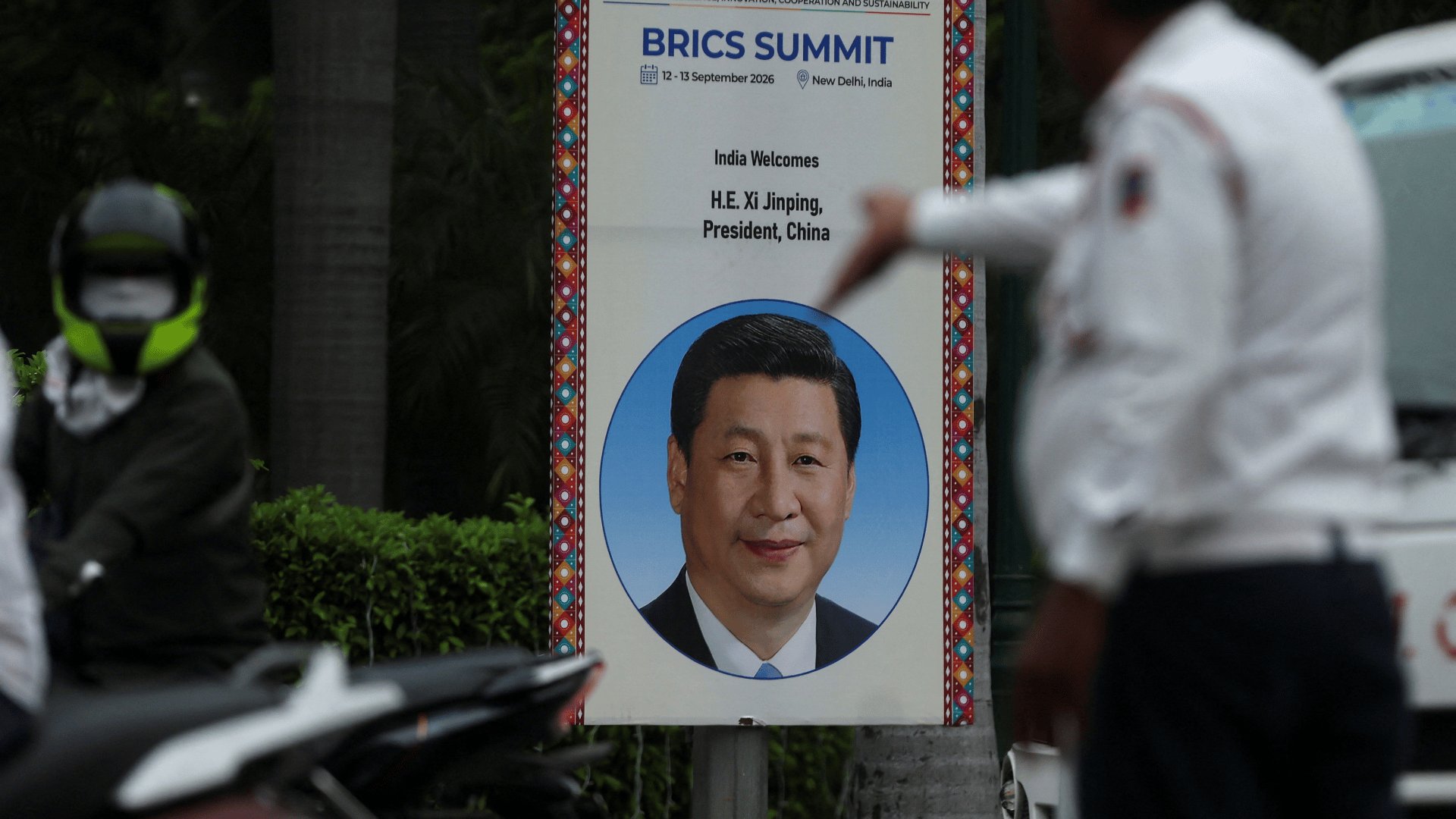
President Xi arrived in the Indian capital on Saturday morning, his first visit to the country in seven years as the two Asian giants seek to thaw relations.
He said the fighting in the Middle East did not serve the world’s interests. “As the situation in the Middle East and the Gulf region continues to evolve, the war there has caused serious losses to people across the region,” China’s Xinhua quoted Xi as saying.
It “does not serve the common interests of the international community”, Xi said.
- Now Playing
Xi visits India for the first time in seven years as ties slowly thaw
- Next
Couple welcomes child from embryo frozen for 22 years
Man arrested over killing of Tasia Fortune, found hanging from a tree last month
Jerusalem Daily: Kites for Gaza
Will Houthi gains give Iran leverage in its war with the US? | Inside Story



On Friday, Modi held talks with Putin – agreeing to deepen ties – and with Pezeshkian, raising freedom of navigation and the safety of ship crews in the Strait of Hormuz.
South Africa’s Cyril Ramaphosa, Egypt’s Abdel Fattah el-Sisi, Ethiopia’s Abiy Ahmed and Indonesia’s Prabowo Subianto are also attending. The United Arab Emirates has sent the Crown Prince of Abu Dhabi, Sheikh Khaled bin Mohamed bin Zayed Al Nahyan, as its representative. Founding member Brazil sent Foreign Minister Mauro Vieira to stand in for President Luiz Inacio Lula da Silva.
BRICS – which stands for Brazil, Russia, India, China and South Africa – was created in 2006 as BRIC by the first four countries as a forum for major emerging economies seeking greater influence in institutions dominated by Western powers. It has since expanded to include other states.
The heads of the World Health Organization (WHO), the World Trade Organization (WTO), and United Nations Secretary-General Antonio Guterres are also present at the India summit.
Speaking at a closed session, Egypt’s el-Sisi called for maintaining “the stability and freedom of international navigation”.
“The current developments in the Middle East and their negative repercussions on the global economy, trade and energy flows, and supply chains affirm the close link between security and development,” he said.
Key divisions
Iran and the UAE, both members, are on opposing sides of the war waged on Iran by the United States and Israel.
Last year’s summit saw the bloc issue a joint declaration condemning the 12-day US-Israeli bombing campaign against Iran’s leadership and nuclear programme. But a meeting of BRICS foreign ministers in May this year ended without a joint statement on the conflict.
The bloc’s finance ministers and central bank governors have objected to tariffs and non-tariff measures they say distort trade and are inconsistent with WTO rules.
The US has levied tariffs on several BRICS members under different pretexts, often conditioning their removal on policy changes by the target country. President Donald Trump has described the bloc as “anti-American” and threatened to impose punitive tariffs on countries that align with it.
“As the host, New Delhi has a delicate balancing act,” says Al Jazeera’s Um-e-Kulsoom Shariff, reporting from the summit.
“It has pressing issues to address: trade, finance, technology, energy security, resilient supply chains and climate change. But as the alliance marks its 20th anniversary, the major test is whether its newly expanded membership can further empower the Global South.”


No comments:
Post a Comment