Thursday, September 28, 2017

Suspend weapons supplies to Myanmar army, prosecute commanders: U.S. envoy Nikki Haley

YANGON/UNITED NATIONS (Reuters) - U.S. Ambassador to the United Nations Nikki Haley on Thursday called on countries to suspend providing weapons to Myanmar over violence against Rohingya Muslims until the military puts sufficient accountability measures in place.
It was the first time the United States called for punishment of military leaders behind the repression, but stopped short of threatening to reimpose U.S. sanctions which were suspended under the Obama administration.
“We cannot be afraid to call the actions of the Burmese authorities what they appear to be - a brutal, sustained campaign to cleanse the country of an ethnic minority,” Haley told the U.N. Security Council, the first time Washington has echoed the U.N.’s accusation that the displacement of hundreds of thousands of people in Rakhine State was ethnic cleansing.
Myanmar rejects accusations of ethnic cleansing.
“The Burmese military must respect human rights and fundamental freedoms. Those who have been accused of committing abuses should be removed from command responsibilities immediately and prosecuted for wrongdoing,” Haley said.
“And any country that is currently providing weapons to the Burmese military should suspend these activities until sufficient accountability measures are in place,” Haley said.
Meanwhile, international aid groups in Myanmar have urged the government to allow free access to Rakhine State, where an army offensive has sent more than 500,000 people fleeing to Bangladesh, but hundreds of thousands remain cut off from food, shelter and medical care.
Refugees are still leaving Myanmar, more than a month after Rohingya Muslim insurgents attacked security posts near the border, triggering fierce Myanmar military retaliation.
Aid groups said on Thursday the total number of refugees in Bangladesh was now 502,000 while the United Nations said at least 15 refugees, including nine children, drowned when their boat capsized off the coast in bad weather.
The Myanmar government has stopped international aid groups and U.N. agencies from carrying out most of their work in the north of Rakhine state, citing insecurity since the Aug. 25 insurgent attacks.

Aid groups said in a joint statement they were: “increasingly concerned about severe restrictions on humanitarian access and impediments to the delivery of critically needed humanitarian assistance throughout Rakhine State.” 
“We urge the government and authorities of Myanmar to ensure that all people in need in Rakhine Sate have full, free and unimpeded access to life-saving humanitarian assistance.”
The government has put the Myanmar Red Cross in charge of aid to the state, with the help of the International Committee of the Red Cross. But the groups said they feared insufficient aid was getting through.
Relations between the government and aid agencies had been difficult for months, with some officials accusing the groups of helping the insurgents.
Aid groups dismissed the accusations, which they said had inflamed anger towards them among Buddhists in the communally divided state, and called for an end to “misinformation and unfounded accusations”.
Rights groups have accused the army of trying to push Rohingya Muslims out of Myanmar, and of committing crimes against humanity. They have called for sanctions, in particular an arms embargo.
The British Minister of State for Asia and the Pacific, Mark Field, described the situation as “an unacceptable tragedy” after visiting Myanmar and meeting leaders including Nobel laureate Aung San Suu Kyi, who has faced scathing criticism and calls for her Nobel prize to be withdrawn.
She denounced rights abuses in an address last week and expressed concern about the suffering. She also said any refugees verified as coming from Myanmar would be allowed to return.
United Nations Secretary-General Antonio Guterres warned on Thursday that the violence against Rohingya Muslims in the northern part of Rakhine state could spread to central Rakhine, where 250,000 more people were at risk of displacement.
Guterres told the U.N. Security Council during its first public meeting on Myanmar in eight years, that the violence had spiraled into the “world’s fastest developing refugee emergency, a humanitarian and human rights nightmare.”
A group of Republican and Democratic senators urged the Trump administration on Thursday to use the “full weight” of its influence to help resolve the Rohingya crisis in Myanmar and Bangladesh. A letter seen by Reuters and signed by four Republican and 17 Democratic members of the 100-seat Senate also calls on Secretary of State Rex Tillerson and U.S. Agency for International Development Administrator Mark Green to provide more humanitarian aid.
‘NO JUSTICE’
Police in Bangladesh said they recovered the bodies of 14 refugees, including nine children, after their boat went down. A Reuters photographer said he saw several babies among the victims.
Police officer Afrajul Hoque Tutu said three boats had capsized in heavy seas.
The U.N. International Organization for Migration later put the toll at 15, and said there had been about 100 people on the boat when it capsized as the captain tried to anchor it close to the shore, but lost control in rough seas.
Myanmar was getting ready to “verify” refugees who want to return, the government minister charged with putting into effect recommendations to solve problems in Rakhine said.
Myanmar would conduct a “national verification process” at two points on its border with Bangladesh under terms agreed during a repatriation effort in 1993, state media quoted Win Myat Aye, the minister for social welfare, relief and resettlement, as saying.
It is unclear how many refugees would be willing to return, or have the documents they will likely need to qualify.
Myanmar authorities do not recognize Rohingya as an indigenous ethnic group, instead regarding them as illegal immigrants from Bangladesh.
“The government hates us,” said refugee Zafar Alam, 55, sheltering from rain near a refugee settlement in Bangladesh, referring to the Myanmar government.
“I don’t think I’d be safe there. There’s no justice.”

Act Now to End and Remedy Crimes Against Humanity in Myanmar - joint statement from Fortify Rights and other human rights groups

United Nations: Act Now to End and Remedy Crimes Against Humanity in Myanmar


U.N. Secretary General to brief Security Council today, 88 organizations call for arms embargo, sanctions on Myanmar


(NEW YORK and BANGKOK, September 28, 2017)—The United Nations Security Council and U.N. member states should act urgently to impose an arms embargo on the Myanmar military and targeted sanctions on individuals responsible for atrocity crimes against Rohingya Muslims and others in Rakhine State, Fortify Rights said today. U.N. Secretary General António Guterres will today publicly brief the U.N. Security Council on the human rights situation in Rakhine State.

“No more excuses, the international community must act now,” said Kate Vigneswaran, Legal Director at Fortify Rights. “Condemnations from the international community are important, but concrete action is urgently needed to end and remedy atrocities against Rohingya and others.”  

Fortify Rights, Human Rights Watch, Amnesty International, and 85 other civil society organizations from around the world called today for U.N. Security Council action as well as a U.N. General Assembly Resolution to demand an immediate end to crimes against humanity against Rohingya. The organizations call on the Government of Myanmar to provide humanitarian aid agencies with “immediate and unhindered access to populations in need,” and for the authorities to provide unfettered access to a U.N. Fact-Finding Mission established by the U.N. Human Rights Council in March. The organizations also urged “member states and the Security Council to explore possible avenues to bring perpetrators of crimes under international law to justice.”

Fortify Rights has documented killings, rape and gang-rape, mass graves, and other crimes, including the razing of entire villages, by state security forces against Rohingya civilians during two waves of Myanmar Army-led “clearance operations” beginning in October 2016 and continuing in August and September 2017. These attacks are ongoing and have forcibly displaced more than half a million Rohingya since the October violence.

“These are crimes against humanity, and they are being committed with complete impunity,” said Kate Vigneswaran. “The Security Council needs to act to ensure the attacks stop and the perpetrators are brought to justice.”

Article 7 of the Rome Statute defines “crimes against humanity” as an act “committed as part of a widespread or systematic attack directed against any civilian population, with knowledge of the attack.”

Fortify Rights has collected a significant body of evidence in Rakhine State and on the Bangladesh-Myanmar border since October 2016 indicating that soldiers and police intentionally carried out prohibited acts within the context of a widespread and systematic attack against Rohingya with knowledge of the broader context into which these crimes were perpetrated and in full awareness that their actions contributed to the attack. This evidence indicates that Myanmar Army soldiers and members of the Myanmar Police Force committed crimes against humanity.

The Myanmar Army-led attacks against Rohingya were in response to attacks on state security forces by the Arakan Rohingya Salvation Army (ARSA), known locally as al-Yaqin. On October 9, 2016, ARSA killed nine police officers during a surprise attack on three police outposts in Maungdaw and Rathedaung townships. On August 25, 2017, ARSA killed another 12 state security officials in attacks on 30 police outposts and an army base in Maungdaw, Buthidaung, and Rathedaung townships.

Fortify Rights also documented killings of Rohingya civilians by ARSA and called on the Myanmar government to hold perpetrators accountable.

In recent days, the Myanmar government announced the discovery of 45 “Hindus” in a mass grave near Kha Maung Seik village in northern Maungdaw Township, alleging ARSA killed them on August 25. The government continues to deny the U.N. Fact Finding Mission access to Rakhine State.

The U.N. Fact Finding Mission should be given immediate and unfettered access to Rakhine State and other parts of the country, including Kachin and Shan states, to urgently investigate atrocity crimes, Fortify Rights said.

“We’ve already seen what ongoing impunity for international crimes has done for Myanmar,” said Kate Vigneswaran. “It’s been destructive for the country and for the region and can’t continue to be an option for the international community.”

For more information, please contact:

Kate Vigneswaran, Legal Director, Fortify Rights, +66.94.940.8057 (Thailand), kate.vigneswaran@fortifyrights.org; Twitter: @KateVigneswaran, @FortifyRights

Matthew Smith, Chief Executive Officer, +1.202.503.8032 (U.S.), matthew.smith@fortifyrights.org; Twitter: @matthewfsmith, @fortifyrights


JOINT STATEMENT


UN member states should act to pressure Myanmar to end crimes against humanity Myanmar


We, a global coalition of 88 civil society organizations, urgently call upon UN member states to take immediate steps to address the human rights abuses and humanitarian catastrophe engulfing Myanmar’s ethnic Rohingya population. UN Secretary-General Antonio Guterres and UN High Commissioner for Human Rights Zeid Ra’ad al Hussein have described the Myanmar security forces’ ongoing campaign against the Rohingya in northern Rakhine State as ethnic cleansing. As more evidence emerges, it is clear that the atrocities committed by Myanmar state security forces amount to crimes against humanity. The United Nations and its member states need to take urgent action.

We urge UN delegations, especially those from the 114 countries committed to the Accountability, Coherence and Transparency (ACT) Code of Conduct, who made a pledge to support “timely and decisive action” to prevent or end the commission of genocide, crimes against humanity, and war crimes, to immediately undertake efforts to adopt a resolution in the UN General Assembly addressing the situation, and call upon the UN Security Council to consider measures to be imposed on the Myanmar government.

Over 400,000 Rohingya have fled across the border into Bangladesh since August 25, when Myanmar security forces launched operations in response to coordinated attacks by the Arakan Rohingya Salvation Army (ARSA) in Rakhine State. These operations, involving widespread killing, laying of landmines, looting, and arson targeting the Rohingya, have resulted in the mass destruction of more than 200 villages, according to satellite imagery and eyewitness testimony. Tens of thousands of people from other ethnic minorities have also been displaced as a result of the violence.

Strong condemnations by the UN and world leaders have not brought an end to Myanmar’s atrocities. In his opening statement to the Human Rights Council on September 11, al Hussein noted that in 2016 he “warned that the pattern of gross violations of the human rights of the Rohingya suggested a widespread or systematic attack against the community, possibly amounting to crimes against humanity.”Civil society organizations have warned that the campaign of Myanmar’s security forces against the Rohingya since August 25 amounts to crimes against humanity. It is crucial for UN members to take concrete action and place direct pressure on Myanmar’s military and civilian leaders.

The European Union, until recently, was the chief sponsor of an annual resolution on human rights in Myanmar at the General Assembly. Last year, the EU decided to stop the effort even in the midst of government violence against the Rohingya beginning in October 2016. Now, we urge members of the EU to work with the Organization of Islamic Cooperation, and the Association of Southeast Asian Nations, as well as other concerned states to jointly revive this resolution as a means of pursuing decisive action by the General Assembly in response to the gravity of the ongoing situation in Rakhine State and the evolving human rights and humanitarian crisis.

A General Assembly resolution should demand an immediate end to the abuses, that humanitarian aid agencies have immediate and unhindered access to populations in need, and for the UN Fact-Finding Mission authorized by the Human Rights Council in Geneva to be allowed unfettered access into and within Myanmar to investigate alleged human rights abuses across the country. It should also demand that the Myanmar authorities commit to ensuring that all Rohingya and other refugees and displaced people are able to return to their places of origin safely, voluntarily, and with dignity, and to dismantling the institutional discrimination and segregation of Rohingya and other Muslims in Rakhine State that forms the backdrop to the current crisis. The resolution should also urge member states and the Security Council to explore possible avenues to bring perpetrators of crimes under international law to justice.

We also urge members of the Security Council to add to the pressure on Myanmar authorities by seriously considering options such as an arms embargo against the military and targeted financial sanctions against individuals responsible for crimes and serious abuses.

All concerned UN member states should also consider bilateral, multilateral, and regional actions they can take to place added pressure on the Myanmar government. In particular, we call on all states to immediately suspend military assistance and cooperation with Myanmar.

If governments, UN officials and diplomats simply hold meetings and make speeches as atrocities continue in Myanmar, they bear the risk of failing to use every diplomatic tool at their disposal to stop the ethnic cleansing campaign and further crimes against humanity. In the face of mass destruction, killings and hundreds of thousands displaced, inaction should not be an option.

Signatories:
 
AFL-CIO
American Jewish World Service
Amnesty International
ASEAN Parliamentarians for Human Rights (APHR)
Asia Pacific Refugee Rights Network
Asociación Pro Derechos Humano - Peru (APRODEH)
Asylum Access
Avaaz
Burma Campaign UK
Burma Human Rights Network (BHRN)
Burma Task Force
Burmese Rohingya Organisation UK
Canadian Centre for the Responsibility to Protect
Center for Civilians in Conflict
Center for Development of International Law
Christian Solidarity Worldwide
Coalition for Justice and Accountability (COJA)  
Coalition for the Rights of Refugees and Stateless Persons (CRSP)
Council for Humanitarian Networking of Sheikul Islam Office
CREDO Action
Cross Cultural Foundation (CRCF)
Development and Justice Initiative, India
Equal Rights Trust
Fortify Rights
Foundation for Rural Development (FRD)
Front Mahasiswa
Genocide Watch
Global Centre for the Responsibility to Protect (GCR2P)
Global Progressive Hub
Human Rights and Development Foundation (HRDF)
Human Rights Now
Human Rights Watch
Indonesia Legal Aid Foundation (YLBHI)
Institute for Asian Democracy
Institute on Statelessness and Inclusion
International Campaign for the Rohingya
International Coalition for the Responsibility to Protect
International Detention Coalition
International Federation for Human Rights (FIDH)
International Justice Project
International Organization for Victim Assistance
International State Crime Initiative
Islamic Society of North America (ISNA)
Jewish Alliance of Concern Over Burma
Jewish Council for Public Affairs
Jiyan Foundation for Human Rights
Justice Centre Hong Kong
Maryknoll Office for Global Concerns
Migrant 88
Migrant Working Group (MWG) 
Minority Rights Group International
Montreal Institute for Genocide and Human Rights Studies
National Council of Churches
National Religious Campaign Against Torture
Odhikar
Pan African Lawyers Union's (PALU)
Partners Relief & Development
Pemuda Anti Kekerasan Acheh
Persatuan Darul Fitrah Terengganu
Persatuan Ulama Kedah
Physicians for Human Rights
Presbyterian Church (USA)
Progressive Voice Myanmar
PROHAM (Society for the Promotion of Human Rights Malaysia)
Refugees International
Religious Action Center of Reform Judaism
Restless Beings
SANRIM
SHARP-Pakistan
Society for Rights of Indigenous People of Sarawak
Society for Threatened Peoples-Germany
STAND Canada
STAND: The Student-Led Movement to End Mass Atrocities
Suaka Indonesia
Swedish Burma Committee 
The Arakan Project
The Episcopal Church
The Jacob Blaustein Institute for the Advancement of Human Rights 
The Stanley Foundation
Ummatee 
Union for Reform Judaism
Unitarian Universalist Service Committee
United Nations Association – UK
US Campaign for Burma
Win Without War
World Federalist Movement - Canada
World Federalist Movement-Institute for Global Policy
Yateem TV

UN chief calls for 'urgent end to Rohingya 'nightmare'

Antonio Guterres urges Myanmar's government to end military operation as refugees continue to flee to Bangladesh.

28 Sep 2017 20:16 GMT
The United Nations boss has called for action to end "violence" against the Rohingya, pleading to the Myanmar government to immediately end military operations against the Muslim ethnic group.

In a speech to the UN Security Council on Thursday, Antonio Guterres said the current crisis is "steadily deteriorating", adding that since the conflict began last month about 500,000 Rohingya have already crossed the border to Bangladesh to flee the violence in Myanmar's Rakhine State. 
"The situation has spiraled into the world's fastest developing refugee emergency - a humanitarian and human rights nightmare," Guterres said.
"The reality on the ground demands action. Swift action, to protect people, alleviate suffering, prevent further instability, address the root causes of the situation and forge a long lasting and durable solution." 
He urged Myanmar's government to allow humanitarian access to the conflict region, as well as allow "voluntary return" of refugees to their areas of origin.   
The Muslim Rohingya, a marginalised and stateless people in Buddhist-majority Myanmar, have been fleeing to Bangladesh amid reports of atrocities committed by the army.

Earlier this week, a UN agency said that up to 700,000 Rohingya refugees have fled their homes to other parts of Myanmar or to Bangladesh. 

Guterres said that of the hundreds of thousands of people displaced, more than 90 percent are Rohingya. 
"We have received bone-chilling accounts from those who fled, mainly women, children and the elderly," he said. "These testimonies point to excessive violence and serious violations of human rights."   
Guterres also cautioned that the current conflict risks the possibility of "radicalisation" among the refugees, as well as trafficking of women and children. 
The International Organization for Migration (IOM) also said it has been receiving increasing reports that Rohingya Muslims have been sexually assaulted in Rakhine state.
Earlier on Thursday, scores of Rohingya refugees were feared drowned after trying to flee to Bangladesh from Myanmar.

Has the UN failed Myanmar's Rohingya Muslims?

Has the UN failed Myanmar's Rohingya Muslims?

One former UN official said the head of the UN in Myanmar (Burma) tried to prevent human rights advocates from visiting sensitive Rohingya areas.
More than 500,000 Rohingya have fled an offensive by the military, with many now sheltering in camps in Bangladesh.
The UN in Myanmar "strongly disagreed" with the BBC findings.
In the month since Rohingya Muslims began flowing into Bangladesh, the UN has been at the forefront of the response. It has delivered aid and made robust statements condemning the Burmese authorities.
But sources within the UN and the aid community both in Myanmar and outside have told the BBC that, in the four years before the current crisis, the head of the United Nations Country Team (UNCT), a Canadian called Renata Lok-Dessallien:
  • tried to stop human rights activists travelling to Rohingya areas
  • attempted to shut down public advocacy on the subject
  • isolated staff who tried to warn that ethnic cleansing might be on the way
One aid worker, Caroline Vandenabeele, had seen the warning signs before. She worked in Rwanda in the run-up to the genocide in late 1993 and early 1994 and says when she first arrived in Myanmar she noticed worrying similarities.
"I was with a group of expats and Burmese business people talking about Rakhine and Rohingya and one of the Burmese people just said 'we should kill them all as if they are just dogs'. For me, this level of dehumanisation of humans is one sign that you have reached a level of acceptance in society that this is normal."
For more than a year I have been corresponding with Ms Vandenabeele, who has served in conflict areas such as Afghanistan, Pakistan, Sri Lanka, Rwanda and Nepal, where she is now based and where we recently met.
Between 2013 and 2015 she had a crucial job in the UNCT in Myanmar. She was head of office for what is known as the resident co-ordinator, the top UN official in the country, currently Ms Dessallien.
The job gave Ms Vandenabeele a front-row seat as the UN grappled with how to respond to rising tensions in Rakhine state.
Back in 2012, clashes between Rohingya Muslims and Rakhine Buddhists left more than 100 dead and more than 100,000 Rohingya Muslims in camps around the state capital, Sittwe.
Since then, there have been periodic flare-ups and, in the past year, the emergence of a Rohingya militant group. Attempts to deliver aid to the Rohingya have been complicated by Rakhine Buddhists who resent the supply of aid for the Rohingya, at times blocking it and even attacking aid vehicles.
It presented a complex emergency for the UN and aid agencies, who needed the co-operation of the government and the Buddhist community to get basic aid to the Rohingya.
At the same time they knew that speaking up about the human rights and statelessness of the Rohingya would upset many Buddhists.
So the decision was made to focus on a long-term strategy. The UN and the international community prioritised long-term development in Rakhine in the hope that eventually increased prosperity would lead to reduced tensions between the Rohingya and the Buddhists.
 
For UN staff it meant that publicly talking about the Rohingya became almost taboo. Many UN press releases about Rakhine avoided using the word completely. The Burmese government does not even use the word Rohingya or recognise them as a distinct group, preferring to call them "Bengalis".
During my years reporting from Myanmar, very few UN staff were willing to speak frankly on the record about the Rohingya. Now an investigation into the internal workings of the UN in Myanmar has revealed that even behind closed doors the Rohingyas' problems were put to one side.
Rohingyas' problems were put to one side.
Grey line

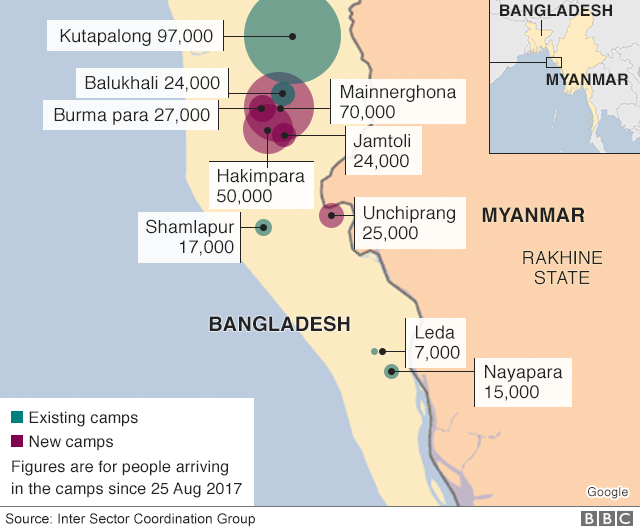
Where have the Rohingya fled to

bbc map
Grey line
Multiple sources in Myanmar's aid community have told the BBC that at high-level UN meetings in Myanmar any question of asking the Burmese authorities to respect the Rohingyas' human rights became almost impossible.
Ms Vandenabeele said it soon became clear to everyone that raising the Rohingyas' problems, or warning of ethnic cleansing in senior UN meetings, was simply not acceptable.
"Well you could do it but it had consequences," she said. "And it had negative consequences, like you were no longer invited to meetings and your travel authorisations were not cleared. Other staff were taken off jobs - and being humiliated in meetings. An atmosphere was created that talking about these issues was simply not on."
Repeat offenders, like the head of the UN's Office for the Co-ordination for Humanitarian Assistance (UNOCHA) were deliberately excluded from discussions.
Ms Vandenabeele told me she was often instructed to find out when the UNOCHA representative was out of town so meetings could be held at those times. The head of UNOCHA declined to speak to the BBC but it has been confirmed by several other UN sources inside Myanmar.
Ms Vandenabeele said she was labelled a troublemaker and frozen out of her job for repeatedly warning about the possibility of Rohingya ethnic cleansing. This version of events has not been challenged by the UN.
Attempts to restrict those talking about the Rohingya extended to UN officials visiting Myanmar. Tomas Quintana is now the UN special rapporteur for human rights in North Korea but for six years, until 2014, held that same role for Myanmar.
Speaking from Argentina, he told me about being met at Yangon airport by Ms Dessallien.
"I received this advice from her - saying you should not go to northern Rakhine state - please don't go there. So I asked why and there was not an answer in any respect, there was just the stance of not trying to bring trouble with the authorities, basically," he said.
"This is just one story, but it demonstrates what was the strategy of the UN Country Team in regards to the issue of the Rohingya."
Mr Quintana still went to northern Rakhine but said Ms Dessallien "disassociated" herself from his mission and he didn't see her again.
One senior UN staffer told me: "We've been pandering to the Rakhine community at the expense of the Rohingya.
"The government knows how to use us and to manipulate us and they keep on doing it - we never learn. And we can never stand up to them because we can't upset the government."
Image copyright Getty Images
Image caption Many Rohingya fled by night into Banglsdesh leaving everything behind
The UN's priorities in Rakhine were examined in a report commissioned by the UN in 2015 entitled "Slippery Slope: Helping Victims or Supporting Systems of Abuse".
Leaked to the BBC, it is damning of the UNCT approach.
"The UNCT strategy with respect to human rights focuses too heavily on the over-simplified hope that development investment itself will reduce tensions, failing to take into account that investing in a discriminatory structure run by discriminatory state actors is more likely to reinforce discrimination than change it."
There have been other documents with similar conclusions. With António Guterres as the new secretary general in New York, a former senior member of the UN was asked to write a memo for his team in April.
Titled "Repositioning the UN" the two-page document was damning in its assessment, calling the UN in Myanmar "glaringly dysfunctional".
In the weeks that followed the memo, the UN confirmed that Ms Dessallien was being "rotated" but stressed it was nothing to do with her performance. Three months on Ms Dessallien is still the UN's top official there after the Burmese government rejected her proposed successor.
"She has a fair view and is not biased," Shwe Mann, a former senior general and close ally of Myanmar's de facto leader Aung San Suu Kyi, told me. "Whoever is biased towards the Rohingyas, they won't like her and they will criticise her."
Ms Dessallien declined to give an interview to the BBC to respond to this article.
The UN in Myanmar said its approach was to be "fully inclusive" and ensure the participation of all relevant experts.
"We strongly disagree with the accusations that the resident co-ordinator 'prevented' internal discussions. The resident co-ordinator regularly convenes all UN agencies in Myanmar to discuss how to support peace and security, human rights, development and humanitarian assistance in Rakhine state," a statement from a UN spokesperson in Yangon said.
On Tomas Quintana's visits to Rakhine, the spokesperson said Ms Dessallien had "provided full support" in terms of personnel, logistics and security.
Ten ambassadors, including from Britain and the United States, wrote unsolicited emails to the BBC when they heard we were working on this report, expressing their support for Ms Dessallien.
There are those who see similarities between the UN's much-criticised role in Sri Lanka and what has happened in Myanmar. Charles Petrie wrote a damning report into the UN and Sri Lanka, and also served as the UN's top official in Myanmar (before being expelled in 2007).
He said the UN's response to the Rohingya over the past few years had been confused and that Ms Dessallien hadn't been given the mandate to bring all of the key areas together.
"I think the key lesson for Myanmar from Sri Lanka is the lack of a focal point. A senior level focal point addressing the situation in Myanmar in its totality - the political, the human rights, the humanitarian and the development. It remains diffuse. And that means over the last few years there have been almost competing agendas."
So might a different approach from the UN and the international community have averted the humanitarian disaster we are seeing now? It's hard to see how it might have deterred the Burmese army's massive response following the 25 August Rohingya militant attack.
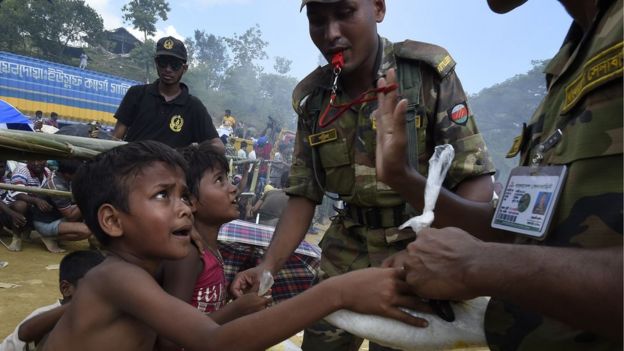
Bangladeshi soldiers distribute rice to young Rohingya refugees at the camp of Balukhali near Gumdhum on September 25, 2017Image copyright AFP
Image caption Bangladesh says it is struggling to cope with the refugees
Ms Vandenabeele said she at least believed an early warning system she proposed might have provided some indications of what was about to unfold.
"It's hard to say which action would have been able to prevent this," she told me. "But what I know for sure is that the way it was done was never going to prevent it. The way it was done was simply ignoring the issue."
Mr Quintana said he wished the international community had pushed harder for some sort of transitional justice system as part of the move to a hybrid democratic government.
One source said the UN now appeared to be preparing itself for an inquiry into its response to Rakhine, and this could be similar to the inquiry that came after the controversial end to Sri Lanka's civil war - and which found it wanting.

Wednesday, September 27, 2017

Nazis March into Germany’s Parliament

Nazis March into Germany’s Parliament

Muslim Nations Are Rallying to Protect the Rohingya, What About the Rest of Us?

Muslim Nations Are Rallying to Protect the Rohingya, What About the Rest of Us?

It is imperative to call Myanmar’s Rohingya persecution by its legal name, GENOCIDE

It is imperative to call Myanmar’s Rohingya persecution by its legal name, GENOCIDE
Gregory Stanton
BA (Oberlin College), MTS (Harvard Divinity School), MA and Ph.D. in Anthropology (U. of Chicago), and J.D. (Yale Law School)
Research Professor in Genocide Studies and Prevention, George Mason U., USA

The press and spokespersons for governments have called the Myanmar government’s aggression “ethnic cleansing.” This is a term invented by Slobodan Milosevic as a euphemism for forced displacement and genocide. It is an insidious term because there is no international treaty law against it, whereas there are international laws against forced displacement and genocide.

Genocidal massacres are acts of genocide. Genocide consists of acts of genocide intended to destroy, in whole or in part, a national, ethnic, racial, or religious group.

Genocide is precisely what the Myanmar government and supporting militias are committing against the Rohingya. Myanmar is committing both “ethnic cleansing” [forced displacement] and genocide. The crimes often go together. Genocidal massacres are used to terrorize a victim group into fleeing.

The so-called “international community” (which exists only in mythology) will avoid calling the crimes “genocide.” 

There are several reasons:

Lawyers have gutted the word “genocide” of its preventive effect by insisting on judicial standards of proof beyond a reasonable doubt rather than a prosecutor’s preponderance of the evidence standard. British Foreign Office, US State Department, and Dutch Foreign Ministry lawyers have even claimed that only a court can invoke the word “genocide,” a view that ignores the very name of the International Convention for the Prevention and Punishment of the Crime of Genocide. Courts always come after a genocide is over, too late to prevent it.

China will block forceful action by the UN Security Council. ASEAN, the relevant regional organization, could Act under UN Charter Chapter Eight, as it did in East Timor. But it won’t because normally ASEAN governments leave each alone.

“Genocide” is a more powerful word than “ethnic cleansing” but governments in the UN prefer to do nothing, rather than take more forceful action to stop genocide. 

Why does it make a difference whether these crimes not be named “crimes against humanity” or “war crimes,” and instead be called “genocide?”

Ethnic Cleansing is a euphemism for forcible displacement. “Ethnic cleansing” is not a term used in the Rome Treaty of the International Criminal Court. It has no legal meaning in international law.

In 2007, three epidemiologists and I conducted a study of the effect of using the words “ethnic cleansing” rather than genocide in four of the most recent genocides: Rwanda, Bosnia, Kosovo, and Darfur. Our team counted the number of uses of the terms “ethnic cleansing” and “genocide” in The New York Times, UN press releases, law journals, and statements by Amnesty International and Human Rights Watch.

We came to four important conclusions:

Use of the terms has no relationship to the number of people who have been killed. 8000 killed at Srebrenica was ruled “genocide” by the ICTY. Yet a U.N. Commission of Inquiry ruled that over 100,000 killed in Darfur (now over 300,000) was not sufficient evidence of intent to commit genocide by the government of Sudan.

Choice of the term to be used is determined by willingness to take action to stop the killing. When the terms “ethnic cleansing” or “crimes against humanity” were used, it indicated unwillingness to take forceful action to stop the crimes. These weak words have never motivated the use of force. Indeed they were probably chosen because the decision whether or not to use force had already been made.

It was not until the term “genocide” was applied to the crimes, that force was used to stop them.

This occurred three months into the genocide in Rwanda when the State Department finally acknowledged on June 10, 1994 that “acts of genocide” in Rwanda were the same as “genocide”, which is defined in the Genocide Convention as “acts.” This declaration came after the US had voted in the UN Security Council to pull UNAMIR troops out of Rwanda on April 21, 1994 and voted against sending in UN forces in May, when the killing was still underway. By June 10, the Rwandan Patriotic Front had won the civil war and stopped the genocide. 800,000 Rwandans were slaughtered. The US and other world powers were not willing to risk the life of a single soldier to protect them. The International Criminal Tribunal for Rwanda has convicted over fifty leaders of genocide and courts in Rwanda have convicted hundreds more.

The same denial emerged in Bosnia, as the world press and the US government called the massacres “ethnic cleansing” from 1991 until the Srebrenica massacre on July 11 – 13,1995, which provoked a NATO conference on July 21, and resulted in NATO bombing of Serb forces on August 30. The bombing brought Serbia to Dayton to agree to a ceasefire, division of Bosnia, and a NATO peacekeeping operation. The Bosnian civil war came to an end. The ICTY and International Court of Justice have ruled that the massacre at Srebrenica was genocide.

Kosovo was called “ethnic cleansing” until US War Crimes Ambassador David Scheffer noted “indicators of genocide” on April 7, 1999, followed immediately by bombing of Belgrade, which brought Serb surrender and NATO occupation of Kosovo. Six Serb leaders were convicted of crimes against humanity by the ICTY and the Kosovo Tribunal has convicted other perpetrators.

Regarding Darfur, following a careful empirical survey of evidence of genocide among Darfuri refugees, on September 9, 2004, Secretary of State Colin Powell declared that “genocide has occurred and may still be occurring in Darfur. We believe the evidence corroborates the specific intent of the perpetrators to destroy “a group in whole or in part.” He also said, “However, no new action is dictated by this determination.” A decision had evidently been made by the President not to involve US or NATO military forces in stopping the genocide, so all that followed were ineffective increases in the African Union monitoring force, but no direct military intervention by NATO or the US. Although the International Criminal Court has charged Sudanese President Omar al-Bashir and two others with genocide in Darfur, they have never been arrested and brought to trial. Sudan has three active genocides today. It is an example of the failure of the UN to stop genocide, and of the African Union and states-parties to the ICC Treaty to enforce international criminal law.

When the term “genocide” is used to describe crimes against humanity, use of force is
possible. When the crimes are only called “ethnic cleansing” or “crimes against humanity,” it is a sure indicator of lack of political will to take forceful action to stop them. Since 2000, the term “atrocities” has replaced “crimes against humanity” as an indicator of absence of will to take forceful action to stop them.
 
Dr. Gregory Stanton is Research Professor in Genocide Studies and Prevention at the School for Conflict Analysis and Resolution, George Mason University, Arlington, Virginia. He was the President (2007 – 2009) and First Vice President (2005 – 2007) of the International Association of Genocide Scholars (IAGS). Dr. Stanton is the founder (1999) and chairman of Genocide Watch (http://www.genocidewatch.com), the founder (1981) and director of the Cambodian Genocide Project, and is the founder (1999) and chairman of the Alliance Against Genocide, which has 65 member organizations in 24 countries. Dr. Stanton served in the State Department (1992-1999), where he drafted the United Nations Security Council resolutions that created the International Criminal Tribunal for Rwanda and wrote the options paper on ways to bring the Khmer Rouge to justice in Cambodia. He holds a BA (Oberlin College), MTS (Harvard Divinity School), MA and Ph.D. in Anthropology (U. of Chicago), and J.D. (Yale Law School.)

US lifts sanctions on daughter of military-linked Myanmar businessman

  The United States has removed sanctions on the daughter of a Myanmar businessman accused of supporting the military-installed government. ...