Monday, May 30, 2022

Jewish Settlers Storm Jerusalem’s Old City in Provocative ‘Flag March’ (VIDEOS)

 The provocative Israeli flag march stormed the Old City of occupied Jerusalem from Bab al-Amoud on Sunday night, with the participation of thousands of settlers, the official Palestinian news agency WAFA reported.

During the march, Jewish settlers insulted the Prophet Mohammad and chanted racist and other slogans calling for the death of Arabs.

At least 24 Palestinians were injured in attacks by the Israeli occupation forces and settlers in the occupied city of Jerusalem during the provocative march.

The Palestinian Red Crescent Society in Jerusalem reported that its crews dealt with at least 24 cases, including injuries from being shot by rubber-coated metal bullets, beatings, and pepper spray. Eight cases were transferred to hospitals, it added.

Meanwhile, a march of Palestinian flags took place in occupied Jerusalem, in response to the ‘flags march’ organized by the settlers.

Local sources reported that dozens of Palestinians marched with Palestinian flags on Salah El-Din Street in occupied Jerusalem, adding that settlers assaulted journalist Layali Eid and the accompanying staff, and tried to prevent her from carrying out her duty.

Israeli police attacked the Palestinian march, leading to clashes and the injury of at least two Palestinian youth.

The Israeli occupation forces arrested at least 25 citizens in the vicinity of Bab Al-Amoud and inside the neighborhoods of the Old City and Al-Aqsa Mosque.

(WAFA, PC, Social Media)

After Assassination of Guards Colonel, Israel PM Says Iran Has No Immunity

 Iranian Revolutionary Guards colonel Hassan Khodai was assassinated last week, in an attack Iran blamed on Israel. Israel has declined comment.

In the course of continuing to not comment on the killing, Prime Minister Naftali Bennett presented Israel as having targeted “the head of the octopus,” and insisted those in Iran’s regime involved in terror will all pay the “full price.”

Emphasizing the idea that Iran no longer has immunity, Bennett accused Iran of threatening Israeli interests, and seemed to tie Col. Khodai into the plots in a generalized fashion.

The narrative seems built around justifying an assassination they haven’t admitted to, and threatening more violence for the retaliation that is threatened butr hasn’t actually happened yet.

US expresses concern after UN human rights chief visits China’s Xinjiang

 The United States expressed concern on Saturday over China's "efforts to restrict and manipulate" the UN human rights chief's visit to the Xinjiang region where Beijing is accused of detaining over a million people in indoctrination camps.

Michelle Bachelet's long-planned trip this week took her to the far-western Xinjiang region, where the United States has labeled China's detention of a million Uyghurs and other Muslim minorities a "genocide." "We are concerned the conditions Beijing authorities imposed on the visit did not enable a complete and independent assessment of the human rights environment in (China), including in Xinjiang, where genocide and crimes against humanity are ongoing," US Secretary of State Antony Blinken said in a statement.

The top US diplomat reiterated his country's stance that Chinese authorities would not allow Bachelet full access during her long-planned trip, saying the United States was "concerned" about China's "efforts to restrict and manipulate her visit." Bachelet defended her visit earlier on Saturday while still inside China, saying it was "not an investigation" but called on Beijing to avoid "arbitrary and indiscriminate measures" in its crackdown in Xinjiang.

She said the trip was a chance for her to speak with "candour" to Chinese authorities as well as civil society groups and academics. Her visit was the first to China by a UN high commissioner for human rights in 17 years and comes after painstaking negotiations over the conditions of the visit.

'Warned not to complain'

"We are further troubled by reports that residents of Xinjiang were warned not to complain or speak openly about conditions in the region, that no insight was provided into the whereabouts of hundreds of missing Uyghurs and conditions for over a million individuals in detention," Blinken said. "The High Commissioner should have been allowed confidential meetings with family members of Uyghur and other ethnic minority diaspora communities in Xinjiang who are not in detention facilities but are forbidden from traveling out of the region."

Bachelet's remarks were also swiftly criticised by activists and NGOs, who accused her of providing Beijing with a major propaganda win. "Resignation is the only meaningful thing she can do for the Human Rights Council," said Dilxat Raxit, spokesperson for the World Uyghur Congress advocacy group, while US-based Uyghur activist Rayhan Asat called it a "total betrayal" on Twitter.

The trip included a virtual meeting with President Xi Jinping in which state media suggested Bachelet supported China's vision of human rights. Her office later clarified that her remarks did not contain a direct endorsement of China's rights record.

Witnesses and rights groups say more than one million people have been detained in indoctrination camps in the western Chinese region that aim to destroy the Uyghurs' Islamic culture and forcibly integrate them into China's Han majority. Beijing denies the allegations and says it is offering vocational training to reduce potential for Islamist extremism.

(AFP)

Saturday, May 28, 2022

India's Hindtuvadis try to take possession of Taj Mahal

 Allahabad High Court on Thursday (May 12) dismissed a petition filed by BJP leader Rajneesh Singh asking for a fact-finding panel to establish “the real History of Taj Mahal”, and for more than 20 sealed “rooms” to be opened to look for the possible presence of idols of Hindu gods on the premises of the monument.

=============

A petition has been filed before the Lucknow bench of the Allahabad High Court seeking a direction to the Archaeological Survey of India (ASI) to open the doors of over 20 chambers inside the Taj Mahal premises. It is hoped that whatever is found will put the controversy related to the "history of Taj Mahal" to rest. The petition, filed by Dr Rajneesh Singh who is the media in charge of the Bharatiya Janata Party (BJP) Ayodhya unit, has sought the constitution of a fact-finding committee as the idols of the deities are locked up behind these chambers. These chambers were closed a few decades ago because of security reasons by the ASI.

While filing the PIL Rajneesh Singh said he has been trying to get details about the locked chambers since 2020 through the Right to Information Act (RTI) and his petition was submitted to the Union Ministry of Culture. But instead of providing the details of these chambers, the ministry said that these rooms were locked due to security reasons. Singh said he had also asked for the opening of these chambers.

"Since all my efforts have failed, I have no alternative but to approach the High Court for its directives to the ASI to open these chambers and find out whether and what idols and scriptures are kept there," Singh said. The PIL seeks historical evidence about idols and other materials hidden there on the instructions of Mughal Emperor Shah Jahan. The plea, filed through advocate Rudra Vikram Singh, said that many Hindu groups have been claiming that the Taj Mahal is an old Shiva Temple which was known as Tejo Mahalaya and this is supported by many historians as well. These claims, the petition said, have led to a situation where Hindus and Muslims are fighting with each other and therefore the controversy needs to be put to rest.

Narrative 

Narrative These “chambers” of the Taj Mahal form the platform on which the actual building rests. The structure is situated on a reclining piece of land beside the river, writesM Hasan The decades-old saffronised controversy over the history of the Taj Mahal has finally landed in the Lucknow bench of the High Court for its archaeological adjudication. These “chambers” form the platform on which the actual building rests. The structure is situated on a reclining piece of land beside the river. According to historical evidence from Shah Jahan’s reign, historians have gathered information as to how the foundations were laid to give a firm base to the superstructures, especially on the riverfront. According to historian Prof Ali Nadeem Rezavi of Aligarh Muslim University, “at the time of laying the foundation, the chief architects the Muhandis and/or the mimar first chalked out the plan on the ground and then the diggers excavated the foundations to considerable depths. The foundations of the Taj Mahal were built on stone and watertight mortar-Sooraj.” The PIL filed by Ayodhya-based BJP leader Dr Rajneesh Singh has pointed out that “there were 22 rooms situated in the upper and lower portion of the four-storied building of the monument which was permanently locked and historians like PN Oak and many Hindu worshippers believed that in those rooms lies the temple of Shiva”. The PIL has “submitted that since Taj Mahal is an ancient monument, and large sums of money are being invested for the preservation of the monument, the correct and complete historical facts about the monument should be disclosed to the public.” “It is said that Taj Mahal was named after Shah Jahan’s wife Mumtaz Mahal, however, in many books the name of the wife of Shahjahan was described as Mumtaz-ul-Zamani, not Mumtaz Mahal. The fact that the construction of a mausoleum takes 22 years for completion is beyond reality and totally an absurdity,” the PIL stated. The PIL said, “It is there in many history books that in 1212 AD, Raja Paramardi Dev had built Tejo Mahalaya temple palace (presently Taj Mahal). The temple was later inherited by Raja Maan Singh, the then Maharaja of Jaipur. After him, the property was held and managed by Raja Jai Singh but was annexed by Shah Jahan (in 1632) and later it was converted into a memorial for the wife of Shah Jahan.” Taj Mahal is a perfectly symmetrical original monument representing the finest architectural and artistic achievements through excellent craftsmanship and perfect harmony of design. Its foundation was a herculean task to build as in those days. The standard cloggy soil was usually avoided for construction due to its unstable nature. Taj Mahal has been recognised as one of the “seven wonders” of the world and a world heritage site by the United Nations Educational, Scientific and Cultural Organisation (UNESCO) in 1983. In February 2018 the Archaeological Survey of India (ASI) had tried to set the controversy at rest by filing an affidavit in Agra court in which the agency made it clear that the Taj Mahal was the tomb of Emperor Shah Jahan and his wife Mumtaz Mahal and that claims that it was a Shiva temple, “Tejo Mahalaya,” were imaginary. The ASI affidavit further said that “the Supreme Court had already decided what parts of the Taj Mahal are to be opened and what should be closed, so there was no need for a review of the matter”. The ASI had also observed that the entire controversy originated from a book by PN Oak-Taj Mahal-The true history, which claimed Taj Mahal’s Hindu origins. Dr Ravi Panwar of IIT Jabalpur writes, “because of the age of the structure, initial drawings used for the construction of the monument are no longer available. Also, with the time conditions around the site have altered significantly. Therefore, the exact construction details of the foundation are not known”. But the structure still stands tall and intact even after so many centuries essentially because of the construction technique employed in its foundation.

https://www.news9live.com/india/asi-had-buried-taj-mahal-controversy-long-ago-but-pil-wants-it-dug-up-afresh-169216

Right of Return, Nakba Are Back on Palestinian Agenda BY RAMZY BAROUD

 The Nakba is back on the Palestinian agenda.

For nearly three decades, Palestinians were told that the Nakba – or Catastrophe – is a thing of the past. That real peace requires compromises and sacrifices, therefore, the original sin that has led to the destruction of their historic homeland should be entirely removed from any ‘pragmatic’ political discourse. They were urged to move on.

The consequences of that shift in narrative were dire. Disowning the Nakba, the single most important event that shaped modern Palestinian history, has resulted in more than political division between the so-called radicals and the supposedly peace-loving pragmatists, the likes of Mahmoud Abbas and his Palestinian Authority. It also divided Palestinian communities in Palestine and across the world around political, ideological and class lines.

Following the signing of the Oslo Accords in 1993, it became clear that the Palestinian struggle for freedom was being entirely redefined and reframed. It was no longer a Palestinian fight against Zionism and Israeli settler colonialism that goes back to the start of the 20th century, but a ‘conflict’ between two equal parties, with equally legitimate territorial claims that can only be resolved through ‘painful concessions’.

The first of such concessions was relegating the core issue of the ‘Right of Return’ for Palestinian refugees who were driven out of their villages and cities in 1947-48. That Palestinian Nakba paved the way for Israel’s ‘independence’, which was declared atop the rubble and smoke of nearly 500 destroyed and burnt Palestinian villages and towns.

At the start of the ‘peace process’, Israel was asked to honor the Right of Return for Palestinians, although symbolically. Israel refused. Palestinians were then pushed to relegate that fundamental issue to a ‘final status negotiations’, which never took place. This meant that millions of Palestinian refugees – many of whom are still living in refugee camps in Lebanon, Syria and Jordan, as well as the occupied Palestinian territories – were dropped from the political conversation altogether.

If it were not for the continued social and cultural activities of the refugees themselves, insisting on their rights and teaching their children to do the same, such terms as the Nakba and Right of Return would have been completely dropped out of the Palestinian political lexicon.

While some Palestinians rejected the marginalization of the refugees, insisting that the subject is a political not merely a humanitarian one, others were willing to move on as if this right was of no consequence. Various Palestinian officials affiliated with the now defunct ‘peace process’ have made it clear that the Right of Return was no longer a Palestinian priority. But none came even close to the way that PA President Abbas, himself, framed the Palestinian position in a 2012 interview with Israeli Channel 2.

“Palestine now for me is the ’67 borders, with East Jerusalem as its capital. This is now and forever … This is Palestine for me. I am [a] refugee, but I am living in Ramallah,” he said.

Abbas had it completely wrong, of course. Whether he wished to exercise his right of return or not, that right, according to United Nations General Assembly Resolution 194, is simply “inalienable”, meaning that neither Israel, nor the Palestinians themselves, can deny or forfeit it.

Let alone the lack of intellectual integrity of separating the tragic reality of the present from its main root cause, Abbas lacked political wisdom as well. With his ‘peace process’ floundering, and with the lack of any tangible political solution, he simply decided to abandon millions of refugees, denying them the very hope of having their homes, land or dignity restored.

Since then, Israel, along with the United States, has fought Palestinians on two different fronts: one, through denying them any political horizon and, the other, by attempting to dismantle their historically enshrined rights, mainly their Right of Return. Washington’s war on the Palestinian refugees’ agency, UNRWA, falls under the latter category as the aim was – and remains – the destruction of the very legal and humanitarian infrastructures that allow Palestinian refugees to see themselves as a collective of people seeking repatriation, reparations and justice.

Yet, all such efforts continue to fail. Far more important than Abbas’ personal concessions to Israel, UNRWA’s ever-shrinking budget or the failure of the international community to restore Palestinian rights, is the fact that the Palestinian people are, once again, unifying around the Nakba anniversary, thus insisting on the Right of Return for the seven million refugees in Palestine and the shattat – Diaspora.

Ironically, it was Israel that has unwittingly re-unified Palestinians around the Nakba. By refusing to concede an inch of Palestine, let alone allow Palestinians to claim any victory, a State of their own – demilitarized or otherwise – or allow a single refugee to go home, Palestinians were forced to abandon Oslo and its numerous illusions. The once popular argument that the Right of Return was simply ‘impractical’ no longer matters, neither to ordinary Palestinians nor to their intellectual or political elites.

In political logic, for something to be impossible, an alternative would have to be attainable. However, with Palestinian reality worsening under the deepening system of Israeli settler colonialism and apartheid, Palestinians now understand that they have no possible alternative but their unity, their resistance and the return to the fundamentals of their struggle. The Unity Intifada of last May was a culmination of this new realization. Moreover, the Nakba anniversary commemoration rallies and events throughout historic Palestine and the world on May 15 have further helped crystallize the new discourse that the Nakba is no longer symbolic and the Right of Return is the collective, core demand of most Palestinians.

Israel is now an apartheid state in the real meaning of the word. Israeli apartheid, like any such system of racial separation aims at protecting the gains of nearly 74 years of unhinged colonialism, land theft and military dominance. Palestinians, whether in Haifa, Gaza or Jerusalem, now fully understand this, and are increasingly fighting back as one nation.

And since the Nakba and the subsequent ethnic cleansing of Palestinian refugees are the common denominator behind all Palestinian suffering, the term and its underpinnings are back at center stage of any meaningful conversation on Palestine, as should have always been the case.

Tunisia: Algerian president claims Tunisia has gone off 'democratic path'

 Algeria's president has offered to help Tunisia return to the "democratic path" as political instability in the north African country continues to provoke criticism abroad.

During a press conference with his Italian counterpart Sergio Mattarella, Algerian President Abdelmadjid Tebboune stated that his country has agreed to "help Tunisia return to the democratic path".

He said there was an Algerian-Italian consensus on the Tunisian crisis, saying Algeria shared its neighbour's problems.

"We are prepared to help it get out of the impasse it has entered and return to the path of democracy," he said.

On 25 July last year, Tunisian President Kais Saied announced a set of controversial measures, revealed by Middle East Eye two months earlier, including the suspension of parliament and the sacking of the prime minister, that were denounced as a coup by rights groups and opposition parties.

Saied shut down the country's independent anti-corruption authority and sidelined the national election authority. He later dissolved the Supreme Judicial Council - the body that oversees judicial independence - and granted himself control over the selection and promotion of judges.

The president also initiated an online public consultation before drafting a new constitution that he said will be put to a referendum in July, followed by parliamentary elections in December.

Tebboune's change of tune

Tebboune's remarks contrast sharply with his earlier stance on Saied's power grab, when he expressed his "understanding" of the exceptional measures, while also announcing a $300m loan to "support the struggling Tunisian economy". 

In August, Tebboune also criticised Tunisia's democratisation process - repeatedly held up as the most successful of the 2011 Arab Spring - arguing in an interview that the country had picked a governing system "incompatible with the configurations of Third World [countries]."

The Algerian president’s comments follow Saied’s ratification of a presidential decree calling for voters to vote on a new draft constitution for a “new republic” on 25 July, ignoring calls from opposition forces to “reverse the controversial move”. 

The referendum's sole question, according to a decree published in the Official Gazette on Wednesday, will be: "Do you agree with the new constitution?"

'Time for action is now': US needs to reassess approach towards Tunisia, experts say
Read More »

As the country's political and economic crisis worsens, Saied has found himself increasingly isolated by allies in and out of the country, with Algeria's distancing itself from Saied coinciding with opposition groups and political parties in Tunisia rejecting Saied's demands for a "national dialogue".

Saied had proclaimed the opening of the "dialogue" at the beginning of May in an effort to "resolve" the political impasse - however, the dialogue excluded key opposition groups and parties who, according to the president, have "sabotaged, starved, and mistreated the people." 

Organisations such as the influential Tunisian General Labour Union (UGTT) refused to participate in the dialogue, with the union stating: "We reject any formal dialogue in which roles are determined unilaterally and civil and political forces are excluded."

This is seen as a sign of the president's increasing isolation.

On Monday, Saied appointed new members of the election commission, in a move critics say will entrench his one-man rule and cast doubt on the country's electoral integrity.

Saied has said his actions were needed to save Tunisia from years of economic stagnation and political paralysis at the hands of a corrupt, self-serving elite.

Last month, several Tunisian opposition parties announced the formation of a National Salvation Front to "save" the country from the deepening political crisis.

UN Security Council Renews Arms Embargo on South Sudan

 The UN Security Council on Thursday renewed an arms embargo and sanctions against South Sudan amid continuing unrest in the country.

A resolution to extend the ban through May 2023, drafted by the United States, was passed with 10 out of 15 votes, with Gabon, Kenya, India, Russia, and China abstaining.

The embargo was imposed in 2018 after a peace agreement ended five years of bloody civil war between factions loyal to President Salva Kiir and Vice President Riek Machar.

When the embargo was last extended a year ago, authorities in South Sudan were given a list of political and security conditions in order for the restrictions to be lifted or relaxed.

However, earlier this month, a UN expert panel recommended that the embargo remain in place over persistent ceasefire violations as well as over the government’s imports of armored vehicles in violation of the ban.

And UN Secretary General Antonio Guterres said more progress is needed in the areas of disarmament, demobilization and reintegration of combatants.

A diplomatic source said the resolution passed Thursday contains a provision for a possible easing of the restrictions for non-lethal military equipment if it is needed to fulfil the 2018 peace agreement.

The provision was included at the request of the Security Council’s three African members, Kenya, Gabon, and Ghana, the diplomatic source said.

The youngest country in the world, South Sudan has experienced chronic instability since becoming independent from Sudan in 2011.

The 2013-2018 war left nearly 400,000 dead and millions displaced.

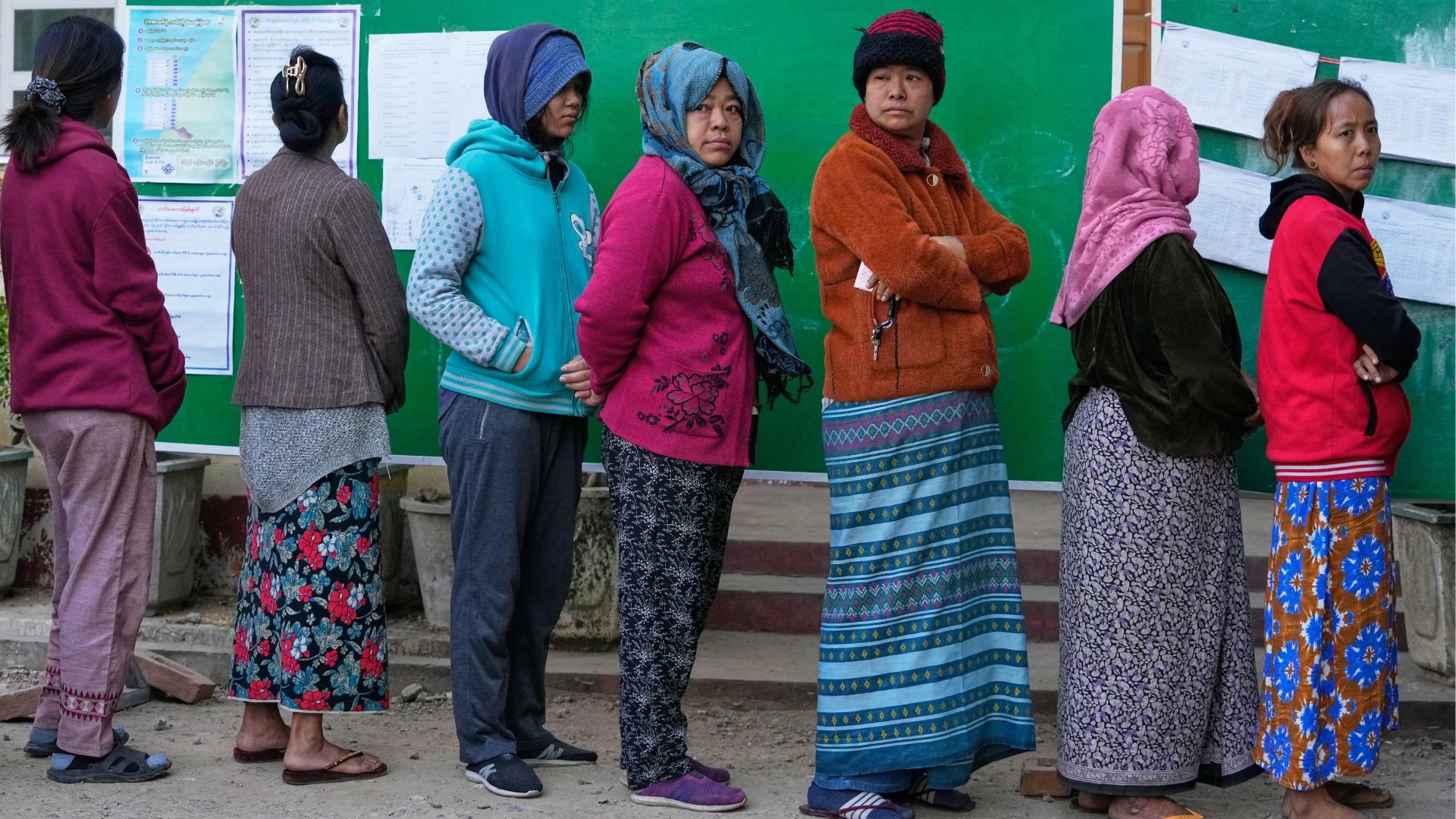
US lifts sanctions on daughter of military-linked Myanmar businessman

  The United States has removed sanctions on the daughter of a Myanmar businessman accused of supporting the military-installed government. ...