Monday, January 30, 2023

A State for Some of Its Citizens: Captured Black Soldier’s Saga Highlights Racism in Israel BY RAMZY BAROUD

 “For how long will I be in captivity? After so many years, where are the state and the people of Israel?” These were the words, uttered in Hebrew, of a person believed to be Avera Mengistu, an Israeli soldier of Ethiopian origin who was captured and held in Gaza in 2014.

Footage of Mengistu, looking nervous but also somewhat defiant, calling on his countrymen to end his 9-year incarceration, mostly ended speculation in Israel on whether the soldier was alive or dead.

The timing of the release of the footage by Hamas was obvious, and is directly linked to the Palestinian group’s efforts aimed at conducting a prisoner exchange similar to the one carried out in 2011, which saw the release of captured Israeli soldier Gilad Shalit, in exchange for the release of over 1,000 Palestinian prisoners.

The main target audience of Hamas’ message is the new government and, specifically, the new military leadership. Israel now has a new army chief, Lt. Gen. Herzi Halevi, who has replaced the departing chief, Aviv Kochavi. The latter seemed disinterested in Mengistu’s cause, while the new chief arrives with lofty promises about uniting the country behind its military and opening a new page where the army is no longer involved in everyday politics.

It may appear that Hamas and other Gaza groups are in a stronger position than the one they enjoyed during Shalit’s captivity, between 2006 and 2011. Not only are they militarily stronger but, instead of capturing one Israeli, they have four: aside from Mengistu, they also have Hisham al-Sayed, and what is believed to be the remains of two other soldiers, Hadar Goldin and Oron Shaul.

But this is when the story gets particularly complicated. Unlike Shalit, who is white and holds dual Israeli-French citizenship, Mengistu and al-Sayed are Ethiopian Jew and Bedouin, respectively.

Racism based on color and ethnicity is rife in Israel. Although no Israeli officials will admit to this openly, Israel is in no rush to rescue two men who are not members of the dominant Ashkenazi group, or even of the socially less privileged Sephardic or Mizrahi Jews.

Black Jews and Bedouins have always been placed at the bottom of Israel’s socio-economic indicators. In 2011, the Israeli newspaper The Jerusalem Post shared numbers from a disturbing report, which placed poverty among children of Ethiopian immigrants at a whopping 65 percent. The number is particularly staggering when compared to the average poverty rate in Israel, of 21 percent.

Things have not improved much since then. The Israeli Justice Ministry’s annual report on racism complaints shows that 24 percent of all complaints are filed by Ethiopians. This racism covers most aspects of public life, from education to services to police mistreatment.

Not even enlisting in the military – Israel’s most revered institution – is enough to change Ethiopians’ position in Israeli society.

The famous story of Demas Fikadey in 2015 is a case in point. Then only 21, the Ethiopian soldier was beaten up severely by two Israeli police officers in a Tel Aviv suburb for no reason at all. The whole episode was caught on camera, leading to mass protests and even violent clashes. For Ethiopian Jews, the humiliation and violence carried out against Fikadey was a representation of years of suffering, racism and discrimination.

Many believe that the government’s lackluster response to Mengistu’s prolonged capture is directly linked to the fact that he is black.

Israel’s discriminatory behavior against African asylum seekers, which often leads to forceful deportation following humiliating treatment, is well known. Amnesty International described this in a report in 2018 as “a cruel and misguided abandonment of responsibility”.

But discriminating against a black soldier, who, by Israel’s own estimation, is believed to suffer from mental illness, is a whole different kind of ‘abandonment’.

A former Israeli army official, Col. Moshe Tal did not mince words in a recent national radio interview when he said that Mengistu and al-Sayed are a low priority for the public “on the account of their race”, Haaretz reported.

“If we were speaking about two other citizens from other backgrounds and socio-economic statuses … the amount of interest would be different,” Tal said. In contrast to Shalit’s story, the government’s “attention to the affair (and) the media pulse, is close to zero.”

Israel’s Ethiopian Jews number around 170,000, hardly an important political constituency in a remarkably divided and polarized society. Most of them are immigrants or descendants of immigrants who arrived in Israel between 1980 and 1992. Though they are still known as the Falasha, they are sometimes referred to by the more dignified name of ‘Beta Israel’, or ‘House of Israel’.

Superficial language alterations aside, their struggle is evident in everyday Israel. The plight of Mengistu, as expressed in his own question, “where are the state and the people of Israel?” sums up the sense of collective loss and alienation this community has felt for nearly two generations.

When Mengistu arrived with his family at the age of 5 in Israel, escaping a bloody civil war in Ethiopia and historic discrimination there, the family, like most Ethiopians, hardly knew that discrimination would follow them, even in the supposed land of ‘milk and honey’.

And, most likely, they also knew little about the plight of Palestinians, the native inhabitants of that historic land, who are victims of terrible violence, racism and much more.

Palestinians know well why Israel has done little to free the black soldier; Mengistu and his Ethiopian community also understand how race is an important factor in Israeli politics. Although a prisoner exchange could potentially free Mengistu and an unspecified number of Palestinian prisoners held in Israel, the suffering of the Palestinians at the hands of Israel and discrimination against Ethiopian Jews will carry on for much longer.

While Palestinians are resisting Israel’s military occupation and apartheid, Ethiopian Jews should mount their own resistance for greater rights. Their resistance must be predicated on the understanding that Palestinians and Arabs are not the enemy but potential allies in a joint fight against racism, apartheid and socio-economic marginalization.

Moderation à la Modi: Indian government's crackdown on BBC documentary backfires


TECH 24
TECH 24 © FRANCE 24

The Indian federal government's attempt to suppress a BBC documentary about Prime Minister Narendra Modi's role during the deadly 2002 anti-Muslim riots in Gujarat has backfired. Activists have been organising screenings across the country, and many people are continuing to share clips on platforms other than Twitter and YouTube. In this week's edition of Tech 24, Peter O'Brien breaks down what the consequences are, particularly for Twitter and the Modi government.

Indian police detain students over Modi documentary screenings

 Police have detained many students in the Indian capital, New Delhi, over the screening of a BBC documentary on Prime Minister Narendra Modi’s alleged role during the deadly Gujarat sectarian riots in 2002.

Police swarmed Delhi University after student groups supportive of Modi’s Bharatiya Janata Party (BJP) objected to the screening, seizing laptops and imposing a ban on assemblies of more than four people.

Police officer Sagar Singh Kalsi told Indian news channel NDTV that 24 students were detained.

Earlier this week, the federal government used emergency powers to block the airing of the documentary and banned its sharing on social media. Twitter and YouTube complied with the request and removed many links to the documentary.

Students at Delhi University and at numerous campuses across India gathered to watch the documentary on laptops and phones, defying government efforts to stop the film’s streaming.

Policemen and security guards of Delhi University escort a protesting student out
Students at Delhi University have been detained over the screening of the BBC documentary [Manish Swarup/AP Photo]

The two-part film says Modi had ordered police to turn a blind eye to deadly riots while he was chief minister of Gujarat state.

The violence began after 59 Hindu pilgrims were killed in a fire on a train. Thirty-one Muslims were convicted of criminal conspiracy and murder over that incident.

About 2,000 people, mostly Muslims, were killed in the unrest that followed.

The documentary quoted a previously classified British foreign ministry report which said the violence was “politically motivated” and the aim “was to purge Muslims from Hindu areas”.

The report also claims that the riots were impossible “without the climate of impunity”, created by Modi’s administration.

Privacy Policy

Defying government rules

Defiant students have staged broadcasts on several campuses around the country.

On Wednesday, tensions over the issue flared in New Delhi, where a student group at Jamia Millia Islamia university said it planned to screen the banned documentary, prompting dozens of police equipped with tear gas and riot gear to gather outside the campus gates.

Police, some in plain clothes, scuffled with protesting students and detained at least half a dozen of them.

The Jawaharlal Nehru University authorities in the capital cut off power and internet on the campus on Tuesday before the documentary was scheduled to be screened by a students’ union.

Authorities said it would disturb the peace on campus, but students nonetheless watched the documentary on their laptops and mobile phones after sharing it on messaging services such as Telegram and WhatsApp.

At the University of Hyderabad, in India’s south, an inquiry was launched after a student group showed the banned documentary earlier this week.

In the southern state of Kerala, BJP workers held demonstrations after some student groups affiliated with rival political parties defied the ban and screened the film.

Declining press freedom

Modi ran Gujarat from 2001 until his election as prime minister in 2014 and briefly faced a travel ban by the United States over the violence in 2002.

An investigation team appointed by the Supreme Court of India to investigate the role of Modi and others in the riots said in 2012 it did not find any evidence to prosecute him.

The government’s ban on the documentary has set off a wave of criticism from opposition parties and rights groups that slammed it as an attack against press freedom. It also drew more attention to the documentary, sparking scores of social media users to share clips on WhatsApp, Telegram and Twitter.

Press freedom in India has declined in recent years. The country fell eight places to 150 out of 180 countries in last year’s Press Freedom Index published by Reporters Without Borders. It accuses Modi’s government of silencing criticism on social media, particularly on Twitter.

Human Rights Watch said the ban on the documentary reflects a broader crackdown on minorities under the Modi government, which the rights group said has frequently invoked draconian laws to muzzle criticism.

“You can ban, you can suppress the press, you can control the institutions but the truth is the truth. It has a nasty habit of coming out,” Rahul Gandhi, a leader of the opposition Congress party, told reporters.

SOURCE: AL JAZEERA AND NEWS AGENCIES

Israeli Soldiers Open Fire at Palestinian Journalists Covering Event near Nablus

 Israeli occupation soldiers on Saturday opened fire in the direction of Palestinian journalists while covering an event in the town of Beita, near Nablus, the official news agency WAFA reported.

Palestinian journalist Wahaj Bani Moufleh told WAFA that he and his colleague, Mohammad Sumrin, were preparing a report on the Israeli army’s closure of the Beita entrance with cement boulders. Israeli soldiers shot live gunfire in their direction despite the fact that they were wearing vests clearly indicating that they were press.

Sumrin reported that a couple of Israeli soldiers first fired tear gas canisters at a group of youths, then opened fire in their direction and forced them to pull back immediately.

Last night, a Jewish settler opened fire and injured five people in the town of Beita.

Afterward, Israeli soldiers came to the area and instead of arresting the settler placed the boulders at the entrance of the town, blocking the movement of people, even pedestrians.

Israeli settlers carry out 144 attacks against Palestinians in one day

 Israeli settlers unleashed a wave of attacks targeting Palestinians and their properties in the occupied West Bank on the morning of 29 January, according to reports.

According to WAFA news agency, the Palestinian official Ghassan Daghlas spoke of 144 registered attacks in the occupied West Bank.

Settlers threw stones, damaged vehicles, and set fire to at least six vehicles in the occupied West Bank and Jerusalem.

According to the report, the attacks occurred in the towns and villages of Madama, Qusra, Jorish, Majdal Bani Fadel, and Huwwara, where at least 22 Palestinian shops were targeted.

Israel’s government under Prime Minister Benjamin Netanyahu made true on its promise to intensify state violence and harassment of Palestinians, killing 32 in 2023 alone.

Meanwhile, the Palestinian Authority (PA) held Israel responsible for the growing tensions and violence in the streets, which reached its peak when Israeli forces entered Jenin and massacred at least 10 Palestinians.

In addition to the violent acts carried out by Israeli settlers on Sunday, occupation bulldozers began with the demolition of Palestinian homes in the Jabal al-Mukabber neighborhood in occupied Jerusalem, according to various videos shared on social media.

In response, the prime minister also announced that his administration would look into plans to make it easier for Israelis to acquire weapons. Additionally, his office said they are looking into ways to “strengthen” illegal settlements in the occupied West Bank. According to Israeli media, there are discussions about distributing “thousands of weapons” to settlers.

Meanwhile, on 28 January, the Israeli army announced that it was deploying three additional battalions to the West Bank due to heightened tensions between the Israeli army and the Palestinian resistance, which left over two dozen dead this week.

Moreover, Netanyahu is expected to put forward a law to deport the families of Palestinian resistance fighters, and the cabinet will discuss arresting the relatives and close associates of the perpetrators of the recent attacks.

In retaliation to the massacre in Jenin, Palestinians have so far carried out two shooting operations on settlers in occupied Jerusalem that left at least 12 dead, dealing a heavy blow to Israel’s security situation.

Israeli Nobel laureate says judicial overhaul plan would mark ‘the end of democrac’

 Nobel Prize laureate Prof. Daniel Kahneman said in an interview Sunday that he is deeply concerned about the future of the country — even more so than he was during the 1973 Yom Kippur War.

“From my perspective, it’s almost the end of the world,” he said in an interview with Channel 12 news. “It’s the end of the country as I know it.”

Kahneman, 88, said he has been thinking to himself about “whether I was more worried in 1973. And the answer was I was less worried…. Today, I am more worried. I’m worried for the essence of the state.”

Then-US president Barack Obama awards Daniel Kahneman the Presidential Medal of Freedom, November 20, 2013, during a ceremony in the East Room of the White House in Washington. (AP Photo/ Evan Vucci)

Kahneman told Channel 12 news that the moment “the executive authority will supersede the judicial authority… that’s the end of democracy. There is no doubt.” Such a move, he said, would bring Israel in line with Hungary, Poland, and Turkey — “dictatorships that impersonate democracies.”

The Nobel prize winner said that stripping power from Israel’s judicial system was just the start of a slippery slope that would see harm to journalists and then “to individual freedoms. That’s the direction we’re heading in.”


He rejected any claims that the government’s planned shakeup of the judicial system is relatively minor: “This isn’t a small change, it’s a huge revolution. It’s a revolution that changes the nature of the country, from a working democracy to something that is not a democracy, that is pretending to be a democracy.”

On the economic front, Kahneman noted that an independent judicial system is necessary “to prevent corruption, and to allow the economy to develop. Modern, democratic economies are reliant on the judicial system.” Such changes will make “the State of Israel less attractive” in the eyes of the world and to investors, he said.

The government’s radical overhaul plan “turns the State of Israel from something that you can be proud of to something that is a little uncomfortable to be linked to.”

The professor’s comments to Channel 12 echoed similar remarks he made in an interview with The Marker published last week. Kahneman told the financial newspaper that the judicial shakeup signified “the end of Israeli democracy.”

Protesters against the proposed changes to the justice system at Habima Square in Tel Aviv, on January 21, 2023. (Avshalom Sassoni/Flash90)

Kahneman was one of hundreds of signatories to an “emergency letter” published last week, warning that the far-reaching judicial shakeup could have grave implications for the economy.

“I ask everyone I meet if there is room for hope, I haven’t heard anything promising. I hope the worst doesn’t happen,” Kahneman said.


The economist also said last week that he believed the moves by the government would lead to a downgrading of Israel’s position in the academic world.

“There are already many academics who don’t participate in conferences in Israel, but they are a minority. The impact is still to come — Israel will be ostracized, like South Africa was in the past, and like it is in Turkey, where it’s difficult to hold scientific conferences today,” he said.

As presented by Justice Minister Yariv Levin, the coalition’s proposals would severely restrict the High Court’s capacity to strike down laws and government decisions, with an “override clause” enabling the Knesset to re-legislate struck-down laws with a bare majority of 61; give the government complete control over the selection of judges; prevent the court from using a test of “reasonableness” to judge legislation and government decisions; and allow ministers to appoint their own legal advisers, instead of getting counsel from advisers operating under the aegis of the Justice Ministry.

Dozens killed in Pakistan mosque blast

 
Security officials inspect the site of a mosque in Peshawar
Security officials inspect the site of a mosque blast in Peshawar, Pakistan [Maaz Ali/AFP]

Dozens of people have been killed in a bomb attack targeting a mosque in a security compound in the northwestern Pakistani city of Peshawar, according to authorities.

Muhammed Asim, a spokesperson for the Lady Reading Hospital in Peshawar, told Al Jazeera that at least 59 people were killed and 157 others were wounded in the blast. Police later confirmed the death toll.

Siddique Khan, a police official, said the attacker blew himself up while among the worshippers. Authorities said 27 of the dead were police officials

Sarbakaf Mohmand, a commander for the Pakistan Taliban (Tehreek-e-Taliban, or TTP), initially claimed responsibility for the attack on Twitter.

But hours later, TTP spokesperson Mohammad Khurasani distanced the group from the bombing, saying it was not its policy to target mosques, seminaries and religious places. His did not address why a TTP commander had claimed responsibility for the bombing.

“Tehreek-e-Taliban has nothing to do with this attack,” a TTP statement said.

The mosque is located inside a highly fortified compound that includes the headquarters of the provincial police force and a counterterrorism department.

Authorities said part of the building collapsed and that many people were feared to be trapped under the rubble.

Peshawar’s Police Chief Muhammad Ijaz Khan said in a televised statement that the capacity of the main hall of the mosque was nearly 300 and it was “nearly full” at the time of the explosion.

Privacy Policy

The mosque is within Peshawar’s Police Lines, an area that is part of the city’s red zone where a number of important government installations are, including the Chief Minister House, Governor House, and the Khyber Pakhtunkhwa provincial assembly building.

Al Jazeera’s Kamal Hyder, reporting from Islamabad, said that “the suicide bomber [was reportedly] sitting in the front row of the congregational prayers inside the mosque”.

Interactive_Pakistan_PeshawarBlast_Jan30_Update 3B
(Al Jazeera)

Shahid Ali, a policeman who survived the attack, said the explosion took place seconds after the prayers started.

“I saw black smoke rising to the sky. I ran out to save my life,” the 47-year-old told the AFP news agency.

“The screams of the people are still echoing in my mind,” he added. “People were screaming for help.”

Prime Minister Shehbaz Sharif condemned the bombing as an “attack on Pakistan”. He promised “stern action” against those behind the attack.

Former Pakistan Prime Minister Imran Khan took to Twitter to denounce the bombing.

“Strongly condemn the terrorist suicide attack in police lines mosque Peshawar during prayers,” he tweeted.

“It is imperative we improve our intelligence gathering and properly equip our police forces to combat the growing threat of terrorism.”

Peshawar, the capital of the Khyber Pakhtunkhwa province bordering Afghanistan, has experienced frequent attacks.

Last March, a suicide bomber targeted a mosque there, killing 64 in Pakistan’s deadliest attack since 2018. The Islamic State in Khorasan Province, ISKP (ISIS-K) claimed responsibility for the bombing.

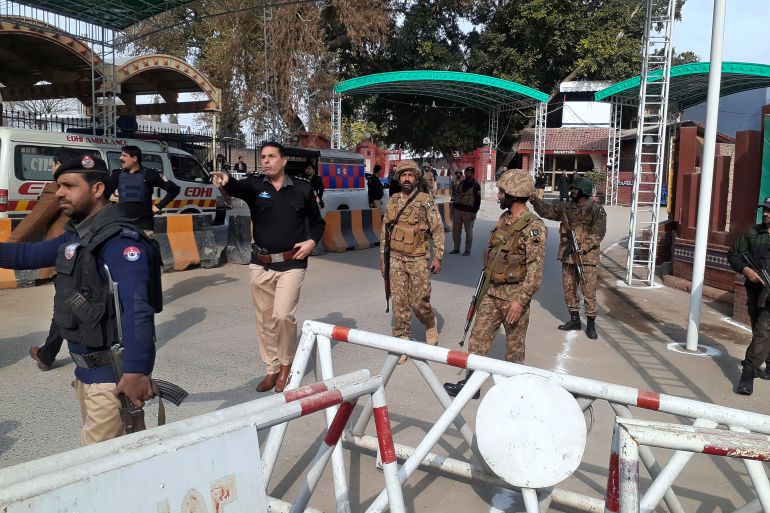
Army soldiers and police officers clear the way for ambulances rushing toward a bomb explosion site, at the main entry gate of police offices, in Peshawar, Pakistan
Army and police personnel clear the way for ambulances rushing towards the explosion site in Peshawar, Pakistan [Muhammad Sajjad/AP Photo]

Pakistan has seen a surge in violence during the last year, with numerous attacks on law enforcement officials, particularly in the Khyber Pakhtunkhwa province as well as the southern province of Balochistan.

In November last year, the TTP, which has been waging a rebellion against Pakistan for more than a decade, unilaterally ended a ceasefire with the Pakistani state.

In 2022 alone, Pakistan’s monitoring agencies recorded more than 150 attacks launched by the TTP – a group ideologically aligned with the Afghan Taliban – that struck across the country and killed dozens of people.

Authorities fear the return to power of the Taliban in Afghanistan has emboldened the TTP and led to its resurgence.

The group demands the imposition of their hardline interpretation of Islamic law, the release of their members arrested by the government, and a reversal of the merger of Pakistan’s tribal areas with Khyber Pakhtunkhwa province.

Al Jazeera’s Abid Hussain contributed reporting from Islamabad, Pakistan.

SOURCE: AL JAZEERA AND NEWS AGENCIES

Letter from Bethlehem: Mazin Qumsiyeh

   posted at https://popular-resistance.blogspot.com/2026/10/good-news.html Good news 1) The largest country in South America (Brazil) has r...