Sunday, March 31, 2024

Palestinian Christians barred from Jerusalem’s Old City at Easter

 As Christians around the world prepare to celebrate Easter, Palestinians in the land that birthed the religion are facing severe restrictions on entering Jerusalem’s Old City to mark the occasion.

While at least 200 leaders from the occupied West Bank have been given permits to enter the area, their congregations are not being allowed access to participate in the services, said Al Jazeera’s Imran Khan, reporting from occupied East Jerusalem.

The restrictions are “unprecedented”, Khan said as a procession of worshippers, far smaller than the usual Good Friday crowds, walked the Via Dolorosa – the path Jesus is said to have followed on the way to his crucifixion more than 2,000 years ago.

The Old City is unusually empty owing to the war in Gaza, but Palestinian Christians were “desperate” to visit their places of worship, Khan said.

“Palestinian Christians from the occupied West Bank – not the international tourists who are staying away because of the war on Gaza – these are people who actually want to come to the Old City and celebrate Easter, but they’re not being allowed to.”

Video Duration 02 minutes 39 seconds

Christians are usually granted access to East Jerusalem, he said, although Palestinian Muslims routinely face restrictions. Access to Al-Aqsa Mosque has been denied to men under the age of 65 and women under the age of 50 on the third Friday of the Muslim holy month of Ramadan.

‘Dark days’

“These are very dark days, very difficult days,” the Reverend Munther Isaac said, speaking to Al Jazeera from Bethlehem in the West Bank. “I think the restrictions this year have definitely increased. Even for us here in Bethlehem – and Jerusalem is literally 20 minutes away from here – we don’t have access.”

Privacy Policy

“Jerusalem is very important for us, especially at Easter. We’re accustomed to … praying in the Church of the Holy Sepulchre,” he said.


“This is part of our daily life under occupation. The war has added to our pain because of the magnitude of death and killing.”

Fayaz Dakkak, the owner of a family store selling religious souvenirs, said he was not expecting to make any sales. As the war rages on, the typical crowds from around the world have not descended on the city to visit the 12th-century Church of the Holy Sepulchre, the site where Jesus is believed to have been crucified, buried and resurrected.

“We’ve been feeling a lot more uncomfortable this time because there’s profiling. If you’re passing by any gate, whether it’s the Damascus Gate, New Gate, Jaffa Gate, and the police officer or the soldier feels you are not Israeli, you’re stopped, you’re checked,” he said.

“Most of the time, it’s not very pleasant,” he added. While some members of the security forces carry out straightforward ID checks, others are more “violent”, he said.

Rafi, a Christian youth coordinator, said Israeli settlers had made the Old City an almost no-go zone. “Even before the war started, we saw the settlers attacking the churches and even the Christian cemeteries,” he said.


“They were attacking any priest or any nun walking inside Jerusalem. Even the pilgrims walking the Way of the Cross [Via Dolorosa] were under attack.”

Worshippers carry a cross as they participate in the Good Friday procession at the Via Dolorosa in Jerusalem's Old City
Worshippers carry a cross as they participate in the Good Friday procession of the Via Dolorosa in Jerusalem’s Old City on March 29, 2024 [Ammar Awad/Reuters]

Many Palestinian Christians from the occupied West Bank have been deprived of walking the Via Dolorosa this year.

Even before the war, Palestinian Christian had to request permission to visit the Old City well in advance of celebrations. Last year, the Greek Orthodox Church slammed what it called Israel’s “heavy-handed restrictions” on freedom of worship during Easter.

Israeli police had said limits were needed for safety during the “Holy Fire” celebration at the Church of the Holy Sepulchre, during which a flame taken from Jesus’s tomb in the church is used to light the candles of worshippers. Christian leaders said there was no need to alter a ceremony that had been held for centuries and they believed it was part of an ongoing Israeli policy to push Palestinians out of their homeland.

SOURCE: AL JAZEERA

NPR: U.N. expert says Israel has committed acts of genocide in Gaza

 NPR's Leila Fadel talks to Francesca Albanese, U.N. special rapporteur on human rights in the occupied Palestinian territories, about the grounds to believe Israel is committing acts of genocide.

LEILA FADEL, HOST:

In a new report released this week, a human rights lawyer and appointee with the U.N. found, quote, "reasonable grounds" to believe Israel has committed acts of genocide in Gaza. She presented her findings this week in Geneva, more than five months into Israel's war in Gaza that started after Hamas attacked Israel on October 7 and took hostages. We have the author of that report with us. Francesca Albanese is the U.N. special rapporteur on human rights in the occupied Palestinian territories. Good morning, and thanks for being on the program.

FRANCESCA ALBANESE: Good morning, and thanks for having me.

FADEL: So genocide has such a narrow and specific legal definition. So what evidence can you point to that leads you to believe that Israel has met the threshold for committing acts of genocide in Gaza?

ALBANESE: Yes. Just probably for the benefit of those who are listening to us, it might help explaining what genocide is - because it's often told to be the crime of crimes. And it's true. It has a very high threshold to be proven. But genocide is the condition of any special acts prescribed by the Genocide Convention committed with intent to destroy, in whole or in part, a group as such. And acts that are listed in the Genocide Convention include the killing members of the group, causing seriously - serious bodily or mental harm to members of the group or deliberately inflicting on the group conditions of life calculated to bring about its physical destruction, in full or in part.

And what characterizes genocide is the intent, which is the intent to commit one of those acts that I just listed and the intent - the specific intent - of the - through these acts destroying the group in total or in part. I've analyzed and I've monitored Israel's conduct of hostilities since the beginning of this latest assault. And I had been a special rapporteur doing this job for 16 months before the 8 of October, and I had already documented serious violations of international law, which, in my assessment, amounted to war crimes and crimes against humanity.

But then as of the 7 of October, there has been a declared genocidal - there has been genocidal incitement that has been manifested through statements of policy and military leaders. But this is not enough. This is not enough. This is - this can be indicative, suggestive of genocide. What has been conclusive for me is how this has reverberated both through policy documents, like, for example, the legal justification that Israel has given, how it has reverberated, been internalized and resulted in the conduct of the troops on the ground, but also patterns.

FADEL: Right. But if you could give me some specific examples of both the language that you're referring to and how it's reverberated that makes you get to this conclusion.

ALBANESE: Yeah. First of all, I've looked at the acts committed. How did we get to 70 - to 30 - over 30,000 people killed, 70% of whom have always been women and children? And we cannot assume, as the government has, as the militaries - Israeli occupation forces - have done, that those are all militants. But there is the killing. There is the heightened blockade which has caused starvation, the destruction of the hospitals.

But as you ask me for this language, I talked about humanitarian camouflage to refer to the distortions of IHL that Israel has proposed since the 8 of October, because, in fact, Israel has never denied the commission of the act. It has justified those as IHL-abiding both in its statements and in front of the International Court of Justice during the proceedings initiated by South Africa.

So, for example, human shields, warnings, evacuation, safe zones, military objectives - all this jargon has been used to justify military assaults and military operations. But if we look at the conduct that has been undertaken, it's clear that each action justified as through the terms I used reveals the full distortion of the very protection function that IHL carries because there has been a generalization of what can be considered human shields. Use of human shields is prohibited, but it's clear that Israel has assumed, like, a blanket justification, that civilians in Gaza wear human shields.

Or, for example - let me give you this example - how it has - the concept of proportionality has been completely, completely capsized - the bombing of Jabalia - of the Jabalia refugee camp kill one commander, one Hamas commander. And never we received evidence of that. But let's assume that there was one commander - hundreds of people were killed and injured, including hostages. How proportionate can it be?

FADEL: Right. Your report has been met with serious opposition. In a statement, the Israeli Embassy in Geneva says the report brings shame on the Human Rights Council and that it utterly rejects the report. And when the U.S. State Department spokesperson Matthew Miller was asked about it, he said this.

(SOUNDBITE OF ARCHIVED RECORDING)

MATTHEW MILLER: First, we have for a long-standing period of time opposed the mandate of this special rapporteur, which we believe is not productive. And when it comes to the individual who holds that position, I can't help but note a history of antisemitic comments that she has made that have been reported.

UNIDENTIFIED REPORTER: She made antisemitic comments?

FADEL: So how do you respond to that?

ALBANESE: Look, first of all, I want to clarify. I feel that the report has been met with - by a sense of relief among the human rights community and also civil society, who has been watching and asking what was happening in Gaza because it has - this is a genocide, as the South African legal team has said, which has been televised by its own - and thanks to the - its own victims - and the soldiers, I would say. But so, yes, of course, there was a criticism of Israel.

And I was appalled by the by the words that the U.S. spokesperson used. It's so irresponsible because it's true - I've criticized the state of Israel for its policies. Is it that outrageous to expect that Israel behaves in line with international law? Is this antisemitic? And I find it really discouraging because this man has no idea of the pressure that has been put on me just before delivering - just for serving the Human Rights Council - and also for free, as I've been asked. And there is a lot of pressure on me because of that. So he is not making my life easier.

FADEL: Now, you made a number of recommendations in your report, including an arms embargo on Israel, an investigation and an international protective presence in Gaza. But I have to ask if this is an exercise in futility. I mean, we saw the U.N. Security Council pass a resolution demanding a cease-fire and the release of hostages. Both of those things haven't happened. Do you expect international backing for these recommendations?

ALBANESE: There must be. There must be - because the reason why we face the most significant failure of multilateralism, of international law and international protection systems is because of the opposition. And I'm sorry to say that, but this is the opposition made by the United States. The United States are a clear - part and parcel of what's happening in Gaza. In the same message the U.S. spokesperson used to smear me, he said that Israel is complying with international humanitarian law. I mean, how can this be credible when it's clear that there are violations through and through? Think just of starvation - causing starvation. How can it be legal?

FADEL: Francesca Albanese is the U.N. special rapporteur on human rights in the occupied Palestinian territories. Thank you for your time and for being on the program.

ALBANESE: Thank you, Leila. Bye.

Saturday, March 30, 2024

Gaza starvation could amount to war crime, UN human rights chief tells BBC

 After months of warnings, a recent UN-backed report offered hard statistical evidence that the humanitarian catastrophe in Gaza is turning into a man-made famine.

It has increased the pressure on Israel to fulfil its legal responsibilities to protect Palestinian civilians, and to allow adequate supplies of humanitarian aid to reach the people who need it.

The UN's most senior human rights official, Volker Türk, said in a BBC interview that Israel bore significant blame, and that there was a "plausible" case that Israel was using starvation as a weapon of war in Gaza.

Mr Türk, who is the UN high commissioner for human rights, said that if intent was proven, that would amount to a war crime.

Israel's economy minister, Nir Barkat, a senior politician in Benjamin Netanyahu's Likud party, dismissed Mr Türk's warnings as "total nonsense - a totally irresponsible thing to say".

Like his cabinet colleagues, Mr Barkat insisted that Israel was letting in all the aid offered by the US and the rest of the world. Israel says the UN fails to distribute whatever is left once Hamas has helped itself.

But a long line of lorries fully loaded with aid supplies desperately needed in the Gaza Strip is backing up on the Egyptian side of the border with Rafah. They can only enter Gaza after a complex and bureaucratic series of Israeli checks.

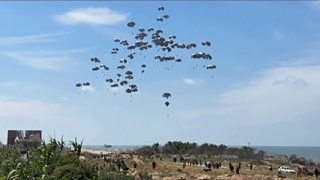
The absence of adequate supplies has forced Jordan, and now other countries including the US and UK, to drop aid from the air - the least effective way to deliver humanitarian supplies.

Palestinians on the ground fighting to secure a share have drowned as they try to swim to pallets that have landed in the sea, or have been crushed when parachutes fail.

Watch: Gazans reportedly drown after video shows rush for aid drop that landed in sea

The US Navy is also sending an engineering flotilla across the Atlantic to build a temporary pier to land aid by sea.

None of that would be necessary if Israel granted full road access to Gaza and expedited the delivery of relief supplies through the modern container port at Ashdod, only about half an hour's drive north of the Gaza Strip.

In an interview from Geneva, Mr Türk said evidence had emerged that Israel was slowing down or withholding the delivery of aid.

Mr Türk condemned the Hamas attacks on Israeli civilians and soldiers on 7 October, including killing, rape and hostage-taking. But he also said that no side in the war should evade accountability for its actions, including for any attempt to withhold aid supplies from the people who need it in Gaza.

"All of my humanitarian colleagues keep telling us that there is a lot of red tape. There are obstacles. There are hindrances… Israel is to blame in a significant way," he said.

"I can only say the facts speak for themselves… I understand that this needs to be controlled, but it cannot take days for it to be done.

"When you put all kinds of requirements on the table that are unreasonable in an emergency… that brings up the question, with all the restrictions that we currently see, whether there is a plausible claim to be made that starvation is, or may be used as, a weapon of war."

Concern about humanitarian catastrophe in the Gaza Strip deepened last week with the release of a soberly written commentary alongside a series of maps, charts and statistics. It prompted more warnings from Israel's allies that it should change the way it is fighting the war against Hamas to spare civilians from death from either high explosive or hunger.

The study is the latest report from a respected international network, the Integrated Food Security Phase Classification, known as IPC. It provides governments, the UN and aid agencies with apolitical data to measure the scale of hunger. The headline on the report was stark - "Gaza Strip: Famine is imminent as 1.1 million people, half of Gaza, experience catastrophic food insecurity."

Its data explained how famine could come at any time in the next eight weeks or so if there was no ceasefire and relief aid did not pour into the Gaza Strip.

Palestinian parents who had managed to bring sick and hungry children to one of the few hospitals still operating in Gaza after Israel's onslaught did not have to wait for the statistics. For weeks and months, as they struggled to feed them, they have watched their children decline.

Gaza is no place to be ill. One young girl at the hospital, reached by a Palestinian freelance journalist working for the BBC, lay semi-conscious on a bed.

The girl, Noora Mohammed, has lung and liver fibrosis, conditions that can be fatal even in peacetime. In the months of starvation since the war began, and without the right medical care, she is deteriorating fast.

"My daughter can't move," her mother said. "She's anaemic, always sleeping, and there's nothing nutritious to eat."

At least Noora reached hospital. Most of just over one million Gazans considered to be in acute need will not have that option.

The evidence of Gaza's humanitarian catastrophe is overwhelming. Our pictures from the hospital showed children with swollen joints, wasted limbs and dermatitis, all classic symptoms of acute malnutrition.

Child in Gaza hospital visited by Palestinian freelance journalist working for the BBC
There are signs among children of acute malnutrition

Israel has ignored the UN Security Council resolution demanding an immediate ceasefire. Nir Barkat, the Israeli economy minister, said that nothing would be allowed to get in the way of Israel's war aim of smashing Hamas for good and freeing the hostages taken on 7 October.

Allies around the world, he said, supported Israel's strategic goal. When I pointed out many of Israel's friends, starting with US President Joe Biden, did not like the way Israel was fighting the war, Mr Barkat was blunt.

"That's tough. We are going to finish the war. We'll do everything we can to kill the Hamas terrorists and to minimise collateral damage as much as we can," he said.

"With all due respect, we're fighting evil, and we expect the world to help us fight evil until we finish Hamas off the map."

The UN high commissioner for human rights had a succinct response to stinging criticism from Israel.

"The only thing I can say to them is that there is an emerging international consensus, and it may not have been there before, but it is clearly there now, including with this week's Security Council resolution, on the humanitarian situation," Mr Türk said.

"The human rights situation is so tragic that an immediate ceasefire is required. That's my response to that."

CAIR Welcomes South Carolina Town’s Passage of Hate Crime Ordinance

  The Council on American-Islamic Relations (CAIR), the nation’s largest Muslim civil rights and advocacy organization, today welcomed a dec...