
In
science, nature is conceived as a complex interconnected set of bio-physical
sub-systems, ‘a tightly coupled dance, with life and the material environment
as partners’.2 This
dynamic coupling provides the conditions of existence for our species.
Overwhelming evidence points to the approaching collapse of these conditions.
While cumulative man-made gaseous waste up to
the present is unlikely to cause temperature rises to exceed 1.5
degrees,3 unless
physically unprecedented and revolutionary measures are taken from now onwards
the biophysical conditions for existence of many human beings are likely to be
destroyed within the lifetime of anyone under the age of 20. In the view of one
distinguished scientific team, the ‘safe operating space’ in at least three
major physical sub-systems (of their set of nine): had quite likely already
been exhausted a decade ago by material developments ‘eating away at our own
social support systems’.4 These
three are:
1.
1. Climate change.
On top of the heating already under way – the product of global economic
activity using fossil fuels (which Trump’s Energy Department now deigns to call
‘freedom molecules’) is heading, under business-as-usual assumptions, for a
rise in global temperature that will put paid to most kinds of business. Half
the world’s man-made atmospheric carbon dioxide (CO2) was
emitted in the last 30 years, during which time the 20 companies which produced
a third of world-historical emissions5 (from
energy and cement) have been hard at work defending, and grabbing
ever-increasing subsidies for, fossil fuels.6
2. Losses of
biodiversity and of redundancy7 are
accelerating at a rate not found in any record since the cretaceous extinction
some 66 million years ago.8
3.
Vast excesses of nitrogen and phosphorus from fertilizer run-off
and fossil fuel combustion already compromise the resilience of soil and water
sub-systems, pollute the oceans and risk anoxic extinctions.
A further set of three
further planetary sub-systems currently thought to be approaching dangerous
thresholds of destabilisation are:
1.
1.
The oceans, where acidification due to carbonic acid is
dissolving the calcium in corals, shellfish and planktonic species, threatening
substantial portions of marine ecosystems, and the fishing industry which
depends on them.
2.
Fresh water, whose diversion for agricultural, industrial and
domestic use is causing pollution, droughts and water scarcities.
3. Land: land-use
change for the expansion of agriculture is reducing biodiversity, releasing
green-house gases, inviting destructive weather events and redistributing
species, sometimes with disastrous consequences.9
In addition, other activities
threaten natural eco-systems in ways which are less well measured – ‘known
unknowns’. The team behind the science of safe operating spaces for mankind,
cited above, identifies three:
1.
1. Persistent
organic pollutants, plastics, endocrine disrupters (such as oestrogen-mimicking
chemicals), heavy metals and nuclear waste are all compromising ecosystems.10
2. Atmospheric
aerosols, an increasing proportion of which are man-made, penetrate deep into
animal tissues including lungs and may aggravate respiratory, cardiovascular
and allergic disease.11
3. Atmospheric
ozone depletion is allowing carcinogenic ultra-violet B-rays to damage life.
The Montreal Protocol (which started to be implemented in 1989) has reduced the
ozone depletion rate, but success of this treaty has diverted attention from
the special conditions which enabled it to succeed and encouraged an unfounded
faith that similar political actions of a kind which will not disrupt the
global economy can avert environmental threats.12
This
summary of trends in the planet’s physical sub-systems jolts us into realising
that most writing about climate change and global heating is severely
reductionist. First, the huge regional variations in the processes that are
under way are airbrushed out.13 Second,
climate change, which everyone talks about, is only one of many major
interacting threats to our planetary ecosystems. Third, the factors causing
climate change also contribute and feed back to these other threats – both
directly (e.g. oil pollution in the Caspian sea) and indirectly through causing
climate change (which is set to overtake land-use change as the major driver of
biodiversity loss). Many parts of this complex interactive system are being
damaged, in some cases irreparably, by activities which policy-makers and
publics have often not even identified as a problem.
Despite
the enormous environmental damage previously done to regions under communist
rule, it is capitalism that now bestrides the narrow world like a colossus –
pace Shakespeare’s Julius Caesar – yet it is capitalism which is
studiously not identified in the stream of scientists’ assessments. Instead, UN
agencies list ‘countries’ as causers of gaseous emissions in terms of their
cumulative stocks and current flows of gas: gross, net, per capita, and per
megawatt hour. And the problem, weakly called ‘pollution’, is categorised by
criteria such as the toxicity of industrial waste for the immediate area is in,
or by economic sectors, or by the types of consumption involved. Conceiving the
problem in these ways identifies and ranks the ‘national’ perpetrators
differently. This generates agendas of response for each kind of problem, the
signal result of which is that they have all failed to arrest the march of
planetary society toward or beyond safe environmental thresholds. So the
question of what is to be done has become increasingly urgent.
In
line with the reductionism noted above, the UN has framed the urgency in terms
of a ‘window of opportunity’ before we have used up the planet’s atmospheric
‘budget’ for the concentration of CO2 at
a level that will keep the increase in temperature below 1.5 degrees above the
average level of the years 1850-1900.14 While
according to some estimates the ‘window’ is already closed, in 2018 the IPCC
declared it still open, giving us anywhere between 2 and12 years before
planetary self-reinforcing feedback processes kick in and other scientists
reckon we may have 10-30 years. But no serious scientist thinks we have longer
than this.15 Scientists
also imagine targets that would need to be met within these time frames – e.g.
national targets for shifting to renewable energy16 –
and dates are set. But as targets proliferate, they become increasingly draconian,
while the deadlines set for them recede into a future when the windows will
have closed and the discursive frame becomes fantastic.
This
sense of urgency has been criticized as amounting to ‘catastrophism’.17 Insofar
as the dire findings of science are used to generate a political mobilising
response driven by fear, one version of this might be what Greta Thunberg
famously said at at Davos in 2019: ‘I want you to panic…. I want you to act as
if the house was on fire’.18 Another
version would be Richard Smith’s and other ecological Marxist claims that
capitalism will shortly collapse through the combined weight of its internal
contradictions and its rift with nature.19 The
critics respond that catastrophism is a counsel of despair on several counts.20 First,
anxiety is a weak driver of radical social change. Second, the crisis revealed
by science is not a crisis of nature, or even of humanity versus nature;21 it
is produced by the co-evolution of capital with nature. Capital
constantly internalises constraints, responds to the price signals they cause,
and dynamically reinvents itself. Wartime planning, carbon trading,
bio-engineering, geo-engineering, GMOs, and dematerialisation are frequently
cited examples.22 Despite
the evident limits to resource availability, ‘(t)he idea of the limit is
aesthetic’ explained David Harvey in conversation with Leo Panitch.23 For
Harvey, the only limit of consequence is the limit to social alienation;
reaching that limit will trigger revolutionary political action.24
However,
as John Bellamy Foster observed about the Socialist Register’s 2007 issue on
environment: ‘(t)he very fact that capitalism is not likely to collapse of
itself and may ‘prevail’ for some time to come is precisely why the planet is
in such absolute peril…(T)he advent of a more barbaric form [of capitalism] is
no longer the worst of our worries. It is the threat to the planet itself that
constitutes our most dire challenge’.25 The
British Labour Party’s recent policy paper on the environment puts it
differently: ‘winning slowly on climate change is the same as losing’. 26

Karl Marx (1818-1883). Everett Collection, Shutterstock
Human
Development and Restitution Under Socialism
If we accept the dire nature
and urgent time-frame of the challenges posed by what science tells us about
the ecological impact of capitalism, it is useful to revisit the early
materialists’ concepts of physical metabolism and human development. There are two
reasons for this: first, because of their implications for ‘the way we live
now’, and second, for their insights about social responses to our
environmental crises – and about socialist responses.
These
concepts were developed by Marx and his peers in a radically different context
in the mid 19th century.27 Their
question was man’s relations to nature.28 Out
of the attempt to apply to society ‘developments in the science of physiology
that were derived from agricultural thought’,29 came
the concept of metabolism (Stoffwechsel in German).30 For
Marx, social and ecological metabolism is the process of material exchanges in
which nature is appropriated ‘for the satisfaction of human needs’.31 Nature
and society co-evolve, nature through the laws of irreversible physical
processes; society through historically institutionalised norms governing the
division of labour and distribution of wealth.32 ‘Man lives on
nature – means that nature is his body, with which he must remain in continuous
interchange if he is not to die.’33 It
follows that while we are united with nature, in the sense that we are
materially a part of it, we also cannot exist without continual struggles with
nature to shape it to our needs and wants.
Under
capital, struggles take a particular shape.34 Nature,
in the form of matter and energy, is continually transformed through
competition. The ‘natural resource’ of labour is also commodified, exploited
and alienated from the conditions of production. In so doing, a ‘whole gamut of
permanent conditions of life required by the generations’ is encroached upon,
conditions of social reproduction whose commodification threatens the
conditions of life.35 Capitalist
production relations open up a fourfold social-metabolic rift.
1.
1.
Through the privatised ownership and extraction of natural
resources and ever-greater spatial relocations of the commodities produced they
disrupt the natural stocks and flows of material and energy.
2. Through the
exploitation of labour, they transform the inseparability of labour and nature,
thereby ensuring that nature is objectified as a set of resources for human
exploitation.36
3.
Through competition and commodification, they encroach on the
very existence conditions of non-human life forms, as well as those needed by
humans.
4. Capitalist
production, distribution and consumption of commodities also re-shape
metabolism through the ever-increasing generation of waste material. The
depletion of energy and materials due to the dumping of most waste has been
accepted because it has not been an immediate obstacle to the production of
surplus value. Although the planet is an open energy system and part of the
solar system, the physical and social processes of degradation, dissipation,
decomposition and reconstitution of waste operate at (slow) speeds that neither
the capitalist system, nor the planet, can use or cope with.37
Marx
envisaged an alternative dialectical process, one that was impossible under
capitalist production relations.38 He
invoked the systematic application of science to govern ‘the human metabolism
with nature in a rational way…with the least expenditure of energy…and the
re-use of waste…under collective (social) control…as associated producers’.39 These
are the social and ecological conditions in which fully emancipated individual
human development unfolds40 and
in which science is to be used neither to dominate nature nor to assume nature
is inexhaustible.41 It
is, noteworthy in this respect that Marx ended the longest chapter by far in
volume 1 of Capital, ‘Machinery and Modern Industry’, with this crucial argument:
Capitalist production
completely tears asunder the old bond of union which held together agriculture
and manufacture in their infancy. But at the same time it creates the material
conditions for a higher synthesis in the future, viz., the union of agriculture
and industry on the basis of the more perfected forms they have each acquired
during their temporary separation. Capitalist production, by collecting the
population in great centres, and causing an ever-increasing preponderance of
town population, on the one hand concentrates the historical motive power of
society; on the other hand, it disturbs the circulation of matter between man
and the soil, i.e., prevents the return to the soil of its elements consumed by
man in the form of food and clothing; it therefore violates the conditions
necessary to lasting fertility of the soil… But while upsetting the naturally
grown conditions for the maintenance of that circulation of matter, it
imperiously calls for its restoration as a system [N.B. the German term in the
original is ‘restitution’ – BHW], as a regulating law of social production, and
under a form appropriate to the full development of the human race… In modern
agriculture, as in the urban industries, the increased productiveness and
quantity of the labour set in motion are bought at the cost of laying waste and
consuming by disease labour-power itself. Moreover, all progress in
capitalistic agriculture is a progress in the art, not only of robbing the
labourer, but of robbing the soil; all progress in increasing the fertility of
the soil for a given time, is a progress towards ruining the lasting sources of
that fertility… Capitalist production, therefore, develops technology, and the
combining together of various processes into a social whole, only by sapping
the original sources of all wealth — the soil and the labourer.
That
Marx actually used the concept of ‘restitution’ here, which is quite different
from ‘restoration’, as it has usually been translated into English, is
important. For Marx makes it clear that human development, while being bound to
relations with nature and with collective work, is not a matter of restoring
nature to a status quo ante: restitution is different. This difference is not
only because the metabolic status quo ante (before either capitalism or settled
agriculture) is irretrievably altered and ‘spoiled’.42 Nor
is it just because the processes and sequencing of restoration are not
understood43 or
because biophysical processes are dynamic not static and the very notion of the
status quo that is inappropriate. Nor is it because any kind of compensation
cannot be other than physically dislocated. Nor does the difference between
restoration and restitution even arise because social relations with nature
have spun out of capital’s control.44 Rather
the activity of ecological restitution is a collaboration with nature involving
collective work through which individuals also achieve and practise human
development.45
Understanding
Marx’s concept of human development as implying the relation to nature which he
called ‘restitution’ – akin to what we might perhaps now call ecological
trusteeship – helps to appreciate why he thought this was something which only
a socialist society could achieve. ‘Societies are not owners of the earth, they
are simply its possessors, its beneficiaries, and have to bequeath it in an
improved state to succeeding generations as boni patres familias’.46 Our
full, free and rich development requires we improve the
earth.47
The
idea of restitution did not originate with Marx, although the composite project
of human-ecological development did. Restitution as an ecological idea – one
originating long before the concept and discipline of ecology – seems to have
been communicated in the influential mid 19th century Letters
on Modern Agriculture of German soil scientist Justus von
Liebig, with which Engels and Marx were very familiar.48 Liebig
researched agriculture but his argument is equally valid for all of the
material imbalances within and between all sectors of an economy – what
Thompson and Medel called the web of life.49 In
his critique of the ‘spoiliation system of farming’, which constantly robs the
soil of nutrients, Leibig writes that ‘rational agriculture is based on the
principle of restitution’.50 Here
he means restoring soil fertility. It is not land as territory, but the
constituents of the soil, which provide for the nutrition of plants and through
which wealth is constituted, that requires restitution. In letters about the
conditions needed for minerals to do their nutritional work for plants,
Liebig’s erlass (which can also mean ‘enact’ and ‘adopt’) is again
translated in terms of restitution, a process of returning to the soil minerals
and manures in the form of plant, animal and human waste.51 Even
more relevant to 21st century conditions, Liebig uses the concept to cover the
restoration of a disturbed agricultural equilibrium while providing sustainably
for sustenance.52 Restitution
would now have to be extended to addressing rifts of nutrients, matter and
energy which have interactive and disruptive effects ranging from the
microbiome inside our bodies to the entire planet’s lithosphere, biosphere and
atmosphere. Today the concept of restitution survives only in philosophy and
law where it means both compensation for loss and the act of returning
something stolen – as in movements for the ‘restitution of silenced histories,
repressed subjectivities, subalternized knowledges’ (Mignolo, 2007, p 451). As
a political concept it tends to be avoided – even in socialist thought. There
are a few exceptions. Distinguishing social restitution from metabolic
restoration, the environmental-political philosopher Peter Critchley theorises
the former as a condition of the latter. Citing Istvan Meszaros, he sees
‘socialism … presented in its true form as a project of restitution … restored
to the social body and exercised by the associated producers as social powers’.53 South
African land policy provides a contemporary example of restitution understood
as a project of economic justice and territory, involving the transfer of land
to groups of African farmers.54 Yet
as the anthropologist Lesley Green explains, if restitution is confined to the
ownership of the means of production, even if this involves the collective
ownership of land by ‘associated producers as social powers’, the relationship
of people to land in a capitalist agrarian economy in which ‘partnership with
the ecosystem is replaced by mastery over soils’ is inadequately addressed. He
explains: ‘the breaks imposed in soil ecology under industrial agriculture’
need a fuller concept of restitution to stop. ‘Farmers need to be supported to
work with the partnerships that make healthy soils for free: partnerships with
plants, soil microbes, insects, cows, earthworms, burrowing animals –and
time! Because these partnerships take time to make soil.’ 55
We
see in this example that the concept of restitution has survived, if at all, in
a form dis-integrated from the processes of collective work for human development
through the improvement of nature as a general objective of social and
political existence. It is now co-terminous with a set of less ambitious
concepts: notably restoration – used by most environmental scholars and
defining entire sub-fields of economics and of biology – but also
‘conservation’, ‘repair’ ‘compensation’, ‘recuperation’, ‘reparation’ (a branch
of ecology ),56 ‘halting
degradation’,57 and
not forgetting the IPCC’s negative emissions scenarios, of which more anon.
Reducing
nature to land and soils, as we have done so far, also ducks the fact that a
rapidly expanding proportion of the global population – at least 55 per cent –
is not involved directly in the work through which the kind of nature referred
to so far in this essay is subjugated. Most people are involved in consuming –
and creating waste from – the result of this process. Yet our production and
consumption of (fuel) energy, cement, iron and steel, aluminium, minerals,
chemicals and paper exceed man-land-livestock relations in their consequences
for metabolic rifts.58 Not
only is it impossible to restore the natural world to its condition prior to
the capitalist and communist metabolic rifts – let alone to its condition in
perhaps 200,000 BCE when humans first started using fire to modify vegetative
cover.59 It
is also impossible to restore what is being destroyed now. Capitalism is
destroying nature irreparably.

Love Our Planet, protest on Market St San Francisco,
CA. Photo: Ronan Furuta, Unsplash
Restitution
and Restoration in the 21st Century
Over
time the spectre of planetary peril has belatedly coaxed responses at a
planetary scale: from the Pentagon’s basing of its military planning and
technologies on the assumption that global warming will not be halted; to
massively detailed scientific assessments, (including the Vatican’s apostolic
academies’ weighty volumes of evidence and the Pope’s denunciation of greed and
indifference); the adoption of market mechanisms to abate CO2 emissions, the
institutional conditions for which cannot be met;60 and
regular rounds of conflictual deliberations and inadequate voluntary pledges by
the planet’s 196 nation-states.61 There
is no lack of blueprints. Faced with the disparity between the evidence and the
social reaction, with cognitive dissonance and insufficiency of will on a
global scale,62 some
people take to cycling and shop for vegan food with cloth bags, avoid
single-use plastic, segregate and recycle waste and buy renewable electricity
and ‘green gas’. Determined local groups invest in solar panels on school
roofs, cities tax and try to ban diesel vehicles, and frequent fliers get trees
planted. But extreme weather events and climate-change-related migrations and conflicts
mean that already more and more people are dying. With restitution as the
object of human development nothing but a utopian vision, socialists have to
confront the limited but nonetheless imperative question of figuring out how
the destruction of the remaining ecological space for human life can be halted
in time. The first steps towards what Richard Smith has called ‘post-capitalist
ecological democracy’,63 a
move towards human development in harmony with nature, cannot avoid an
engagement with the conditions of actually existing capitalism.
In
full awareness that I am practising the reductionism I have criticised above,
gyrating between the abstract and the concrete and historical, reviewing
literatures trapped in disciplinary silos which carve nature into special –
often mutually incomprehensible – fields, and being unavoidably forced, for
reasons of space, to try to summarise extensive fields of knowledge, I turn now
to looking at restorative initiatives for just one of the nine planetary
sub-systems on which life depends: air. Although each subsystem has its own
specific material and political problems, the dimensions of all of them are
clear enough from what is known about air;64 and
the drivers of gaseous pollution and atmospheric heating are also driving
crises in the other physical subsystems. Following the template for full human
development, I ask three kinds of questions about the initiatives on offer: how
is science being used; how is it proposed that the use of materials and energy
will be minimised, and waste re-used; and what forms of social organisation and
control are envisaged for them?
Restoring the Earth’s Air
What we inhale when we draw our first breath has become invisible
garbage. Our ways of living in the 21st century have finally confronted us with
a phenomenon first identified in the early 19th century; the effect of waste
gas on atmospheric temperature, and on the health of everyone. Making the world
a better place means both stopping the (rate of) rise in global temperature and
lowering the pollution in our atmosphere. Despite wars of denial and
scepticism, the atrophy of US research funds, and the disappearance of
websites, science has been mobilised for the ecological crisis across the
board.
Here
we take one iconic text as the product of the collective work of science. In
2016, the UN’s climate change body, the IPCC, set about organising 91 climate
scientists (and 188 contributing authors) from 40 countries in a particularly
focussed way65 to
assess the prospects for damage-limitation. Organised into working groups for
physical science, impacts and adaptation, and mitigation, they painstakingly
reviewed about 6,000 research papers and fielded 42,000 peer reviewers’
comments. All the while, the voluntary pledges from the 195 national
signatories to the Paris accord of 2015 were adding up to a total which
suggested their target of a maximum rise in global temperature of 1.5 degrees
above the 1850-1900 average was going to be overshot by 100 per cent – i.e the
pledges implied an increase of 3 degrees. In late 2018 the scientists
estimated and extrapolated the damages that could be expected to result from a
global temperature rise of 2 degrees over the 1850-1900 average, and compared
them with those resulting from 1.5 degrees. On the assumption that
business-as-usual continues, the scientists estimated that the temperature will
hit the 1.5 threshold somewhere between 2030 and – a strangely specific date –
2052. They also asked how global temperature rise could be kept under 1.5
degrees by 2100 and how to halt the rate of change of atmospheric gases.66
The
IPPC accepted a brief that covered the whole planet. Its 30 background chapters
are extensive, detailed, the opposite of hubristic – and rarely read. Its
conclusions are carefully qualified with references to the varied dynamics of
regional ecosystems – especially the most vulnerable coastlines and drylands,
the Arctic, small islands and poor agrarian populations. And throughout its
argument, general statements drag around their balls and chains of confidence
levels and probabilities. The ‘carbon budget’ – the amount of CO2 that can be
released into the atmosphere – that remains if temperature rise is to be kept
under the 1.5 degree target is subject to substantial uncertainty – between 580
and 770 Giga tonnes (Gt) – due to there being several accepted definitions and
measurements of global temperature. To make things worse, without controls,
other gases than CO2 could
reduce this budget by anywhere from 100 to 250 Gts.
The
IPCC responded to the need for action by producing some 90 complex integrated
assessment models generating planetary emissions pathways, four of which are
published as illustrative simplifications, replete with wide margins of
probability. They reveal what is at stake. Pathway number one simulates an
immediate start to the process of restoration, by banning fossil fuel, lowering
energy demand while increasing the standard of living in the ‘south’, investing
heavily in afforestation, and decarbonising rapidly – indeed completely by
2050. Pathway two involves the UN’s sustainable development goals which require
investment in contemporary versions of human development, changes in land use
and consumption, aid for a global convergence in sustainable development,
comparatively limited use of bio-energy and carbon capture and storage technology
(BECCS), and considerable low Carbon innovation. Pathway three assumes
historical patterns of fossil fuel and nuclear technology with emissions
reductions from decarbonised energy and drops in demand, with BECSS
intensifying dramatically over time. Pathway four represents GHG-intensive
lifestyles, overshooting 1.567 and
with a delayed response requiring correspondingly greater compensation by
intensive Carbon dioxide removal (CDR) and BECCS.
The
IPCC’s report makes clear the great difficulty of making a single conclusion
for the planet. But its banner headline is that to limit heating to the 1.5
target would require global annual net human-caused emissions of CO2 to fall by about 45 percent from 2010 levels by 2030, reaching
‘net zero’ around 2050.68
Minimising Energy, Materials
and Waste
All four extrapolations into the future involve rapid ‘far reaching’,
‘unprecedented’ transitions in energy, land use, infrastructure and industrial
systems. These are not transitions in the sense in which lay people understand
the term. Although it is commonly said that the technology exists, none of the
major carbon-reducing mechanisms required by these pathways exists at scale. It
is climate scientists not economists who are assuming there is a can-opener. If
it exists at all, how the carbon draw-down technology is to be scaled up,
whether it could work in varied conditions across the world and whether land
exists sufficient for the scale of bio-energy production required are unproven
questions. However, the later the process of restoration is initiated, the
steeper the reduction gradient and the greater the need for these imagined
technologies. Overshoot is modelled, perhaps reassuring politicians, but the
technical problems with atmospheric cooling technology (let alone the effects
on the earth) suggest that overshoot should be avoided at all costs.69
The
IPCC excludes ‘solar radiation modification measures’ from its technological
armoury (speculative geoengineering, at present including clouds of
sulphur dioxide, orbiting sunshades, injections of aerosols in the
stratosphere, pan-oceanic fertilisation by iron filings to stimulate carbon
sequestration by phytoplankton, etc). But the transformation of energy systems,
the extraction and storage of carbon, the slashing of the output of other
green-house gases, new ways to lower the materials intensity of
production-consumption systems, and the scaling up of bio-energy sources, would
all affect the biosphere in ways currently unknown. For ecosystem restoration,
the estimated quantities of of livestock pasture needing conversion, mostly to
forests – 0.5 -11m sq km – are extraordinary; just as the accompanying
vegetarian revolution in global diets is far-fetched in its authoritarian
assumptions.70 And
while the IPCC sees gaseous waste as the problem,
it overlooks the handling of other waste gases and other waste in the
production-consumption system.
The mind-boggling amount of
new inventions assumed for all four pathways casts precaution to the winds,
while their compatibility with the incentives and requirements of the
(unmentioned) capitalist economy is simply assumed.
Social and Political Control
Although time is of the essence, the IPCC report’s planetary scope means the
pathways to emissions reductions have to be ahistorical and asocial. Yet they
cannot avoid being political projects. The IPCC’s depoliticised politics speaks
of ‘emissions portfolios’ that are imagined to be held by, or assigned to, each
national state. These can vary in energy and resource intensities, rates of
decarbonisation, and permutations, combinations and sequences of CO2 removal technologies.
The IPCC report is far from
an encomium to neoliberalism. Conventional market-mechanisms such as carbon
trading (which have so far failed) go unmentioned, while calls for effective
governance (as well as governance systems and multi-level governance) and
transformational adaptation are strewn about the report. So are repeated
warnings about ‘barriers’: socio-economic, financial, institutional,
technological and environmental barriers. Delay is another obstacle –
escalating costs, locking-in polluting infrastructure, stranding assets and
reducing flexibility.
For
the IPCC, state capacity and competence is paramount in overcoming these
barriers and obstacles. States are assumed able to direct and control capital.
Since individual national projects of restorative environmental action will
churn indiscriminately in global atmospheric currents,71 states
are assumed capable of acting in the planetary interest and of suppressing
temptations to free ride. There is more. Remarkably, the IPCC calls for careful
management of poverty reduction and careful consideration of ethics and equity.
It expects achieving the 1.5 goal to generate ‘synergies in excess of
trade-offs’ in technocratic swathes of sustainable human development: in
health, food and human security livelihoods, cities and economic growth – all
delivered, by implication, through ‘green capitalism’. Is this less utopian
than Andreas Malm’s ecologically-sensitive reformulation of the communist
manifesto,72 or
than the collective work of restitution achieved though the rich human
development envisaged by Marx?
In subsequent discussions,
some of these scientists have shown that they see politics as ‘ideology’,
something they seek to avoid. When calling for unprecedented transformations,
they mean unprecedented technologically, not politically. Politicians just lack
‘political will’. What their ‘pathways’ clearly call for is a powerful
planetary political authority, yet there is no call for it.
‘Out of the
Mouths of Babes’
At
first sight, nothing could be more different from the IPCC’s report than a
single iconic child. ‘School Strikes for Climate’ was initiated as a protest by
15 year-old Greta Thunberg in August 2018, struggling, as she explains, with
her inability to live in a state of cognitive dissonance between the climate
science and daily social life.73 After
her address at the Katowice COP 24 meeting, by March 2019 an estimated 1.4
million children in 112 countries had joined the Friday School Strikes for
Climate. They were joined by many parents and by an independently mobilised,
militant and effective mass movement of civil disobedience, Extinction
Rebellion.74 In
the May EU parliamentary elections the ‘Greta effect’ on adult voters was
widely credited with the one-third increase in the number of Green party MEPs
across the EU. Greens, previously an isolated, mostly left minority, were now
being referred to as ‘kingmakers’.75
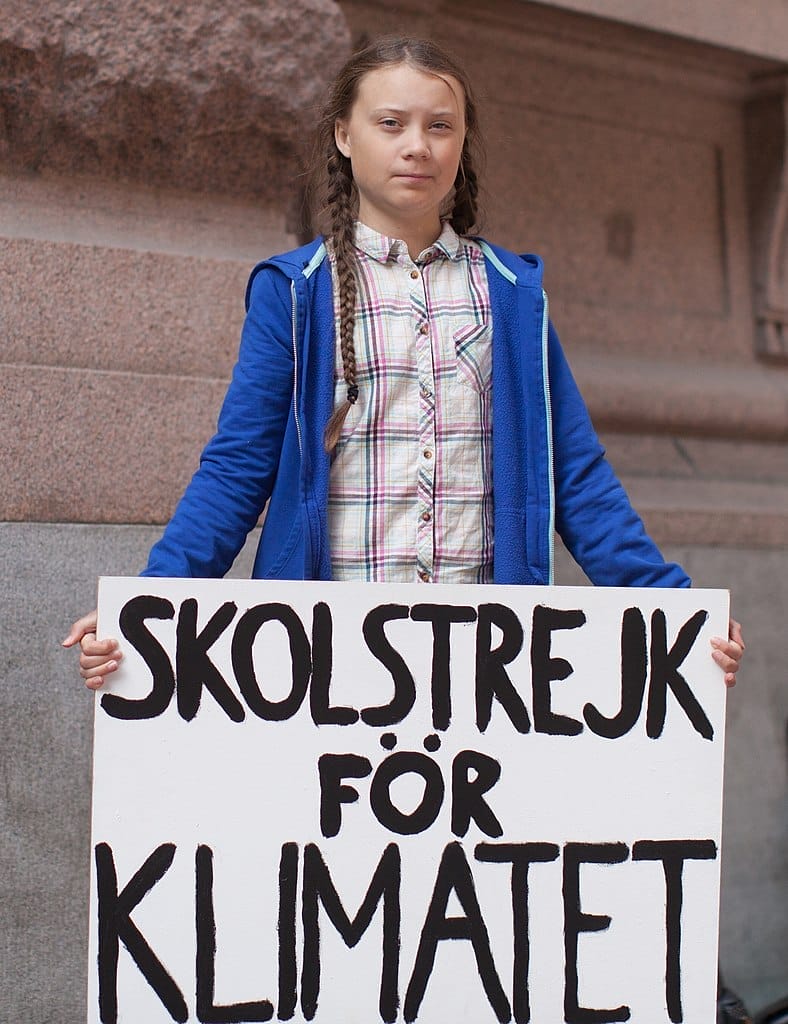
Thunberg in front of the Swedish parliament, holding a
“Skolstrejk för klimatet” (transl. School Strike for the Climate) sign,
Stockholm, August 2018. Wikipedia Commons
Thunberg is consistent in her
desire to restore. She protests about popular ignorance, official silence,
political apathy about the climate science, political concealment, denial and
hostility. She appeals to states to fulfil the (inadequate) Paris Agreement
pledges and to ban fossil fuels. She demands that the EU lives within planetary
boundaries, doubling the target rate of emissions reduction from 1990 levels
from 45% to at least 80% by 2030 and including the reduction of pollution from
aviation and shipping. She exemplifies individual lifestyle environmentalism as
a vegan, an austere consumer and a ‘flight-shamer’ who uses public transport
and electric cars.
Three
aspects of the movement she has triggered are noteworthy. First, Thunberg reads
the science as implying a catastrophe and sees the IPCC report as arguing that
‘we are less than 12 years away from not being able to undo our mistakes’, or
‘from an irreversible chain reaction’.76 Whatever
its faults, and although the document stresses urgent action, we have seen here
that this is not exactly what it says. However, the 12- year time-frame has
been seized on by the media and in popular consciousness either as
counting-down to the end of the world (i.e. the sixth extinction, including of
humanity), or alternatively as a useful political escape hatch in electoral
democracies currently unwilling to address the complexity of climate change
where politicians are ‘decision averse’.
Second,
Thunberg concretises a politics of generational responsibility. ‘You are
stealing our future.’ And public figures as varied as Pope Francis, Antonio
Guterres, Prince Charles, George Monbiot, and Michael Gove have confessed guilt
at the profligacy of their generation, at their procrastination and at the
failure of their efforts to counter climate change. Naming and blaming a
generation may make a useful case for rapid action. But climate change is not
the work of a generation but the manifestation of a metabolic rift caused by
global capital, energised by fossil fuel, devouring material resources,
unfolding in historical time and victimising those least responsible – in terms
of regions,77 of
nations and of their constituent labouring classes. Let’s not forget that some
of the aged have fought life-long inside and outside their workplaces against
capital and its waste. If the ideas of young people not yet in the workforce
were to prevail over capital – without identifying it – and if they could
mobilise economic and political force where trade unions and many other civil
society and politically activist organisations have failed, this would be an
achievement unique in world history.
Third,
comes the question of state competence, for Thunberg’s call for action is
directed – as is that of the IPCC – to politicians and officials. Her point is
that gesture is not action. Decades ago, the legal scholar Philip Alston argued
that signatures and intentions are but the first step in any process of action.78 Public
interest commitments have to be codified; provision and claim need to be
institutionalised; mechanisms for redress for non-provision established and
enforcement empowered. Each of these processes embodies a political struggle
against opposition. Without these institutional mechanisms in place, intentions
cannot be operationalised. At national levels, the unprecedentedly complicated
policy processes for restoring the air and transforming global society have
barely started and are not co-ordinated.79 Meanwhile
a considerable scholarly literature questions the competence of the now
commodified and captured state to do anything much other than capital’s bidding.80 And,
as Aeron Davies reveals, even capital’s bidding is compromised by the
‘precarious, rootless and increasingly self-serving’ elites permeating the
state. After 20 years of research, he concludes they are ‘reckless
opportunists’.81 Joseph
Stiglitz, the within-system dissenting economist who earlier computed the costs
of the disastrous Iraq war, and is expert at the arts and sciences of global
accounting, calls for a ‘war footing’ on climate change.82 But
as the civil servant credited with sensitising Thatcher to climate change,
Crispin Tickell, warned exasperatedly in 2010, ‘we have lost the capacity to
plan’.83
A
National Response: The UK Labour Party
The
British Labour Party’s 2017 Manifesto champions the environment in brief, dense
paragraphs which outline an anti-market, pro-state policy and commit to 60 per
cent renewable energy by 2030. Yet as Jeremy Gilbert observed, nothing in the
manifesto suggested an eco-socialist vision unhitched from industrial
capitalism and growth.84 In
late 2018 the Labour Party consolidated its commitments in an Environment
Policy paper, which was explicitly grounded in the IPCC science plus a wider
science and technology literature, but focussed on preventing the tipping
points and feedback loops which the IPCC had pointedly steered around in its
report.85 The
paper is evidence-based and – following Keynes and Samuelson – commits to
revising policy in the light of changes in knowledge. Reducing materials and
polluting energy are prominent priorities in its stresses on renewable energy,
ultra-low emissions vehicles and energy efficiency in buildings and industry.
Labour will also reverse bio-diversity decline. Tree-planting and conservation
are principles for policy in agriculture and fisheries. Atmospheric and
non-atmospheric waste is to be reduced through public transport and an assault
on plastics.
The
politics of this environment policy are complicated. Like the IPCC, Labour
calls for transformational change and the rebalancing of economic power away
from markets (proven to be inadequate for the task) and towards coordinated
planning. It mainstreams livelihoods in such planning, building on the ‘just
transition’ of international labour movements.86 Unlike
the IPCC, Labour is also able to be quite specific about banning fracking, and
about the renationalisation of electricity transmission, distribution and grid
connectivity,87 railways
(including an extended Hi-speed2 to Scotland) and water. To enable this, Labour
would create a National Transformation Fund of £250 billion over a decade. The
policy also recognises the principle of subsidiarity through local government
control over home insulation to high performance standards, zero carbon
affordable new building, and cycle networks. Local government already controls
waste disposal and recycling. In agriculture and fisheries, subsidies for small
scale sustainable practices are proposed, and the routine use of antibiotics in
livestock rearing would be banned.88
Labour’s internationalism
will shape an environmental foreign policy; development aid will avoid fossil
fuel investments and encourage low carbon and SDG convergence worldwide.
Vagueness may be encouraged by the IPCC demonstration effect. Labour is unspecific
about the redistribution of resource control e.g. whether and how the ultra-low
emissions vehicles will be manufactured – or imported, how future airport and
aviation expansion will be ‘severely’ regulated. Several of IPCC’s central
concerns are conspicuous by their absence: the phase out of (imported) coal,
the controversial future of nuclear energy and the holy grail of carbon capture
and storage. Like the IPCC report, Labour’s policy is not conflictual. The
social preconditions needed for it to work are not identified, nor are its
workforce implications, nor is opposition to it. Buying opposition out,
by-passing or destroying it are tactics not incorporated into into the party’s
policy.
Labour’s
policy for a green transformation is noteworthy for three related reasons.
First it bears a close family resemblance to several other prominent
blueprints, some over a decade old: not just the Green New Deal legislation
Alexandria Ocasio-Cortez has presented to Congress,89 but
also the UK’s Green Party’s 2009 Million Jobs Green Recovery Package, and the
Campaign against Climate Change (CACC) Trade Union branch’s Million Climate
Jobs project (updated between 2009 and 2014) which put work central.90 Second,
all these projects embrace the need for social and political transformations
both as necessary in themselves and as preconditions for the technological
project to restore the damaged atmosphere.91 Third,
reluctantly or with conviction, explicitly mentioning capital or euphemising
it, all these projects argue that the crisis can be addressed through reforms
within the system. Though the UK has joined the declarations of a ‘climate
emergency’, this never threatened the Conservative Government’s neoliberal
world-view. ‘No special powers have been put in place’.92 Labour’s
radical reforms, such as ending fossil fuel monopolies and redistributing
control over resources, themselves co-exist with anything but transformative
sounding competitive commitments to develop export markets for green technology
and access to the EU’s internal energy market.
Conclusion
This has been a hard essay to
write, first because of the vast variety and accelerating pace of activity
throughout the world demanding ‘action’; second because the project of
restoration has yet to be paid the attention it requires; third because of the
inexorable and unremitting degradation of the planet’s physical sub-systems as
the metabolic rift deepens and becomes more complex; fourth because of the need
to contain the scope of this essay by being selective in the choice of
sub-system and sources. It does not help that the science is organised in
proliferating sub-fields and sometimes has to operate with wide margins of
probability.
What does the science say?
Almost all the findings point in the same direction. For a blueprint to restore
the atmosphere, there is no planetary alternative to the IPCC’s. The longer an
unprecedented global assault on the causes of GHG emissions is delayed, the
less likely the planet will be habitable in ways we recognise.
What does it mean we need to
do and by when? The IPCC 2018, representing 196 governments, is indeed at pains
to stress the urgency of the growing ecological crisis. To have a chance to
keep the rise in global temperature below 1.5 degrees, global emissions have to
be halved by 2030. How? It’s not our department said IPPC. It involves
technologies for materials and energy efficiency, land-use change and carbon
extraction that are currently unproven and at scales that are currently
imaginary.
Can
it be done in time under the assumption that the world remains capitalist? The
project is without historical precedent. But the IPCC, the School Strikes, New
Deals, Extinction Rebellion etc, not to mention the Pentagon all assume the
need to work extremely fast, through competent states, and within capitalism –
without explicitly considering its nature and mechanisms. Concerned individuals
are pitted against the energy majors, so it will be left to these corporations
to self-destruct, which at present is highly unlikely.93 Even
restoration needs growth, materials and energy. Paul Burkett has visited this
issue, arguing that such solutions as ‘recycling and waste management,
environmental restoration of forests, strip mined lands and plundered maritime
eco-systems, all become ecologically impoverished constitutive parts of the
problem, requiring a fresh expenditure of energy and materials rather than
being ecologically restorative’.94
What
can be done in any one country? The British Labour Party plan confronts some of
the obstacles but, like all the national movements involved in the problem,
operates under capitalism and also faces the free rider objection. An exception
to the latter though not the former, Costa Rica has a lot to lose from the
impact of climate change on its mountain-cloud forests, while the results of
its commitment to carbon neutrality by 2021 will pass unnoticed in the troubled
atmosphere.95 Will
its refusal to free ride have ripple effects, just as the butterfly does in
chaos theory?
How
should socialists act given these constraints? Marx proposed a relationship
with the material world, one of restitution, that would require a socialist
society to develop and maintain, and which would at least not degrade that
world further but would try to improve it. This is however a utopian dream,
especially given the non-existence of socialist forces and the time-scale of
the threat.96 Restoration
has no counter-hegemonic politics.
So, given that the problem is
capitalism, are socialists defining the ecological crisis as one of restorative
class struggle? The Labour Party, even under its current socialist leadership,
does not do this. Can it be afforded politically? Can socialists engage
practically with the science? Is the time frame of a focus on socialist
education, organisation and agitation consistent with the time frame of
essential action to keep human life on earth viable? If not, then what?
Barbara Harriss-White is Emeritus Professor
Development Studies, Oxford University. Between 2006-2009, she helped to guide
Zarni in research on Burma. Since 1969 she has researched India’s political
economy, mostly through field-work. https://en.wikipedia.org/wiki/Barbara_Harriss-White
In retirement she works on India’s rural development and is vexed by the
economy as a waste-producing system.


No comments:
Post a Comment