Iran has launched a missile attack on Israel - the Israeli military says around 180 missiles were fired, most of which were intercepted
No serious injuries have been reported so far and Israeli authorities say civilians can leave bomb shelters. Israeli military spokesperson Daniel Hagari says "this attack will have consequences"
Israeli troops have invaded Lebanon, in what the Israeli military calls a "limited, localised and targeted" ground operation against Hezbollah
On Tuesday morning, an Israeli security official told the BBC there had been "no clashes" yet - but a military spokesman later told people in around 25 Lebanese villages to evacuate
The UN and EU have reiterated calls for a ceasefire, with the UN Security Council due to meet tomorrow
Israeli Prime Minister Benjamin Netanyahu says Iran "made a big mistake tonight, and will pay for it".
Speaking at the opening of a cabinet meeting, the Israeli PM says Iran "does not understand" his country's "determination to retaliate" against its enemies.
"They will understand," he says. "We will stand by the rule we established: whoever attacks us - we will attack" them.
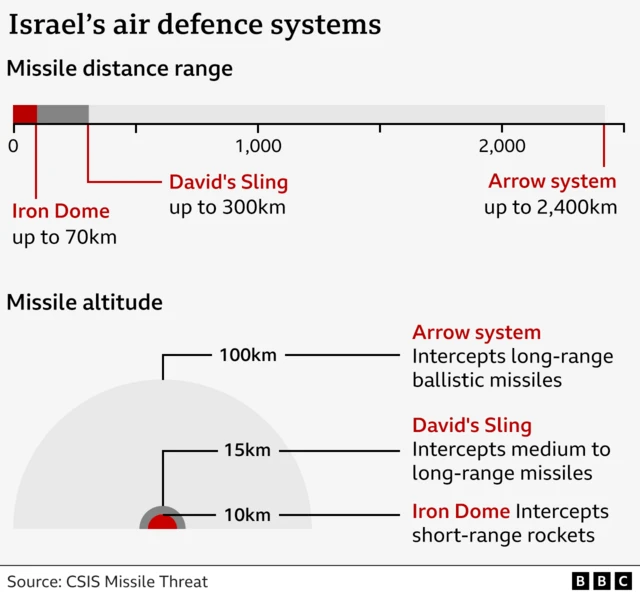
Israel has an elaborate system of air defences, a system which has once again been called into action tonight.
Different elements of this "layered" system are used to dealing with different threats.
Iron Dome is the most familiar, designed to intercept short-range rockets of the sort fired by Hamas and Hezbollah over the past year.
But when it comes to bigger threats, Israel has other tools at its disposal. David's Sling is used to intercept medium to long-range rockets, as well as ballistic and cruise missiles.
And when it comes to long-range ballistic missiles, which fly outside the earth’s atmosphere, Israel has the Arrow 2 and Arrow 3 interceptors. Both have been used to bring down ballistic missiles fired by the Houthi rebels in Yemen.
Israel used all elements of its air defences during Iran's last attack, in mid-April, which involved drones and cruise missiles. David's Sling and Arrow 2 and 3 will have played instrumental roles in confronting tonight's attacks.
Videos circulating on social media appear to show that a significant number of missiles got through Israel’s defences, suggesting that in some places, those defences were overwhelmed.
Last week, Israel said the US had promised a massive new package of military assistance, including $5.2bn for air defences.
Hamas praises Iran's missile attack on Israel
The Palestinian group Hamas has praised Iran's "heroic" missile attack on Israel.
In a statement, the group, which is fighting Israel in Gaza, says "we congratulate" the rocket launches carried out by the Islamic Revolutionary Guard Corps in Iran "against wide areas of our occupied lands".
Israel will now be tempted to retaliate against Iran with far greater force than it did back in April.
At that time, following a volley of around 300 Iranian missiles and drones, launched in response to an Israeli strike on Iran’s consulate in Damascus, there was a concerted international diplomatic effort to restrain Israel from reacting too forcefully.
In the end, Israel carried out a minor but symbolic missile attack on a target close to Iran’s nuclear facilities. It caused little damage but showed Iran it had the reach.
This time may well be different. Israel sees its recent actions around the region as both a deterrent to its enemies and the elimination of the threats it has been facing.
Just as Iran felt it had to respond to the assassinations of Hamas leader Ismail Haniyeh in Tehran in July and of the Hezbollah leader in September, Israel is unlikely to take this direct attack from Iran lying down.
Its targets could range from Iran’s nuclear facilities to IRGC bases to the launch sites and storage depots from where Tuesday’s missile attack were fired from.


No comments:
Post a Comment