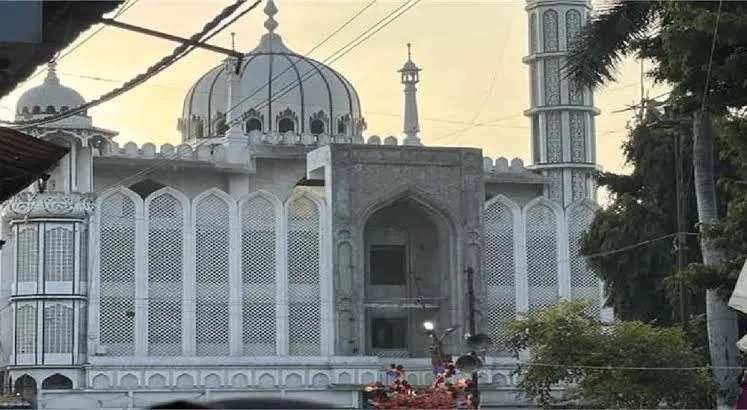
Madhya Pradesh High Court upheld the proposed partial demolition of Ujjain’s century-old Shahi Masjid for road widening ahead of the 2028 Simhastha Kumbh, citing public safety, traffic management and larger public interest.
The Madhya Pradesh High Court has dismissed two writ petitions challenging notices issued by the Ujjain Municipal Corporation proposing the removal of a portion of the Shahi Masjid to facilitate the widening of a road to 15 metres ahead of the 2028 Simhastha Kumbh.
Simhastha 2028 is a massive Hindu pilgrimage and the sacred Ujjain Simhastha festival, scheduled to take place in Ujjain, Madhya Pradesh, India, from March 27 to May 27, 2028.
A bench of Justice Sandeep N. Bhatt held that the Corporation’s proposed action was taken in accordance with the applicable statutory provisions and after providing an opportunity for a hearing to those administering the mosque, Live Law reported.
The court found no violation of Articles 14, 25, 26 or 300A of the Constitution.
The court also considered the scale of the upcoming Simhastha Kumbh in 2028, which is expected to draw crores of devotees, and the need for traffic management and public facilities.
It noted that the Shahi Masjid is located almost opposite the Mahakaleshwar Temple and close to the Kshipra River.
“Therefore, considering the upcoming event of the Simhastha Kumbh, 2028, whereby the expectations of crores of devotees are required to be kept in mind, as well as the need to provide better facilities and to manage the traffic of such events; and considering the situation of the premises in question, which is almost opposite to the Mahakaleshwar Temple and very near to the Kshipra River; and for the consideration of the larger public safety and larger public interest, the action taken by the respondent is found to be after following the necessary provisions of law,” the bench said.
The petitions were filed by two groups of people claiming to administer the mosque, which is registered as waqf property.
They challenged the Corporation’s demolition notice, which proposed removing a portion of the mosque to facilitate the road-widening project.
The petitioners argued that the proposed action would affect part of the prayer hall (Jamat Khana), a 120-foot-tall minaret and Mazhar Chouk Shahi, and would infringe upon their fundamental rights. They described the mosque as an ancient structure and said its prayer hall, wazoo facility and minaret constituted important religious infrastructure.
Relying on Supreme Court jurisprudence concerning the protection of religious practices under Article 25, the petitioners argued that although road widening may serve a public purpose, it could not override the community’s right to practise its religion at the centuries-old place of worship.
They further argued that the Corporation had failed to follow the procedure prescribed under Sections 322 and 323 of the Madhya Pradesh Municipal Corporation Act, 1956, which deal with public streets, obstructions and unauthorised digging or breaking of pavements.
The petitioners also contended that the Madhya Pradesh Waqf Board had not been properly served.
The Shahi Masjid, also known as Shahi Masjid Waqf Panchayat Mochiyaan, is a more than century-old mosque in Ujjain, Madhya Pradesh, located almost opposite the Mahakaleshwar Temple and near the Kshipra River. It is registered as a Waqf property and has a prayer hall, ablution facilities, a reported 120-foot minaret and Mazhar Chouk Shahi.
Documents cited by its managing committee include a March 17, 1925 letter from the Town Improvement Trust under the Scindia-era Gwalior government referring to land acquisition while directing that the remaining portion of the mosque be kept intact, as well as a 1985 Madhya Pradesh government gazette notification mentioning the mosque and its measurements. The management has also said that it voluntarily surrendered some land in 1975 to ease traffic flow.
Similarly, earlier in Dal Mandi, Varanasi, Uttar Pradesh, authorities demolished portions of six mosques as part of the BJP government’s ₹224-crore project to widen Dal Mandi Road to 17.4 metres to improve access to the Kashi Vishwanath Dham for Hindu pilgrims. The project also involved the demolition of 180 shops and houses, with the majority of the affected properties and businesses owned or run by Muslims.


No comments:
Post a Comment