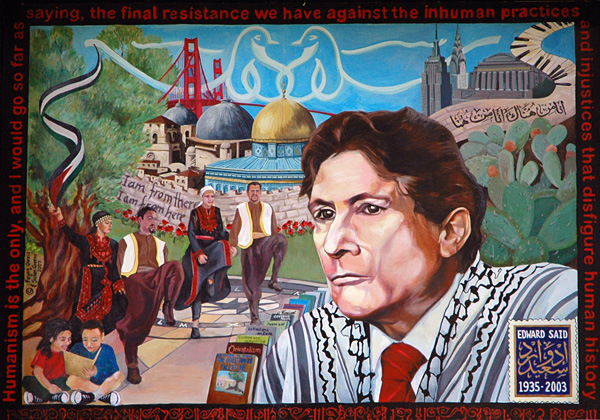
Photograph Source: Leilani Xicotencatl – CC BY 4.0
Noam Chomsky, Richard Falk, and Edward Said were born in 1928, 1930, and 1935, respectively. Each in his own way dominated a different academic field, while at the same time becoming influential global political critics. Whether through opposition to the Vietnam War, warnings about the dangers of nuclear proliferation, or challenges to the West’s understanding of the Arab world, each left a prominent legacy in academia and beyond.
The brief summaries of their careers that follow cannot do justice to the range of their scholarship and political engagement. My purpose here is not to survey all they wrote and accomplished but to ask what their careers tell us about what we are now missing.
What happens to a country when its universities no longer produce, tolerate, or give a public platform to intellectuals who challenge its prevailing political assumptions? Where are the Chomskys, Saids, and Falks today? Who now offers the same combination of intellectual authority, political independence, and public outreach?
Each of the trio combined academic success with influence far beyond the classroom. Chomsky, for example, was a world-famous linguist who became a prominent critic of American foreign policy. At MIT, his principal academic appointment was in linguistics, not political science. Although he taught courses on social and political issues, including Intellectuals and Social Change, he was never a member of the MIT Political Science Department.
Edward Said occupied a similar position in two different worlds. He taught English and Comparative Literature at Columbia for over forty years. Yet, he was also a major force in debates about Palestine, Middle Eastern politics, colonialism, and Western representations of the Arab world. Politically, from 1977 to 1991, he served as an independent member of the Palestinian National Council, the Palestinian parliament-in-exile associated with the PLO.
Academically, Said’s best-known book, Orientalism, changed the way scholars and commentators understood the relationship between Western knowledge and imperial power. Yet Said himself acknowledged the distinction between his academic teaching and his extensive writing about the Middle East. “I have never taught anything about the Middle East,” he wrote in the preface to the 25th-anniversary edition of Orientalism. Trained in comparative literature, he explained that the book, despite its urgent political implications, was about culture, ideas, history, and power rather than Middle Eastern politics as such.
Richard Falk followed a slightly different path. An international legal scholar, he appeared before the International Court of Justice, served as the United Nations Special Rapporteur on the situation of human rights in the occupied Palestinian territories, and regularly criticized American foreign policy. Although he attended Yale Law School and earned his doctorate at Harvard, Falk taught at Ohio State’s University College of Law before spending most of his academic career teaching undergraduates at Princeton.
Chomsky’s, Said’s, and Falk’s significance was not simply that they were professors who expressed public, political opinions. They possessed the intellectual standing to challenge conventional political thinking and communicated their arguments to audiences well beyond academia. (Chomsky, in particular, is better known to the general public for his political positions rather than for his erudite, groundbreaking linguistic theories.)
What happened to the conditions that allowed intellectuals like Chomsky, Said, and Falk to reach a broad public and challenge prevailing political assumptions?
The problem is not that Chomsky should have taught political science at MIT, that Said should have taught Middle East studies at Columbia’s School of International and Public Affairs, or that Falk should have held an endowed chair at Harvard or Yale Law School. The problem is whether universities and society still make room for intellectuals who challenge prevailing ways of thinking about politics and power.
And that is a problem for people like Henry Kissinger.
Henry Kissinger taught at Harvard before entering government; he served as National Security Advisor and Secretary of State to Richard Nixon. He became one of the most influential figures in the history of American foreign policy—opening to China and Middle East shuttle diplomacy—and a media darling. Kissinger’s career illustrates one path from academic expertise to political power and popular adulation. Chomsky, Said, and Falk took another path: they used their intellects to challenge the powerful and the narratives they use to describe the world. Kissinger revelled in the power and glory.
Neither route is inherently incompatible with intellectual independence. The more interesting question is whether a society gives ideas that challenge established power a chance to reach both those who exercise power and the wider public.
How much room is there for those who challenge? One of the crucial lessons of David Halberstam’s classic The Best and the Brightest was how little dissent there was within the Lyndon Johnson administration over its Vietnam policy. Halberstam showed how highly educated, influential policymakers could lead the United States into disaster because they refused to challenge accepted assumptions.
Times have changed. Chomsky, Said, and Falk faced pressure from alumni and, to some extent, from their universities. But they continued teaching. The case of MIT linguist Michel DeGraff shows where we are now. In 2024, MIT rejected his proposed course on language, decolonization, and liberation struggles, including Israel and Palestine. The university cited concerns about the course’s fit with the curriculum and DeGraff’s expertise; DeGraff argued that the decision was politically motivated by his pro-Palestinian advocacy.
The dispute escalated. Various sources, including the New York Times, reported that MIT characterized some of DeGraff’s communications as misconduct, withheld his annual pay increase, and removed him from the linguistics unit, where he had worked for 28 years and was a tenured professor. DeGraff argues that these actions were retaliation for his political speech; MIT has disputed his account.
And students have changed. The May ’68 protests in France were in part about the Vietnam War and Charles DeGaulle’s foreign policy. Today, French students are protesting very basic conditions in their schools, justifiably so, but no more. In the U.S., where is the mass protest movement against the war with Iran? Levitating the Pentagon in 1967 now seems close to ancient history.
Where are the successors to Chomsky, Said, and Falk? Perhaps they exist but are less visible, scattered across disciplines and the media. Or perhaps the conditions that allowed such figures to emerge have changed. The DeGraff case is not an isolated one, as the experiences of academics like Norman Finkelstein testify.
The disappearance of progressive public intellectuals like Chomsky and Said matters. Falk, happily, is still heard and appreciated from time to time in CounterPunch and elsewhere. A functioning society needs intellectuals who challenge power and the powerful—and who have the authority, independence, and public credibility to reach a wide public.


No comments:
Post a Comment