As a reader-funded independent news outlet, we operate free from the influence of governments, advertisers, and corporate backers. This is essential to our mission: to report on what matters most, beholden only to the truth. In that spirit, we made a commitment to ensure that our journalism is free for everyone, not locked behind a paywall. But that means we rely on the voluntary support of our community of readers. Please consider making a tax-deductible donation to support our work today.
DELHI, India—Indian authorities enforced an unprecedented crackdown on demonstrations across Delhi on Saturday and Sunday, as student groups and citizen networks, including lawyers and doctors organized to provide support for people protesting a massive purge of voter lists. The government deployed over 20,000 police and paramilitary personnel to prevent protestors from gathering in the city, pulling forces from border areas, including Kashmir, into Delhi.
For the past two weeks, protestors across India have been demanding the resignation of India’s chief election commissioner, Gyanesh Kumar, after an investigation by The Indian Express, a prominent daily, revealed that the country’s election commission had deleted more than 130 million people from voter rolls without due process.
The call for large demonstrations on Saturday was made by the Cockroach Janata Party (CJP), which in July led widespread protests against the education minister Dharmendra Pradhan for irregularities in nationwide examinations, leading to his resignation. On Saturday, Delhi police detained Abhijeet Dipke, the founder of CJP, along with several other leaders of the group, on their airplane when they arrived at the Delhi airport, holding them until Sunday morning.
The mobilization was supposed to be held at the designated protest site of Jantar Mantar, but it was entirely barricaded by the police, and most of central Delhi was under police lockdown.
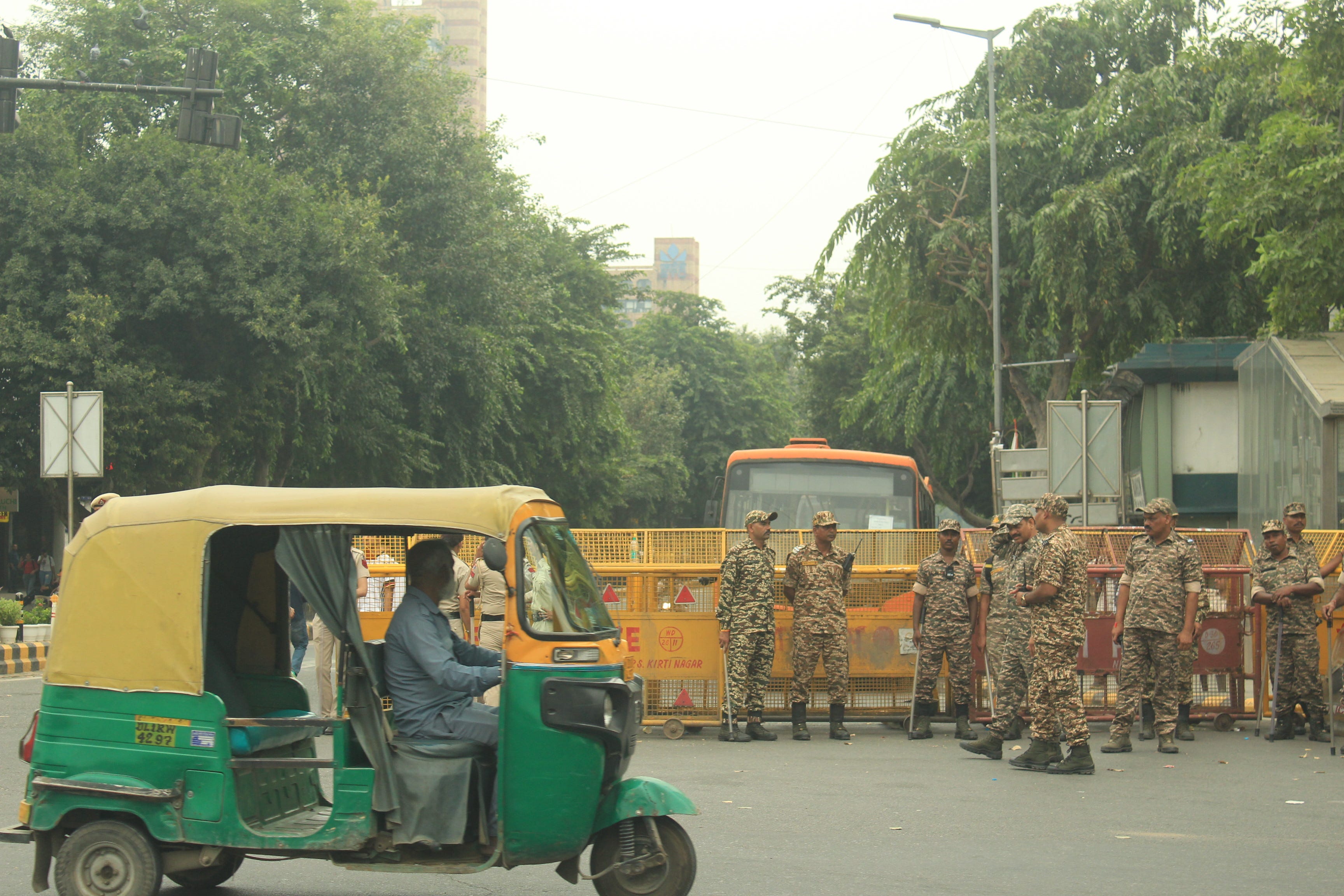
Many of those who responded to the CJP’s call to action were out on the streets on their way to Jantar Mantar when Dipke and others were detained in the flight. Unable to reach the protest site, they wandered around the city. “Everytime the police stopped us on our way here, we told them we are tourists who are lost, so they let us pass by,” said Shubham Sharma, 22, who was there with his 20-year-old cousin, Harsh.
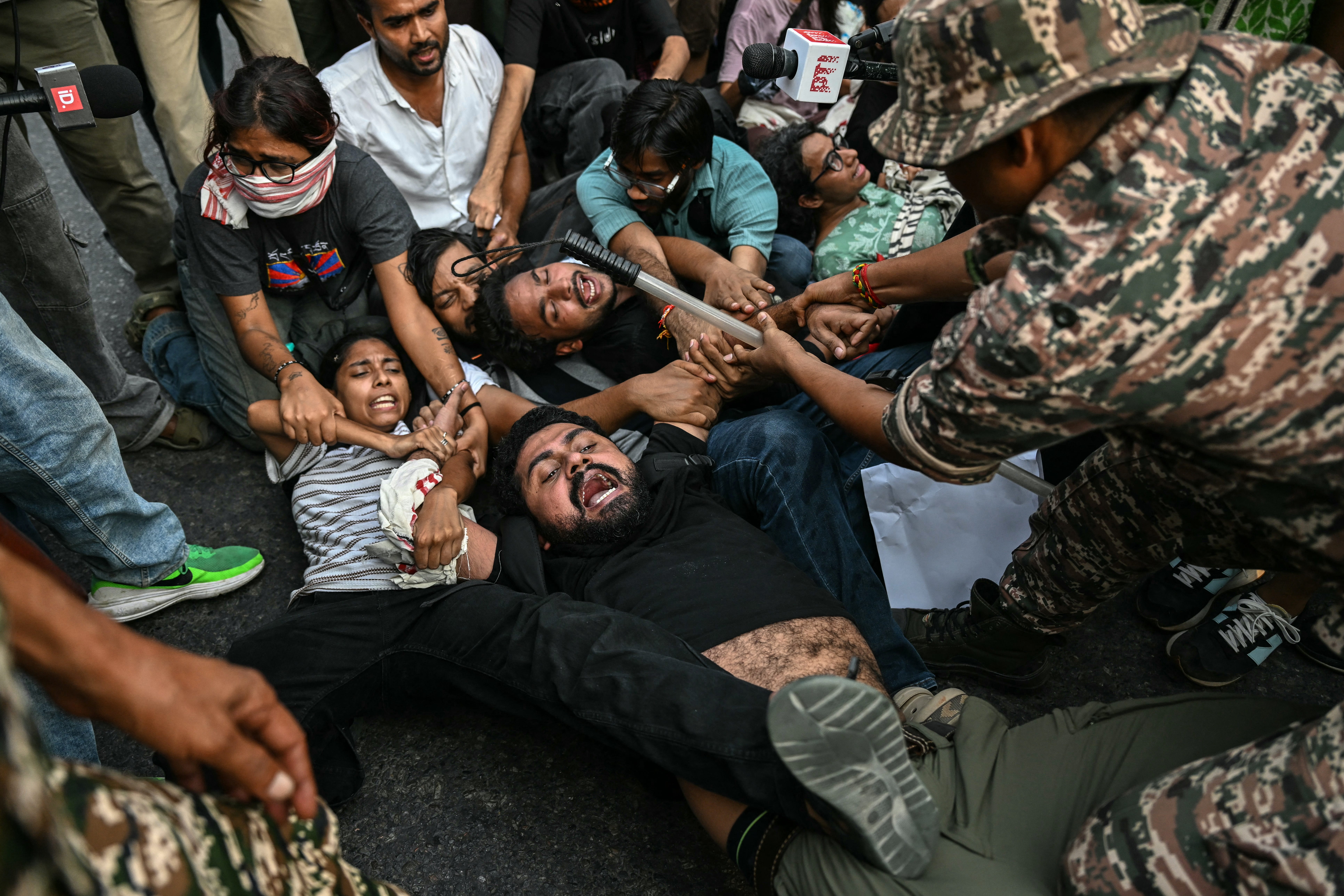
Multiple journalists were detained, despite wearing their press badges. Lawyers were detained as well, including senior Supreme Court advocate Shadan Farasat, who was carried by his arms and legs to a police station. Overall, police detained over 2,000 protestors on Saturday, reported Reuters. Among those detained was the distinguished welfare economist Jean Drèze, who is originally from Belgium but has lived in India for nearly five decades, working on issues of poverty. “In almost 50 years of being in India, I have never seen such use of force to quell protests,” Drèze told Drop Site from the police station.
Another protestor, 40-year-old Maalvi Mishra said that even as she was entering the lane to get to the protest site, she was told by the police that “Jantar Mantar is not in Delhi,” and that she should go home. “I managed to come here but so many others couldn’t,” she said, as she held up a copy of the constitution in her hands, surrounded by cops and border security forces all around.
As protesters began entering the neighboring areas, police detained anyone who appeared to be heading towards the protest site.
“I reached Delhi from Punjab early in the morning and have been here since,” said Karan Singh, who had travelled alone to attend the protests. “It was incredibly difficult to reach here, I had to walk for almost an hour. The police presence in the area makes it feel like it’s fully a dictatorship,” he said.
Drop Site saw protestors being detained within minutes of chanting slogans, or as soon as they merely came close to the barricaded roads outside Jantar Mantar. It wasn’t just protestors—many were picked up from far beyond the protest premises, from arbitrary spots in the city, without explanation. “I didn’t know anything about the protest, I am in the city for some work with my wife. The police just whisked me away without informing me why,” said Mohammad Rahim, who was detained along with nearly 40 others in front of the New Delhi Railway Station.
In addition to the brute force applied by security forces, members of the right-wing Hindu Raksha Dal (Hindu Protection Force), who mobilized in support of the Narendra Modi government, were seen harassing some protestors. In a video that’s now gone viral, four men were seen attacking a man and a woman, beating them up, with the police not intervening to stop them. The four were arrested on Sunday.
Protests Despite Crackdown
As crackdowns against protestors continued unabated, spontaneous demonstrations erupted in other parts of the city. A popular market for tourists called Dilli Haat suddenly emerged as the go-to spot as left wing student leader Neha Bora announced that as their choice of protest ground. A few hours later, the Safdarjung flyover, an extremely busy overpass in the heart of South Delhi, became another hot spot. The protests, however, could only occur in bursts, as people were being detained within minutes.
“Till the time there is even one person protesting on the street, this movement will continue,” said Bora in a video message on social media. Bora pleaded with supporters to protest wherever the police tried to detain them.
Even as the largely young, Gen Z protestors were being bundled into police buses and vans, some from the older generations came to show solidarity and support.
Hansraj Bhutani, 82, came out into the street with food and water in his bag. “I am here to support the protestors,” he said. “I have lived through the Emergency under Prime Minister Indira Gandhi. Even then, things weren’t this bad. I am requesting Modi to stop troubling the public like this.”
In Connaught Place, a central market in Delhi, hundreds of protestors trying to make their way to Jantar Mantar were detained. The police presence in the area heavily outnumbered the protestors. The government prohibited the gathering of more than five people in central Delhi.
Many protestors, who had walked in alone, found solidarity with the few others who managed to make it past the barricades.
Papri Das, Pavneet Kaur, and Rosy met each other at the Connaught Place market while heading towards the protest site. “It is disheartening to see how the government is seeking to silence our voices. But what is heartening is that people are still showing up, despite the crackdowns and despite the police brutality,” said Das, 34.
For Kaur, 35, the solidarity she found among each other gave her hope that this movement could be successful. “We just realized that the three of us belong to different religions. I am Sikh, Papri is Hindu, and Rosy is Muslim. This is exactly what the government fears—people becoming united to fight its tyranny,” she said.
Not far from Connaught Place, police entered a Sikh temple, the Gurudwara Bangla Sahib, and detained people en masse. “I witnessed at least a dozen people being brutalized while the Delhi police tried to detain them. One 75-year-old woman was brutalized by the police so badly, one of her fingers was dangling off, we had to get her a plastic surgery,” said a doctor who was offering medical relief to the injured inside the Gurudwara and did not want to be named out of fear of retaliation.
He said that the police entered the temple premises in their boots and without wearing a head scarf—as required of men entering Sikh places of worship. “Most people were injured due to the police twisting their fingers while trying to detain them. I saw a lot of pinching and nail marks on injured protestors. They are not using batons, but using these other means to brutalize protestors,” he said.
The protests continued on Sunday, with spontaneous marches emerging in Connaught Place multiple times throughout the day and the police detaining hundreds of protestors. “I have been detained almost every day since October 2. I will continue to protest this regime and I will continue to show up on protest sites every day, there is no fear anymore,” one protester told Drop Site through a window of a police bus.
Support Networks
In response to the July protests, a citizen-led volunteer group began to take shape. The group, which calls itself the Protest Support Initiative, has multiple wings, each catering to a different aspect of providing aid and support, with about 150 volunteers. One wing is in charge of driving people home after they are let go from their detention centers, often in far-flung places. Another, led by doctors, is in charge of providing first-aid. There’s also a wing of therapists who help people who’ve undergone trauma during the detention or during confrontation with the police.
For Meghnad, a popular journalist and content creator, forming the group seemed like the most natural thing to do. “No one else was doing it, but someone had to. So might as well be us,” he said. “Eighteen year olds would come up to me asking how do we get home after the police leave us in random parts of the city after detention, I had to help them. I also realized many of these young protesters come from extremely repressive environments at home. They’ve found a space to express themselves through these protests, so we have to be there for them.”
Until October 9, the group had 20 people who had volunteered to drive detainees home. After the October 10 protests, that number has risen to 93. But along with all the support, they now also face the scrutiny and intimidation that comes from the authorities. “Three people were following me throughout the protests on 10th. I routinely get a call from Delhi police checking on me,” said Meghnad.
Satvik Soni, a filmmaker co-leading the Protest Support Initiative, said he had over 140,000 followers on Instagram before the government banned his account in India.
Soni said there was an “organizational gap” in how the protests were being mobilized, and that he and Meghnad have spent over 2 lakh rupees, or $2,600, from their own savings to provide aid to protesters.
“Two things need to happen for people to join the protests in large numbers,” said Soni. “The CJP and other activists have made it cool to attend the protest. But someone needs to make it safe as well, and I think that’s where we come in.”
He said the last round of CJP-led protests, which led to the resignation of the Education Minister, left many protestors detained or injured in its wake. “The protestors had been stranded, and they were chased by right-wing goons and Delhi police,” Soni said. “The leaders left, so we had to step in.”


No comments:
Post a Comment