Monday, August 3, 2020

How to Elevate Rohingya Women’s Voices

How to Elevate Rohingya Women’s Voices Amid a Crackdown on the Coronavirus
Sanctions were a good first step toward levying consequences for the Burmese military’s egregious actions against the Rohingya, but the United States has still stopped short of recognizing those actions as genocide and crimes against humanity.
Rajuma, a young Rohingya woman, clutched her baby boy as she fled the Burmese military’s brutal treatment of her Muslim community. It was then that her already fragile world was shattered.

A soldier clubbed her on the head, while others tore her baby from her arms and threw him into the fire. The violence did not stop with her child’s death. The soldiers then proceeded to gang-rape Rajuma. Before the day was through, she had seen her mother and three siblings killed as well. 

Ultimately, Rajuma escaped to what is now the world’s largest refugee camp in Cox’s Bazar in Bangladesh. The settlement houses over a million people; 52 percent of them are women and girls.

Rajuma is far from being the only Rohingya woman scarred by the Burmese military. The United Nations characterizes the government’s actions there as genocide and crimes against humanity. 

But Rohingya women’s vulnerability to sexual violence and abuse does not end at the Burmese border. It continues in the refugee camps.  

Make no mistake: the genocide that took place in Burma in 2017 is real. Sadly, the U.S. government still stops short of classifying the slaughter there as genocide. Issuing a determination could go a long way towards procuring justice for Rohingya.   

Sexual Violence as a Military Weapon 

For decades, the Burmese military has used sexual violence as a weapon of war against the Rohingya. More than half of the 101 women interviewed in a 2017 study by the UN Office of the High Commission for Human Rights said they had been raped or suffered other forms of sexual violence at the hands of soldiers.

This savage tactic was on full display when the Burmese military carried out so-called clearing operations in Augu
st 2017 which led directly to the displacement of at least 750,000 Rohingya. The UN Population Fund estimates that some 13,500 of these refugees sought services to address sexual violence after crossing into Bangladesh. How many more women and girls endured abuse without seeking treatment is unknown.

In traditional Rohingya Muslim society, rape brings shame to the victim’s household. Pregnancies resulting from rape are viewed as even more shameful to families. As a result, survivors are often victimized twice: first by the Burmese security forces and then from social norms that lead to their abandonment during their time of greatest need. Survivors, especially young girls, often hide their pregnancies and do not seek medical care for their deliveries.

In 2018, shortly after the refugee influx, almost fifty thousand babies were born of rape in the refugee camps, and there was a surge in child marriages. Babies born from rape are often shunned rather than seen as a blessing. This attitude creates concerning vulnerabilities that are exploited by traffickers who take unwanted children off their mothers’ hands. 

The Coronavirus Comes to Camp 

As though the atrocities of 2017 weren’t enough, Rohingya women’s suffering is now being compounded by the coronavirus pandemic. An overcrowded refugee camp is hardly conducive to social distancing. And access to medical care, already limited, is increasingly difficult. Coronavirus conditions are further exacerbating barriers to access to medical care and are further impeding women’s ability to participate in decision-making within the camps. 

Worse, women in the camps are being falsely blamed for the spread of the coronavirus. A recent study found that certain activities by women and girls are perceived as tarnishing the family’s izzat, or “honor.” For example, when women attempt to access healthcare facilities or gender-based violence services, some view this as breaking the practice of purdah, which is the seclusion of women from public spaces.

As a result, women are experiencing more gender-based violence, more behavior-policing, and more restrictions on their mobility. This, in turn, has reduced their access to life-saving health care and information. A quarter of all healthcare workers report that fewer women are visiting their facilities.  

And 43 percent say they have heard of pregnant women or mothers dying due to heightened barriers to access to maternal health and labor services during the coronavirus era. In Rohingya society, women are not usually the ones who make these health care decisions. In over half of Rohingya households, men decide when and where women should give birth. 

Even prior to coronavirus, power in refugee camps was concentrated in the hands of men. Day-to-day camp activities are controlled by camps-in-charge, and all camps-in-charge are men. Men are also the primary decisionmakers over household-related issues, such as budgeting and food purchases, as well as issues that directly affect only women and girls.

Changing U.S. Strategy 

As the United States continues to play a critical role in responding to the coronavirus outbreak in the camps, it should consider a multi-pronged approach, one that elevates the voices of Rohingya women and girls.

In June 2019, the White House published the United States Strategy on Women, Peace, and Security (WPS). The document specifically committed to “promote the protection of women and girls’ human rights, access to aid, and safety from violence, abuse, and exploitation around the world.”  

This June, the Department of Defense, the Department of Homeland Security, the Department of State, and USAID rolled out their WPS implementation plans. The United States is now trying to make its commitment to prioritizing women in foreign policy a reality.

The administration can put this policy into action by amplifying Rohingya women’s roles in combating the coronavirus and providing community support during a difficult time.

What Rohingya Women Bring to the Table

While Rohingya men hold the power in their communities, it is Rohingya women who hold their communities together. They can play in spreading accurate information about the coronavirus throughout their communities—information that can quite literally, save lives.

Despite the restrictions of camp life, many women are already doing this. A small group of volunteers have mobilized to provide accurate information about preventing the spread of the coronavirus. They are educating friends and neighbors on best practices like hand-washing and social distancing. Additionally, Rohingya women already produced over fifty thousand masks through a program coordinated by UN Women.

These women are filling critical gaps in the camps. A lack of access to reliable information about the coronavirus has been a particular challenge in Cox’s Bazar—in part, due to preventable causes.

What the United States Can Do to Help

The United States can help with this.  It should press the government of Bangladesh to lift restrictions on internet and telecommunications access to ensure that refugees, including women, have adequate access to information. Sometimes elevating the role of women requires governments to get out of the way.

In other cases, it requires governments’ active involvement to ensure that women’s voices are heard. Promoting the rights of women comports with the free and open Indo-Pacific strategy, an inherently values-based approach to U.S. policy in Asia. This strategy is what led to the sanctioning of Senior General Min Aung Hlaing, the Burmese military official largely responsible for atrocities committed against the Rohingya in August 2017, as well as the designations of the 33rd and 99th Light Infantry Divisions who carried out the general’s orders.  

Sanctions were a good first step toward levying consequences for the Burmese military’s egregious actions, but the United States has still stopped short of recognizing the military’s actions for what they are: genocide and crimes against humanity. 

The Secretary of State has the authority to designate what happened to the Rohingya as genocide at any point in time. Yet, nearly three years on, the U.S. government has failed to call a spade a spade.  

The UN Fact-Finding Mission found evidence for both crimes against humanity and genocide. Notable entities like the U.S. Holocaust Memorial Museum concur. It’s time the United States got on board. 

The United States is already the top donor to the Rohingya refugees. A U.S. decision to issue an atrocity determination could spark much-needed aid and assistance from around the globe. This could ensure adequate aid to the Rohingya, including support for programs that seek to elevate the voices of women and heal the wounds that Rohingya women endured when the Burmese military committed these atrocities.  

Hareem F. Abdullah is a recent graduate of George Mason University’s Schar School of Policy and Government. Olivia Enos is a senior policy analyst in The Heritage Foundation’s Asian Studies Center. 


Saturday, August 1, 2020

The controversy on Hagia Sofia

The reconversion of Hagia Sophia to a mosque has caused much controversy - was it right decision or a wrong one? Dr Zakir Naik provides his opinion on the issue in this link https://www.youtube.com/watch?v=iKtJ7_YBAI0

In the Deen show, the subject was adequately discussed and you can view this by clicking here.

How a Church Turned into a brothel and later became Masjid Sofia with Guest and Historian Dr. Stef Keris, a Greek Muslim. https://www.stefkeris.com/

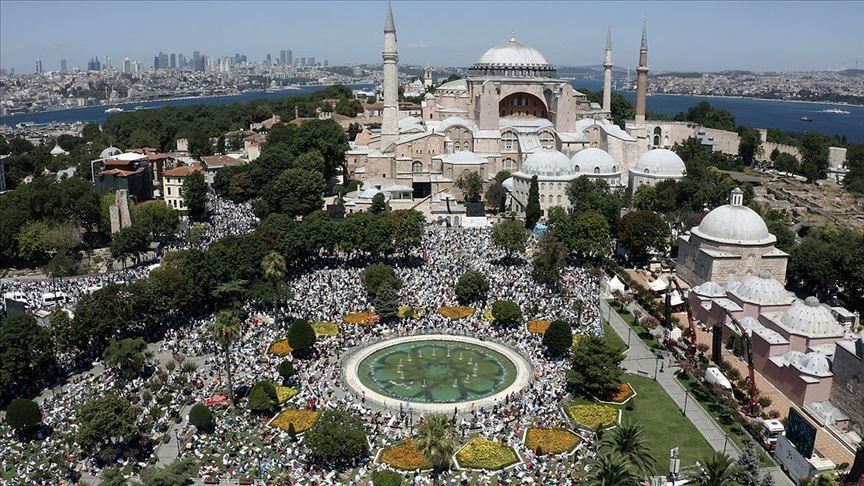
Thousands attend Eid al-Adha prayer in Hagia Sophia

Thousands of faithful Turks attended the special congregational morning prayer at Hagia Sophia Grand Mosque on Friday to mark the beginning of Qurban Bayram, also known as Eid al-Adha.

The first Bayram prayers at Hagia Sophia in 86 years was led by the head of the Presidency of Religious Affairs (Diyanet) Ali ErbaÅŸ.

Parliament speaker Mustafa Åžentop, Minister of Transportation and Infrastructure Ali KaraismailoÄŸlu, Istanbul Governor Ali Yerlikaya and Istanbul’s Fatih district Mayor Mehmet Ergün Turan joined the faithful at the Hagia Sophia.

Coming from all over the country, thousands of people filled the Hagia Sophia, as well as the streets surrounding the historic landmark in Istanbul.

On July 10, a Turkish court annulled a 1934 Cabinet decree that transformed the Hagia Sophia into a museum, paving the way for its use as a mosque.

Two weeks after the court’s ruling, the first prayer at Hagia Sophia was held with the attendance of some 350,000 people, as well as top political figures in Turkey, including President Recep Tayyip ErdoÄŸan.


On Friday, Muslims marked the beginning of Qurban Bayram, a four-day holiday marking the end of the hajj and the second most important religious festivity after Ramadan Bayram, also known as Eid al-Fitr.


On this holy day, Muslims sacrifice livestock, namely, sheep, goats, cows or camels, in commemoration of Prophet Abraham's willingness to sacrifice his son Ismail on Allah's command.


Like Ramadan Bayram, this festival is a time for sharing gifts and food among friends and family members as well as with the poor. The sacrificed animal's meat is usually divided into three parts – one part for the family, another for relatives and the final part is for people in need.


To sacrifice an animal, it is important to follow specific Islamic rules throughout the entire process to ensure that the animal is suitable for sacrifice. It is highly advised that the animal be cut by professionals at a specified location. Muslims may also donate their sacrifice to non-governmental organizations (NGOs) or other charitable organizations.


Hagia Sofia well protected by Turks, Greek priest says

Evangelos Papanikolaou, priest at Analipseos Church in Rafina, Athens, says Turks protected many churches in Greece

Hagia Sofia well protected by Turks, Greek priest says

ATHENS

If the Turks had not protected Hagia Sofia, it would have fallen a long time ago, a Greek Orthodox priest said.

Evangelos Papanikolaou, the priest at Analipseos Church in Rafina near Athens, said in a speech that Turks protected many churches in Greece and did not close them.

“Who would protect a massive building like Hagia Sofia? Turks did,” he said, adding that Turks never shut any churches in Crete but many monasteries and churches were closed down in Greece on the orders of Otto I,” he said, referring to a Catholic Bavarian prince who was declared the king of Greece in 1832.

Othonas refused to adopt Orthodoxy and remained as a heretic in the eyes of Greek population.

Papanikolaou said people were able to practice their religion under the Turkish rule in Greece.

“That’s why [Byzantine] people had said ‘I’d rather see Turkish turban than Latin mitre’. I would wish to see none of those two but if I have to make a decision, I would prefer the Turks,” he said.


The famous phrase "I would rather see a Turkish turban in the midst of the City (i.e., Constantinople) than the Latin mitre" reflects the suffering of Orthodox Christians in the hands of Catholics following the Great Schism of Christianity on July 16, 1054.

Papanikolaou went on to say that many tourists visited Hagia Sofia in improper clothes while it was a museum but from now on they will take off their shoes and wear long dresses and headscarves in accordance with the attire rules in a place of worship.

“Isn’t it a sign of respect?,” he asked rhetorically.

“Maybe we need to take this not as a damnation but a correction,” he said referring to Turkey's restoring of Hagia Sophia's status as a mosque.

On July 24, Friday’s prayers in the Hagia Sophia Grand Mosque marked the first acts of worship there in 86 years.

Some 350,000 Muslims took part in Friday prayers both inside and outside the historic mosque in Istanbul, Turkey’s largest metropolis.

On July 10, a Turkish court annulled a 1934 Cabinet decree that turned Hagia Sophia into a museum, paving the way for its use as a mosque.

Hagia Sophia served as a church for 916 years until the conquest of Istanbul, and a mosque from 1453 to 1934 -- nearly 500 years -- and most recently as a museum for 86 years.

In 1985, during its time as a museum, Hagia Sophia was added to the UNESCO World Heritage List.

Besides being a mosque, Hagia Sophia is also among Turkey’s top tourism destinations and will remain open for domestic and foreign visitors.


Implications of the Myanmar ICJ and ICC Cases for Non-Rohingya Minorities

As my colleagues Param-Preet Singh and Nadira Kourt laid out in the first two pieces of this forum, the International Court of Justice (ICJ) case concerning Myanmar’s genocide of the Rohingya presents opportunities for Myanmar to finally dismantle the root causes of its longstanding persecution of Rohingya people and the international community to live up to its promise of “Never Again.” In this final forum article, I look at what all the recent international attention paid to Myanmar’s treatment of the Rohingya means for other ethnic minorities that have suffered atrocities at the hands of Myanmar’s military (the Tatmadaw).

In some ways, international attention on the experiences of other ethnic groups in Myanmar is currently at a zenith. The intensifying conflict between the Tatmadaw and the Arakan Army – an armed group seeking increased autonomy for the multi-ethnic peoples in Rakhine state (referred to by the Arakan Army as “Arakan” state) – and the recent announcement of new military clearance operations by the Tatmadaw in ethnic Rakhine regions, have brought condemnation from American, Australian, British, and Canadian embassies in Myanmar.

In other ways, however, the attention of the international community remains fixated on the Rohingya. This is particularly true when discussing accountability efforts. Despite the flurry of activity on Myanmar at the ICJ, the International Criminal Court (ICC), foreign domestic courts (for example, Argentinian courts) and United Nations bodies, attention on the atrocities committed against a wider array of Myanmar’s ethnic minorities has been wanting.

Myanmar’s Other Atrocity Victim Groups

Since Myanmar’s independence, numerous ethnically-based armed conflicts in the country’s border regions have continued for decades. In engaging in these conflicts, the Tatmadaw has repeatedly and intentionally targeted civilians of the same ethnic background as that associated with whatever armed groups they were fighting at the time. Over the past several years, ethnic Rakhine, Kachin, and Shan civilians, and others, have been subjected to widespread attacks, indiscriminate killings, destruction and looting of property, food supplies, critical services, and places of worship.

Of special note is the Tatmadaw’s repeated commission of sexual and gender-based violence against ethnic minority populations. While the specific context of each armed group’s conflict with the Tatmadaw is distinct, the Tatmadaw’s use of rape as a weapon of war has remained a universal tactic. Ethnic women’s organizations have found time and again that widespread sexual violence is part of a deliberate and systematic pattern of targeting women and girls in their communities. Indeed, the U.N. Independent International Fact-Finding Mission on Myanmar (FFM), found that sexual and gender-based violence was a “hallmark of the Tatmadaw’s operations against ethnic minorities in Kachin, Shan and Rakhine states” and that “[t]hese violations, for most part perpetrated against ethnic women and girls, were used with the intent to intimidate, terrorise and punish the civilian population and as a tactic of war.” Even Aung San Suu Kyi, Myanmar’s State Counselor and de facto leader, decried the targeting of ethnic minorities for sexual violence in 2011, stating that “[r]ape is used in my country as a weapon against those who only want to live in peace, who only want to assert their basic human rights. It is used as a weapon by armed forces to intimidate the ethnic nationalities and to divide our country.”

The Focus on Crimes Against the Rohingya

Despite clear findings of grave human rights violations by local civil society, international fact-finders, and the de facto head of government, avenues for, or even conversations about, accountability for crimes against non-Rohingya ethnic minorities are virtually non-existent.

This is partly due to jurisdictional limitations and choices inherent in the ongoing investigations and cases, especially those at the ICJ and ICC. For example, the ICJ case is focused narrowly on the Rohingya because the facts indicate the Tatmadaw acted with an intent to destroy only the Rohingya – an essential element of the crime of genocide. Thus, while brutal and constituting crimes against humanity, the Tatmadaw’s atrocities against other ethnic groups do not fit the definition of genocide, and thus these victims cannot avail themselves of the ICJ’s jurisdiction, which is tied specifically to the Genocide Convention in the ongoing Gambia v. Myanmar litigation.

Similarly, the ICC investigation is focusing on crimes against the Rohingya because of the narrow jurisdiction available to that court – the crimes must be linked to the “clearance operations” in Rakhine state beginning in 2016 and, crucially, must have at least one element occurring in Bangladesh (the nation the vast majority of Rohingya victims have fled to). This is because unlike Myanmar, Bangladesh is a party to the ICC’s Rome Statute, which confers the court with territorial jurisdiction. A universal jurisdiction case brought in Argentina by Rohingya human rights activists likewise targets members of the Tatmadaw and Myanmar government with alleged crimes against the Rohingya specifically.

The one exception to this narrow focus on the Rohingya is the Independent Investigative Mechanism for Myanmar (IIMM), created by the U.N. Human Rights Council. The IIMM’s mandate empowers it to investigate the most serious international crimes occurring anywhere in Myanmar, and therefore against any ethnic group, since 2011. Yet, the IIMM’s work has been overshadowed by the exclusive focus on the plight of the Rohingya at the ICJ, ICC, in Argentinian courts, and more generally in press coverage and U.N. statements.

The picture is not much different in international political spheres, where fear of alienating Myanmar, an emergent economic partner, has clipped the responses of countries and international organizations. Though to be fair, Australia, the EU, U.K. and United States have all levied targeted sanctions against certain Tatmadaw officials for their roles in atrocities against Shan, Kachin, and ethnic Rakhine victims – along with Rohingya ones. Relevant U.N. General Assembly and Human Rights Council resolutions similarly name human rights violations against multiple of Myanmar’s ethnic groups. At the same time however, the Security Council has failed to take action outside the Rohingya context, with the infamous “Rosenthal Report” describing a systemic failure at the U.N. in addressing all atrocities by the Tatmadaw. Meanwhile, key economic partners, such as Japan, have turned a blind eye to the gaping hole in accountability for crimes against Myanmar’s ethnic minorities.

This is not to take away from the uniquely brutal character and scale of crimes committed against the Rohingya. As pointed out above, unlike other groups, the Rohingya were targeted for destruction by the Tatmadaw. This, coupled with the displacement of nearly 1,000,000 Rohingya, calls for an urgent and comprehensive response. However, it is also important to acknowledge that all atrocity crimes, whatever their specific character, continue to be integral aspects of the Tatmadaw’s standard operating procedures in operations against ethnic minorities. Justice and accountability for such crimes is essential.

Indeed, human rights defenders from Myanmar’s ethnic communities have shown broad support for international efforts aimed at justice for the Rohingya. Karen, Shan, Mon, and Kachin groups have all put out statements of solidarity, each highlighting that until the Tatmadaw is held accountable, atrocities against ethnic communities will continue. Collectively, the statements paint a broader, much more comprehensive picture of crimes in Myanmar, by detailing the decades-long patterns of similar abuses against ethnic minorities.

The patterned nature of these violations is what renders the various Rohingya cases potentially such potent aids in accountability efforts by other ethnic groups. The same military and government leaders that are responsible for the Rohingya genocide are implicated in the crimes against other ethnicities. The FFM found that “[t]he consistent tactical formula employed by the Tatmadaw exhibits a degree of coordination only possible when all troops are acting under the effective control of a single unified command.” At the top of this chain of command are Myanmar’s Commander-in-Chief, the Deputy Commander-in-Chief, and numerous other Lieutenant and Brigadier Generals.

Conclusion: Justice for All or Stability for None

The international community has the tools and knows what to do when centralized commands and high-level perpetrators commit mass atrocities. The Security Council should refer the situation to the ICC, as it did in Sudan and Libya, to widen the scope of the prosecutor’s ongoing investigation to encompass crimes committed exclusively on the territory of Myanmar. Or, the Council could instead create an ad hoc tribunal, like it did following atrocities in the former Yugoslavia and Rwanda, and empower it to investigate and prosecute crimes occurring against all of Myanmar’s ethnic minorities. A third-party state could also demand the extradition of alleged perpetrators, or a regional country could propose a special tribunal, both of which were steps that contributed to the trial and conviction of Chadian dictator Hissène Habré. In the very least, the international community should sever all military and economic relationships with the Tatmadaw’s leaders.

Too often justice and accountability are seen as barriers to achieving stability in Myanmar. The Tatmadaw’s pattern of human rights violations against ethnic communities are a grim reminder that the opposite is actually true – justice and accountability are necessary preconditions for a true democratic transition. Justice for all is the only path forward, and until it is achieved, the Tatmadaw will continue its decades-long practice of scapegoating and targeting all of Myanmar’s ethnic minorities.

A cause for hope for the Rohingya in Myanmar by Azeem Ibrahim

Inline image
Rohingya villagers watch as international media visit Maung Hna Ma village, Buthidaung township, northern Rakhine state, Myanmar, July, 2017. (Reuters)

Something peculiar and unexpected happened in Myanmar in mid-July: A group of Rakhine Buddhist students visited a camp for Rohingya refugees.

This kind of thing is new. While the “clearing operations” against the Rohingya over the past two years have been orchestrated by the federal military forces of Myanmar, directed from Naypyidaw, the Rakhines had long been a primary engine of previous violent outbursts against their Rohingya neighbors in Rakhine/Arakan, such as in the 2012-13 flareups of ethnic conflict. Indeed, crackdowns on the Rohingya by federal authorities have frequently been invited and welcomed by Rakhines throughout the turbulent history of post-independence Myanmar.

What is unclear at the moment is whether the federal government in Naypyidaw is aware of these developments, or indeed whether they might even be supportive of them. What is known so far is that an apparent, concerted effort to build bridges between the communities is actively supported by younger Rakhines, particularly students. As such, it is plausible that they are working entirely outside the reach of the Myanmar federal authorities, and indeed, outside of the knowledge of local Rakhine authorities who had been so hostile to Rohingyas in the past.

But it is also the case that both Rakhine and federal authorities have been running a pretty tight ship on anti-Rohingya propaganda up to now, so the fact that this is happening at present seems odd. Given that Rohingyas are so routinely demonized as “Muslim terrorists,” and sympathy toward the “terrorists” has been suppressed in the past, the fact that this new movement from among the Rakhine youth in the state has made it through to an international audience may point to some shifts in the background as to how authorities are approaching the issue of the Rohingya. Especially since, one has to imagine, the students had to get past security at the camps.

Might this have been allowed to happen in order that the authorities in Myanmar could be able to point to “civil society efforts” as positive developments as it continues to face unrelenting criticism on the international stage, and perhaps even censure at the International Court of Justice? Might this even have been encouraged or instigated by some state or federal authorities as a PR exercise for the country?

One needs to watch these efforts closely, and actively support any real dialogue between the people of Rakhine/Arakan state. If these students are indeed leading an independent effort to change things for the better in their country, the global community should be very vocal and robust in defending them against any censure from the authorities for speaking out.

"The entire global community must continue to fight relentlessly for the Rohingya to be accepted as equal citizens in their own country."

Dr. Azeem Ibrahim

Indeed, even if this is some cynical ploy where the authorities are working in the background either to allow or actively encourage these initiatives for PR and propaganda purposes, the international community should still support the debate moving forward toward the acceptance of the Rohingya in the land of their birth, and use the opportunity to push for them receiving full rights as citizens which they are entitled to under international law.

In all cases, this is a positive development. Things will not now suddenly, or inevitably get better. The entire global community must continue to fight relentlessly for the Rohingya to be accepted as equal citizens in their own country. Nor can the global community allow the perpetrators of the genocide be left off the hook, now that the debate seems to be changing toward a more positive direction. Whatever the reason for these developments, the international community must continue to support them, but it must also make sure that it does not lose focus of all the other things that need to be done.

  • Dr. Azeem Ibrahim is a research professor at the Strategic Studies Institute US Army War College and author of “Prospective Foreign Policy of a Corbyn Government and US National Security Implications.” Twitter: @AzeemIbrahim

Genocide ruling against Myanmar welcome but it highlights good and bad of international law

  Alex Cunningham Vladimir Putin, Benjamin Netanyahu, Joseph Kony. All three men stand accused of slaughtering innocent civilians, abducting...