Tuesday, September 6, 2022

Biden administration expresses ‘concern’ over Israeli raids, but refuses to condemn them

 On August 18 Israeli forces carried out an overnight raid on the offices of seven Palestinian civil society organizations in the occupied West Bank. Armed soldiers stole documents, damaged property, and welded the office doors shut.

Six of the seven targeted groups (Al-Haq, Addameer, Defense for Children International – Palestine, the Union of Agricultural Work Committees, The Bisan Center for Research and Development, and the Union of Palestinian Women’s Committees) had been designated as terrorist organizations by the Israeli government in October 2021. Israel has never provided any public evidence to back up these allegations and classified documents obtained by +972, Local Call, and The Intercept show that the accusations are dubious.

Shortly after Israel designated the groups as terrorists, they presented the Biden administration with what they claimed to be “unequivocal” intelligence against the Palestinian NGOs. “We receive detailed information from the Israeli government,” State Department spokesman Ned Price told reporters at the time. “We appreciated the consultation. We’re reviewing the information that they provided us.”

Advertisement
Mondoweiss Podcast, Episode 43: Operation Breaking Dawn and Israeli elections


That was ten months ago, but the Biden administration has still not made a public conclusion about the evidence. At an April 2022 State Department briefing Price reiterated the same sentiments from October and did not indicate that they were any closer to reaching a verdict. “We have received detailed information on that very question from our Israeli partners, and it’s something that we’re continuing to review,” he said. “We received detailed information from our Israeli partners on the basis for their designation. We’re taking a very close look at that ourselves.”

At yesterday’s briefing Price was hit with a barrage of questions from the AP’s Matt Lee and Al Quds’ Said Arikat about the raid. Price expressed “concern” about the raids and said the administration was awaiting information about situation from its Israeli partners, the reporters asked why it hadn’t released a statement about the evidence from October and why people should expect them to assess any new evidence in a timely manner. Lee told Price that the administration seemed to be in a “perpetual state of limbo.”

“We have not seen anything that has caused us to change our position,” Price eventually admitted, which marks the first time that the administration has acknowledged that it doesn’t share Israel’s position on the issue. However, Price refused to disagree with the Israeli government directly, much less accuse them of lying.

“So you don’t believe the Israelis’ information?,” asked Lee at one point.

“Intelligence information is always information that is the subject of analysis and different parties can read information differently,” responded Price. “They can perceive of threats differently. Our own analysis heretofore of the information that was provided last year has not caused us to change our approach to these organizations.”

When Price was asked why the administration is simply voicing concern, instead of condemning the raids, he curiously referenced October evidence. “I think the fact is that our Israeli partners..took an action..to designate these organizations as so-called ‘terrorist organizations’, said Price. “What we’ve seen publicly, what they’ve conveyed privately in recent hours, is that there’s an appropriate basis for the actions that they have taken. It will be a matter of urgency for us to review the basis for that information.”

U.S. complicity

On Twitter some pointed out that the Biden administration helped facilitate the raids via their inaction in regards to the original intelligence. “To be clear, while this is the furthest the U.S. government has come, it still falls very short of where it needs to be,” wrote the Palestinian-American political analyst Yousef Munayyer. “Their equivocation for months emboldened Israel to raid these offices today. When will the US finally condemn these actions, how much further does Israel have to go?”

“The Biden Admin has had Israel’s ‘evidence’ for almost a year,” wrote Foundation for Middle East Peace president Lara Friedman. “It clearly knows this ‘evidence’ is BS — otherwise there is zero doubt they would have validated Israel’s designations/designated the groups themself. But knowing the evidence was BS, they appear to have taken the politically & morally cowardly approach of staying silent — an approach that amounts to foreign policy gross negligence/complicity.”

“Make no mistake: This is a Chekov’s gun situation,” she continued. “Israel put the gun on the table last October. The Biden Admin saw that gun and decided to do nothing to pressure Israel to remove it. Now, the Biden Admin cannot claim surprise when Israel aims/fires that gun at Palestinian human rights defenders.”

A few Democratic House members also called Biden to act. “I am upset by the latest attacks by the Israeli army on Palestinian human rights groups,” tweeted Rep. Andre Carson (D-IN). “Silencing human rights defenders is an attempt to avoid accountability. I reiterate calls from myself and my colleagues that the Biden administration immediately condemn this repression.”

“Once again the IDF has launched a chilling attack on Defense for Children International-Palestine, a human rights organization supporting Palestinian children,” wrote Rep. Betty McCollum. “The Biden administration must condemn these efforts to silence groups advocating for Palestinian human rights and civil society.”

Last year McCollum introduced a resolution calling on the administration to condemn Israel’s “authoritarian and antidemocratic” repression of the human rights groups.

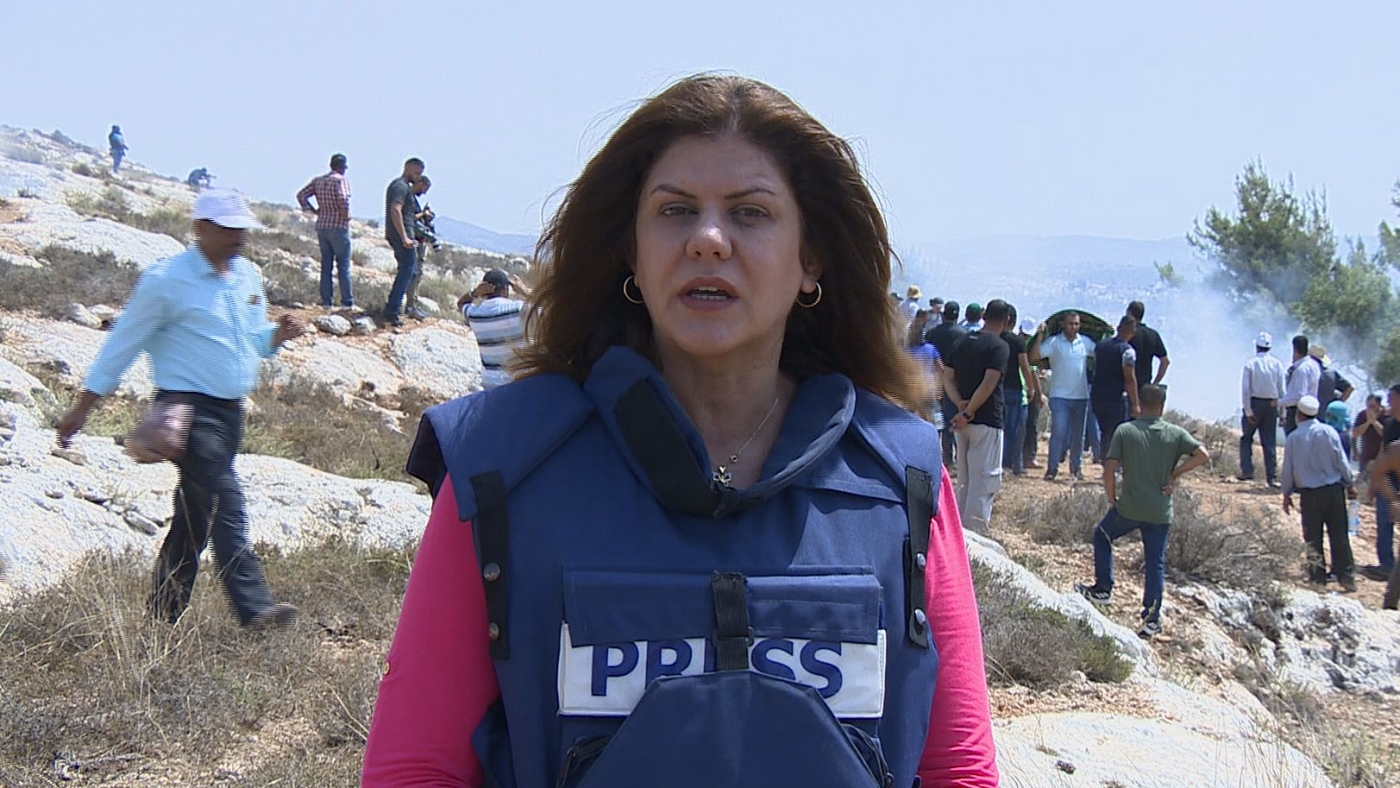
Shireen Abu Akleh: Israeli army admits 'highly probable' it killed journalist

 Army investigation said despite the findings it would not open an investigation into any soldiers involved in the killing
Several international news agencies that have looked into the shooting have concluded that the bullet that killed Abu Akleh was fired from Israeli forces (Al Jazeera)

An Israeli army investigation into the killing of the veteran Al Jazeera journalist Shireen Abu Akleh concluded that she was likely to have been unintentionally shot by an Israeli soldier but was not deliberately targeted, the military said on Monday.

Abu Akleh, a US-Palestinian citizen, was shot dead by Israeli forces on 11 May while covering an Israeli military operation in Jenin in the occupied West Bank. Her colleague Ali al-Samoudi was also shot and injured. 

'Our family is not surprised by this outcome since it's obvious to anyone that Israeli war criminals cannot investigate their own crimes'

- Statement by the family of Abu Akleh

A statement on the investigation published on Monday said "there is a high possibility that M. Abu Akleh was accidentally hit by IDF (Israeli army) gunfire that was fired toward suspects identified as armed Palestinian gunmen".

The Israeli Military Advocate General's Office said it would not open an investigation into any soldiers involved in the incident as "there is no suspicion that a criminal offence was committed".

The army investigation also said it was possible that she was hit by Palestinian gunmen.

In a statement in response to the army's findings, the Abu Akleh family said: "Today, the Israeli government and military released a statement that tried to obscure the truth and avoid responsibility for killing Shireen Abu Akleh, our aunt, sister, best friend, journalist, and a Palestinian American.

"We've known for over four months now that an Israeli soldier shot and killed Shireen as countless investigations conducted by CNN, the Associated Press, the New York Times, Al Jazeera, Al-Haq, B'tselem, the United Nations, and others have all concluded. 

"And yet, as expected, Israel has refused to take responsibility for murdering Shireen.

"Our family is not surprised by this outcome since it's obvious to anyone that Israeli war criminals cannot investigate their own crimes. However, we remain deeply hurt, frustrated, and disappointed."

The Israeli army investigation found that Abu Akleh was likely mistakenly shot by an Israeli soldier while under fire who was using a telescopic scope and misidentified her as an armed Palestinian gunman.

Middle East Eye contributor Shatha Hanaysha was with Abu Akleh when they came under fire.

"What happened was a deliberate attempt to kill us. Whoever shot at us aimed to kill," she told MEE at the time.

According to Hanaysha, there were no Palestinian fighters nearby and the location where Abu Akleh was killed was in a relatively open area.

UN inquiry

In June, the UN concluded that Israeli forces had fired the fatal bullet that killed Abu Akleh.

UN Human Rights Office spokesperson Ravina Shamdasani told reporters in Geneva that the organisation found that the shots that killed Abu Akleh came from Israeli forces.

Shireen Abu Akleh's family meets with Blinken, renews demands for justice
Read More »

“It is deeply disturbing that the Israeli authorities have not conducted a criminal investigation," she said.

"We at the UN Human Rights Office have concluded our independent monitoring into the incident.

"All information we have gathered - including official information from the Israeli military and the Palestinian attorney-general - is consistent with the finding that the shots that killed Abu Akleh and injured her colleague Ali Sammoudi came from Israeli Security Forces and not from indiscriminate firing by armed Palestinians, as initially claimed by Israeli authorities."

Several international news agencies that have looked into the shooting have also concluded that the fatal bullet was fired from Israeli forces.

Liz Truss and the Middle East: Where new UK PM stands on key issues

 Faced with domestic woes and the need to strike business deals, a Liz Truss premiership is set to put money over human rights and democracy in the region
New Conservative Party leader and Britain's next Prime Minister Liz Truss delivers a speech following the announcement of the winner of the Conservative Party leadership contest in London, 5 September 2022 (AFP)

The British Conservative Party selected Liz Truss as its new leader, and the United Kingdom's next prime minister, on Monday.

Truss, who is currently foreign secretary, will formally be confirmed as prime minister on Tuesday following her success in the contest to succeed Boris Johnson as leader of the governing party.

She has been called a political "shapeshifter" and someone whose views are "very black and white". As prime minister she inherits a political agenda dominated by a domestic cost of living crisis fuelled by spiralling inflation and energy prices.

But her record as foreign secretary and previously as a minister for international trade also offers clues as to the likely direction the Truss-led government will take in the key policy areas involving the UK and the Middle East.

Israel-Palestine

As Israeli air strikes pummelled the besieged Gaza strip in early August, killing at least 45 Palestinian civilians, including 15 children, Truss issued a statement of support for Israel, saying: "The UK stands by Israel, and its right to defend itself."

Closer to home, Truss will be taking over a government that is seeking to outlaw the Boycott, Divestment, Sanctions (BDS) movement by preventing public bodies, councils and their pension funds from boycotting investments in Israel. 

Despite criticism from civil society organisations that the move would represent a "threat to freedom of expression, and the ability of public bodies and democratic institutions to spend, invest and trade ethically in line with international law and human rights", Truss has offered no indication that she would reverse course. 

The prime minister's staunch support for Israel has even led to her stating that she had overruled long-serving bureaucrats at the Foreign Office by backing Israel at the UN Human Rights Council (UNHRC), and suggesting that the UN body had been "used to peddle a particular agenda which frankly have strong elements of antisemitism". 

'A Truss government would be managing the different crises according to its interests and privileging security and stability over any other issue'

- Umberto Profazio, associate fellow at International Institute for Strategic Studies

In June, UNHRC members passed two resolutions affirming the right of the Palestinian people to self-determination and condemning illegal Israeli settlements in the occupied Palestinian territories, including East Jerusalem, and the occupied Golan Heights. 

The UK voted against the resolutions, putting it largely out of step with the rest of the international community. 

More recently, in a move that would reverse decades of British policy on Israel-Palestine, Truss said she would "review" the relocation of the country's Israel embassy to Jerusalem

"I’ve had many conversations with my good friend [Israeli] Prime Minister [Yair] Lapid on this topic. Acknowledging that, I will review a move to ensure we are operating on the strongest footing within Israel," she wrote in a letter to the Conservative Friends of Israel advocacy group.

Under Truss, the British foreign office has also opened free trade negotiations with Israel, hoping to boost the more than $5bn worth of trade between the two countries.

UK and Gulf ties

When a committee of members of parliament asked Truss to name a time that she had raised human rights concerns with the Gulf Cooperation Council (GCC) countries - a political and economic bloc made up of Saudi Arabia, the United Arab Emirates, Qatar, Kuwait, Bahrain and Oman - she failed to do so. 

Despite her past promises to hold countries engaged with human rights abuses "to account", Truss believes it's more important "to do business" with Gulf countries.

As foreign secretary, she oversaw the start of the UK's efforts to secure a free trade agreement with the GCC countries. The British government has "identified the region as crucial to London's interest for commercial and strategic reasons," said Umberto Profazio, associate fellow at the International Institute for Strategic Studies (IISS).

"For the post-Brexit UK, it's evidently important to diversify as much as possible its trade partners, and the Gulf is certainly an important region where London is nonetheless facing several competitors that have been able to make significant inroads in recent years," Profazio told Middle East Eye. 

Liz Truss failed Nazanin Zaghari-Ratcliffe, says husband
Read More »

"Facing China and Russia's growing influence in the region, the UK is certainly losing ground like many other western powers, which are suffering from a lack of credibility in the eyes of their Arab partners," added Profazio. 

As Britain seeks to diversify its trading relationship, Saudi Arabia's war in Yemen, which has left thousands dead and millions on the brink of starvation, will likely take a back seat. 

The humanitarian crises in Yemen hasn't prevented the UK government from approving continuing weapons sales to the Saudis either, with the Department of International Trade dragging its feet when MEE asked to see documents which could offer insights into how decisions about policy regarding arms sales to Saudi Arabia has been shaped by the conflict.

Egypt's human rights record

Liz Truss's focus on doing business with Middle East countries and prioritising her leadership race to become the prime minister has meant the plight of the British-Egyptian activist Alaa Abd el-Fattah has been largely ignored. 

The Egyptian state has hounded the Egyptian writer and political activist since 2014. He was arrested and imprisoned in 2019 and, in December 2021, was sentenced to five years for spreading "false news". The evidence used against him was a retweet.

Since May, Alaa has been on hunger strike, with prison authorities denying him consular assistance, reading materials, a bed, and even a clock.

Alaa's family recently slammed Truss for her failure to assist him, expressing their exasperation at her lack of help. "Honestly, it just feels like she is intentionally dismissing our plight and her responsibility towards us," his sister Mona Seif wrote on Twitter. 

Business as usual on Iran

While Truss was credited for helping Nazanin Zaghari-Ratcliffe, the UK-Iranian charity worker who spent more than five years in jail in Iran on accusations of spying, back to Britain, her husband accused her of not doing enough to hold to account those responsible for his wife's incarceration.

Richard Ratcliffe said Truss had not followed through on a promise to impose sanctions on individuals in Iran who had been involved in the affair.

On the pressing matter of the Iranian nuclear deal, Truss has taken a more hardline position. 

"I have been clear that progress on the Joint Comprehensive Plan of Action is not moving fast enough, and I assure you that if the JCPOA collapses, all options are on the table," she said recently.

There is every sign that Truss would follow a "business as usual" approach on the Middle East, said Profazio from ISS. 

Israel-Palestine: Tory candidates lurch into dangerous U-turn on Jerusalem
Peter Oborne
Read More »

"While much of her attention would be inevitably devoted to the difficult economic situation and domestic policies, a Truss government would be managing the different crises according to its interests and privileging security and stability over any other issue," added Profazio.

"I would expect much closer ties with Gulf partners, in consideration of the importance of the FTA negotiations for the UK, and further efforts to accommodate the interests of main partners such as Saudi Arabia and the UAE, including in the main conflict theatres where these countries are actively engaging," Profazio told MEE.

Ultra-Hawk Liz Truss to Be Next British Prime Minister


Truss said at a recent town hall that she would be 'ready' to launch nuclear weapons as prime minister

British Foreign Secretary Liz Truss will replace Boris Johnson as the British prime minister after the UK’s Conservative Party voted to make her the leader of the government. She beat out former Finance Minister Rishi Sunak and is expected to be formally named prime minister by the Queen on Tuesday.

As the British foreign secretary, Truss has delivered some of the most hawkish rhetoric against Russia in NATO’s response to the invasion of Ukraine. When the war first broke out, Truss said that she supported individuals from the UK who wanted to fight in Ukraine.

While campaigning to become the prime minister, Truss said if she took the position, she would follow in Johnson’s footsteps and be Ukraine’s “greatest friend” to ensure that Russian President Vladimir Putin “fails in Ukraine and suffers a strategic defeat.”

According to a report from The Financial Times, Truss and her team have been frustrated that the US hasn’t taken a “harder line” on Russia even as Washington has pledged over $13 billion in weapons for Ukraine, dwarfing the $2.8 billion in military aid London has committed.

While the UK isn’t contributing nearly as much money as the US, Britain is one of the leading NATO supporters of Ukraine. The British are currently training thousands of Ukrainian soldiers inside the UK, with the goal of training 10,000 within 120 days. According to reports from The Times and The New York Times, British special operations forces are on the ground in Ukraine.

Truss has also voiced her opposition to negotiations with Russia, saying talks could only happen after Moscow is “defeated.” Johnson frequently discouraged negotiations and reportedly played an integral role in the failure of earlier peace talks between Russia and Ukraine, a pattern that will likely continue under a Truss premiership.

Truss has also been hawkish in her rhetoric against China and has called for a “global NATO” that’s capable of defending Taiwan and the broader Asia Pacific region. She is expected to be confrontational with Beijing and will reportedly classify China as a “threat” to British national security for the first time.

During a recent town hall, Truss was asked by host John Pienaar how she would “feel” if she had to order a nuclear strike, which Pienaar recognized would likely mean global annihilation. Truss said, “I think it’s an important duty of the prime minister and I’m ready to do that.”

When asked again how ordering a nuclear strike would make her feel, Truss simply responded, “I’m ready to do that.”

Monday, September 5, 2022

Why ethnic tensions are flaring again in northern Kosovo?

 PRISTINA, Sept 1 (Reuters) - Kosovo will begin on Thursday a two-month implementation period for a controversial move to oblige Serbs, mainly those living in the northern part of the Balkan nation, bordering Serbia, to start using license plates issued by the government in Pristina. read more

Ethnic tensions over the decision erupted last month when ethnic Serbs in northern Kosovo, who are backed by Serbia and do not recognise Pristina's authority, set up roadblocks to protest the new rule.

Kosovo and Serbia intend to join the European Union and have agreed, as part of that membership process, to resolve their outstanding issues and build good neighbourly relations.

Here are some facts about the standoff:

WHY ARE THERE TENSIONS?

Kosovo won independence from Serbia in 2008, almost a decade after a guerrilla uprising against Belgrade's repressive rule.

Serbia, however, still considers Kosovo to be an integral part of its territory and rejects suggestions it is whipping up tensions and conflict within its neighbour's borders. Belgrade accuses Pristina of trampling on the rights of minority Serbs.

Ethnic Serbs account for 5% of Kosovo's 1.8 million people, with ethnic Albanians making up about 90%.

WHY DID TENSIONS FLARE AGAIN?

Kosovo has for years wanted the approximately 50,000 Serbs who live in the north to switch their Serbian license plants to ones issued by Pristina, as part of the government's desire to assert authority over its territory.

Ethnic Serbs have long refused to recognise the authority of Kosovo's institutions in the north, venting their hostility by refusing to pay Kosovo's power operator for the electricity they use and frequently attacking police who try to make arrests.

Kosovo's push last year to impose the license plates was aborted when ethnic Serbs protested. On July 31 of this year, Pristina announced a two-month window for the plates to be switched over, triggering new protests.

Tensions eased after Kosovo Prime Minister Albin Kurti, under U.S. and EU pressure, agreed to postpone the switch.

WHAT DO THE SERBS WANT?

Serbs in Kosovo want to create an association of majority-Serb municipalities that would operate with greater autonomy. Serbia and Kosovo have made little progress on this and other issues since committing in 2013 to the EU-sponsored dialogue.

WHAT IS THE ROLE OF NATO AND THE EU?

WHAT IS THE ROLE OF NATO AND THE EU?

NATO has about 3,700 troops stationed in Kosovo to maintain the peace. The alliance said it would intervene in line with its mandate if stability in the area were jeopardized. The European Union Rule of Law Mission in Kosovo (EULEX), which arrived in 2008, still has around 200 special police officers there.


Friday, August 26, 2022

BHRN Message


BHRN Welcomes UK Government’s Decision to Join Rohingya Genocide Case at the ICJ


26 Aug 2022


Burma Human Rights Network (BHRN) welcomes the decision by the UK government to support the genocide case against Myanmar at the International Court of Justice (ICJ). On 25 August, Minister for Asia Amanda Milling confirmed the UK’s intention to intervene in the case of The Gambia v. Myanmar before the International Court of Justice. The case will determine whether Myanmar has violated its obligations under the Genocide Convention in relation to the military’s acts against the Rohingya in 2016 and 2017.


“The U.K. Government decision to intervene in the case of The Gambia vs. Myanmar before the International Court of Justice sends a strong message of solidarity to the Rohingya people five years since the genocidal attacks in Rakhine State,” said Burma Human Rights Network Executive Director, Kyaw Win. “International justice can have a preventative affect and stop future atrocities by the brutal junta in Burma.”


The Gambia filed the case against Burma before the ICJ in November 2019, alleging that the Myanmar military’s campaign against the Rohingya people violated various provisions of the Genocide Convention. 60 countries supported the case which included Canada, the Netherlands, the UK and all 57 members of the Organisation of Islamic Cooperation (OIC). In January 2020, the ICJ unanimously indicated legally binding provisional measures of protection for the Rohingya people, requiring Burma to ensure that the military and other security forces do not commit acts of genocide,


Despite the provisional measures, BHRN has continued to document abuses against the Rohingya remaining in Burma. In Rakhine State, nearly 600,000 Rohingya remain trapped under a system of discriminatory laws and policies that amount to crimes against humanity and ongoing genocide. Since the attempted military coup on 1 February 2021, the human rights situation of the Rohingya has further deteriorated with Rohingya facing tightened restrictions on their fundamental freedoms and are increasingly at risk of being subjected to further atrocity crimes.


The Gambia’s laudable step towards ending impunity for those committing atrocities in Myanmar should be fully supported by the international community. Recalling that the Genocide Convention requires all States parties to prevent the crime of genocide and hold those responsible to account, BHRN calls on all States Parties to the Genocide Convention to support efforts addressing these violations. BHRN calls on the British government, as penholder on Burma at the United Nations Security Council, to convene a meeting of the Security Council to discuss progress in implementing the provisional measures. BHRN also continues to call on the United Nations Security Council to refer the situation to the International Criminal Court to enable further scrutiny.


Organisation’s Background

BHRN is based in London, operates across Burma and works for human rights, minority rights and religious freedom in Burma. BHRN has played a crucial role advocating for human rights and religious freedom with politicians and world leaders.


Media Enquiries

Please contact:

Kyaw Win, Executive Director

Burma Human Rights Network (BHRN)

E: kyawwin@bhrn.org.uk 

T: +44(0) 740 345 2378


Learn More


[Burma Human Rights Network] | [Phone] | [E-mail] | [Website]


Connect with us


Facebook Twitter  Instagram


CAIR Texas Defends MSAs Against SBOE Member’s Baseless Claims

  The Texas chapter of the Council on American-Islamic Relations (CAIR Texas) today condemned the State Board of Education member Brandon Ha...