BY ON 2/27/22 AT 6:38 PM
EST
China Changes Tack As Xi Tells
Putin to Negotiate Peace

The United States' effort to condemn Russia's
military operations in Ukraine at the United Nations Security Council was unsurprisingly
vetoed by Moscow, but three other powers spoiled a consensus as well, including
two partners of Washington along with its top rival.
As China, India and
the United Arab Emirates doubled down on their abstentions Sunday during
another vote that ultimately passed despite Russia's opposition on holding an
emergency session of the U.N. General Assembly, Newsweek spoke
with experts from the trio of countries to determine why their nations opted to
stay neutral and still pursue closer ties with Moscow.
Russian President Vladimir Putin's
decision to conduct a "special military operation" to
"demilitarize" and "de-Nazify" Ukraine was met with
widespread backlash among U.S. allies and partners across the globe. At a fiery
U.N. Security Council gathering on Friday, France and the United Kingdom, along
with the sole Eastern European representative Albania voted alongside their
ally the U.S. to censure Russia, as did neutral fellow Europe's Ireland and
Norway, Africa's Gabon, Ghana and Kenya along with Latin America's Brazil and
Mexico.
Despite Washington's
efforts to court India in recent years as an effort to counter Beijing in the
Asia-Pacific region, New Delhi took a neutral stance, a likely nod to its
Harsha Kakar, a
retired major general of the Indian Armed Forces who also led the department of
strategic studies at India's College of Defence Management, told Newsweek that his country's decision was rooted
in "India's traditional ties with Russia, including defense deals and
continued dependence on weapon spare parts and imports including S-400 missile
systems."
"This makes
Russia a close ally," he said.
India's decision to
acquire the S-400 surface-to-air missile system and foster closer military ties
with Russia has been a sticking point in the U.S'. attempt to further integrate
the South Asian power into its broader geopoltical goals. However, unlike Turkey,
a U.S. NATO ally that
also purchased the S-400, India has not yet faced sanctions for its decisions,
highlighting the country's importance to U.S. strategy.
Kakar also pointed to
other areas of critical ties between Moscow and New Delhi, including their
interactions as part of BRICS alongside Brazil, China and South Africa, as well
as the trilateral RIC forum with China.
"Growing
strategic relations with the U.S. cannot imply India dumps its ally
Russia," Kakar said. "The U.S. would understand Indian
compulsions."
He also referenced
India's relations with Ukraine, noting they "involve defense deals
including spares for naval gas turbine engines and upgrading of the AN
[Antonov] fleet of aircraft." But he cited the words of India's top
diplomat in illustrating these ties were dwarfed by the need for positive ties with
Russia.
"As Indian
Foreign Secretary Harsh Shringla stated some time ago, 'Without Russian spares
our planes won't fly and our ships won't sail,'" Kakar said.
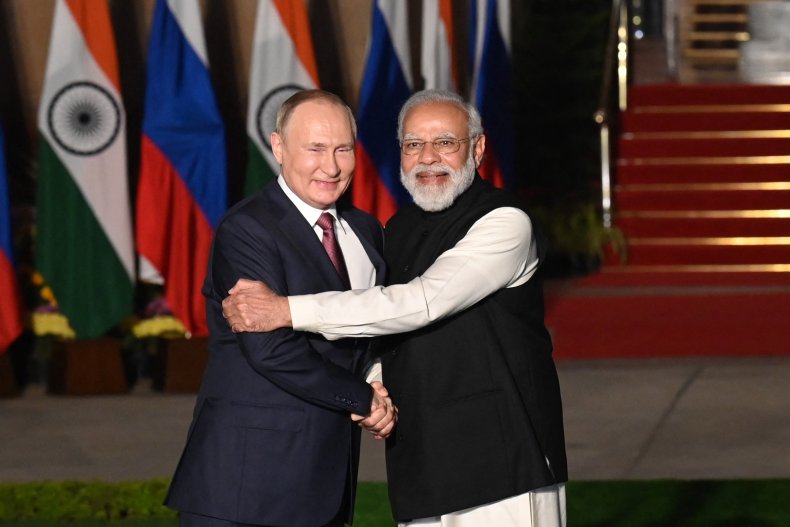 Above, India's Prime
Minister Narendra Modi greets Russian President Vladimir Putin before a meeting
at Hyderabad House in New Delhi on December 6, 2021.MONEY
SHARMA/AFP/GETTY IMAGES
Above, India's Prime
Minister Narendra Modi greets Russian President Vladimir Putin before a meeting
at Hyderabad House in New Delhi on December 6, 2021.MONEY
SHARMA/AFP/GETTY IMAGES
Elsewhere in Asia was
another holdout from U.S'. hopes to present a united front against Russia.
Former U.S. Defense
Secretary James Mattis famously nicknamed the UAE "little Sparta" due
to its outsized posture in the fraught security situation of the Persian Gulf
region. But in addition to seeking U.S. military support
in the face of tense times with nearby Iran, Abu Dhabi has also eyed closer
ties with Moscow in a number of sectors, including defense.
The trend was on full
display in recent UAE arms expos in which an array of Russian weapons were
showcased. Parallel to this has been a greater U.S. hesitance to sell military
equipment to the UAE due to concerns of civilian casualties in the ongoing war
in Yemen and of Abu Dhabi's growing relationship with Beijing.
Frustration over
China's footprint in the UAE appeared to be a central factor in the stalling of
the Pentagon's plans to
sell F-35 fighter jets to the Arab state. After months of uncertainty, Abu
Dhabi informed Washington in December that it was suspending plans to acquire
the advanced warplane.
On Wednesday, hours
before Putin announced the beginning of military operations against Ukraine,
UAE Foreign Minister Sheikh Abdullah bin Zayed Al Nahyan called for
strengthening ties and deepening cooperation in a call with Russian counterpart
Sergey Lavrov. Hours before Friday's vote, Sheikh Abdullah announced he would
visit Moscow on Monday to boost bilateral bonds.
Abdulkhaleq Abdulla, a
professor of political science in the UAE, told Newsweek that
the UAE's decision to abstain from weighing in on Russia's actions in Ukraine
"is consistent with the new UAE foreign policy activism, which stems from
being confident of its decisions and its approach to global and regional
politics."
"Confidence has a
lot to do with this vote," Abdulla said, "that finally we are
independent enough, competent enough to take this kind of position, which is
consistent with our own way of doing things."
"Maybe it doesn't
resonate too well in Washington," he added, "but that's the way
things are going to be from now on."
READ MORE
·
NATO States May Give Sanctuary to Fleeing Ukraine
Forces as Russia Advances
·
Exclusive: U.S. Expects Kyiv's Fall in Days,
Ukraine Source Warns of Siege
·
US-Russia Tensions On Rise in Europe, But the
Arctic Is Their True Frontier
As the UAE's top
diplomat prepares to visit the Russian capital, Abdulla said that the UAE has
been in touch with Washington including in recent calls between Sheikh Abdulla
and U.S. Secretary of State Antony Blinken. The
Emirati expert said he did not believe the trip "is going to be of any
surprise to Washington" and even suggested there may be a peacekeeping
capacity to the high-level trip.
"This visit is
important and maybe there is a way for the UAE to do some kind of mediation
between Moscow and Washington to ease tension," Abdulla said. "That
is primarily why he's going."
And while the UAE
continues to consider the U.S. an important partner, he argued that the focus
of this relationship has been tempered by Washington's endeavor to shift
foreign policy priorities from maintaining security in the Middle East to
countering China in Asia, and more recently shore up efforts against Russia in
Europe.
"I think it is
dawning on us," Abdulla said. "It is becoming like something on the
near horizon, America is pulling back."
In response to what he
termed a "retreat" from the region, Abdulla said that the "UAE,
like many countries in the region, are positioning themselves for this
post-America, Middle East and post-Gulf Middle East, so I think this thinking
is sinking in."
As a result, Abdulla
said that "Asia is definitely the future, and I think, if that is so, then
Asia has become bigger and bigger in our strategic thinking." While
"China is only one" aspect of this new trajectory, he indicated it
would be an increasingly important one.
"If there is this
post-American world post-America Gulf, correspondingly there will be more of
China," he said. "Less of America probably translates into also more
of China, in the region and throughout, by the way."
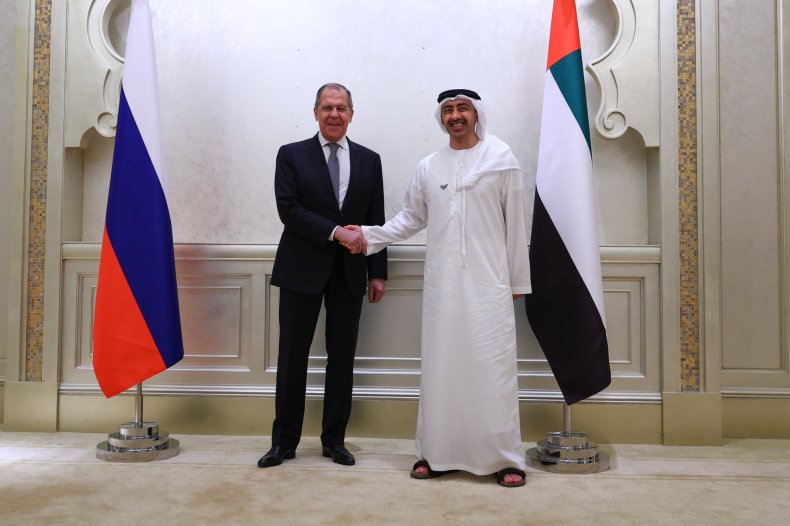
Above,
Russian Foreign Minister Sergey Lavrov (L) shakes hands with UAE Foreign
Minister Sheikh Abdullah bin Zayed Al Nahyan during the former's visit to Abu
Dhabi on March 9, 2021. The two men were set to meet again Monday as the UAE's
top diplomat visited Moscow amid war between Russia and Ukraine.
RUSSIAN MINISTRY OF FOREIGN AFFAIRS
With China assuming an
increasingly central role on the world stage, even the U.S. had appealed to the
People's Republic to use its influence with Moscow to deescalate the crisis
that ultimately led to war in Europe.
But as relations
between Beijing and Washington have eroded in recent years, fewer areas of
common ground have emerged. At the same time, Putin and Chinese President Xi Jinping have
only fortified their "comprehensive strategic partnership of coordination
for the new era," an unprecedented bond between the two that was
reinforced during their high-profile summit at
the beginning of the Winter Olympic Games in Beijing earlier this month.
The two countries have
often joined forces to wield their vetoes at the U.N. Security Council on
issues proposed by the U.S. and, while Beijing opted to abstain on Friday,
Chinese officials have also backed Moscow's concerns regarding NATO expansion
and U.S. military support for Ukraine as being central factors that have
inflamed the crisis and ensuing war.
And while President Joe Biden's
administration has sought to prove inconsistencies between Beijing's stated
commitment to respect sovereignty and its tacit backing for Moscow's
intervention in Ukraine, the stark worsening of the U.S.-China relations on a
range of issues, most critically Taiwan, has left little room for common ground
between the two leading powers.
On Saturday, local
time, the U.S. Navy's Arleigh Burke-class guided-missile destroyer USS Ralph Johnson transited the Taiwan strait as
part of a "routine operation" designed to challenge China's claim to
the waterway between the mainland and the self-ruling island Beijing considers
a part of its territory.
People's Liberation
Army spokesperson Senior Colonel Shi Yi issued a statement in response saying
that the Eastern Theater Command mobilized its forces to closely monitor the
U.S. warship's passage, an act considered a provocation by Beijing.
"The U.S. has
carried out this provocative act, trying to support the 'Taiwan independence'
forces by making some gestures, which is both hypocritical and futile,"
Shi said. "The theater troops maintain high alert at all times and
resolutely safeguard national sovereignty and security and regional peace and
stability."
The South China Sea
Probing Initiative, a Chinese observer group that monitored and reported on the USS Ralph Johnson's movements, said that, even as
Washington sought to address an explosive situation in Europe, the U.S. has
kept up challenges to China in the Asia-Pacific.
"Based on our
observations in the recent two months, the U.S. military presence and
activities around China have not weakened, but have continued to
increase," the South China Sea Probing Initiative told Newsweek. "We agree that the United States still
wants to focus its Indo-Pacific strategy while dealing with the crisis in
Ukraine."
Chinese officials have
emphasized, including to Newsweek, that there was no comparison between
Russia's approach to Ukraine and China's toward Taiwan, and Taiwanese officials
have also sought to downplay an association between the two situations. At the
same time, the Chinese monitor pointed out the likely concerns in Taipei as
another U.S. partner came under direct attack by a nation questioning its
sovereignty.
"Taiwan
authorities have openly stressed 'the difference between Taiwan and Ukraine'
and showed confidence on the situation of Taiwan Strait, however, at heart,
they must be very worried about the credibility of U.S. commitment now,"
the South China Sea Probing Initiative said.
The Chinese monitor
added that Washington's approach to Taiwan had influenced Beijing's stance in
Europe.
"Yes, the U.S.
high-frequency hostile military moves around China largely determines China's
negative position on America's defense policy including NATO expansion,"
the South China Sea Probing Initiative said.


No comments:
Post a Comment