Only education can ensure future leadership for
survival as nation, says father of 3
Md.
Kamruzzaman |08.09.2022
COX’S BAZAR, Bangladesh
One early afternoon, thousands of Rohingya Muslims in
Bangladesh’s sprawling refugee camps had just completed their midday prayers
and were moving toward makeshift tents for lunch.
A sweet sound of the recitation
of the Quran by a chorus of children was heard from a camp-based mosque in camp
no. 12.
The world’s largest refugee
settlement in Bangladesh, divided into 34 camps, is currently home to more than
1.2 million Rohingya, most of whom fled a brutal military clampdown in their
home country of Myanmar's Rakhine State in August 2017.
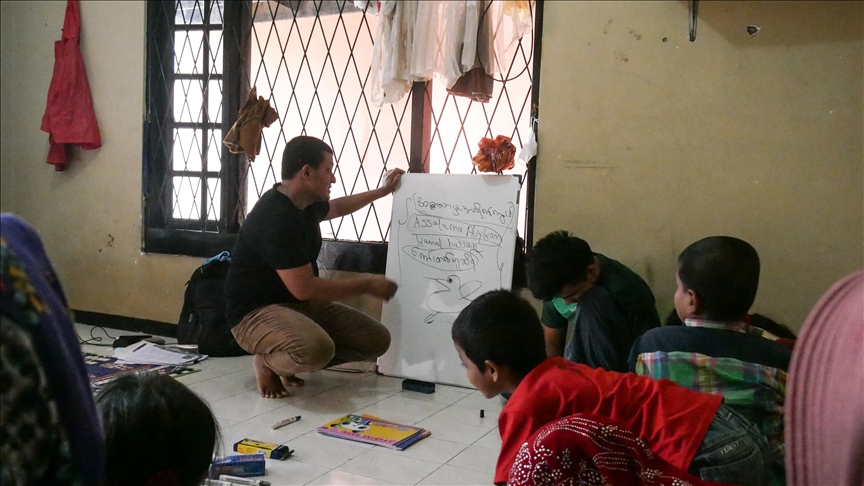
Mohammad Ekram Ullah, 42, was
teaching the Quran to children inside the mosque. He has been teaching three
batches of children.
Ullah, also the imam at that
mosque who leads worshipers in five daily compulsory prayers, voluntarily
serves the children in his community.
"Before fleeing the genocide
in my home country in 2017, I was a teacher at an Islamic seminary there.
Hundreds of children learned the Quran along with the traditional education at
that institute. Now, I am trying to keep our children busy in reading at least
the Holy Quran so that they are morally enlightened and not misguided," Ullah
told Anadolu Agency.
The religious leader was speaking
on the eve of International Literacy Day celebrated on Sept. 8. UNESCO declared
the day on Oct. 26, 1966, to highlight the importance of literacy.
Ullah said because of their
status as “displaced nationals of Myanmar,” and not refugees, the Rohingya
people in Bangladesh’s camps are allowed to only complete the primary level of
education in a limited number of learning centers approved by authorities of
the host country.
“Already, we have passed five
years here since the latest exodus. Hundreds of our school-going children have
been dropped out and many children are growing up without even minimal
education and no scope for higher education," Ullah said, adding that the
Rohingya were at high risk of being leaderless in the future.
- Restrictions on education
depriving Rohingya
A father of three, Abdul Hamid
told Anadolu Agency that education was not a privilege but a basic right of
every human. His eldest son is supposed to be studying at the secondary level.
"But, I have no scope in
Bangladesh to continue the education of my son. Now, I'm worried about my other
two children and whether I can ensure even primary education for them," said
Hamid, who asked: What will the future hold for the next generation if they are
not educated?
Bangladesh has banned thousands
of camp-based learning centers run by educated Rohingya young people, citing
internal discipline and safety.
"In December 2021,
Bangladesh reversed course and banned all Rohingya-led schools and 'home-based'
learning facilities, affecting roughly 32,000 students," the Human Rights
Watch said in March.
The New York-based rights
watchdog alleged that the Bangladeshi government was tightening the screws to
prevent refugee children from "any access to formal education, after years
of deliberately depriving them of quality schooling."
Bangladesh has denied the
allegation and claims that educational activities in all approved learning
centers were going smoothly.
- More local, international
support needed
According to a statement in April
2019 by the UN's refugee agency, UNHCR, the International Organization for
Migration and the UN Office for the Coordination of Humanitarian Affairs almost
half of the 540,000 Rohingya refugee children under the age of 12 are missing
out on education altogether.
"The remainder have access
only to very limited schooling. Only a handful of teenage children are
currently able to access any form of education or training," it said.
The chairperson of the European
Rohingya Council, Ambia Perveen, told Anadolu Agency that without immediately
ensuring education, including at the higher level, the future would be very
grim for the Rohingya.
"One must not forget that
education is a basic human right regardless of color, background, and
religion," said Perveen.
She added that Rohingya should be
given "pens and papers" with other basic rights to write their own
stories.
"As we don't know how many
years it will take to start a sustainable repatriation, the Bangladesh
government and the international community should focus on education for
Rohingya in the refugee camps as we are not allowed to have access to education
outside," she said.
The Council also warned that if
the children are not educated, they would be subject to abuses including child
marriage, child labor, drug peddling, and human trafficking.
"As a result, they will not
only be a threat locally and regionally, but also for the whole world," it
said.


No comments:
Post a Comment