The Sunni Muslim
ethnic group is one of the most persecuted minorities in the world

Over 640,000 Rohingya live in
Kutupalong refugee camp, Bangladesh. The camp near Cox"s Bazar is
said to be the largest in the world. © SH Saw Myint / Unsplash
Discrimination, violence, murder - the Rohingya have been
expelled and despised for decades. If tolerated at all, the members of the
Sunni Muslim ethnic group often live a dreary life. Without nationality
and without rights, they cannot find a way out of poverty. Rohingya have
been systematically persecuted since 1948, when Myanmar gained independence
from British colonialism. The Burmese government also declared
statelessness in 1982. Identifying as Rohingya was forbidden. From
that point on, Rohingya were considered invaders in their homeland.
Myanmar labels the relatives as immigrants, since their actual
homeland is Bangladesh. The neighboring state, in turn, refers to the
families who have lived in Myanmar for generations and therefore does not see
them as citizens. A touchy and highly sensitive political issue between
the two nations. The Rohingya minority lives mainly in Rakhine State, in
western Myanmar on the border with Bangladesh. They speak their own
language and follow their own cultural customs. Overall, according to
estimates, between 750,000 and two million people are Rohingya.
Their origin is largely unclear, which results in
discrimination and exclusion by the population. Due to the differences,
the country's government does not recognize the Rohingya as citizens to this
day.
- Malteser International
In the otherwise predominantly Buddhist Myanmar, Rohingya define
themselves as Muslims. "Especially because of their faith and their
unclear origins, they are repeatedly affected by discrimination, exclusion and
persecution by the government and the military of Myanmar," Malteser
International notes. They do not receive birth certificates and remain
legally and administratively invisible. This massively restricts their
freedom of movement and their future opportunities. Entire villages can be
arbitrarily destroyed, private belongings can be confiscated by the military. Because
officially they don't own anything, settlements where they live are illegal,
their presence in Myanmar is not wanted.
No country grants them citizenship, no nation wants to integrate
them. They are tolerated in some neighboring countries, but nothing more. In
2013, the UN named the Rohingya people one of the most persecuted minorities in
the world.
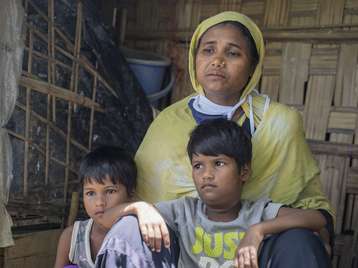 The people in the refugee camps are desperate. They cannot
survive without outside help. © Saikat Mojumder/MSF
VIOLENCE AND DESPAIR
Since Myanmar's declaration of independence, there have been
repeated violent clashes between the military and the Rohingya - the worst
riots took place in 1978, 1992, 2012 and 2016. Thousands of people were
displaced and killed. During the last escalation in August 2017, hundreds
of thousands of people fled their homes. The violent military offensive
caused huge streams of refugees within a very short time. "More than
700,000 Rohingya - women, men and children - have had to flee Myanmar to
Bangladesh," UNHCR said. The stories of the refugees can hardly be
processed. Rapes, mass killings and widespread destruction are repeatedly
described by victims. Families were torn apart, children and adults
severely traumatized. "
Driven from their homeland, the Rohingya have received
protection in the neighboring country. But Bangladesh, the most densely
populated country in the world, is already struggling with poverty within its
own population. The nation cannot cope with taking in and, above all,
caring for and accommodating the Rohingya. Although the families who have
fled have found temporary accommodation, there can hardly be any talk of a
dignified life. The refugees are housed in camps near Cox's Bazar. One
of them Kutupalong. As the largest refugee camp in the world, it is home
to over 640,000 people.
See UNHCR
Instagram view profile

Bangladesh, 2017:
Rohingya people cross the border from Myanmar.Photograph: Roger Arnold/UNHCR
In August 2017,
Violence in Myanmar's Rakhine state forced Rohingya to flee their homes.
5 years later
here are five things to Know
The living conditions in the camps are bad. Simple huts
made of thin wood, tarpaulins and cardboard serve as living space. There
are hardly any sanitary facilities or toilets. Running water is in short
supply, as is medical care. Food, clothing and educational opportunities
are not really available. The people in the refugee camps are exposed to
the extreme weather in the region, and the temporary shelters do not offer any
protection from heavy rain. The camps are overcrowded, disease spreads
easily. For years, the Rohingya who have settled in Bangladesh have been
dependent on the help of foreign organizations. But with the large number
of humanitarian emergencies, the media spotlight has long since ceased to focus
on the minority and their situation.
BACK TO MYANMAR
A return to Myanmar is currently out of the question. The
situation after the military takeover last year was too uncertain. The
situation for Rohingya still living in the country has even worsened. Many
of the refugees long for their homes. They want to go back to their
homeland and live in peace. But this would only work if they could be
guaranteed citizenship, including rights, on the one hand, and security on the
other. A basis that unfortunately will not be implemented any time soon.


No comments:
Post a Comment