August 23, 2022 8:40
PM

Rohingya Women Protest in Kutipalong Refugee camp in 2019
CHIANG
MAI, THAILAND — Myanmar’s displaced
Rohingya Muslims are marking a solemn anniversary this week.
On August
25, 2017, the Myanmar military began a brutal "clearance operation"
in response to government reports that a Rohingya insurgent group called the
Arakan Rohingya Salvation Army or ARSA, had attacked more than 30 police
outposts in Rakhine State.
The
disproportionate response from Myanmar security forces, which commenced at
daybreak, drove an estimated 700,000 Rohingya Muslims to flee to neighboring
Bangladesh over the following weeks, and led to charges of genocide against the
Myanmar army leaders.
The death
toll rose quickly.
Wheels of Justice Turn Slowly for
Displaced Rohingya People

An estimated 6,700 Rohingya were killed in the first month with
thousands more in the months to follow, according to Médecins Sans Frontières
(Doctors Without Borders), as accounts of gang rapes, torture, and mass
killings were relayed by survivors and villagers who escaped the attacks.
Despite
the global condemnation of their actions in 2017, the Myanmar army has
continued its brutal aggression on civilians since seizing power in a coup last
year, followed by attacks on all ethnic groups.
Myanmar
officials have denied the military carried out human rights abuses. The
government said the campaign was necessary to defend against attacks by
Rohingya militants.
In March,
the United States declared Myanmar military actions against the Rohingya as
genocide.
Experts
say ongoing abuses being committed across Myanmar have confirmed the
credibility of the accounts of the 2017 attacks.
“It’s
drawn the attention of the international community to the grave abuses that the
military is committing and also has opened the eyes of some of the other groups
within Myanmar to the plight of the Rohingya, groups that had previously not
believed what the military was committing against the Rohingya or believed the
military’s lies,” explained Dan Sullivan, Refugee International’s Asia and
Africa deputy director.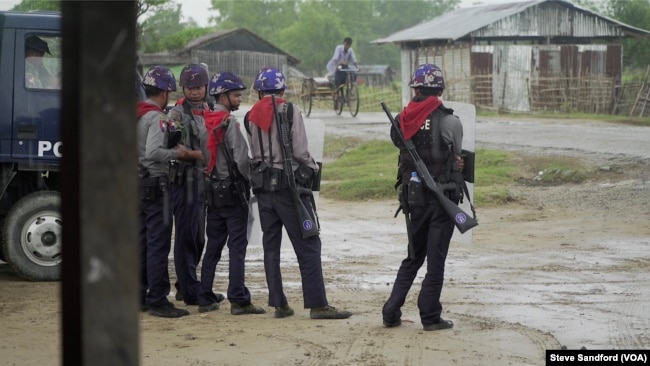 Border Guard
Police stand at edge of Sittwe IDP camp in August
2017, a few days after the start of the clearance operation.
While the
move to unite all opposing ethnic forces has become increasingly popular, some
rights groups are not sure that it will become reality.
“In order
to overcome the ruthless military junta, all parties need to be united against
them,” says Kyaw Win, the executive director of the Burma Human Rights Network
(BHRN). “It is not enough only opposing the junta ... it is crucial to
collaborate with each other.”
There are
135 ethnic groups in Myanmar, excluding the Rohingya, who were stripped of
their citizenship in a 1982 law created by the army, which perpetuated decades
of abuse and unfair treatment.
Meanwhile,
life in the sprawling Bangladesh camps remains tough for the stateless
refugees, who face adverse conditions and increased restrictions.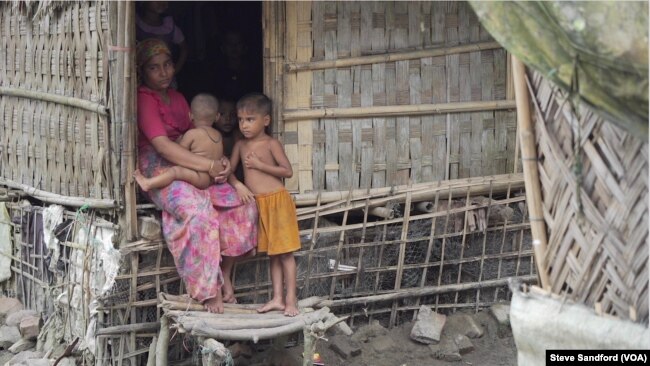 A Rohingya family
at a settlement village near Sittwe in August 2017, a few days after the
clearance operation began. Travel restrictions forbid anyone in the village
from traveling.
“Since
the completion of the fencing around the whole refugee camp, people are having
trouble traveling from one camp to another—even inside the fenced area—because
of the security forces who were deployed in the camp and many other reasons,”
explained a 25-year-old camp youth, who lives in Kutapalong, the world’s
largest refugee camp.
The
youth, who asked to remain anonymous, says that while the fencing is good for
security, police often extort the Rohingya instead of protecting them, and taxi
fees have doubled because drivers now have to pay more money at checkpoints.
U.N. High
Commissioner for Human Rights Michelle Bachelet discussed repatriation options
with Rohingya representatives during a visit to the massive camp earlier this
month.
“All of
them have said, we want to go back, but we want to go back … when we have an
identity as citizens of Myanmar,” she said while visiting the camp. “When our
rights are respected, we can have our livelihoods again, we can have our land
and we can feel we are a part of a country.”
This
desire for equal rights and recognition is echoed by the few Rohingya who have
remained in Rakhine, as coup-related travel restrictions in Myanmar have
contributed to increased food prices, exacerbating the hardships.
An
experienced Rohingya aid worker in Rakhine who did not want to use his name
because of security concerns, assessed the junta’s promises of new homes and
jobs for Rohingya people who choose to be repatriated.
“It is
very difficult, and I would say there are rare opportunities for the Rohingya.
Inside Myanmar and Maungdaw, I would say no preparations have been made for
them to come back,” the aid worker told VOA by phone, referring to a town in
Rakhine.
The aid
worker, who witnessed the 2017 exodus first-hand and assisted foreign support
teams in Bangladesh, said that some of the refugees are desperate to escape the
camps.
“Some
people will try to come back but, in the end, it will be a more horrible
situation than what they are facing in the refugee camps.”
The
worker also said some repatriation shelters, complete with barbed wire and
watch towers, have been constructed near Maungdaw in the last few years, but
they have already been flooded and damaged.
While
waiting for conditions to improve, foreign aid and rights groups are urging the
Bangladeshi government to allow schooling for the displaced youngsters in the
camps.
“Expanding
these education and livelihood opportunities for girls and boys will be the
best way to prevent social problems and criminality and to fully prepare
refugees for sustainable reintegration in Myanmar society,” Bachelet said at
the end of her visit.
Preparing
future generations of Rohingya is also a concern for BHRN’s Kyaw Win.
“The
Bangladesh government has done a great job opening its border to save many
lives," Kyaw Win said. "However, not allowing education for the
children in camp is like killing their souls. Education is extremely important
for the Rohingya children to build up their community in future. More
humanitarian and human rights organizations must be allowed to operate inside
the camp to provide trauma healing courses.”
Despite
setbacks created by increased Myanmar junta atrocities, the first step toward
justice for the Rohingya people occurred last month in The Hague.
After
dismissing objections by Myanmar’s military ruler, the International Court of
Justice (ICJ) in July allowed a case to proceed alleging that Myanmar performed
acts of genocide against the Rohingya.
Despite
overwhelming evidence gathered, analysts say that more pressure is needed as
the trial could continue for years.
“Fundamentally,
the impunity of the junta needs to be addressed through concerted international
actions with better coordinated and expanded sanctions including the oil and
gas sectors, the pursuing of an arms embargo and then sustaining that
humanitarian aid and accountability,” explained Sullivan of Refugee
International.
BHRN’s
Khaw Win agrees with calls for increased pressure on the junta.
“More
countries need to join the ICJ case and more countries should open up universal
jurisdiction cases against the perpetrators,” Khaw Win said, adding that
mounting evidence collected by international agencies is increasingly difficult
to refute.
Texting
from his bamboo hut, the unnamed 25-year-old Rohingya youth struck a more
optimistic tone on the historic court ruling.
“We feel
good because the world is still under the administration of intellectual people
that will reveal there’s no place in the world for perpetrators,” the youth
wrote. “We also feel that this is the time to deliver justice and hold the
perpetrators accountable.”
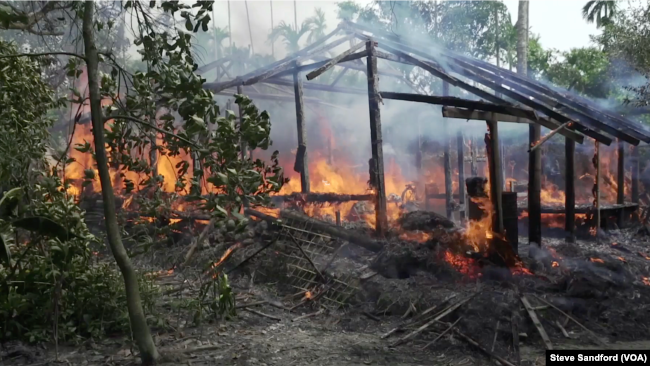 A village hut
burns to the ground in Rakhine in September 2017.


No comments:
Post a Comment