BANGKOK — Two years after
Myanmar’s military toppled a democratically elected government, analysts say
the country remains trapped in a deadly battle of attrition between the ruling
junta and resistance forces that will only get bloodier ahead of planned
elections this year.
The junta still fails to control wide swaths of hinterland and
continues to come under heavy attack from a patchwork or armed groups across
the country of 54 million people. The United Nations says over 1.2 million have
been displaced by fighting since the coup, a number still growing by tens of
thousands each month.
Despite the chaos, analysts expect the junta to press ahead with
plans to hold national elections by August in order to transfer power to a
civilian government. The junta’s opponents say any election run by the regime
will be rigged and yield a civilian government in name only.
“There will be no military solution, and a political resolution
seems very far off,” Richard Horsey, a Myanmar analyst and senior adviser to
the International Crisis Group, said of the conflict.
“That means continued rule of a military or military-linked
government that the people do not recognize [or] legitimate and hate, and that
government therefore having to use authoritarian methods to enforce its rule,”
he added. “That’s a pretty depressing prospect, but that is the prospect that
stretches out in the next year.”
Since the military’s February 2021 coup, hundreds of local
militias dubbed people’s defense forces, or PDFs, have sprung up across the
country to resist the military’s rule.
Many have aligned with the National Unity Government (NUG), a
shadow administration in exile and hiding that is attempting to topple the
junta, and with some of the ethnic armed groups that have been fighting the
military for decades for control over areas where minorities make up most of
the population.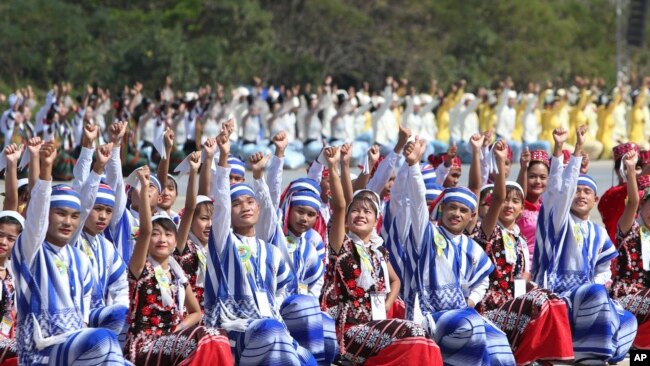 A traditional
artist group performs during a ceremony marking Myanmar's 75th anniversary of
Independence Day in Naypyitaw, Myanmar, Wednesday, Jan. 4, 2023.
A traditional
artist group performs during a ceremony marking Myanmar's 75th anniversary of
Independence Day in Naypyitaw, Myanmar, Wednesday, Jan. 4, 2023.
Reports on the fighting compiled by the Armed Conflict Location
and Event Data Project, an international non-profit, show little sign of a
letup in the violence.
Contest and control
The project’s data show over 770 battles and more than 860
explosions or remote attacks in the last three months of 2022. The most recent
data analyzed by the UK’s International Institute for Strategic Studies show
some 500 attacks or armed clashes in October alone, about as many as the same
month last year.
The institute’s data mapping shows much of the fighting still
concentrated in Myanmar’s dry zone, stretching north and west from the central
Mandalay region into Magwe and Sagaing. It also shows pockets of heavy fighting
in southern Kachin and northern Shan states, in Myanmar’s northeast, and down along
the country’s eastern border with Thailand.
“The resistance has become better capable to contest the junta’s
control,” said Ye Myo Hein, a fellow at the Wilson Center in Washington, D.C.,
who heads the Tagaung Institute of Political Studies, a Myanmar think tank.
The greater challenge for the resistance, he added, is holding
and controlling what it contests, especially in urban areas, which the junta
still commands.
“Although they extend the fighting territory and also their war
zones ... it’s very difficult for them to consolidate control, especially due
to some weaknesses,” he said.
The first is a persistent dearth of automatic and heavy weapons,
including the portable anti-aircraft missiles that could challenge the
military’s growing reliance on air strikes.
Ye Myo Hein said resistance groups are making strides. In
addition to the weapons they can buy or borrow from the well-equipped ethnic
armed groups they have allied with, he said PDFs are now operating some 70
workshops nationwide churning out rudimentary guns and rifles, even a few
automatic weapons and mortars. But for the most part, he added, they are still
“low quality.”
The opposition’s other main problem, analysts say, is a stubborn
lack of cohesion and coordination at the national level.
“Some [groups] are closer to the NUG than others,” Horsey said,
“but there hasn’t been any sort of grand alliance between ethnic armed groups
and the NUG and the post-coup armed resistance forces, and that seems pretty
unlikely.”
Ye Myo Hein said the NUG has made some progress at pulling the
resistance together over the past year. It now has an Alliance Committee, the
“J2C,” for Joint Command and Coordination, and a Central Command and
Coordination Committee, each tasked with working with a different set of ethnic
armed groups around the country.
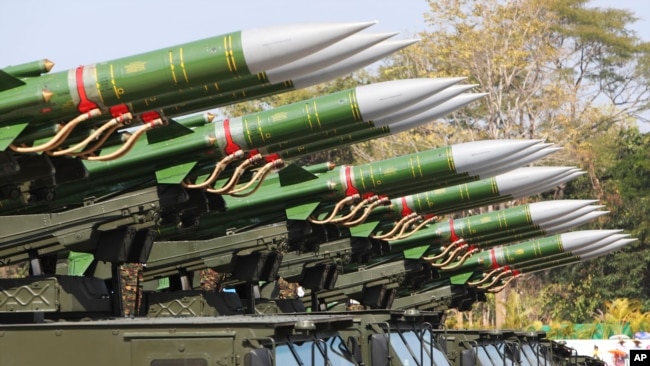 Myanmar's
military trucks loaded with missiles are seen during a ceremony marking
Myanmar's 75th anniversary of Independence Day in Naypyitaw, Myanmar,
Wednesday, Jan. 4, 2023.
Myanmar's
military trucks loaded with missiles are seen during a ceremony marking
Myanmar's 75th anniversary of Independence Day in Naypyitaw, Myanmar,
Wednesday, Jan. 4, 2023.
“But the key challenge for them is how to coordinate these
different command structures on the strategic level,” he said. “It’s a key
challenge for the NUG and its aligned [groups] in the coming year.”
Ballots and bullets
Junta forces are thought to be struggling too.
Analysts say resistance groups are inflicting heavy battlefield
losses on the military, though reliable figures of dead and wounded are
missing. And while the mass military defections the opposition is hoping for
have yet to come, desertions and defections are reportedly rising. Heavy
fighting in parts of Myanmar where the military usually draws most of its new
recruits from is also believed to be making it much tougher for the junta to
replace the troops it is losing.
What the analysts say the military does not lack are weapons,
and the fuel and ammunition — and the will — to use them.
“The military junta is still thinking they have ... superior
firepower to suppress the opposition, and at the same time they think they can
control well inside the country; that’s why they are going to go ahead with the
election,” said Aung Thu Nyein, an analyst with Myanmar’s Institute for
Strategy and Policy, another think tank.
The junta has yet to set a date for the polls, but insists it
wants to hand power back to an elected government this year. The NUG,
meanwhile, announced its own intentions in October to bring the junta or any
proxy government down by the end of 2023.
Aung Thu Nyein and the others say that’s likely to make for an
especially violent year ahead, as the junta vies to make more of the country
safe for elections and the resistance tries to thwart them, with neither side
strong enough to win nor weak enough to lose any time soon.
“There have already been deadly attacks on ... regime
administrative staff collecting polling list data, and I think that’s just a
foretaste of what’s coming,” said Horsey.
“The election will present a lot of potential targets,” he
added. “And so, I think we’ll see a rather violent electoral year.”
Meanwhile, a growing number of
assassination targets, on both sides, are being abducted and decapitated. Aung
Thu Nyein says that portends not just a deadlier fight ahead, but a more bitter
and brutal one.


No comments:
Post a Comment