I am, maybe, a reader at cross-purposes from this book’s intent. I translate the challenge of fighting Zionist oppression of Palestine gentiles, somewhat automatically, also to the question, How do we redeem Jewish identity?
Confronting Zionism, by international law scholars Noura Erakat and John Reynolds, reviews the colonial and imperialist legal assumptions in the Balfour declaration, the League of Nations Mandate,and the May 1948 declaration of the State of Israel.
Once seen, it is hard to unsee, the principles that Erakat and Reynolds name as the face of Zionism to Palestinians: domination and dehumanization.
Their work is about failed attempts to use international institutions to protect Gaza since October 7, 2023, and during Zionism’s stages for the past 100 years in its accomplishment of Jewish nationalist rule of Palestine. They analyze the colonial assumptions in international structures that made the conquest feasible.
There’s a lot of cognitive dissonance in being a Jew reading a recounting of Zionist torment of Palestine – reconciling lifetime programming of being of a special and persecuted people, with industrial-scale targeting of non-Jews because they live where nationalist Jews covet.
Norman Finkelstein proposes one rational motive for Jewish anti-Zionism – the wish to keep clear from the Zionist project’s consequences, from hostile scrutiny as Jews:
If Israel calls itself the state of the Jewish people, if Jews do not repudiate that title, or what’s a 1,000 times worse, embrace that title uncritically, then the reasonable inference is that you support the actions of the state of Israel… Non-Jews will feel a high degree of animus towards Jews if there isn’t a clear rupture between American Jewish opinion and Israeli opinion.
Many Jews within and without Israel do speak clearly against the criminal nature of what, in modern Jewish culture, became a source of pride as the rebirth of “our nation.” The reward is often being called the epithet “Kapo!”
(Kapo is a term of disgust, for collaborators in Nazi concentration camps.)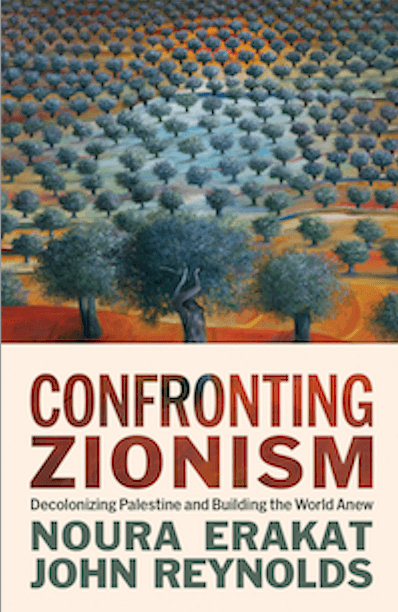
Do anti-Zionist Jews have an effective role to play, other than as publicly disapproving witnesses for Jewish reputational preservation?
It’s evident that Israeli Jews are not going to go quietly into a multi-ethnic regime of mere equality.
Full human rights for Palestinians in lands occupied by Israel, much less the right of return for forcibly exiled Palestinians, in “the state of the Jewish people,” is unlikely.
Membership in Israel’s parliament is limited to those who swear allegiance to that basis of the state, a pledge even elected Israeli-citizen Palestinians must take.
The idea that Jews living in Israel serve the reborn Jewish nation is foundational to civics education in Israel. Jewish immigration to Israel is called “ascending” in Hebrew. (And leaving is termed “descending.”)
Given how inflexible and impermeable Zionist militancy is, the scene is set for more years of suffering.
The book’s authors report that the 1948 Convention on the Prevention and Punishment of the Crime of Genocide specifically removed colonial displacement as a form of genocide, before ratification, so western colonizing nations would sign.
What they note is particularly relevant to the Palestine experience, where removal of Arabs for Jews was pursued by Jewish nationalist terrorists, the Haganah, then the IDF, and then the legal structures of the new “Jewish” state.
If international law is silent, and the Israeli government follows Zionist aims of maximum Jews, minimum Arabs, law becomes law for Palestinian expulsion.
The UN Security Council-approved and Donald Trump-headed Gaza “Board of Peace,” in concert with IDF herding of almost two million traumatized Gaza citizens to a small enclave, looks very much like displacement for imperial interests.
In their review of failed international efforts to apply International Criminal Court(ICC) restraints to Israeli leaders, Erakat and Reynolds write, “This all reflects the reality that international criminal law has functioned as a disciplining mechanism against subaltern peoples more than as a catalyst for their liberation.”
The book describes the delays and hair-splitting discussion of genocide versus ethnic cleansing versus war crimes, with the conclusion that international law will follow and not lead worldwide pressure for protection of Palestinians under Israeli control and assault.
Will anti-Zionist Jews have a productive role?
On the occasion of Rosh Hashanah, the Jewish New Year, a time for accounting and repentance, Peter Beinart envisioned, fancifully I think,
For Jews, collectively, this kind of repentance remains possible. It requires documenting what Israel has done–and keeps doing—to destroy the Palestinian people, and challenging the complicity of Jewish leaders and institutions in the United States. And it requires listening to Palestinians and reclaiming silenced voices from Jewish tradition so we can envision a path not of supremacy and genocide, but of righteousness.
By saying fancifully, I don’t mean undesirable – but far from the Zionist construction of the “New Jew,” the strong and proud Jew, the unapologetic Jew, retaking our land of Canaan.
The world, and Jews, both have tasks of “Confronting Zionism,” tasks that are allied but not the same.
Confronting Zionism: Decolonizing Palestine and Building the World Anew
By Noura Erakat and John Reynolds
Haymarket Books, Publication: November 10, 2026
Abba A. Solomon is the author of “The Miasma of Unity: Jews and Israel” and “The Speech, and Its Context: Jacob Blaustein’s Speech ‘The Meaning of Palestine Partition to American Jews,’ Given to the Baltimore Chapter, American Jewish Committee, February 15, 1948.”


No comments:
Post a Comment