Months after an ostensible “ceasefire” agreement was signed by Marco Rubio’s State Department, the U.S. Army Infantry School-trained President of Lebanon Joseph Aoun, and the government of Israel, Israeli occupation forces continue to occupy much of southern Lebanon, demolish entire villages with C4 explosives, and perpetrate massacres of civilians.
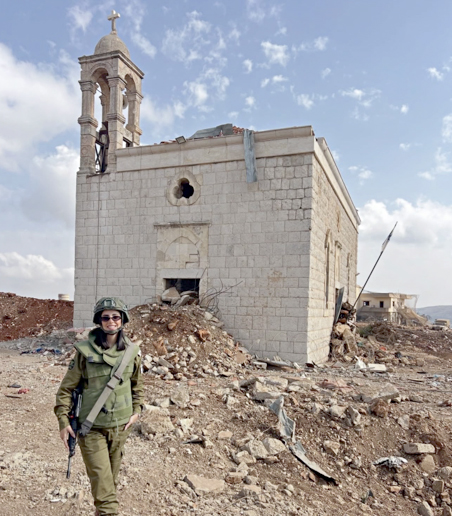
An Israeli soldier smiles at the destruction of St. Joseph’s Church in Qawzah, Lebanon
Under the terms of the Rubio ceasefire, Israel has permission to continue occupying what is called a “security zone,” while Lebanese forces are deputized to accomplish the objective of “disarming” Hezbollah. Only once Hezbollah is disarmed must Israel redeploy from Lebanon. The agreement was designed to supplant the terms of the Iran-U.S. MOU negotiated in Switzerland by J.D. Vance and signed on June 17, 2026, which tied the end of the Iran War to the “immediate and permanent termination of military operations on all fronts, including in Lebanon” and on “ensuring the territorial integrity and sovereignty of Lebanon.”
As Lebanese journalist Mohamad Kleit explained to Dragnet, Lebanese forces have only replaced Israeli occupation forces in three southern villages while Israel’s wholesale destruction of villages continues unabated. A recent New York Times investigation reported that “48 of the roughly 60 villages and towns within Israeli-occupied southern Lebanon are mostly leveled,” noting that “of the 48 villages that have been mostly destroyed, almost all are majority Shiite.”
While corporate media frames the Israeli destruction of those villages and the thousands of civilian casualties Israel has produced as incidental to Israel’s fight with Hezbollah, public statements by Israeli officials reveal what Lebanese human rights activists call “inherent systematic targeting” which “there can be no doubt is deliberate.” Boasting of the destruction of more than 23,000 homes on Israeli television, Israel’s Defense Minister Israel Katz reiterated his longstanding position that Israel seeks to impose what he calls “the Gaza model” in southern Lebanon.
As Israel continues to advance through southern Lebanon despite a ceasefire, Israeli commentators and Lebanese lawmakers alike have said the agreement is designed not to end the conflict but to fuel it, potentially leading to sectarian conflict and civil war.
When the deal was signed, an Israeli analyst remarked on Israel’s Channel 13 that “it seems we’re leading the state of Lebanon into civil war,” adding “maybe it’s not so bad for us, let the Lebanese government fight Hezbollah,” to which his co-host replied that this was “the goal from the start.”
Most recently, Lebanese Druze leader Walid Jumblatt admitted that “we made a mistake by choosing Marco Rubio’s track,” because “believing that the Americans can pressure Israel to withdraw is a complete illusion.” Jumblatt, a former self-admitted warlord responsible for what Jumblatt himself calls “religious cleansing and mass destruction” is no fan of Hezbollah. Yet he now believes he “cannot accept a hardline approach toward Hezbollah if it leads to civil war.”
Indeed, Lebanon is historically ripe for civil war, a consequence of its French imposed system of confessionalism in which political positions are constitutionally divided by religious sect: the President must be a Maronite Christian, the Prime Minister must be a Sunni Muslim, and the Speaker of Parliament must be a Shia Muslim. As the Beirut-based war correspondent Robert Fisk argued (he passed away in 2020), confessionalism is one of the root causes of suffering in Lebanon – with the country being the site of some of the most devastating sectarian massacres of the late 20th century. It “may have beautiful mountains, fine food, an extraordinarily well-educated population, but it is sectarian. It’s a bit like owning a Rolls Royce complete with fresh leather seats, a flat screen television and a cocktail bar – but with square wheels. It doesn’t work.”
Israel’s current occupation has exploited these sectarian fault lines, issuing orders seemingly designed to inflame inter-sect animosities. As The New York Times reported in April, 2026,
“Israeli officials have conveyed a [sic] targeted message… In private calls to local leaders across southern Lebanon, Israeli military officials have assured several Christian and Druse communities that they could remain in the evacuation zone. They have pressed them, however, to force out any Lebanese from neighboring Shiite Muslim communities who have sought refuge among them as Israeli bombardments flatten Shiite towns, according to local Christian, Druse and Shiite leaders.”
When Israel destroys Christian villages, demolishing churches and statues of Jesus Christ, Israel blames Hezbollah – the militant group who Shia historically support – for allegedly using them as shelter areas, and some – but not all – Christians in Lebanon have accepted that excuse. Our own various investigations at Dragnet, the substack from this author and Jeremy Loffredo, reveal that what Israel labels “Hezbollah” are usually just Shia families, who often have little or no connection to the group at all. Just as Israel labels the tens of thousands of Palestinians its military killed in Gaza as “Hamas,” Israel likewise uses “Hezbollah” as a rhetorical device to justify its targeting of Shia families. Unlike Israeli statements targeting American audiences, the distinction between “Hezbollah” and Shia Muslims is almost non-existent in Hebrew media, with Defense Minister Katz telling Israeli Channel 14 News in July that in 24 villages destroyed in Lebanon, “there were Shiites who acted as enemies on behalf of Hezbollah and threatened our borders, our residents, and constantly carried out provocations.”
There are Christian leaders in Lebanon who reject Israel’s attempts to inflame sectarian divisions. One of them is Father Tony Hanna, whose church and village of Qaouzah was demolished by Israeli occupation forces in November 2024. Last week, a photo went viral of an Israeli soldier smiling in front of Hanna’s church.
Father Tony Hanna tells Dragnet that while armed groups have existed around the town, he does not view it as an excuse, nor does he blame Shia Muslims for Israel’s destruction of the town. “The Muslims in general and the Shiite sect, we have all respect and love for them, and there are deep friendships and close relationships with many…. Let the words be more than clear… We have never said that Islam, the Muslims, or our Shiite brothers are the ones who demolished the church or because of them…. we are the sons of one nation.”
Two weeks before Israeli forces demolished Qaouzah, an Israeli airstrike hit the Church of Saint George the Wonderworker in Deirdghaya, a Melkite Greek Catholic church in the Tyre District built in 1911. The strike, on the night of October 9, 2024, targeted the square beside the church, according to Georges Elia, a social activist at the church who lives in the village’s historic neighborhood. It damaged the church’s façade and collapsed its multi-story parish hall, which “had also been used to shelter displaced civilians,” adding that the strikes also “affected the priest’s residence and the parish office building.” Lebanese media reported an initial death toll of seven, including five Civil Defense members.
Elia tells Dragnet that on Christmas, 2024, he “took the initiative to place a simple Christmas tree amid the ruins of the church. My intention was to preserve the spirit of Christmas and convey a message that damage to a building does not mean the end of the village’s spiritual and social life. ”
It was not the first time the Church had been bombed by Israel. Elia said Israeli forces had struck the church during the 1978 invasion, destroying its western wall, and again in 1992, when bombardment destroyed the attached parish building and cracked the dome. He called the 2024 strike “the most destructive attack in the church’s recent history.”
As Elia explains to Dragnet, “the destruction was not limited to stones and walls. It affected a place that had served as a space for worship, gatherings, solidarity, and welcoming people in need and displaced families.”
Like Father Hanna in Qaouzah, Georges Elia says that “damage to a building does not mean the end of the village’s spiritual and social life.”
Asked about the attempt to blame Shia Muslims or “Hezbollah” for the attacks on Christian’s communities, Elia declined to comment, telling Dragnet, “I do not wish to engage in political or sectarian debates. I respect all components of Lebanese society and believe that coexistence and mutual respect among all citizens are fundamental.”
But complicating the narrative Israel seeks to impose upon Lebanon is the role Hezbollah has often played protecting Lebanon’s and Syria’s Christian communities. As the Pro-Israel Wall Street Journal begrudgingly admitted in 2015, “Christians in the Lebanese village of Al-Qaa depended on army troops to shield them from nearby ISIS militants. Another source of protection: Shiite militants in Hezbollah… The village’s main priest, Father Elian Nasrallah, and others, are promoting the idea that Hezbollah, unlike Sunni extremists, has
always been a friend of Christians.” As Father Elian Nasrallah explains in the video report “Hezbollah was never a danger for Christians.” And as BBC reported in 2014, Hezbollah was instrumental in expelling “al-Qaeda-affiliated al-Nusra Front,” also referred to by BBC as “rebels” – whose leader Al-Jolani is now President of Syria – from the Christian village of Maaloula.
These factors explain why many Lebanese Christians do not view the pretext of “fighting Hezbollah” as an excuse for Israel’s destruction of their communities. And as the U.S. funds and backs that Israeli effort, Iran – historically allied with Hezbollah – has demonstrated itself as the region’s only guarantor of Lebanon’s territorial integrity, continuing to tie an end to the Iran War to an Israeli withdrawal from the south.


No comments:
Post a Comment