Wednesday, September 30, 2026

 Los Angeles mayoral candidate and City Council member Nithya Raman leads Mayor Karen Bass in several polls, although that could change after comments Raman made during a Tuesday forum.

The Jewish Los Angeles Mayoral Forum featured back-to-back conversations with Raman and Bass on Tuesday evening. Moderated by Spectrum News host Alex Cohen, candidates were asked about issues impacting L.A.’s Jewish residents. The event was held only days after a University of California Berkeley Institute of Government Studies poll gave Raman an 11-point lead over Bass, with one-third of voters still undecided five weeks before the November 3 general election.

However, some of those undecided voters could have been swayed after Raman made comments that inspired audible reactions from the crowd on multiple occasions.

Newsweek reached out to the Bass and Raman campaigns by email on Wednesday for comment.


Los Angeles City Council member and mayoral candidate Nithya Raman speaks at a campaign celebration with volunteers and supporters marking her advance into the general election, on June 13 in North Hollywood, California. At a mayoral forum this week, Raman discussed her use of the word “genocide” and her thoughts on BDS.

What Did Raman Say About Genocide?

At one point in the discussion, Raman was asked to explain her use of the word “genocide” when she has described events in the Gaza Strip. Israeli Prime Minister Benjamin Netanyahu has denied allegations that Israel is committing genocide there involving civilians and the Israeli military.

“That is what guided me to using that term in describing what’s happening in Gaza,” Raman said, drawing gasps from the crowd. “I do want to underscore here that I recognize that the word ‘genocide’ is a deeply painful word. I understand its historical context and the weight of that historical context for the world…and I used it because other experts have used it to describe what’s happening. I used it because I felt compelled to speak out about issues we saw, the images that are coming, the targeting of hospitals, the deaths of children.”

The crowd reacted again with gasps, although there was scattered applause. Raman went on to say that she condemned the Hamas attacks against Israel on October 7, 2023, “without reservation” and that she will continue to speak up.

In a statement after the October 7 attacks, Raman said: “Our district is home to beautiful Israeli and Jewish-American communities, and so many who have family in Israel. I cannot imagine the terror they are experiencing. I stand with them in condemning the horrific violence by Hamas and praying for a peaceful end to this conflict.”

In July, the Associated Press shared results from an AP-NORC poll that found one-third of U.S. adults, roughly half of which were Democrats, believed that Israel committed genocide during the Gaza war. Thirty percent of Jewish adults said they believed Israel had committed genocide, with 49 percent saying it has not.

Israel and Hamas at War

The war at the heart of Raman’s comments began on October 7, 2023, when Hamas carried out a coordinated attack in southern Israel that killed almost 1,200 people and left more than 5,400 injured, according to humanitarian agencies.

More than 200 hostages were taken into Gaza. Israeli authorities and humanitarian organizations have since documented additional Israeli deaths in the ensuing conflict, bringing the total number of Israelis killed in the Gaza war and related hostilities to more than 2,000, a figure that includes civilians, soldiers, police personnel and security officials.

Gaza’s Health Ministry and international humanitarian agencies report that more than 74,000 Palestinians have been killed since October 7, 2023, with the broader casualty count rising to at least 76,621 people across the region when including deaths in Israel, Lebanon, Syria, Yemen and Iran.

A study by the Office of the High Commissioner for Human Rights found that 70 percent of Palestinians killed in residential buildings were women and children, underscoring the disproportionate impact on civilians.

What Did Raman Say About BDS?

The crowd reacted again when Raman made comments about the Boycott, Divestment, Sanctions (BDS) movement, which “works to end international support for Israel’s oppression of Palestinians,” according to the BDS website.

“I want to just say that I think Boycott, Divestment, and Sanctions is a legitimate form of peaceful protest,” Raman said to an audible reaction from the crowd, including groans and some applause. “I support people’s right to free protest. It is the hallmark of America, and the First Amendment right to peaceful protest is really important, and I will fight for that right.”

Raman went on to say that BDS is not part of her platform.

What Do Polls Show?

A New York Times roundup of polls taken and published before the forum included:

University of California Berkeley Institute of Governmental Studies: Sponsored by the Los Angeles Times, the poll surveyed 2,150 likely voters September 15-20. It gave Raman an 11-point lead over Bass, with one-third of voters still undecided. The same group held a poll in May that gave Raman a 4-point lead.

Hart Research Associates: Sponsored by Raman, the poll surveyed 600 likely voters September 1-9 and gave Raman a 5-point lead, 44 percent to 39 percent.

Impact Research: Sponsored by an organization affiliated with Raman, the poll was conducted August 28-September 3 among 700 likely voters. The results showed Bass with a 1-point lead, 38 percent to 37 percent, with 26 percent undecided.

What Happens Next

New polls coming out that were conducted after the forum will provide a glimpse into whether or not Raman’s comments about the war in Gaza will impact her standing among Los Angeles voters.

When Law Fails: A Jew Reads ‘Confronting Zionism’ by Abba A. Solomon

 I am, maybe, a reader at cross-purposes from this book’s intent. I translate the challenge of fighting Zionist oppression of Palestine gentiles, somewhat automatically, also to the question, How do we redeem Jewish identity?

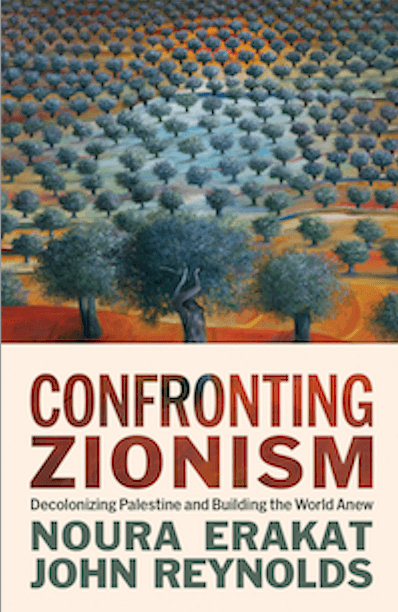
Confronting Zionism, by international law scholars Noura Erakat and John Reynolds, reviews the colonial and imperialist legal assumptions in the Balfour declaration, the League of Nations Mandate,and the May 1948 declaration of the State of Israel.

Once seen, it is hard to unsee, the principles that Erakat and Reynolds name as the face of Zionism to Palestinians: domination and dehumanization.

Their work is about failed attempts to use international institutions to protect Gaza since October 7, 2023, and during Zionism’s stages for the past 100 years in its accomplishment of Jewish nationalist rule of Palestine.  They analyze the colonial assumptions in international structures that made the conquest feasible.

There’s a lot of cognitive dissonance in being a Jew reading a recounting of Zionist torment of Palestine – reconciling lifetime programming of being of a special and persecuted people, with industrial-scale targeting of non-Jews because they live where nationalist Jews covet.

Norman Finkelstein proposes one rational motive for Jewish anti-Zionism – the wish to keep clear from the Zionist project’s consequences, from hostile scrutiny as Jews:

If Israel calls itself the state of the Jewish people, if Jews do not repudiate that title, or what’s a 1,000 times worse, embrace that title uncritically, then the reasonable inference is that you support the actions of the state of Israel… Non-Jews will feel a high degree of animus towards Jews if there isn’t a clear rupture between American Jewish opinion and Israeli opinion.

Many Jews within and without Israel do speak clearly against the criminal nature of what, in modern Jewish culture, became a source of pride as the rebirth of “our nation.” The reward is often being called the epithet “Kapo!”

(Kapo is a term of disgust, for collaborators in Nazi concentration camps.)

Do anti-Zionist Jews have an effective role to play, other than as publicly disapproving witnesses for Jewish reputational preservation?

It’s evident that Israeli Jews are not going to go quietly into a multi-ethnic regime of mere equality.

Full human rights for Palestinians in lands occupied by Israel, much less the right of return for forcibly exiled Palestinians, in “the state of the Jewish people,” is unlikely.

Membership in Israel’s parliament is limited to those who swear allegiance to that basis of the state, a pledge even elected Israeli-citizen Palestinians must take.

The idea that Jews living in Israel serve the reborn Jewish nation is foundational to civics education in Israel. Jewish immigration to Israel is called “ascending” in Hebrew. (And leaving is termed “descending.”)

Given how inflexible and impermeable Zionist militancy is, the scene is set for more years of suffering.

The book’s authors report that the 1948 Convention on the Prevention and Punishment of the Crime of Genocide specifically removed colonial displacement as a form of genocide, before ratification, so western colonizing nations would sign.

What they note is particularly relevant to the Palestine experience, where removal of Arabs for Jews was pursued by Jewish nationalist terrorists, the Haganah, then the IDF, and then the legal structures of the new “Jewish” state.

If international law is silent, and the Israeli government follows Zionist aims of maximum Jews, minimum Arabs, law becomes law for Palestinian expulsion.

The UN Security Council-approved and Donald Trump-headed Gaza “Board of Peace,” in concert with IDF herding of almost two million traumatized Gaza citizens to a small enclave, looks very much like displacement for imperial interests.

In their review of failed international efforts to apply International Criminal Court(ICC) restraints to Israeli leaders, Erakat and Reynolds write, “This all reflects the reality that international criminal law has functioned as a disciplining mechanism against subaltern peoples more than as a catalyst for their liberation.”

The book describes the delays and hair-splitting discussion of genocide versus ethnic cleansing versus war crimes, with the conclusion that international law will follow and not lead worldwide pressure for protection of Palestinians under Israeli control and assault.

Will anti-Zionist Jews have a productive role?

On the occasion of Rosh Hashanah, the Jewish New Year, a time for accounting and repentance, Peter Beinart envisioned, fancifully I think,

For Jews, collectively, this kind of repentance remains possible. It requires documenting what Israel has done–and keeps doing—to destroy the Palestinian people, and challenging the complicity of Jewish leaders and institutions in the United States. And it requires listening to Palestinians and reclaiming silenced voices from Jewish tradition so we can envision a path not of supremacy and genocide, but of righteousness.

By saying fancifully, I don’t mean undesirable – but far from the Zionist construction of the “New Jew,” the strong and proud Jew, the unapologetic Jew, retaking our land of Canaan.

The world, and Jews, both have tasks of “Confronting Zionism,” tasks that are allied but not the same.

Confronting Zionism: Decolonizing Palestine and Building the World Anew
By Noura Erakat and John Reynolds
Haymarket Books, Publication: November 10, 2026

Abba A. Solomon is the author of “The Miasma of Unity: Jews and Israel” and “The Speech, and Its Context: Jacob Blaustein’s Speech ‘The Meaning of Palestine Partition to American Jews,’ Given to the Baltimore Chapter, American Jewish Committee, February 15, 1948.”

Mass Funeral Held in Central Gaza for Dozens of Palestinians Killed by Previous Israeli Attacks


More than 8,000 bodies are estimated to still be under the rubble, and the US and Israel continue to block construction equipment from entering Gaza

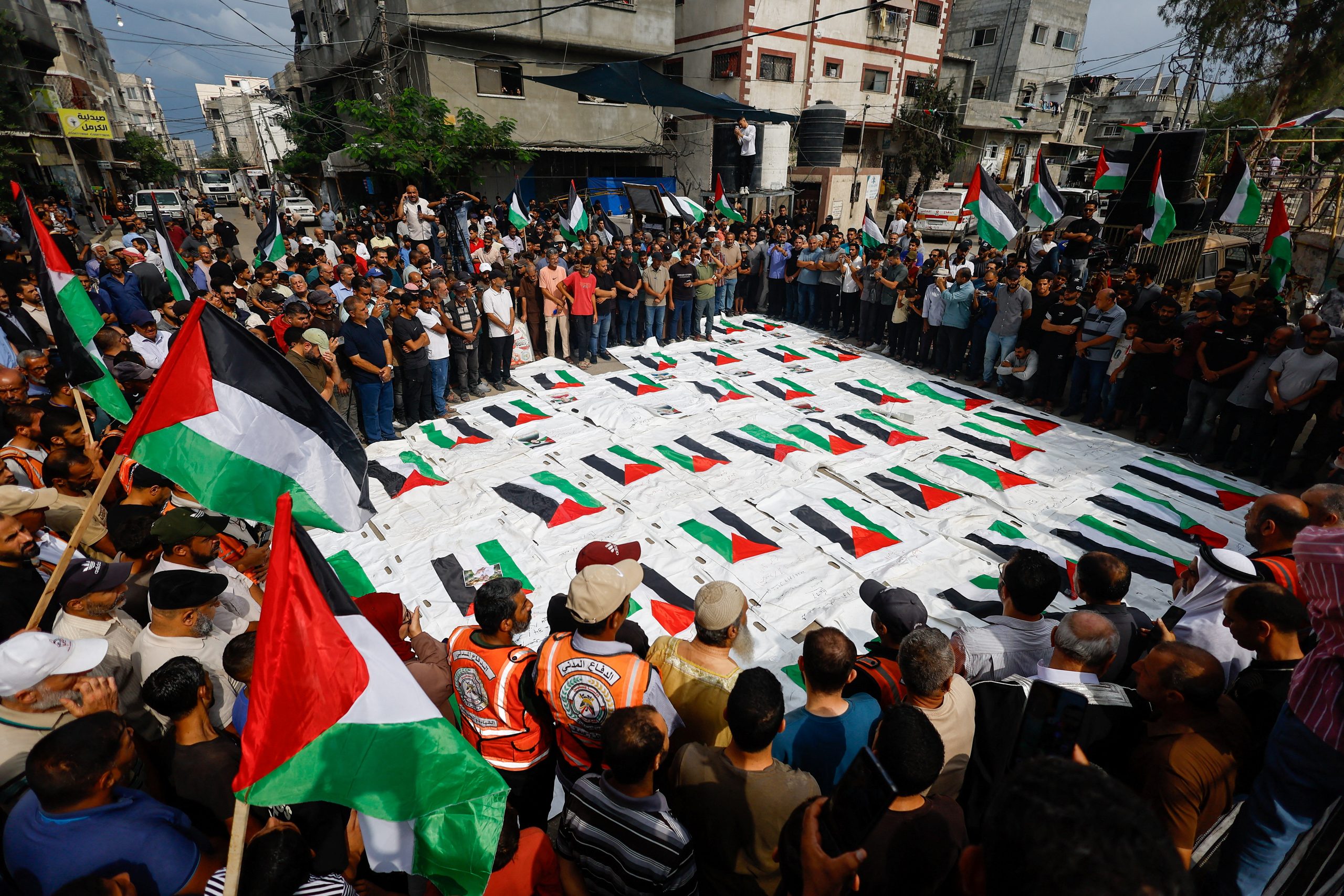
A mass funeral was held in the Nuseirat refugee camp in central Gaza on Tuesday for dozens of Palestinians killed by previous Israeli attacks, whose remains have been recovered from the rubble.

Reports vary on the number of people who were buried during the funeral, with Reuters reporting 41 and the Yaffa News Network reporting that 51 Palestinians were mourned.

Mohammad Abu Nabhan, a 42-year-old Gaza resident, told Yaffa that he was mourning 13 members of his family, including his mother, two brothers, their wives and children, who were killed by an Israeli strike on the family home in July, 2025.

Areej Farajallah, 36, said that she was saying goodbye to her husband, Samir, who was killed by an Israeli strike in November 2024. She said she had only two of his bones to bury, calling it “better than nothing.”

Mourners attend a mass funeral for 41 Palestinians whose bodies were recovered from the rubble of a residential building hit in an Israeli strike on October 31, 2023, according to the Civil Defense, in Nuseirat refugee camp in the central Gaza Strip, September 29, 2026. REUTERS/Mahmoud Issa

“There are mixed feelings between relief, sadness, and pain. But thank God, the fire in my heart has eased a little, because my husband now has a grave that my orphaned children and I can visit,” Farajallah told Reuters.

Gaza’s rescue workers have struggled to dig bodies out of the rubble as the US and Israel are still blocking construction equipment from entering the Strip and preventing reconstruction, a joint decision made by the two countries.

There have been multiple mass funerals held in Gaza this year, including one in Gaza City earlier in September, where about 100 Palestinians, including 62 children, were buried.

Gaza’s Civil Defense said on Tuesday that there will be another mass funeral for 105 Palestinians in Gaza City on October 1. “May God have mercy on the martyrs and grant their families patience and strength,” the agency said on Telegram.

Gaza’s Health Ministry said that since the ceasefire deal, which Israel has constantly violated, was signed in October 2025, 834 bodies have been recovered from the rubble. It’s estimated that more than 8,000 remain buried, including many on the Israeli-occupied side of the strip, where the IDF has continued demolitions and has been removing rubble, raising questions about whether human remains are also being removed.

Raed al-Dahshan, head of Gaza’s Civil Defense, said earlier this month that with the proper equipment, it would take about 90 days to recover all the bodies, but “if that equipment is barred from entering Gaza … this work will continue for years.”

The Worst-Case Scenario for Israel Isn’t Tehran It’s the American Electorate by Leon Hadar

 For eight decades, the Israeli political and security establishment has operated on a premise so deeply embedded that it is rarely stated as a premise at all: that American support is not a policy but a condition of nature, as fixed as the Mediterranean coastline. Administrations would come and go, presidents would hector and cajole, but the underlying architecture, congressional majorities, public sympathy, the annual aid package renewed on autopilot, would hold. This was never quite true even in 1973, when Washington resupplied a faltering IDF only after extracting, in the following months, a set of diplomatic concessions Jerusalem did not want to make. But it was true enough, for long enough, that Israeli planners could treat American backing as a structural fact rather than a political variable.

That premise is now the thing actually at risk. Not a battlefield reversal, not an Iranian breakout, not even the next round with Hezbollah. The worst case Israel is facing is demographic, and it is already visible in the numbers.

Start with Gallup, which has tracked American sympathies in the Israeli-Palestinian conflict since 2001. Every year of that survey, Israelis led — often by margins above 40 points. In 2026, for the first time, they did not: 41 percent of Americans now sympathize more with Palestinians, 36 percent with Israelis, a gap inside the margin of error. Pew’s numbers tell the same story from a different angle: 60 percent of U.S. adults now hold an unfavorable view of Israel, up from 42 percent in 2022, nearly a doubling in four years, and 59 percent lack confidence in Netanyahu on world affairs. Among Democrats, unfavorable views of Israel have reached 80 percent.

The good news, if there is any, is that this is not yet a bipartisan collapse. Republicans still favor Israelis over Palestinians 70 to 13. The bad news is where the erosion is concentrated: among the young, in both parties. Gallup’s 18-to-34 cohort now sympathizes with Palestinians by a majority, 53 percent, a record. Pew finds Republicans under 30 offer only 52 percent confidence in Trump’s handling of U.S.-Israel relations, against 93 percent among Republicans over 65.

A Yale youth survey last year measured the generational gap directly and found it larger than any other divide in American political life: Baby Boomers score +34 on a composite pro-Israel index; Gen Z scores -22. A 56-point swing in one generation is not noise. It is not correctable by a better hasbara campaign, a slicker influencer strategy, or another congressional delegation trip to the Golan. It is what happens when one generation’s formative memory is the Six-Day War and the next generation’s formative memory is a live-streamed war in Gaza.

Here the Israeli establishment tends to reach for a familiar analogy, Pearl Harbor, or October 1973 itself, the idea that a shock reliably produces a rally effect, and that opinion, having drifted, will snap back. October 7 was tested against exactly this expectation, and it did not hold beyond a matter of months.

The reason is structural, not sentimental: American sympathy for Israel was never a free-floating cultural attachment. It was underwritten by a specific set of postwar and Cold War circumstances, Holocaust memory in living generational reach, a Soviet-backed Arab bloc, an Israel that read, to American eyes, as embattled and democratic rather than as the regional power with the fourth-strongest air force on earth. Those circumstances are not returning. Cohort replacement does not reverse; it accumulates. Every year, an electorate slightly more shaped by Gaza and slightly less shaped by 1967 replaces one slightly more shaped by 1967.

Run the arithmetic forward and the worst case is not hard to sketch. The $3.8 billion annual military aid package under the current memorandum runs through 2028; the negotiation for what follows it will be conducted by a Congress with more members who came of political age after October 7 than before it. Automatic UN Security Council cover, unconditional arms sales, the reflexive “ironclad” language recited by every administration since Clinton, these are not laws of physics. They are political outputs, sustained by an electoral coalition that is visibly aging out of the electorate on one side and, on the other, being replaced by voters for whom “ironclad” is not a description but a demand awaiting justification.

Within a decade, on current trend, the debate in Washington will not be whether to support Israel but on what terms, and Israeli governments accustomed to treating American backing as unconditional will find themselves negotiating from a position they have never had to occupy before.

None of this is fate. Public opinion is not a glacier; it responds to events, and a genuine diplomatic settlement, a change in Israeli governance, or a shift in the character of the next crisis could all bend the curve. But the assumption that time itself is on Israel’s side with the American public, that the relationship is a fixed asset rather than a renewable, and increasingly contested, political arrangement — is the one assumption Israeli strategy can no longer afford to make.

The Mirage of Statecraft: America’s Blind Drift in West Asia


by | Sep 30, 2026 | 2 Comments

For decades, the architecture of West Asia has rested on a comforting fiction: that Pax Americana could indefinitely manage the region through the policy of offshore balancing, security guarantees to autocrats and the supreme might of the U.S. military.

That order is gone. Not bruised, not bending, but wholly vaporized.

Washington’s illusion that it could facilely pivot away from the region while maintaining a stranglehold on its security dynamics has collided with the hard reality of enduring quagmires. Current historical events have swept away the geopolitical framework of the past that relied on predictable diplomatic patterns, managed proxy clashes and the arrogant belief that normalization pacts could be achieved while entirely ignoring public sentiment.

As Washington stumbles through the wreckage, one inescapable harrowing question hangs in the air: the old-order is spent; the status quo is dead; America is rudderless, clueless and at war. So what now?

To understand how the United States found itself adrift, one must confront a bipartisan delusion. For a quarter century, since the launch of the “war on terror,” U.S. strategists have operated on the flawed belief that military might could permanently freeze a dynamic region in embers.

Washington thought it could dispense billions in weaponry, project power through sprawling military bases across the Persian Gulf and treat the fundamental grievances of millions as merely background noise. It assumed that Arab rulers would remain compliant, that energy routes would remain permanently pacified by default and that their adversaries, like Iran, could be permanently contained through economic starvation, sabotage and periodic airstrikes.

The foundation has buckled under the weight of its own contradictions. The proliferation of precision drones, ballistic missiles and asymmetric warfare has punctured the myth of invulnerability. The comforting scripts of past decades no longer apply.

The United States now finds itself entangled in ever-widening military clashes. It is a superpower operating on muscle memory, reacting with kinetic force and without a coherent doctrinal compass. A rudderless empire is dangerous; not because of its strength, but because of its unpredictability.

Washington’s current geopolitical posture fluctuates between grand attempts to engineer a “new regional order” through flawed summits and reactively managing wars without a clear vision. Policy roadmaps look brilliant in think tanks, but they completely fail to align with the fractured realities of Beirut, San’a, Tehran, or Gaza. Policymakers ignore the reality that regional state and non-state actors have learned to operate around, beneath and directly against American power.

To label the current American establishment “clueless” is not an insult; it is a structural diagnosis. There is a profound failure of imagination among leaders who refuse to accept that U.S. hegemony in West Asia is no longer the organizing principle of local affairs. Regional powers are hedging, diversifying partnerships by building stronger ties with China and Russia, while pursuing their own agendas independent of Washington’s preferences.

When fighting a war you do not know how to exit and clinging to a status quo that has turned to ashes, you are no longer shaping events. Events are shaping you.

If the old superpower playbook is bankrupt and you are flying blind, what comes next? It is unrealistic to believe that the political conditions that led to the 1995 Oslo Accords or the 2010-2011 Arab Spring can be recreated today.

The Gaza revolution of October 7, 2023, alongside the ongoing U.S.-Israel war against Iran, have established a completely new reality for the region. The road ahead for the United States demands a radical sober geopolitical reckoning built on epochal realities; much like the following:

  • Acknowledge the limits of power: Washington must accept that it can no longer dictate and control the geopolitical dynamics of the Levant and the Persian Gulf. It cannot rely on sheer military might to sustain its regional alliances with undemocratic regimes. The U.S.-led security framework has been exposed as an outdated fantasy that needs to be completely abandoned. Security will increasingly be negotiated, or fought over, by the people who actually live there.
  • Prioritize diplomatic statecraft over force: A realistic withdrawal from the addiction to endless interventions is long overdue. If the U.S. insists on maintaining a footprint in the region, it must replace its default reliance on military force and transactional alliances with diplomacy involving all regional stakeholders. It cannot continue treating allies merely as military outposts and and gas stations.
  • Stop enabling the Zionist colony: High priority must be given to the immediate cessation of all military assistance and diplomatic backing for Israel; ending the decades-long blank check policy. Washington should instead leverage its significant economic and diplomatic weight to end the genocide in occupied Gaza and the West Bank and halt Israel’s military escalation against its neighbors.
  • Palestinian grievances must be addressed: True lasting regional peace is impossible without placing justice for the Palestinians at the center of all diplomatic efforts. The United States must pivot toward comprehending and addressing root political grievances rather than furthering Israel’s reliance on brute military force. Until Washington transitions from active accomplice in Israel’s protracted expansive wars and begins acting as an honest broker bound by international law, any talk of regional stability will remain a cruel and lethal mirage.

The courage of regional state and non-state actors who, at great cost, have been resisting injustice has inspired a wave of action among frustrated, subjugated and oppressed people across the globe.

West Asia is writing a new chapter in real time. It is being written in the ink of shifting alliances, bitter resentments and intense struggles for local autonomy. The United States will be left completely sidelined, bypassed not by another global superpower, but by the relentless march of a region that has finally learned to move forward without asking permission from Washington. America’s political class must wake up to the changing reality.

Hijabi students turned away from school in Azerbaijan


.

NewsFeed

Hijabi students turned away from school in Azerbaijan

Video shows female students in tears as they leave a secondary school in Azerbaijan after reportedly being denied entry for wearing headscarves, following changes to uniform rules.

A Free Press, Until the Coverage Gets Uncomfortable?

  A Free Press, Until the Coverage Gets Uncomfortable? On September 18, President Trump barred CNN, MS NOW and Politico reporters from the ...